
Customer adoption measures how successfully your target users integrate your product into their workflow and derive ongoing value from it. While top-of-funnel metrics tell you how many people sign up, customer adoption tells you how many actually use your product meaningfully and stick around. Without adoption, acquisition is wasted spend and retention is a losing battle.
This guide covers the full customer adoption lifecycle: what it is, why it matters, the stages customers move through, the metrics that separate healthy growth from churn risk, and a practical playbook for improving adoption in your organization.
What is Customer Adoption?
Customer adoption is the process by which a new user or customer begins using a product, integrates it into their regular workflow, and continues to derive ongoing value from it. It spans the entire journey from first awareness of a product to full, habitual usage.
Customer adoption is distinct from acquisition. Acquisition gets someone in the door. Adoption ensures they stay, explore, and expand. A customer who signs up for a free trial but never logs in again has been acquired but not adopted. A customer who signs up, completes onboarding, uses the core feature within the first week, and returns regularly has adopted.
Adoption is not binary. It exists on a spectrum. Some customers adopt a single feature. Others adopt the full platform. Some adopt quickly. Others require multiple touchpoints and hand-holding. The goal of any customer adoption strategy is to move customers further along this spectrum, ideally toward full platform adoption and advocacy.
Customer Adoption vs Product Adoption vs User Adoption
These three terms are often used interchangeably, but they describe different levels of analysis. Understanding the distinction helps you diagnose where your adoption bottlenecks actually live.
| Term | Scope | Focus | Example |
|---|---|---|---|
| Customer adoption | Account-level | Whether the buying entity (company) realizes value from the product | A company of 50 users with 40 active users has 80% customer-level adoption |
| Product adoption | Product/feature-level | Whether a specific feature or product line is being used by the target audience | A new reporting dashboard used by 30% of eligible users |
| User adoption | Individual-level | Whether a specific person uses the product regularly | A single sales rep logging into the CRM daily |
In B2B SaaS, customer adoption is the most strategic metric because it ties directly to retention, expansion, and revenue. You can have high user adoption on a single feature but low customer adoption if the account as a whole is not realizing platform-level value. Conversely, you can have a customer who pays but only one person on the team uses the product–that is a customer adoption risk.
Why Customer Adoption Matters for Revenue and Retention
Customer adoption is one of the strongest leading indicators of retention and expansion revenue in any subscription business. When customers deeply adopt a product, they build switching costs, develop habits around the tool, and see measurable outcomes tied to its use.
Retention correlation: Customers who adopt early and thoroughly are far less likely to churn. The reason is straightforward: a customer who has integrated your product into their daily operations would face disruption and cost to replace it. This operational stickiness is far more durable than a contract term.
Expansion revenue: Adoption directly drives expansion. Customers who use more features, more frequently, and across more team members naturally qualify for higher tiers, more seats, and add-on products. A customer using 20% of your platform has limited expansion potential. A customer using 80% of your platform is a candidate for every upgrade you offer.
Reduced support costs: Well-adopted customers require less hand-holding. They understand the product, know where to find help, and self-serve for routine needs. Low-adoption customers generate disproportionate support tickets, often for questions answered in the documentation.
Referral likelihood: The strongest predictor of customer referral is not satisfaction scores but demonstrated usage. Customers who actively use and see value from your product are the ones who recommend it to peers. Usage is a behavioral signal; satisfaction is an attitudinal one. Behavior predicts referrals more reliably than opinions.
Lower customer acquisition costs (CAC): When adoption drives retention, the unit economics of each customer improve because the lifetime value (LTV) stretches across a longer period. A customer who adopts and stays for 24 months instead of 6 months effectively halves the CAC payback period. This compounding effect makes adoption improvement one of the highest-ROI investments a SaaS business can make, because it improves both the numerator (LTV) and the denominator (payback period) of the core unit economics equation.
Predictable revenue forecasting: High adoption rates create predictable renewal patterns. When you can see which accounts are deeply engaged, forecasting renewal revenue moves from guesswork to data-driven projection. Customer success teams can model churn probability with precision and allocate resources accordingly. Low adoption, by contrast, introduces randomness into revenue forecasts because churn becomes hard to predict until it happens.
The 5 Stages of Customer Adoption
Customer adoption follows a predictable progression. Understanding each stage helps you design interventions that move customers to the next stage rather than stalling at any single point.

Stage 1: Awareness. The customer learns your product exists and understands at a high level what it does. This stage happens before any purchase or signup. Strategies at this stage include content marketing, paid advertising, events, partnerships, and peer referrals. The goal is not to close a sale but to create enough understanding that the customer self-selects as a fit.
Stage 2: Interest. The customer actively seeks more information and evaluates whether your product solves their specific problem. They may visit your website, read case studies, watch demos, or talk to sales. This is where content depth matters. Whitepapers, comparison guides, product tours, and customer stories all serve this stage. The goal is to move the customer from “this looks interesting” to “this might work for us.”
Stage 3: Evaluation. The customer compares your product against alternatives, either explicitly (competitive evaluation) or implicitly (status quo bias). They assess fit across features, pricing, integration requirements, and team readiness. Evaluation is where objections surface. The best strategy is to address objections proactively through sales resources, technical documentation, security reviews, and proof-of-concept access.
Stage 4: Trial. The customer gains hands-on access to the product, either through a free trial, pilot program, or proof of concept. This is the most critical stage for adoption. The customer’s experience during the trial period determines whether they convert to paid and, if they do, whether they continue to deepen usage. Onboarding design, time-to-first-value, and early support responsiveness are the key levers at this stage.
Stage 5: Adoption. The customer has integrated the product into their workflow and continues to use it regularly. At this stage, the customer sees ongoing value, has built habits around the tool, and qualifies for expansion motions. The work does not stop here. Continued education, feature announcement campaigns, and periodic health checks prevent the slow drift from active adoption to passive usage to churn.
Note: These five stages are a simplified model for understanding the adoption journey. In practice, customers may loop back to earlier stages, skip stages, or move through them in days versus months depending on deal complexity, team size, and product category.
Key Customer Adoption Metrics to Track
Measuring adoption requires more than a single number. The most useful adoption metrics form a dashboard that tells you not just how many customers are adopting but where they are succeeding or struggling.
Adoption rate: The percentage of users or accounts that have completed a defined adoption milestone. The formula is straightforward: (adopted users / total eligible users) x 100. The definition of “adopted” varies by product. For a CRM, it might be logging a contact within 7 days. For an analytics tool, it might be creating a first dashboard. Choose a milestone that correlates with retained usage, not just first login.
Time to first value (TTFV): The elapsed time between a customer’s first interaction with your product and the moment they experience meaningful value. Shorter TTFV correlates strongly with higher adoption and lower churn. Reducing TTFV is one of the highest-leverage adoption improvements available. A customer who gets value in 10 minutes is far more likely to continue than one who needs 10 days.
Feature adoption rate: The percentage of users who use a specific feature out of those who have access to it. This metric helps you identify underused features that may need better discovery, education, or UX improvements. It also helps you identify your most valuable features–the ones with the highest adoption rates–and double down on highlighting them during onboarding.
Monthly active users (MAU) / daily active users (DAU): The count of unique users who engage with your product in a given period. While these are top-level engagement metrics, they are most useful when segmented. DAU/MAU for your core feature versus your full platform tells a more nuanced story. A high DAU/MAU ratio on a peripheral feature while the core feature has low usage signals a product problem, not adoption success.
Customer health score: A composite metric that combines multiple signals–login frequency, feature usage, support ticket volume, survey responses, and account demographic data–into a single score indicating adoption health. Health scores are predictive: customers with declining scores are at churn risk, while those with improving scores are expansion candidates.
Adoption velocity: The speed at which new customers reach adoption milestones. A customer who completes onboarding and reaches first value in 3 days has higher adoption velocity than one who takes 30 days. Tracking velocity by cohort reveals whether product changes, onboarding improvements, or market shifts are affecting adoption speed.
Net revenue retention (NRR) by adoption tier: Split your customer base into adoption tiers (high, medium, low) and calculate NRR for each tier independently. This analysis reveals the revenue impact of adoption more directly than any single engagement metric. If your high-adoption tier has 120% NRR and your low-adoption tier has 85% NRR, the business case for investing in adoption writes itself. Run this analysis quarterly and present it alongside the raw adoption rate to give leadership a revenue-focused view.
How to Measure Customer Adoption
Measuring adoption requires a systematic approach. Follow these steps to build an adoption measurement framework that supports decision-making rather than just reporting.
Step 1: Define your adoption milestone. The single most important decision is what counts as “adopted.” This milestone must be a concrete, measurable action that correlates with retention. Common choices include: completing onboarding, using the core feature three times in the first week, or reaching a specific usage threshold. Validate your milestone by checking whether customers who hit it retain at significantly higher rates than those who do not.
Step 2: Instrument tracking. Ensure your product analytics capture the defined milestone events. Most SaaS products use tools like Mixpanel, Amplitude, PostHog, or Segment for this. If you track events properly from day one, you can retroactively analyze adoption trends. If you do not, you will lack the data to diagnose adoption problems.
Step 3: Segment by cohort. Measure adoption rates by acquisition channel, customer segment, plan tier, and product area. A 40% overall adoption rate hides critical variation. If self-serve signups adopt at 60% but sales-assisted deals adopt at 20%, the bottleneck is in the sales-to-onboarding handoff, not the product. Segment until you find the fault line.
Step 4: Monitor trends over time. Adoption is not a set-and-forget metric. Track weekly or monthly adoption rates and watch for changes. A declining trend after a product release signals a regression. An improving trend after an onboarding redesign validates the investment. Build dashboards that show adoption trends by cohort with 30- and 90-day rolling windows.
Step 5: Correlate with business outcomes. The ultimate test of any adoption metric is whether it predicts retention, expansion, or revenue. If your adoption milestone does not correlate with lower churn or higher lifetime value, redefine it. This correlation check prevents the common mistake of optimizing for vanity metrics that look good but do not move the business.
Customer Health Scoring as an Adoption Predictor
Customer health scoring bridges the gap between raw usage data and proactive intervention. Rather than waiting for a customer to churn or call support, a health score gives you an early warning system that flags at-risk accounts before they disengage.
A typical health score combines:
- Product usage signals: Login frequency, feature adoption breadth, time in product, completion of key workflows
- Support signals: Ticket volume, ticket severity, response satisfaction, self-service vs assisted support ratio
- Account signals: Contract value, team size changes, payment history, renewal timeline
- Survey signals: NPS or CSAT scores, qualitative feedback, feature requests
Each signal is scored on a consistent scale (for example, 1-10 or 0-100) and weighted by its predictive power. A customer logging in daily with broad feature usage but a low NPS score may be a product quality issue, not an adoption risk. A customer with declining login frequency but no support tickets may be quietly churning.
The output is a single score per account that maps to a tier: healthy (green), at-risk (yellow), or critical (red). The customer success team acts on each tier differently. Healthy accounts receive educational content and expansion offers. At-risk accounts receive proactive outreach and onboarding reinforcement. Critical accounts trigger immediate intervention, often involving account executives or product specialists.
Note: Building a health score model requires historical data on churned and retained customers. If you do not have enough data to validate signal weights, start with equal weights and adjust as you observe which signals predict outcomes.
How to Improve Customer Adoption: A Practical Playbook
Improving adoption requires coordinated work across product, customer success, marketing, and sales. These seven strategies address the most common adoption bottlenecks.
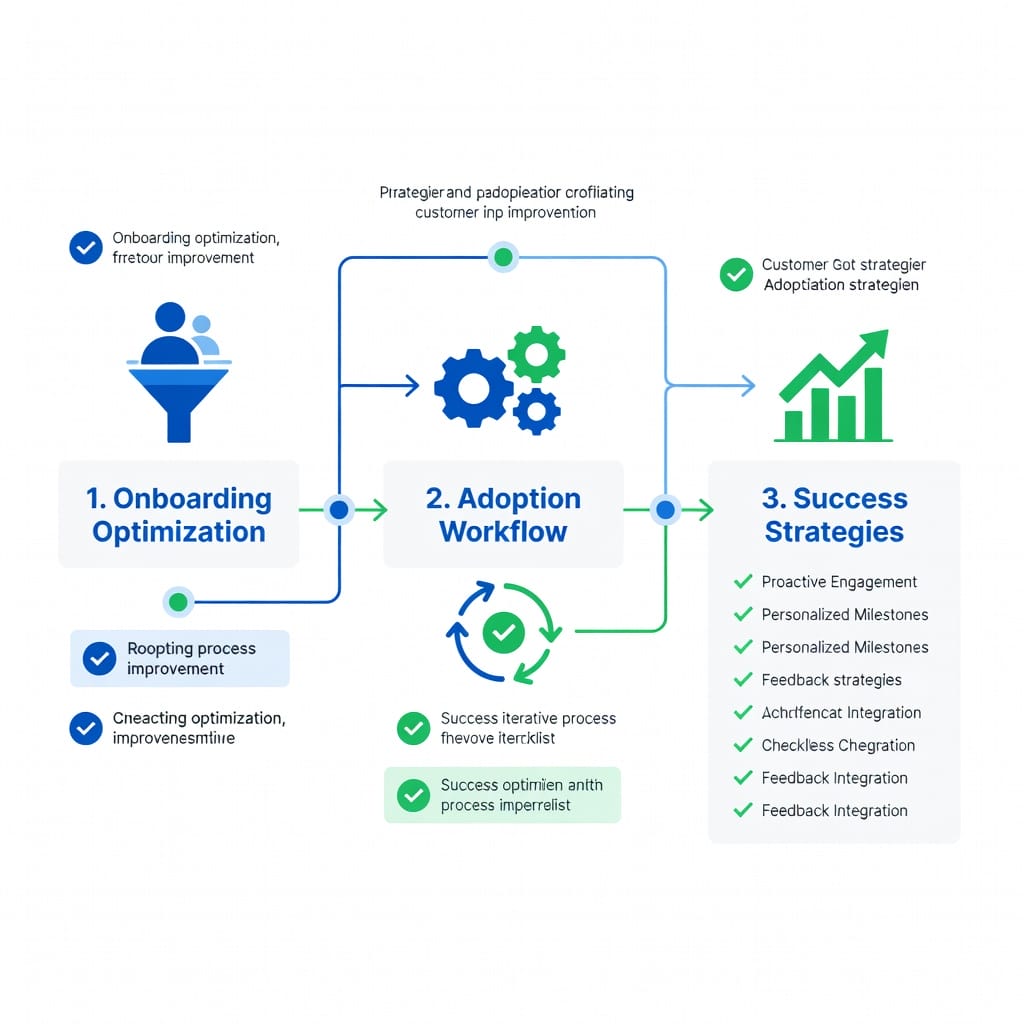
1. Reduce time to first value. Map the fastest path from signup to meaningful value and remove every unnecessary step. This may mean simplifying the initial setup, auto-configuring defaults, providing templates, or offering guided onboarding. Every extra click before the user sees value reduces adoption probability. Audit your onboarding flow quarterly and remove steps that do not directly contribute to first value.
2. Design for the first session, not just the first login. The first session after signup is the highest-leverage moment in the customer lifecycle. Users who have a productive first session adopt at dramatically higher rates. Focus the first session on one complete workflow that demonstrates value, not on feature exploration or configuration. Save advanced settings for later.
3. Use onboarding checklists. Checklist-driven onboarding outperforms free-form exploration for most B2B products. A checklist provides clear next steps, creates progress momentum, and gives the user a sense of completion. Limit the checklist to 5-7 steps that lead directly to the first value moment. Each completed step should bring the user measurably closer to a meaningful outcome.
4. Personalize by segment. Different customer segments need different onboarding paths. An enterprise team with dedicated IT support does not need the same onboarding as a solo founder. Segment your onboarding by company size, use case, industry, and technical sophistication. Trigger different flows, resource center content, and success touches based on segment.
5. Build habit loops into the product. Adoption deepens when the product becomes part of the user’s regular workflow. Design features that pull users back: notifications that point to valuable insights, recurring reports, scheduled digests, or integration-powered triggers that make the product the natural hub for a recurring task. The most effective habit loops connect to external triggers the user already experiences. For example, an email marketing tool that sends a daily notification when campaigns have new engagement data leverages the user’s existing habit of checking email. A project management tool that sends a weekly summary of overdue tasks ties into the user’s existing review cadence. The habit loop should feel like a service, not an interruption. Users should look forward to the notification because it saves them time or provides information they would otherwise have to seek out manually.
6. Educate continuously. Adoption plateaus when users only know the features they discovered during onboarding. Ongoing education through in-app tips, email sequences, resource center content, and live training sessions expands feature adoption over time. A customer who adopts ten features is far stickier than one who adopts two. Structure your education content in a progression. Month one focuses on core workflow features. Month two introduces power-user shortcuts and automation. Month three covers integrations and advanced reporting. Month four and beyond explores use cases the customer may not have considered. This progressive education model ensures that feature adoption grows steadily rather than spiking during onboarding and then flatlining. Trigger educational content based on user behavior, not calendar dates. If a user has logged in twenty times but never used the export feature, send them a tip about exports. If a user has been active for 90 days, invite them to a training session on advanced features. Behavior-triggered education converts at significantly higher rates than broadcast sequences.
7. Measure and iterate. Adoption improvement is not a one-time project. Track your adoption metrics weekly, run A/B tests on onboarding changes, survey users who stall at specific steps, and feed those insights back into product and process improvements. The most effective adoption programs treat adoption rate as a product metric, owned by product management, not a customer success metric. Set up a recurring weekly review of adoption data. In these reviews, look for: which stages have the highest drop-off rates, which customer segments have the lowest adoption, whether recent product releases have moved the adoption needle, and whether the definition of your adoption milestone still correlates with retention. Every quarter, run a deeper analysis that examines adoption across the full customer lifecycle. The goal is not just to track adoption but to create a closed feedback loop where measurement leads to insight, insight leads to experiment, and experiment leads to improvement.
Time-to-Value: The Critical Adoption Accelerator
Time-to-value (TTV) is the single most actionable adoption metric because it directly measures the gap between purchase and realized benefit. Every day of delay in reaching first value increases churn risk. Here is how to accelerate TTV systematically.
Identify the first value moment. What is the specific outcome that makes a new user think, “This product is worth my time”? For a cold email tool, it might be sending the first campaign and seeing replies arrive. For an analytics tool, it might be connecting a data source and seeing a dashboard populate. Be precise. A vague value definition leads to a vague TTV reduction strategy.
Remove pre-value friction. Every step between signup and first value should be scrutinized. Look for: mandatory settings with sensible defaults, unnecessary data entry, complex integrations that could be templated, approval workflows that delay access, and knowledge requirements that assume the user already understands the product domain.
Provide templates and starting points. Blank-slate products have the highest TTV because users must build from nothing. Pre-built templates, sample data, default configurations, and quick-start guides all reduce the effort required to reach first value. The ideal first experience is: sign up, see a working example, customize in 30 seconds, see results.
Use proactive success outreach. Do not wait for the customer to ask for help. Schedule a welcome call within the first 48 hours for high-value accounts. Send contextual tips triggered by user behavior. If a user has not completed setup within 24 hours, send an email with a direct link to resume where they left off. Automated, behavior-triggered outreach is more effective than generic onboarding sequences.
Measure TTV reduction impact on retention. Track whether customers who reach first value faster actually retain at higher rates. This validation step is critical because not all TTV acceleration strategies produce the same result. Reducing time to a low-value action (like creating an account) does not improve adoption. Reducing time to a high-value action (like completing the core workflow) does. Validate your TTV metric by segmenting customers into fast, medium, and slow TTV cohorts and comparing their 90-day retention rates. If the gap between fast and slow cohorts narrows after a certain point, you have identified the maximum useful TTV improvement window.
Avoid the premature expansion trap. When you accelerate time to first value, customers may adopt the product faster, but they also expect more value more quickly after that. If the second value moment takes as long as the first, the customer’s trust erodes faster than if you had never accelerated the first moment at all. Map out at least the first three value moments before you invest in accelerating the first one. Each subsequent value moment should be reachable within a comparable or shorter timeframe. A customer who reaches first value in 5 minutes but then faces a 3-week gap to second value will be more frustrated than one who reached first value in 30 minutes and second value the next day. Accelerate the full value chain, not just the first step.
Customer Adoption in the Cold Email and Outbound Context
Customer adoption has a distinct profile in businesses that rely on cold email and outbound sales. The adoption journey starts differently because the customer relationship often begins with an unsolicited outreach rather than an inbound search.
When a prospect is sourced through cold email, their awareness of your product may be minimal. They need more education at the awareness and interest stages than inbound prospects who have already researched your category. The content you share during the outbound sequence–case studies, product explainers, competitive comparisons–directly shapes their adoption trajectory.
Adoption acceleration for cold-sourced leads requires:
Shorter trial-to-value loops. Outbound leads have lower initial trust than inbound leads. They are less likely to invest significant time exploring your product without early proof of value. Design trial experiences that deliver a compelling result within the first session, even if the result is simplified. A 5-minute demo video that shows the core workflow can be more effective than full platform access for leads who are still building trust.
Better qualification upfront. Not every cold contact is a good adoption candidate. Sending your product to someone who does not fit your ideal customer profile guarantees low adoption and a quick churn. Use lead scoring and enrichment data to filter for prospects who have the budget, authority, need, and timeline to adopt your solution. The effort you save chasing unqualified leads can be reinvested in improving adoption for well-qualified ones.
Alignment between sales promises and product reality. The most common adoption killer for cold-sourced customers is a mismatch between what the sales conversation promised and what the product delivers. Outbound teams under pressure to book meetings may overstate capabilities. When the prospect finally gets access and finds the product does not match expectations, adoption stalls immediately. Tight feedback loops between sales and product, with documented capability boundaries, prevent this gap.
For businesses using cold email as a primary acquisition channel, email deliverability is also a prerequisite for any adoption strategy. If your outreach never reaches the inbox, you cannot start the adoption journey at all. Deliverability fundamentals–domain authentication, warmup protocols, sending reputation management–must be in place before any outbound adoption strategy can function.
Common Customer Adoption Challenges and Solutions
Even well-designed products face adoption barriers. These are the most common challenges and how to address them.
Challenge 1: Users sign up but never return. The classic adoption failure. The user created an account, perhaps logged in once, and never came back. This usually indicates that the first experience did not deliver enough value to justify continued use. The solution is to audit the first session, reduce friction, and ensure the user reaches a meaningful outcome before they leave.
Challenge 2: Low feature adoption. Users adopt the core feature but ignore everything else. This limits expansion revenue and increases vulnerability to competitors who offer adjacent capabilities. The solution is to introduce secondary features contextually during the user’s workflow, not through broadcast emails or release notes that get ignored.
Challenge 3: Adoption stalls after initial enthusiasm. The user had a great first week, logged in daily, and seemed fully engaged. Then usage tapered off. This often happens when the product addresses an initial need but does not create ongoing reasons to return. The solution is to design for habit: notifications, recurring reports, scheduled outputs, or integration-driven triggers that bring the user back.
Challenge 4: Team adoption lags behind individual adoption. One person on the account is enthusiastic, but they cannot get their team to use the product. Without team-level adoption, the account is fragile–if the champion leaves, the account churns. The solution is to make multiplayer features obvious and valuable, provide admin tools for monitoring team usage, and offer enablement resources that the champion can share with their team.
Challenge 5: The product is too complex for the target user. Feature-rich products often overwhelm new users, leading to paralysis rather than adoption. The solution is progressive disclosure: show only the features relevant to the user’s current task and reveal advanced capabilities as the user’s sophistication grows. Role-based interfaces, where each user sees only the features relevant to their role, also reduce complexity.
Challenge 6: Adoption varies dramatically by geography or market segment. A product that works well in North America may see low adoption in Europe or Asia due to language barriers, workflow differences, or integration requirements with locally dominant tools. Similarly, enterprise accounts may adopt at different rates than SMB accounts. The solution is to instrument your adoption tracking by market segment from day one and to segment your onboarding and support by geographic and demographic factors. Run separate adoption analyses for each major market and customize your adoption playbook to account for regional differences in how your product is used.
Challenge 7: Customers adopt the workaround, not the product. Some users prefer to keep using their existing methods (spreadsheets, manual processes, competing tools) alongside your product rather than fully transitioning. This creates a false positive in your adoption metrics: the account is active, but the customer is not realizing the full value of switching. The solution is to identify the most common workarounds users maintain and either eliminate the reason for them (by providing the missing capability) or explicitly address the migration barrier in your onboarding and success outreach. If users are exporting data to spreadsheets for analysis your product does not offer, that is a product gap. If they are doing it out of habit, that is an education gap.
Key Takeaways
- Customer adoption is the process of moving a customer from first awareness to ongoing, habitual product usage. It is distinct from acquisition, activation, and retention, though it influences all three.
- The five stages of adoption are Awareness, Interest, Evaluation, Trial, and Adoption. Each stage requires different strategies and metrics.
- Key adoption metrics include adoption rate, time to first value, feature adoption rate, customer health score, and adoption velocity. The best metric for your business correlates with retention and expansion revenue.
- Measuring adoption requires defining a validated adoption milestone, instrumenting tracking, segmenting by cohort, monitoring trends, and correlating with business outcomes.
- Improving adoption requires reducing time to value, designing for the first session, using onboarding checklists, personalizing by segment, building habit loops, providing continuous education, and iterating based on data.
- Customer health scoring creates an early warning system that flags at-risk accounts before they disengage.
- For cold email and outbound-sourced customers, adoption acceleration requires shorter trial-to-value loops, better qualification, and tight alignment between sales promises and product reality.
Frequently Asked Questions
What is customer adoption?
Customer adoption is the process by which a new customer begins using a product, integrates it into their regular workflow, and continues to derive ongoing value from it. It covers the full journey from first awareness of a product to habitual, sustained usage. Adoption is measured at the account level rather than the individual user level, making it distinct from user adoption or product adoption.
What is the difference between customer adoption and user adoption?
Customer adoption measures adoption at the account level–whether the buying organization as a whole is realizing value from the product. User adoption measures whether individual people are using the product. A customer account with 100 seats but only 10 active users has reasonable user adoption among those 10 but poor customer adoption at the account level. Customer adoption is more strategically important because it correlates directly with retention and expansion revenue.
What are the stages of customer adoption?
The five stages of customer adoption are Awareness (learning the product exists), Interest (seeking more information), Evaluation (comparing against alternatives), Trial (hands-on product experience), and Adoption (full integration into workflow). These stages are a simplified model; in practice, customers may move through them at different speeds, skip stages, or loop back to earlier stages.
How do you measure customer adoption?
Customer adoption is measured by defining a concrete adoption milestone, tracking whether customers reach that milestone, and segmenting the results by cohort. Common metrics include adoption rate (adopted users divided by total eligible users), time to first value, feature adoption rate, customer health scores, and adoption velocity. The best adoption metric is one that correlates with retention and expansion revenue for your specific product and market.
What is a good customer adoption rate?
A good customer adoption rate varies by product category, business model, and pricing tier. In B2B SaaS, adoption rates between 25% and 40% are common for broad platform products. Leading companies in their categories often achieve 60% or higher. Rather than benchmarking against an industry average, measure your own adoption rate, segment it by customer type, and focus on improving it over time. A 40% rate that is trending up is better than a 60% rate that is trending down.
How can I improve customer adoption?
Improving customer adoption involves reducing time to first value, designing a productive first session, using onboarding checklists to guide new users, personalizing the experience by segment, building habit loops into the product, educating users continuously through in-app and email content, and measuring and iterating on adoption metrics. The highest-leverage improvement for most products is reducing the steps between signup and the first moment of meaningful value.
Why is time-to-value important for adoption?
Time to first value (TTFV) is the strongest leading indicator of adoption because every day of delay increases the probability that the user will disengage. A user who reaches meaningful value within minutes of signing up is far more likely to continue using the product than one who needs hours or days. Reducing TTFV is the single most effective adoption improvement strategy for most products because it directly addresses the gap between purchase commitment and realized benefit.
What is customer health scoring?
Customer health scoring combines multiple signals–product usage, support interactions, account data, and survey responses–into a single score that predicts whether a customer is likely to retain, expand, or churn. Health scores are typically mapped to tiers: healthy (green), at-risk (yellow), or critical (red). Customer success teams use these scores to prioritize attention: proactive outreach for at-risk accounts and expansion engagement for healthy accounts.