
What is B2B Sales?
B2B sales is the process of selling products or services from one business to another business. It is different from consumer selling because it involves business outcomes, buying committees, procurement checks, legal review, and longer decision cycles. If you want to learn how to do B2B sales, start by treating every deal as a business case, not a pitch.
A B2B buyer does not usually buy because a product sounds exciting. They buy because a problem is expensive, risky, inefficient, or strategically important. Your job is to understand that problem, quantify its impact, guide the buyer through a decision process, and prove that your solution reduces the gap between where the business is and where it needs to be.
In many categories, the seller is no longer the first source of information. Buyers research independently, compare vendors, ask peers, read reviews, and build internal opinions before speaking with sales. Gartner has reported that the average B2B buying group includes 6 to 10 decision makers, and Pipedrive cites Gartner research that buyers may consume 13 pieces of content before vendor selection. That creates a practical rule: your sales process must educate, not just persuade.
What Does a B2B Sales Rep Actually Do?
A B2B sales rep identifies potential business buyers, starts conversations, qualifies fit, discovers business pain, presents a solution, manages stakeholders, handles objections, and closes revenue. Depending on the company, one person may run the whole cycle or the work may be split between SDRs, account executives, sales engineers, and customer success.
In a split team, SDRs usually handle prospecting and meeting creation. Account executives own discovery, demos, proposals, negotiation, and closing. Sales engineers support technical validation. Customer success takes over after signature and ensures the promised value becomes real. In a full-cycle model, one rep handles all of this alone, which can work in simpler or founder-led sales environments.
The best reps do more than deliver scripts. They diagnose business problems, create urgency, translate technical features into financial impact, and help buyers make internal decisions. That last skill matters because many deals die not because the buyer dislikes the product, but because the buying committee cannot align on priority, risk, timing, or ownership.
Why Is B2B Sales Harder Than It Looks?
B2B sales is hard because the visible buyer is rarely the only buyer. A single conversation may represent finance, legal, security, procurement, operations, and executive stakeholders who all have different concerns. Winning means solving the business problem and making the internal decision process easier for every stakeholder involved.
A marketing leader may love your solution because it increases pipeline. Finance may resist because the contract hits budget this quarter. Legal may delay the signature over data processing terms. Security may require a questionnaire. Procurement may ask for a discount after the business team has already approved. None of those objections are random; they are normal parts of B2B buying.
This is why successful B2B selling is process-driven. You need a repeatable way to identify the right accounts, qualify them early, uncover decision criteria, map stakeholders, control next steps, and forecast likelihood. Without that system, reps chase enthusiasm instead of probability and managers confuse activity with pipeline quality.
B2B vs B2C: Key Differences You Need to Know
B2B and B2C sales are not just different audiences; they are different decision systems. B2C sales often depends on individual preference, convenience, emotion, or price. B2B sales depends on business impact, stakeholder alignment, implementation risk, and return on investment. Treating B2B buyers like consumers creates shallow messaging and weak deals.
| Dimension | B2B Sales | B2C Sales |
|---|---|---|
| Buyer | Buying committee or business stakeholder group | Individual consumer or household |
| Decision driver | ROI, risk reduction, efficiency, compliance, growth | Preference, emotion, price, convenience |
| Sales cycle | Weeks to months, sometimes over a year | Minutes to weeks |
| Deal value | Often higher, recurring, contract-based | Usually lower and transactional |
| Proof needed | Case studies, ROI, security, references, implementation plan | Reviews, discounts, social proof, brand trust |
| Process | Discovery, demo, proposal, procurement, legal | Website, cart, checkout, support |
The biggest difference is consequence. A consumer buying a pair of shoes can regret the purchase and move on. A business buyer choosing the wrong vendor can miss a quarter, waste budget, expose data, anger internal users, or damage their own reputation. That is why B2B buyers ask more questions and move more slowly.
How Does the Buying Committee Change the Sale?
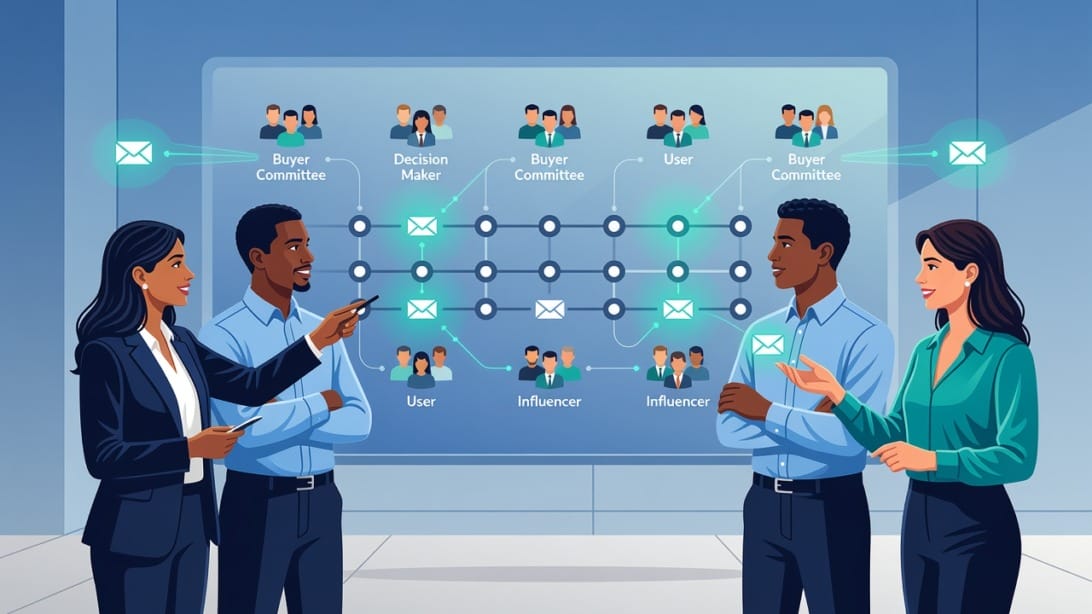
The buying committee changes the sale because each stakeholder evaluates a different version of risk. The user cares about workflow fit, the manager cares about team adoption, finance cares about cost, security cares about data, and executives care about strategic impact. Your sales process must answer each concern before the deal can close.
The mistake many reps make is selling only to the person who takes the first meeting. That person may be interested but unable to approve the purchase. Early in discovery, ask who else will influence the decision, what each person cares about, and what could slow approval. Then help your champion socialize the business case internally.
A simple stakeholder map can prevent late-stage surprises:
| Stakeholder | Likely Concern | Sales Asset Needed |
|---|---|---|
| End user | Ease of use and daily workflow | Demo, use-case walkthrough |
| Manager | Productivity and adoption | Implementation plan, training plan |
| Executive | Revenue, cost, strategic outcome | Business case, ROI summary |
| Finance | Budget and contract terms | Pricing options, payback model |
| Security/IT | Data access and risk | Security documentation |
| Legal/procurement | Terms and liability | Contract redlines, vendor forms |
What Makes a B2B Buyer Say Yes?
A B2B buyer says yes when the cost of staying the same feels higher than the cost and risk of changing. That means your sale must establish pain, quantify impact, show a credible path to improvement, and reduce perceived implementation risk. Interest alone is not enough to create a purchase decision.
Most lost deals are not lost to competitors. They are lost to inaction. The buyer likes the product, agrees the problem exists, and still does nothing because the business case is not urgent enough. To avoid this, connect every feature to a measurable outcome and every next step to a reason it matters now.
Useful urgency questions include:
- What happens if this problem remains unchanged for another quarter?
- Which team or metric is most affected right now?
- Why is this being discussed now instead of six months ago?
- What other priorities are competing with this project?
- What would make this a board-level or executive-level problem?
The 7-Step B2B Sales Process
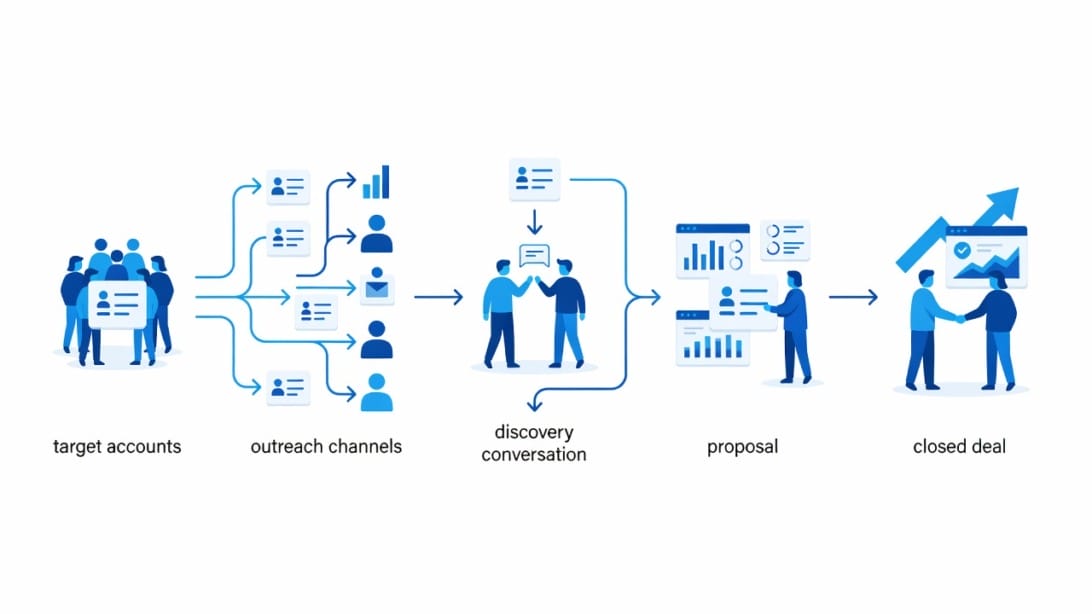
The B2B sales process is a repeatable path that moves a prospect from target account to closed customer. A clear process protects reps from chasing poor-fit opportunities, helps managers forecast revenue, and gives buyers confidence that the seller knows how to guide a complex decision. The steps below work for both outbound and inbound motions.
Step 1: Define Your Ideal Customer Profile
Your ideal customer profile is the type of company most likely to buy, succeed, renew, and expand with your product. It should describe company-level fit before person-level targeting. Strong ICP criteria include industry, employee count, revenue range, region, growth stage, technology stack, trigger events, and the cost of the problem you solve.
Start by studying your best customers, not your biggest list of leads. Look for common patterns among accounts with high retention, fast onboarding, strong usage, and profitable expansion. Then document disqualifiers as clearly as qualifiers. For example, a product may work best for SaaS companies with 50 to 500 employees but poorly for agencies, ecommerce brands, or companies without a dedicated operations owner.
A practical ICP worksheet includes:
- Firmographics: industry, company size, revenue, geography
- Technographics: tools already used, integrations required, platform maturity
- Triggers: funding, hiring, market expansion, compliance change, leadership change
- Pain intensity: cost of current problem, frequency, visibility to leadership
- Buying readiness: active project, existing budget, executive sponsor, deadline
- Disqualifiers: wrong size, wrong industry, no use case, no implementation owner
Step 2: Prospect and Build Your Pipeline
Prospecting is the work of finding companies and contacts that match your ICP and starting relevant conversations. Good prospecting is targeted, researched, and measured. It is not blasting a generic message to everyone with a matching job title. The goal is to create enough qualified conversations to support your revenue target.
Start with account selection. Build a list of companies that match your ICP, then identify likely stakeholders by function and seniority. For each account, find a reason to reach out: recent funding, hiring, technology change, new executive, product launch, regulatory pressure, expansion, or public content that signals a relevant problem.
Useful prospecting sources include:
- LinkedIn search and company pages
- Job postings that reveal priorities or technology stack
- Funding announcements and press releases
- Review sites showing pain with current vendors
- Website technology data
- Webinar attendees and content downloads
- Referrals from customers or partners
The output of prospecting is not just a list. It is a prioritized set of accounts, contacts, triggers, and hypotheses about why the prospect may care now.
Step 3: Qualify Leads Using a Framework
Qualification determines whether a prospect deserves deeper sales time. A qualified opportunity has a real problem, a relevant buyer, a plausible budget path, and a decision process that can move forward. Without qualification, your pipeline fills with polite conversations, students, competitors, low-budget accounts, and people who were only curious.
Use a framework rather than intuition. BANT, MEDDIC, and GPCT are three common options, and each works best in a different sales context. The most important point is consistency: every rep should evaluate opportunities using the same criteria so pipeline reviews and forecasts mean the same thing across the team.
A lead is not qualified just because they booked a meeting. They are qualified when you can answer these questions clearly:
- What business problem are they solving?
- What is the current impact of the problem?
- Who owns the decision and budget?
- What happens if they do nothing?
- What timeline are they working against?
- What alternatives are they considering?
Step 4: Run a Discovery Call
A discovery call is the conversation where you uncover the buyer’s current situation, pain, desired outcome, decision process, and urgency. It is not a product pitch disguised as questions. The buyer should speak more than the seller, and the seller should leave with enough information to build a specific business case.
A strong discovery structure moves from context to pain to impact to decision. Start broad, then narrow. If the prospect says they want better reporting, ask what reporting they use today, what decisions it fails to support, how often that creates problems, and who notices when reporting is wrong or late.
Good discovery questions include:
- What prompted you to look at this now?
- How are you handling this today?
- What is working and what is not?
- What does this problem cost in time, money, risk, or missed opportunity?
- Who else is affected by this problem?
- What will a successful outcome look like six months from now?
- What could prevent this project from moving forward?
The best discovery calls end with a confirmed next step and a reason for that next step. “I’ll send information” is weak. “Let’s schedule a 45-minute demo with your operations lead because adoption risk is your biggest concern” is strong.
Step 5: Deliver a Tailored Demo or Proposal
A tailored demo or proposal shows the buyer exactly how your solution addresses the problems uncovered during discovery. It should not be a feature tour. Every section should connect back to the buyer’s pain, success metric, stakeholder concern, or implementation requirement. The buyer should see their own business reflected in the presentation.
Before the demo, restate the agenda and confirm the outcomes the buyer cares about. During the demo, show the few workflows that matter most rather than every capability. After each section, ask whether that solves the specific issue you discussed. This creates active validation instead of passive viewing.
For proposals, include:
- Executive summary of the problem
- Business impact of solving it
- Recommended solution scope
- Implementation timeline
- Responsibilities on both sides
- Pricing and contract terms
- Risks, assumptions, and dependencies
- Next steps and decision timeline
A good proposal should make it easier for your champion to sell internally when you are not in the room.
Step 6: Handle Objections
Objections are buying friction, not personal rejection. A buyer who objects is often engaged enough to think through risk. Your job is to understand the real concern behind the words, separate valid risk from misunderstanding, and provide evidence that helps the buyer make a confident decision.
Use the LAER model: Listen, Acknowledge, Explore, Respond. Listen without interrupting. Acknowledge the concern in neutral language. Explore the cause with one or two questions. Respond only after you know what the objection really means. This prevents the common mistake of answering the wrong concern.
For example, “too expensive” may mean the buyer lacks budget, does not see enough value, is comparing you to a cheaper vendor, or is negotiating. Those require different responses. Ask, “When you say expensive, are you comparing the price to budget, to another option, or to the value you expect to receive?”
Step 7: Close and Hand Off
Closing is the process of turning agreed value into a signed commitment and successful customer handoff. It includes confirming decision criteria, securing stakeholder approval, navigating procurement, finalizing contract terms, and transferring context to the post-sale team. A rushed close may win the signature but create churn later.
Close by summarizing the agreed problem, desired outcome, solution scope, timeline, and next step. Then ask for commitment clearly. Do not hide the ask inside vague language. Use direct but professional phrasing such as, “Based on what we agreed, are you ready to move forward with the annual plan starting next month?”
After signature, document:
- Why the customer bought
- Main pain points and success metrics
- Promised outcomes and timelines
- Stakeholders and their concerns
- Risks raised during sales
- Contract terms and scope limits
- Implementation expectations
This handoff protects trust. If customer success has to rediscover everything after the sale, the buyer feels like they are starting over.
Lead Qualification Frameworks: BANT, MEDDIC, and GPCT
Lead qualification frameworks give sales teams a common language for judging whether an opportunity is worth pursuing. They reduce emotional forecasting, make pipeline reviews consistent, and help reps avoid spending weeks on deals that cannot close. The right framework depends on deal size, buyer maturity, and whether budget already exists.
| Framework | Best For | Strength | Weakness |
|---|---|---|---|
| BANT | Transactional or lower-complexity B2B sales | Simple and fast | Can miss early-stage buyers without defined budget |
| MEDDIC | Enterprise and high-value deals | Strong stakeholder and business-case discipline | Requires more discovery depth |
| GPCT | Consultative or problem-led sales | Starts with business goals before budget | Less precise for procurement-heavy deals |
BANT: Budget, Authority, Need, Timeline
BANT qualifies opportunities by asking whether the buyer has budget, authority, need, and timeline. It is useful when buyers already know they need a solution and have a budget process in place. BANT is simple, fast, and easy to coach, but it can be too rigid for early-stage or strategic opportunities.
Use BANT when your product category is familiar and buyers usually come with a defined problem. For example, a company replacing a CRM may already have budget and a timeline. In that case, the rep needs to confirm whether the contact can influence approval and whether the need is urgent enough to proceed.
BANT questions:
- Budget: Has a budget been allocated for this project?
- Authority: Who signs off on the purchase?
- Need: What problem are you trying to solve?
- Timeline: When do you need a solution in place?
Do not weaponize BANT as an interrogation. A buyer may not know the budget yet because your discovery is the first step in creating one. If the need is strong and the economic impact is clear, budget can often be created.
MEDDIC: Metrics, Economic Buyer, Decision Criteria, Decision Process, Identify Pain, Champion
MEDDIC is a qualification framework for complex sales where multiple stakeholders, formal decision processes, and large deal sizes are common. It forces reps to quantify success metrics, identify the economic buyer, understand decision criteria, document the decision process, expose pain, and develop an internal champion.
MEDDIC is especially useful when deals are large enough to justify deep discovery. It prevents the common enterprise mistake of confusing a friendly evaluator with a real buyer. A prospect may love the product but have no access to the economic buyer, no internal champion, and no clear decision process. MEDDIC surfaces that risk early.
A MEDDIC-qualified opportunity should answer:
- Metrics: What measurable outcome will justify the purchase?
- Economic buyer: Who controls budget and final approval?
- Decision criteria: What will the buyer evaluate?
- Decision process: What steps must happen before signature?
- Identify pain: What business pain makes change necessary?
- Champion: Who sells internally when you are not present?
GPCT: Goals, Plans, Challenges, Timeline
GPCT qualifies opportunities by starting with the buyer’s goals, then examining current plans, obstacles, and timing. It works well when the buyer has a business problem but has not yet translated it into a purchasing project. GPCT helps sellers create a consultative conversation rather than forcing budget questions too early.
For example, a VP of Sales may have a goal to increase outbound pipeline by 30%. Their current plan may involve hiring more SDRs. Their challenge may be poor deliverability, weak targeting, or low conversion from meetings to opportunities. The timeline may be tied to next quarter’s pipeline target. GPCT turns that business context into a path toward a solution.
GPCT questions:
- Goals: What are you trying to achieve this quarter or year?
- Plans: What are you doing now to achieve it?
- Challenges: What is getting in the way?
- Timeline: When does this need to improve?
Use GPCT when you want to earn trust before discussing budget. It is especially helpful in founder-led sales, advisory selling, and markets where buyers are still learning how to frame the problem.
How to Build a Multi-Channel Sales Cadence
A sales cadence is a planned sequence of touches across channels such as email, phone, LinkedIn, and content sharing. A strong cadence increases the chance of reaching the buyer without becoming repetitive or intrusive. The goal is to create recognition, relevance, and response over time.
A good cadence has three principles. First, every touch should have a reason. Second, channels should reinforce each other rather than repeat the same message. Third, the cadence should stop when the prospect replies, opts out, or clearly shows no fit. Persistence is valuable; pressure is not.
Example 14-day outbound cadence:
| Day | Channel | Purpose |
|---|---|---|
| 1 | Personalized problem hypothesis | |
| 2 | LinkedIn profile view | Light awareness touch |
| 3 | LinkedIn connection | Short relevant note |
| 5 | Useful insight or industry example | |
| 7 | Phone | Human touch after written context |
| 9 | LinkedIn message | Reference prior email and ask simple question |
| 12 | Alternative angle or trigger event | |
| 14 | Email or call | Polite close-the-loop message |
For cold email, personalization matters more than clever copy. Reference a real trigger, job posting, company change, recent interview, technology signal, or operational issue likely to matter to that role. Adobe research cited by competitors notes that a large share of B2B buyers expect personalized experiences, which aligns with what sales teams see in reply quality.
When outbound relies on email, deliverability is part of sales execution. Domains need authentication, warmup, monitoring, and sensible sending volumes. A cold email outreach tool such as Mystrika can help teams manage sequencing and warmup, but the tool will not fix weak targeting or poor messaging. Deliverability protects good outreach; it does not rescue irrelevant outreach.
How Should You Write the First Cold Email?
The first cold email should be short, specific, and centered on a plausible business problem for that prospect. The goal is not to explain your company. The goal is to earn a reply by showing that you understand the buyer’s context and have a relevant reason for reaching out now.
A simple structure works:
1. Observation: mention a relevant trigger or context.
2. Problem hypothesis: describe a likely pain in one sentence.
3. Value angle: explain the outcome you help with.
4. Soft question: ask if the problem is worth discussing.
Example:
Noticed your team is hiring three outbound SDRs in North America. Teams at that stage often find that inbox placement and list quality become the bottleneck before rep capacity does. Are you already tracking whether outbound emails are landing in primary inboxes, or is that still a blind spot?
The message is not magic. It works because it connects a public signal to a relevant business problem and asks a low-friction question.
How Should You Follow Up Without Annoying Prospects?
Follow-up works best when each message adds a new angle instead of repeating the same request. A useful follow-up can share a benchmark, ask a narrower question, mention a risk, provide a relevant example, or offer a simple next step. If every follow-up says “just checking in,” the cadence becomes noise.
Good follow-up angles include:
- “Is this owned by your team or someone else?”
- “Worth comparing how you handle this today?”
- “I may be off, but this usually becomes urgent when…”
- “Should I close the loop for now?”
- “Would a 3-point checklist be useful?”
Respect opt-outs immediately. Also stop or pause sequences when a prospect shows disinterest. A clean sender reputation and professional brand are more valuable than squeezing one more touch into a bad-fit account.
Objection Handling: Common B2B Sales Objections and How to Respond
Objection handling is the skill of converting buyer concerns into clarity. Every serious B2B buyer will question price, risk, timing, implementation, authority, or alternatives. A prepared seller does not memorize manipulative rebuttals. They identify the real concern and respond with evidence, tradeoffs, or a better next step.
Use the LAER model for most objections:
- Listen: let the buyer finish.
- Acknowledge: show the concern makes sense.
- Explore: ask what specifically drives the concern.
- Respond: address the real issue with relevant proof.
How Do You Respond to “It’s Too Expensive”?
The price objection usually means the buyer does not see enough value, lacks budget, is comparing you to a cheaper option, or wants a concession. Do not discount immediately. Ask what “expensive” means in context, then reconnect the investment to the cost of the problem.
Possible response:
I understand. When you say it feels expensive, is the concern that it is outside the available budget, or that the expected return is not clear enough yet?
If value is unclear, revisit impact. If budget is real, discuss scope, timing, or phased rollout. If comparison is the issue, ask which criteria matter besides price. Discounting without diagnosis trains the buyer to negotiate before value is established.
How Do You Respond to “We’re Happy With Our Current Vendor”?
A current vendor objection means the buyer sees switching risk or lacks a compelling reason to change. Do not attack the incumbent. Ask what is working, what could be better, and when the team last evaluated alternatives. The goal is to uncover gaps without forcing dissatisfaction.
Possible response:
That makes sense. If the current vendor is working well, switching may not be worth it. Out of curiosity, what is one thing you wish they handled better or made easier for your team?
If the buyer identifies a gap, explore its impact. If they cannot identify any gap, the account may not be ready. Respect that and schedule a future check-in around renewal or a relevant trigger.
How Do You Respond to “Now Is Not the Right Time”?
A timing objection may be genuine, or it may hide lack of urgency. Clarify which one it is. Ask what is happening now, what has to happen first, and when the problem becomes expensive enough to prioritize. Good timing management turns vague delay into a specific future milestone.
Possible response:
Understood. Is timing difficult because another project has to finish first, or because this problem is not painful enough yet to prioritize?
If there is a real sequence dependency, align to that date. If urgency is weak, revisit the business impact. If neither exists, disqualify respectfully instead of filling your pipeline with a deal that will never move.
How Do You Respond to “I Need Approval”?
Approval objections mean your contact is not the only decision-maker. This is normal in B2B sales, not a problem. The risk is losing control of the message when your champion explains the business case internally without your help. Support them with concise, stakeholder-specific material.
Possible response:
Absolutely. To make that easier, who needs to approve this, and what will they care about most: budget, risk, implementation, or expected return?
Then offer to join the approval conversation or provide a one-page business case. The goal is not to bypass your contact. The goal is to equip them to sell internally with the right proof.
Pipeline Management and Sales Forecasting
Pipeline management is the discipline of tracking, reviewing, and moving opportunities through defined sales stages. Sales forecasting uses that pipeline to predict future revenue. Together, they help teams separate hopeful activity from credible revenue. Without pipeline discipline, teams overestimate deals, miss targets, and discover problems too late.
A simple pipeline might include these stages:
| Stage | Definition | Exit Criteria | Typical Risk |
|---|---|---|---|
| Prospecting | Account identified and outreach started | Prospect responds or books meeting | No interest or no contact |
| Discovery | Need and context discussed | Pain, impact, and next step confirmed | Weak pain or no urgency |
| Qualified | Fit confirmed by framework | Buyer, problem, timeline, and path clear | No authority or budget path |
| Demo/proposal | Solution shown and scoped | Buyer validates fit and receives proposal | Poor stakeholder alignment |
| Negotiation | Terms, pricing, and approvals active | Contract ready for signature | Procurement or legal delay |
| Closed won/lost | Final outcome recorded | Signature or disqualification | Bad loss reason data |
Forecasting improves when each stage has objective exit criteria. A deal should not move to proposal because the rep “feels good.” It should move because discovery is complete, stakeholders are known, the problem is quantified, and the buyer has agreed to evaluate a specific solution.
How Do You Calculate Pipeline Coverage?
Pipeline coverage measures whether you have enough qualified opportunity value to hit a revenue target. Calculate it by dividing total qualified pipeline by target revenue for the period. If your team needs $500,000 in bookings and has $1,500,000 in qualified pipeline, coverage is 3x.
Many B2B teams aim for 3x to 4x coverage, but the right number depends on win rate, deal size, and sales cycle length. A team with a 50% win rate may need less coverage than a team with a 20% win rate. Segment coverage by source and stage, because early-stage pipeline is less reliable than late-stage pipeline.
Coverage formula:
Pipeline Coverage = Qualified Pipeline Value / Revenue Target
Coverage is not a substitute for quality. A pipeline full of stalled, old, or unqualified deals creates false confidence. Review age, next step, stakeholder status, and loss risk during every pipeline meeting.
How Do You Forecast B2B Sales Accurately?
Accurate forecasting depends on clean stage definitions, historical conversion data, rep judgment, and deal-level evidence. The simplest method is weighted pipeline forecasting, where each deal value is multiplied by the probability assigned to its stage. More mature teams combine stage probabilities with deal age, source, rep history, and buyer engagement.
Example:
| Deal | Value | Stage Probability | Weighted Forecast |
|---|---|---|---|
| — | —: | —: | —: |
| Account A | $50,000 | 60% | $30,000 |
| Account B | $25,000 | 40% | $10,000 |
| Account C | $80,000 | 25% | $20,000 |
| Total | $155,000 | – | $60,000 |
Forecast calls should focus on evidence, not optimism. Ask: What happened since last review? What is the buyer’s next step? Who could block the deal? What proof shows the buyer is moving? What changed that affects probability?
How Do You Improve Sales Velocity?
Sales velocity measures how quickly pipeline becomes revenue. It combines number of opportunities, average deal value, win rate, and sales cycle length. Improving any of those inputs increases revenue without necessarily adding more reps. This makes sales velocity a useful management metric for both founders and sales leaders.
Formula:
Sales Velocity = (Number of Opportunities x Average Deal Value x Win Rate) / Average Sales Cycle Length
Ways to improve each variable:
- Increase opportunities by improving prospecting and inbound conversion.
- Increase average deal value through better packaging, expansion, or targeting larger accounts.
- Increase win rate through better qualification, discovery, and stakeholder mapping.
- Reduce cycle length by clarifying decision process early and removing implementation risk.
Do not optimize sales velocity blindly. A higher deal size may increase cycle length. More opportunities may lower qualification quality. The goal is balanced improvement, not vanity activity.
The B2B Sales Technology Stack
A B2B sales technology stack supports prospecting, outreach, qualification, pipeline management, reporting, and post-sale handoff. Tools should make a proven process faster, not replace the process. If your ICP, messaging, stages, and qualification rules are unclear, adding software usually creates more noise.
A practical stack includes:
| Category | Purpose | What to Look For |
|---|---|---|
| CRM | Source of truth for accounts, contacts, deals, and activities | Clean pipeline stages, reporting, integrations |
| Prospecting data | Find accounts and contacts | Accuracy, freshness, coverage, compliance |
| Email outreach | Send sequences and manage replies | Personalization, deliverability, warmup, analytics |
| Calling | Increase phone productivity | Local presence, recording, dispositions |
| Scheduling | Reduce meeting friction | Calendar routing, reminders, time-zone support |
| Conversation intelligence | Review calls and coach reps | Transcripts, summaries, objection tracking |
| Analytics | Improve decisions | Stage conversion, activity quality, forecast accuracy |
| Verification | Reduce bounces and protect reputation | Validity checks, risky email detection |
For outbound email, do not skip infrastructure. Configure SPF, DKIM, and DMARC. Warm new domains gradually. Verify email lists before sending. Monitor bounce rates and spam complaints. If you need a deeper explanation, see this guide to the email warmup process and why it protects deliverability.
When Should You Add Automation?
Add automation only after the manual process is clear enough to document. Automation amplifies whatever already exists. If targeting is wrong, automation sends irrelevant messages faster. If qualification is weak, automation creates more low-quality meetings. If CRM stages are vague, automation makes bad data look organized.
Good candidates for automation include:
- Follow-up reminders after no reply
- CRM task creation after form fills
- Routing inbound leads by territory or segment
- Enrichment of known company fields
- Meeting reminders and no-show follow-up
- Renewal or expansion triggers
- Post-demo recap templates
Avoid automating judgment. Reps should still decide whether an account is strategic, whether a message should be paused, and whether a prospect’s objection deserves a custom response.
How Should You Keep Sales Data Clean?
Sales data stays clean when ownership, required fields, validation rules, and review habits are explicit. Dirty CRM data creates bad forecasts, poor routing, duplicate outreach, weak personalization, and broken reporting. Treat data hygiene as a revenue operation, not an administrative chore.
Minimum data hygiene rules:
- Define required fields at each pipeline stage.
- Use dropdowns instead of free text where possible.
- Create clear loss reason categories.
- Review stale deals weekly.
- Deduplicate contacts and accounts regularly.
- Verify email addresses before outreach.
- Remove or tag inactive contacts.
- Audit source attribution monthly.
Sales reps often resist data entry when it feels disconnected from selling. Keep fields limited to decisions the team actually uses. If a field does not affect routing, forecasting, coaching, personalization, or reporting, reconsider whether it needs to exist.
B2B Sales KPIs: What to Measure and How to Improve
B2B sales KPIs show whether your process is producing enough qualified pipeline, converting it efficiently, and closing profitable customers. The best teams track both leading indicators, which predict future outcomes, and lagging indicators, which confirm what already happened. Measuring only closed revenue hides problems until it is too late.
| KPI | Type | What It Tells You | Improvement Lever |
|---|---|---|---|
| Outreach volume | Leading | Whether prospecting activity is sufficient | Territory focus, rep capacity, automation |
| Reply rate | Leading | Whether messaging and targeting resonate | Personalization, triggers, list quality |
| Meeting booked rate | Leading | Whether prospects agree the problem is worth discussing | Offer clarity, CTA, channel mix |
| Qualified opportunity rate | Leading | Whether meetings fit your ICP | Better targeting and qualification |
| Stage conversion | Leading | Where deals drop | Coaching, assets, qualification criteria |
| Sales cycle length | Lagging | How fast deals move | Decision process control, urgency, stakeholder mapping |
| Win rate | Lagging | How effectively qualified deals close | Discovery, demo quality, competitive strategy |
| Average deal value | Lagging | Size and monetization of customers | Packaging, segmentation, expansion |
| Pipeline coverage | Leading | Whether future target is supported | Prospecting, source mix, deal creation |
Which Leading Indicators Matter Most?
The most useful leading indicators are reply rate, meeting booked rate, qualified opportunity rate, stage conversion, and pipeline coverage. These metrics change before revenue changes. If reply rates fall this month, next month’s meetings decline. If qualified opportunity rate drops, future win rate probably suffers.
Track leading indicators by source. Outbound, inbound demo requests, referrals, partner leads, events, and content downloads behave differently. A blended conversion rate hides whether one source is carrying the team or dragging it down. Segmenting by source helps you invest effort where it produces quality pipeline.
Review leading indicators weekly, but avoid overreacting to small samples. A two-rep team may need a month of data before patterns are meaningful. Larger teams can identify trends faster.
Which Lagging Indicators Matter Most?
The most useful lagging indicators are win rate, average deal size, sales cycle length, churn from newly acquired customers, and customer acquisition cost. These metrics show whether the entire sales motion creates durable revenue. They are slower to change but essential for strategic decisions.
Win rate is especially important because it combines targeting, qualification, competitive positioning, discovery, demo quality, proposal quality, and pricing into one outcome. If win rate drops, do not assume reps are underperforming. Investigate deal source, buyer persona, competitive pressure, discounting, implementation objections, and stage definitions.
Lagging indicators should be reviewed monthly or quarterly. Use them to adjust ICP, pricing, packaging, headcount plans, and sales strategy. Use leading indicators for day-to-day coaching.
How Do You Improve Poor KPI Performance?
Improve poor KPI performance by diagnosing the specific stage where the breakdown happens. Low replies usually indicate weak targeting, bad data, poor deliverability, or irrelevant messaging. Low meeting-to-opportunity conversion indicates poor qualification or unclear pain. Low proposal-to-close conversion indicates stakeholder, budget, risk, or competitive issues.
Diagnosis table:
| Problem | Likely Cause | Fix |
|---|---|---|
| Low reply rate | Bad targeting or generic messaging | Tighten ICP, add triggers, improve personalization |
| High bounce rate | Poor data quality | Verify emails and refresh lists |
| Many meetings but few qualified opportunities | Weak qualification | Add qualification criteria before booking |
| Demos do not advance | Demo not tied to business pain | Rebuild demo around discovery notes |
| Proposals stall | Unclear decision process | Map stakeholders and approval steps earlier |
| Forecast misses | Loose stage definitions | Add objective exit criteria |
| High churn after close | Overselling or poor fit | Strengthen disqualification and handoff |
This approach keeps improvement practical. Instead of telling reps to “sell better,” you identify the exact conversion point and change the behavior, asset, or rule that affects it.
Advanced B2B Sales Techniques That Still Work
Advanced B2B sales techniques work when they help the buyer make a better decision, not when they manipulate urgency. The strongest techniques include consultative selling, value-based selling, account-based selling, social selling, and challenger-style insight. Each technique fits a different buyer situation and sales maturity level.
Consultative Selling
Consultative selling treats the rep as a diagnostic advisor. The seller asks deep questions, understands context, and recommends a solution only after the problem is clear. This technique works well when buyers know they have pain but are unsure how to solve it.
Consultative selling requires patience. Do not rush to a demo before you understand the problem. Summarize what you heard, confirm assumptions, and challenge unclear goals politely. The buyer should feel that the conversation made their own thinking sharper.
Value-Based Selling
Value-based selling connects your solution to financial or operational impact. Instead of saying “we automate reporting,” you say “this reduces 10 hours of manual reporting per week and helps managers act on pipeline risk earlier.” The focus is the buyer’s measurable outcome.
Use value-based selling when price pressure appears. If the buyer sees only features, they compare you to cheaper tools. If they see business impact, they compare the investment to the cost of doing nothing.
Account-Based Selling
Account-based selling targets specific high-value accounts with coordinated research, personalized messaging, and stakeholder mapping. It is useful when your total addressable market is narrow or your average contract value is high enough to justify deep account research.
In account-based sales, you do not simply contact one lead. You identify the buying group, tailor messages by role, build account-level hypotheses, and coordinate touches across sales and marketing. The motion is slower than broad outbound but often produces higher-quality opportunities.
Challenger-Style Insight
Challenger-style selling introduces a valuable commercial insight that reframes the buyer’s view of their problem. It works when buyers are stuck in an old way of thinking or underestimating a hidden cost. The insight must be useful, not contrarian for its own sake.
A good challenger insight might show that a company trying to hire more SDRs actually has a deliverability bottleneck, not a capacity problem. The point is not to tell the buyer they are wrong. The point is to help them see a higher-leverage path.
Common Mistakes That Kill B2B Sales Deals
Most B2B deals do not fail because one dramatic mistake happens at the end. They fail because small process errors accumulate: weak targeting, shallow discovery, poor stakeholder mapping, vague next steps, late procurement surprises, and unsupported forecasts. Preventing these mistakes is often easier than rescuing stalled deals.
Common mistakes include:
- Selling to anyone with a job title instead of a defined ICP
- Pitching before discovery is complete
- Confusing interest with qualification
- Not identifying the economic buyer
- Sending proposals without confirmed decision criteria
- Failing to ask what happens if the buyer does nothing
- Letting next steps stay vague
- Discounting before value is established
- Ignoring implementation risk
- Updating CRM stages based on optimism rather than evidence
Why Do Deals Stall After the Demo?
Deals often stall after the demo because the demo created interest but not internal momentum. The buyer may like the product but lack urgency, budget clarity, stakeholder support, or a clear next step. A demo that is not anchored to quantified pain becomes a nice presentation rather than a decision catalyst.
To prevent post-demo stalls, end every demo with three confirmations:
1. Did this address the problem we discussed?
2. What concerns remain?
3. What specific step should happen next, and who must be involved?
Then send a recap that restates pain, impact, solution fit, remaining risks, and agreed next step. This creates a written record your champion can forward internally.
Why Do Forecasts Become Unrealistic?
Forecasts become unrealistic when stage movement is based on rep confidence instead of buyer evidence. A deal is not 70% likely because the buyer smiled on the call. It is 70% likely because the economic buyer is involved, the business case is validated, decision criteria are documented, procurement steps are known, and a dated next step exists.
Improve forecast discipline with exit criteria for every stage. For example, a deal cannot enter negotiation unless a proposal has been reviewed, pricing is understood, stakeholders are known, and legal/procurement steps are active. This may reduce reported pipeline at first, but it improves forecast accuracy and management trust.
Key Takeaways
B2B sales works best as a structured process: define the right accounts, create relevant conversations, qualify rigorously, run deep discovery, tailor the demo, handle objections, manage pipeline, and close with clean handoff. The goal is not more activity; it is better conversion of qualified business problems into profitable customers.
- B2B sales is business-to-business selling, usually involving multiple stakeholders, longer cycles, higher deal values, and formal approval paths.
- The core process is ICP definition, prospecting, qualification, discovery, tailored demo/proposal, objection handling, closing, and handoff.
- BANT works for simpler deals, MEDDIC works for enterprise deals, and GPCT works for consultative problem-led sales.
- A strong sales cadence uses email, LinkedIn, phone, and useful content over time instead of relying on one channel.
- Discovery should uncover pain, impact, urgency, stakeholders, decision criteria, and the cost of doing nothing.
- Pipeline management requires objective stage definitions, stale deal review, and evidence-based forecasting.
- Sales velocity improves by increasing opportunities, deal value, win rate, or reducing cycle length.
- The sales technology stack should support the process, not replace it.
- Track both leading KPIs, such as reply rate and stage conversion, and lagging KPIs, such as win rate and revenue.
- Most stalled deals fail because of weak qualification, poor stakeholder mapping, or vague next steps.
Frequently Asked Questions
What is the difference between B2B and B2C sales?
B2B sales means selling to other businesses, while B2C sales means selling to individual consumers. B2B sales usually involves larger contracts, longer timelines, multiple decision-makers, procurement review, and ROI justification. B2C sales is often faster, more emotionally driven, and completed by one buyer without formal approval.
What is the best B2B sales qualification framework?
The best framework depends on the deal. BANT is simple and useful when budget and authority are already clear. MEDDIC is stronger for enterprise deals because it forces stakeholder and decision-process clarity. GPCT works well for consultative sales because it starts with business goals before pushing budget questions.
How many touches does it take to close a B2B sale?
A cold B2B prospect may need 8 to 12 touches before responding, and a full deal may require many more interactions across discovery, demos, stakeholder meetings, legal review, and procurement. The exact number depends on deal size and urgency. Quality and relevance matter more than raw touch count.
What is a good B2B sales conversion rate?
A good conversion rate depends on lead source and market. Cold outbound may convert 1% to 5% from initial contact to customer, while inbound demo requests can convert much higher. Track conversion by source, segment, and stage instead of relying on a single blended benchmark.
How do I handle objections in B2B sales?
Handle objections with the LAER model: Listen, Acknowledge, Explore, and Respond. First understand whether the concern is about price, value, risk, timing, authority, or alternatives. Then respond with evidence relevant to that concern. Avoid arguing, over-explaining, or discounting before you diagnose the issue.
What tools do I need for B2B sales?
At minimum, you need a CRM, a prospecting data source, an outreach tool, a calendar scheduler, call or meeting software, and reporting. Teams running outbound email also need verification, authentication, warmup, and deliverability monitoring. Add conversation intelligence, enrichment, and automation after your process is stable.
How long does a typical B2B sales cycle take?
A typical B2B sales cycle can take anywhere from a few weeks to more than a year. Simple SMB sales may close in 14 to 45 days. Mid-market deals often take 2 to 6 months. Enterprise deals with legal, security, procurement, and multiple executives may take 9 to 12 months or longer.
What is the most important B2B sales metric?
Win rate is one of the most important metrics because it shows whether qualified opportunities become customers. However, it should be interpreted alongside pipeline coverage, stage conversion, sales cycle length, and average deal size. Leading indicators explain future performance, while win rate confirms the effectiveness of the whole process.