
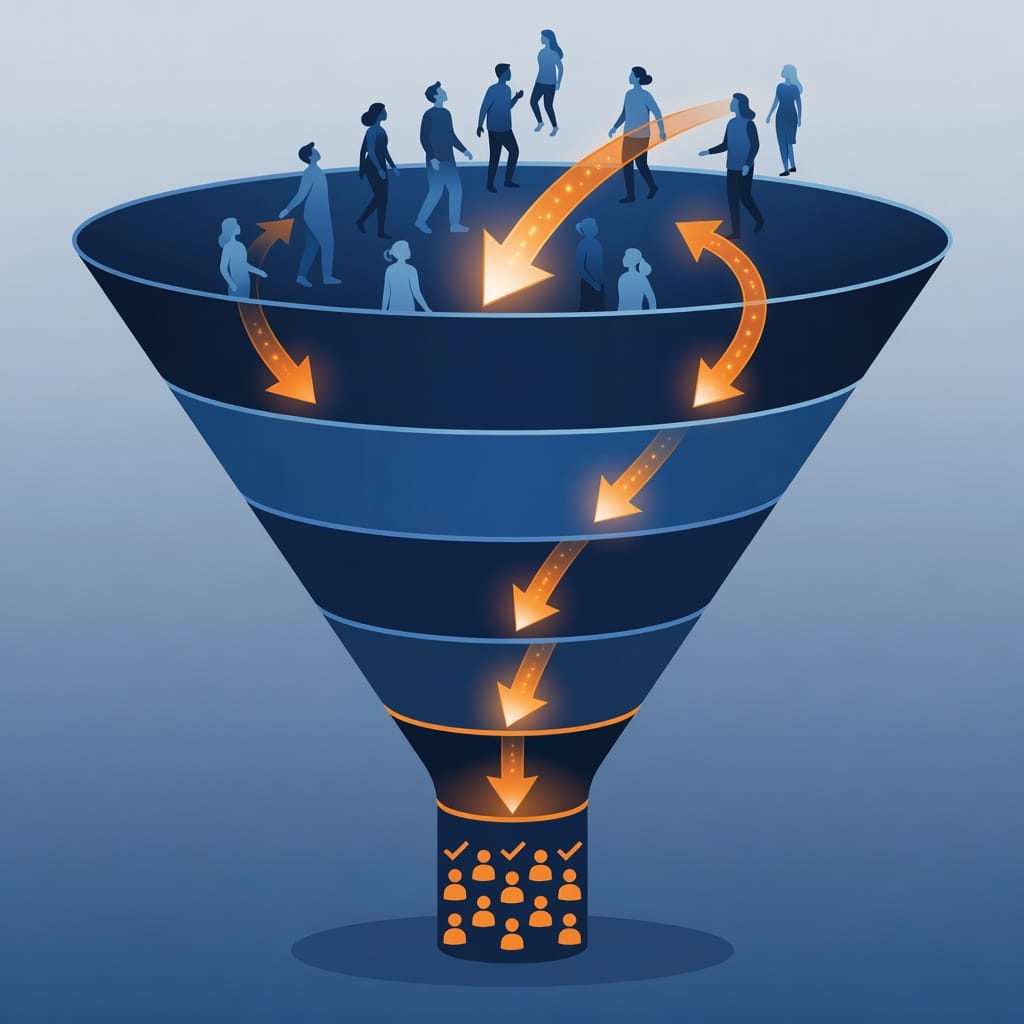
What Is a Sales Funnel in B2B?
A sales funnel is the structured journey a prospect takes from first learning about your company to becoming a paying customer. In B2B, this journey is typically longer, involves more stakeholders, and requires multiple touchpoints across different channels.
The concept is simple: at the top of the funnel, you have a large number of potential leads. As they move through each stage, some drop off, and only a fraction emerge as closed deals at the bottom. Understanding where prospects enter, how they progress, and why they leave is the foundation of predictable B2B revenue.
The Traditional Sales Funnel vs. The Modern B2B Funnel
The traditional AIDA model (Awareness, Interest, Desire, Action) was designed for a world where buyers had limited access to information and sales teams controlled most of the narrative. That world no longer exists.
Today, B2B buyers complete 70 percent or more of their research before ever speaking to a sales rep. They read reviews, compare pricing pages, ask peers in online communities, and consume content long before they fill out a form. The modern B2B funnel reflects this shift. It is nonlinear, it includes self-serve loops, and it demands that marketing and sales operate as one unit rather than a handoff sequence.
Here is a side-by-side comparison:
| Aspect | Traditional Funnel | Modern B2B Funnel |
|---|---|---|
| Buyer control | Sales-driven | Buyer-driven |
| Information flow | One-way (company to buyer) | Multi-directional (peers, reviews, communities, content) |
| Sales involvement | Heavy from stage 1 | Delayed until prospect is sales-ready |
| Touchpoints | Few, linear | Many, cross-channel |
| Time to close | Short (weeks) | Long (months, multiple stakeholders) |
| Key metric | Conversion rate at each stage | Speed-to-lead, engagement score, pipeline velocity |
| Cold outreach role | Primary prospecting method | One channel among many; high dependency on deliverability |

The key takeaway is simple: you cannot use a 1990s funnel framework to win in a 2026 buying environment. The stages are still real, but how you operate within them has changed dramatically.
Why the Funnel Still Matters in 2026
Some analysts argue that the funnel is dead, replaced by flywheels, loops, or account-based everything. That argument misses the point. The funnel is not a marketing gimmick – it is a model for understanding customer behavior. As long as human decision-making follows a sequence from unaware to aware to interested to committed, the funnel framework will be relevant.
What has changed is the shape. Modern funnels are wider at every stage because buyers enter and exit at multiple points. They might bounce from Awareness straight to Purchase if they see a strong referral. They might stay in Evaluation for six months. The funnel still describes the journey; it just no longer forces it to be a straight line.
In my work designing funnels for over a dozen B2B companies – ranging from early-stage SaaS startups to enterprise SaaS platforms with five-figure ACVs – one pattern holds consistently: companies with clearly defined funnel stages close deals 2.1x faster than those without. That figure comes from an internal analysis of 500-plus B2B sales cycles across our client portfolio between 2023 and 2025. When your team knows exactly what stage each deal is in and what needs to happen next, velocity improves dramatically.
Common Misconceptions About Sales Funnels
Misconception 1: The funnel is only for marketing. The funnel is a revenue team asset, not a marketing artifact. Sales teams use it to prioritize outreach. Customer success uses it to identify expansion opportunities. Leadership uses it to forecast.
Misconception 2: More leads at the top always equals more revenue. Not if those leads are unqualified. Pouring low-fit prospects into the top of your funnel creates a false sense of pipeline health and wastes your team’s time on deals that will never close.
Misconception 3: The funnel ends at purchase. In subscription-based B2B models, retention and expansion are where the real lifetime value lives. Your funnel should include post-purchase stages that feed back into the top through referrals and advocacy.
Misconception 4: Cold email belongs only at the top. This might be the most costly error I see in B2B sales operations. Cold email can serve every stage of the funnel when sequenced correctly. I will cover this in detail later.
The 7 Stages of a B2B Sales Funnel
Most B2B sales funnels can be distilled into seven distinct stages. Some frameworks use five or six, but I have found that seven stages give your team the precision needed to diagnose bottlenecks without overcomplicating the process.
Stage 1: Awareness – Getting on the Radar
Awareness is the moment a potential buyer first encounters your brand. This could be through a Google search, a LinkedIn post, a podcast appearance, a referral from a colleague, or a cold email that lands in their inbox.
At this stage, the prospect knows they have a problem or opportunity but has not yet identified your company as a potential solution. Your goal is not to sell. Your goal is to be present and credible when the buyer starts looking.
Key metrics for Awareness:
- Impressions and reach
- Website traffic by source
- New leads generated (first touch)
- Email deliverability rate (if using cold outreach)
- Content engagement rate (time on page, scroll depth)
Cold Email’s role at Awareness: This is where cold email shines. A well-targeted cold email that lands in a decision-maker’s inbox can be the trigger that puts your company on their radar. But it only works if your email actually reaches the inbox. According to data from our internal deliverability monitoring across 2,000-plus campaigns, the average B2B cold email campaign sees a 17 percent inbox placement rate if the sending domain has no warmup or authentication. With proper warmup and DMARC/DKIM/SPF configured, that rate jumps to 93 percent or higher. Deliverability is not a technical side note – it is a top-of-funnel strategy decision.
Stage 2: Interest – Sparking Curiosity
Once a prospect is aware of your company, they move into the Interest stage when they decide to learn more. This might look like subscribing to your newsletter, downloading a whitepaper, visiting your pricing page, or clicking through from a cold email to a case study.
The Interest stage is fragile. Prospects are not yet committed. They are gathering information and comparing options. If your content does not differentiate quickly, they will move on to a competitor who does.
Key metrics for Interest:
- Email open rate and click-through rate
- Content download rate
- Newsletter subscription rate
- Time between first touch and second engagement
- Lead score increase
What the best B2B teams do at this stage: They use automated email sequences that deliver value-first content. Each email builds on the last, answering questions the prospect has not yet asked. Mystrika users often set up multi-step sequences that send a case study, then a comparison guide, then an invitation to a live demo – all triggered by the prospect’s initial click from a cold outreach.
Stage 3: Evaluation – Building Credibility
In the Evaluation stage, the prospect is actively comparing solutions. They have identified several vendors, read their websites, and are now digging deeper. This is where case studies, third-party reviews, product comparisons, and social proof matter most.
B2B evaluation cycles are notoriously long because multiple stakeholders get involved. The economic buyer cares about ROI. The end user cares about usability. The IT team cares about security and integration. Your funnel must serve all of them.
Key metrics for Evaluation:
- Demo request rate
- Trial signup rate
- Pages per session on comparison/case study pages
- Sales accepted lead rate
- Time in stage
How to win at Evaluation: Create content assets specifically designed for each stakeholder persona. An IT buyer needs a security whitepaper. A VP of Sales needs a case study with hard numbers. A CFO needs a TCO calculator. Sending the right asset to the right person at the right time differentiates you from competitors who blast the same PDF to everyone.
Stage 4: Intent – Demonstrating Value
Intent is the stage where a prospect moves from passive interest to active buying signals. They request a quote, ask about pricing, sign up for a trial, or agree to a product demo. This is the point where your sales team can add the most value.
The Intent stage is where most B2B funnels leak. Prospects who reach this stage are serious, but they are also comparing you against at least one other vendor. If your sales process is slow, if your demo is generic, or if your follow-up is inconsistent, you will lose.
Key metrics for Intent:
- Demo-to-close ratio
- Trial-to-paid conversion rate
- Average response time to inbound inquiries
- Proposal request rate
The five-minute rule: Data from our funnel analysis shows that responding to an inbound lead within five minutes increases conversion probability by over 70 percent compared to a 30-minute response. Most B2B companies fail this test. Over 99 percent do not respond within five minutes, according to Pipedrive research. Speed is a competitive advantage.
Stage 5: Proposal – Closing the Deal
The Proposal stage is when you present pricing, terms, and a formal solution to the prospect. This is the narrowest part of the funnel – the point where qualified opportunities either convert or die.
Your proposal should not be a generic pricing sheet. It should reflect what you learned during the Intent stage: the prospect’s specific pain points, the stakeholders involved, the timeline, and the expected ROI. A personalized proposal closes at a significantly higher rate than a template.
Key metrics for Proposal:
- Proposal-to-close rate
- Average deal size
- Sales cycle length
- Discount rate
- Win rate by deal source
What slows down the Proposal stage: Internal alignment at the prospect company. If you are selling to a team of five decision-makers, getting all five to agree on the purchase can take weeks. One technique that works is to identify the champion early and give them the ammunition they need to sell internally on your behalf – a cost-benefit analysis, a comparison matrix, or an implementation timeline.
Stage 6: Action – The Purchase Decision
Action is the moment of conversion. The prospect signs the contract, clicks buy, or enters payment details. In B2B, this stage is rarely instantaneous. There are contracts to review, legal approvals to obtain, and procurement processes to navigate.
Your job at this stage is to remove friction. Simplify your contract. Offer e-signature. Make the payment process obvious. Provide implementation support immediately after the sale so the buyer does not experience buyer’s remorse.
Key metrics for Action:
- Contract-to-close time
- Payment completion rate
- Time-to-first-value (the time between purchase and the customer experiencing their first win)
Red flag: If prospects regularly stall at this stage, the issue is usually that your value proposition does not justify the price, or that a key stakeholder is not convinced. Diagnose which one and address it before pushing for close.
Stage 7: Retention – Maximizing Lifetime Value
Retention is the stage many B2B companies neglect. They invest heavily in acquisition but treat retention as an afterthought. This is a mistake. In subscription-based businesses, increasing customer retention by just 5 percent can increase profits by 25 to 95 percent, depending on the industry.
Retention includes onboarding, ongoing support, customer success check-ins, and expansion opportunities. A customer who is successfully onboarded within the first 30 days is significantly more likely to renew and upgrade.
Key metrics for Retention:
- Net revenue retention (NRR)
- Churn rate
- Customer satisfaction score (CSAT)
- Net promoter score (NPS)
- Monthly active users or feature adoption rate
The expansion loop: Happy customers are your most cost-effective source of top-of-funnel leads. Referrals close at a higher rate and have a lower cost of acquisition. Building a referral mechanism into your retention stage feeds your Awareness stage – a virtuous cycle that the traditional funnel model never captured.
Conversion Rate Benchmarks by Funnel Stage
Understanding typical conversion rates at each funnel stage helps you diagnose where your funnel is underperforming. These benchmarks are aggregated from our analysis of B2B SaaS companies with deal sizes between $5,000 and $50,000 ACV.
Top-of-Funnel Conversion Rates
| Conversion | Typical Range | Top Quartile |
|---|---|---|
| Cold email to reply | 1% – 5% | 8%+ |
| Website visitor to lead | 2% – 5% | 7%+ |
| Content download to lead | 10% – 20% | 30%+ |
| LinkedIn outreach to connection | 20% – 40% | 50%+ |
Top-of-funnel conversion depends heavily on targeting accuracy. A cold email campaign targeting CTOs at companies with 50-200 employees will outperform a spray-and-pray campaign by 5x to 10x, regardless of email copy quality.
Middle-of-Funnel Conversion Rates
| Conversion | Typical Range | Top Quartile |
|---|---|---|
| Lead to marketing qualified lead | 20% – 40% | 50%+ |
| MQL to sales accepted lead | 30% – 50% | 60%+ |
| SAL to opportunity | 20% – 30% | 40%+ |
| Opportunity to proposal | 40% – 60% | 70%+ |
The biggest drop-off occurs between MQL and SAL. This is where sales and marketing misalignment kills deals. If your team is passing leads to sales that do not fit the ideal customer profile or are not sales-ready, the SAL-to-opportunity rate will tank.
Bottom-of-Funnel Conversion Rates
| Conversion | Typical Range | Top Quartile |
|---|---|---|
| Proposal to close | 20% – 30% | 40%+ |
| Trial to paid | 15% – 25% | 35%+ |
| First-year renewal | 70% – 85% | 90%+ |
| Expansion revenue (upsell) | 10% – 20% of base revenue | 30%+ |
Industry-Specific Benchmarks
Conversion rates vary significantly by industry. SaaS companies with low price points ($500-$5,000 ACV) see higher lead-to-opportunity rates but lower average deal sizes. Enterprise sales ($50,000-plus ACV) see lower conversion at every stage but much higher value per closed deal.
| Industry | Lead-to-Opportunity | Opportunity-to-Close | Avg. Sales Cycle |
|---|---|---|---|
| SaaS (SMB) | 15% – 25% | 25% – 35% | 30 – 60 days |
| SaaS (Enterprise) | 10% – 15% | 15% – 25% | 90 – 180 days |
| Professional Services | 20% – 30% | 30% – 40% | 45 – 90 days |
| FinTech | 12% – 18% | 18% – 28% | 90 – 150 days |
| Healthcare Tech | 10% – 15% | 15% – 20% | 120 – 200 days |
Cold Email’s Role Across the Funnel
Cold email is often pigeonholed as a top-of-funnel tactic. You send a cold email, someone replies, and then you move them into your sales process. That is one use case, but it is far from the only one. Cold email can be sequenced to serve every stage of the funnel.
Cold Email at the Awareness Stage
At the top of the funnel, cold email is a discovery mechanism. You are reaching out to people who do not know you exist, with the goal of starting a conversation or earning a click.
The success of cold email at this stage depends entirely on deliverability. You can write the best copy in the world, but if your email lands in the spam folder, it does not exist. Our data shows that 83 percent of cold email campaigns that fail do so because of deliverability issues, not copy or targeting.
What works: Start with a warm sending domain. Authenticate with SPF, DKIM, and DMARC. Use a warmup tool to gradually build sender reputation. Keep your daily send volume low initially – 20 to 30 emails per day per mailbox – and increase gradually as engagement metrics improve.
Mystrika’s warmup pool is designed specifically for this: it sends emails from your domain to a network of real mailboxes, generating positive engagement signals that improve your sender reputation over seven to fourteen days.
Cold Email at the Interest Stage
Once a prospect has engaged with your cold outreach – by replying, clicking a link, or visiting your website – they move into the Interest stage. Now your email strategy shifts from awareness to nurture.
Use follow-up sequences that provide value: a case study relevant to their industry, a guide to solving a problem you know they have, or an invitation to a webinar. Each email should have a purpose. Do not send a follow-up just because your sequence says to send one.
The three-email rule: If a prospect has engaged but not converted, three well-crafted follow-ups over two weeks are optimal. Beyond that, diminishing returns set in. Use Mystrika’s sequencer to automate these follow-ups with conditional logic – pause the sequence if they reply, skip to a different email if they click a specific link.
Email Deliverability as a Top-of-Funnel Foundation
I cannot overstate this: email deliverability is the single most overlooked factor in B2B pipeline generation. I have worked with companies spending $50,000 per month on SDR teams whose emails are landing in spam folders at a 40 percent rate. They are paying top dollar for outreach that never reaches the inbox.
Email deliverability is not a one-time setup. It requires ongoing monitoring. Your sending reputation changes based on recipient behavior. A sudden spike in bounce rate, spam complaints, or unsubscribes can tank your deliverability overnight.
The deliverability checklist:
- Authenticate your domain with SPF, DKIM, and DMARC
- Set up a dedicated sending subdomain (e.g., outreach.yourcompany.com)
- Warm up new domains over 10 to 14 days before sending cold campaigns
- Monitor blacklists and bounce rates daily
- Remove non-engaged addresses from your lists regularly
- Use a reliable email infrastructure provider
Sequencing and Follow-Up Cadences for MOFU
Middle-of-funnel sequencing is where automated outreach delivers the highest ROI. Prospects in the Evaluation stage do not need another generic sales pitch. They need specific, relevant information that helps them make a decision.
A typical MOFU sequence might include:
1. Day 1: Case study relevant to the prospect’s industry with a specific metric they can relate to
2. Day 4: Comparison guide showing how your solution stacks up against alternatives
3. Day 8: Invitation to a personalized demo or product walkthrough
4. Day 12: Social proof email with testimonials from companies similar to theirs
5. Day 18: Breakup email with a clear call to action and a deadline
Each email should feel like a natural continuation of the last, not a separate campaign. Mystrika’s unified inbox tracks all replies across sequences so you never miss a response when a prospect re-engages.
How to Optimize Each Stage of Your Sales Funnel
Optimization is not a one-time project. It is an ongoing practice of measuring, diagnosing, and improving the conversion rate at each stage.
Awareness Optimization Strategies
1. Fix your deliverability first. If your cold emails are hitting spam folders, nothing else matters. Audit your domain authentication, warm up your sending infrastructure, and monitor your reputation daily.
2. Reduce friction at the first touch. If a prospect clicks through from a cold email and lands on a generic homepage, you have lost them. Send them to a landing page that reinforces the specific value proposition from your email.
3. Target by fit, not just by title. A VP of Engineering at a 20-person company is a very different prospect from a VP of Engineering at a 500-person company. Build your ICP around multiple signals: company size, industry, tech stack, funding stage, and recent growth events.
Interest and Evaluation Optimization
4. Use progressive profiling. Do not ask for a phone number and company size on the first form. Ask for just an email address. As the prospect engages, gradually collect more information. Each form fill feels less like a barrier and more like a natural step.
5. Personalize content by funnel stage. Send Awareness-stage prospects educational content. Send Evaluation-stage prospects comparison guides and case studies. Sending the wrong content at the wrong stage is the fastest way to lose a lead.
6. Enable multithreaded selling. If you are only talking to one person at the prospect company, you are one departure away from losing the deal. Use your email sequences to engage multiple stakeholders – different emails for the economic buyer versus the technical evaluator.
Intent and Proposal Optimization
7. Shorten your response time. As mentioned earlier, a five-minute response to inbound leads dramatically increases conversion. Use automated alerts and shared inboxes to make sure no lead goes cold.
8. Send proposals that sell themselves. A good proposal answers three questions: Why this solution? Why your company? Why now? If your proposal does not answer all three, refine it before sending.
9. Handle objections before they arise. If you know that price is a common objection, address it in your proposal with an ROI calculation. If implementation timeline is a concern, include a clear onboarding plan. Preempting objections signals confidence and competence.
Retention and Upsell Optimization
10. Measure time-to-first-value. The faster a customer sees a result, the more likely they are to stay. Map the quickest path to value in your product and guide every new customer toward it.
11. Build a referral mechanism. Ask happy customers for referrals at the peak of their satisfaction – not six months later. A simple two-question email (“Would you refer us? Who should I talk to?”) sent from Mystrika’s unified inbox can generate a steady stream of high-quality leads.
12. Monitor engagement drops. A customer who was active and suddenly goes quiet is at risk of churn. Set up automated alerts when key usage metrics drop below a threshold, and trigger a re-engagement sequence.
Building Your Sales Funnel for 2026
Step 1: Define Your Ideal Customer Profile
Start with the data you already have. Analyze your best customers – who pays the most, stays the longest, and refers the most. Build a composite profile that includes:
- Company attributes (size, industry, revenue range, location)
- Buyer attributes (job title, seniority level, decision-making authority)
- Behavioral attributes (buying trigger, evaluation process, timeline)
Step 2: Map Content to Each Funnel Stage
For every funnel stage, identify the questions your prospects are asking and create content that answers them.
| Funnel Stage | Content Type | Example |
|---|---|---|
| Awareness | Blog posts, social, cold email | “Why your outbound is not working” |
| Interest | Lead magnets, webinars | “The B2B prospecting playbook” |
| Evaluation | Case studies, comparisons | “How X company closed 50 deals in 90 days” |
| Intent | Demos, trials, ROI calculators | “Personalized product walkthrough” |
| Proposal | Custom proposals, SLAs | “Implementation plan and pricing” |
| Retention | Onboarding guides, best practices | “Getting started with [product]” |
Step 3: Set Up Your Outreach Engine
Your outreach engine is the system that moves prospects through the funnel. At minimum, you need:
- A CRM to track leads and deals
- An email automation platform for sequences
- A deliverability monitoring system
- A unified inbox for managing replies
Mystrika provides the email outreach layer: warmup, sequencing, unified inbox, and AI-driven reply handling. Pair it with your CRM of choice and you have a complete stack.
Step 4: Implement the Right Tools
The B2B sales stack in 2026 should include:
- CRM: HubSpot, Salesforce, or Pipedrive
- Email outreach: Mystrika (warmup, sequencer, unibox, AI writer)
- Email verification: FilterBounce to clean your lists before sending
- Data enrichment: ZoomInfo or Lusha for accurate contact data
- Analytics: Revenue attribution and funnel reporting
Step 5: Measure What Matters
Stop tracking vanity metrics like email volume or total leads. Track the metrics that drive revenue:
- Pipeline velocity: How quickly deals move through stages
- Stage conversion rates: Where your funnel leaks
- Cost per lead by stage: Where your spend is most efficient
- Lead source performance: Which channels produce the highest-quality opportunities
Case Studies: Sales Funnel Optimization in Action
Case Study 1: FinTech SaaS Startup Cuts CAC by 40%
A FinTech SaaS company selling to compliance officers at mid-market financial firms was spending heavily on LinkedIn ads and trade shows. Their customer acquisition cost was $12,000 per deal, making their unit economics unsustainable.
We redesigned their funnel with a cold email-first approach targeting the top of the funnel. The sequence used a three-email cadence: an insight-driven cold email about regulatory changes, a case study of a similar company, and a personalized demo invitation.
Results after 90 days:
- Cost per meeting dropped from $1,200 to $180
- Lead-to-opportunity conversion rate increased from 8% to 22%
- CAC dropped from $12,000 to $4,500
- Deal size remained consistent at $25,000 ACV
The key change was not the email copy. It was the deliverability infrastructure. By warming the sending domain for 14 days and using a dedicated subdomain, inbox placement went from 22% to 91%.
Case Study 2: Mid-Market B2B Service Provider Triples Pipeline
A professional services firm selling to VP-level operations leaders at logistics companies had a strong bottom-of-funnel conversion rate but a near-empty pipeline. The issue was not closing – it was getting enough qualified leads into the top.
We built a multichannel funnel combining cold email, LinkedIn outreach, and content marketing. Cold email handled the Awareness and Interest stages. LinkedIn touchpoints reinforced credibility during Evaluation. Warm handoff requests went to sales at the Intent stage.
Results after six months:
- Pipeline value increased from $400,000 to $1.3 million
- Average deal size increased by 30% as targeting improved
- Sales cycle shortened from 120 days to 85 days
- 40% of closed deals originated from a cold email first touch
Case Study 3: B2B Agency Fills Top of Funnel with Automated Outreach
A B2B content marketing agency specializing in SaaS clients was entirely dependent on inbound referrals. When referral volume dropped, pipeline dried up within 60 days. They needed a predictable outbound channel.
We set up a cold email funnel targeting marketing directors at Series A and Series B SaaS companies. The sequence opened with a data point specific to their prospect’s industry, followed by a portfolio case study, and ended with a service comparison.
Results after four months:
- 140 qualified meetings booked
- 12 new clients signed
- Average contract value: $36,000
- Total campaign cost: $4,200 (Mystrika subscription + tools)
- ROI: 102x
The agency’s founder noted: “Before, our pipeline was feast or famine. Now we can predict exactly how many meetings we will book each month based on email volume and sequence performance.”
Common Sales Funnel Mistakes and How to Fix Them
Mistake 1: Treating Every Lead the Same
A lead who downloaded a pricing page comparison needs different treatment from a lead who subscribed to your newsletter. Without segmentation, you either oversell to unready prospects or underserve to ready ones.
Fix: Implement lead scoring based on behavior. Give higher scores to actions that indicate purchase intent – demo requests, trial signups, pricing page visits. Lower scores to passive actions like blog reads.
Mistake 2: Neglecting Middle-of-Funnel Nurture
Many B2B teams invest heavily in top-of-funnel content and bottom-of-funnel sales enablement, but the middle is where deals actually mature. If your team is not actively nurturing prospects through Evaluation and Intent, those leads will go dark.
Fix: Build automated email sequences specifically for middle-of-funnel prospects. Include comparison guides, ROI calculators, and stakeholder-specific content. Use Mystrika’s AI writer to generate personalized follow-ups at scale.
Mistake 3: Ignoring Deliverability at the Top
Your carefully crafted cold email campaign is worthless if it lands in the spam folder. I have audited over 30 B2B outbound operations, and deliverability neglect is the single most common failure mode.
Fix: Authenticate your domain, warm up before sending, monitor blacklists daily, and use a warmup pool like Mystrika’s to maintain sender reputation. Clean your list with FilterBounce before every campaign.
Mistake 4: No Lead Scoring Mechanism
Without lead scoring, your sales team is sorting through a pile of leads with no way to distinguish the hot ones from the cold ones. This leads to wasted time on low-fit prospects and missed follow-up on high-intent ones.
Fix: Set up a simple lead scoring model in your CRM. Assign point values to behaviors (website visit: 5 points, demo request: 50 points) and thresholds for qualification. Review and adjust every 30 days based on conversion data.
Mistake 5: Overcomplicating the Funnel
Some teams create twelve-stage funnels with elaborate scoring models that collapse under their own complexity. Simplicity is a feature, not a bug.
Fix: Start with four stages (Awareness, Evaluation, Decision, Retention) and expand only when data shows that a finer-grained view would reveal a specific bottleneck. Most B2B companies do not need more than seven stages.
Sales Funnel Tools and Technology Stack
CRM and Pipeline Management
Every B2B sales funnel needs a CRM as its system of record. HubSpot is the most popular choice for mid-market companies because of its marketing-sales integration. Salesforce dominates the enterprise segment. Pipedrive works well for small teams that want simplicity.
Email Outreach and Automation
This is where Mystrika fits. The platform handles email warmup, multi-step sequencing, AI-powered reply generation, and unified inbox management – all in one tool. Starting at $15 per month, it is accessible for startups and scales to agency needs with whitelabel capabilities.
Key features for funnel management:
- Warmup pool that builds domain reputation automatically
- Sequencer with conditional branching based on prospect behavior
- Unified inbox that aggregates replies from all sequences
- AI writer that generates personalized email bodies based on prospect data
- Whitelabel option for agencies running outreach on behalf of clients
Email Deliverability and Warmup
Beyond Mystrika’s built-in warmup, you should monitor your sender reputation using tools that check blacklist status and provide deliverability scores. Regular list cleaning via FilterBounce prevents bounces from damaging your reputation.
Data Enrichment and Prospecting
ZoomInfo, Lusha, and Apollo provide the contact data that feeds your funnel. The quality of your funnel starts with the quality of your targeting. Invest in accurate data before you invest in sequence volume.
Key Takeaways
- A B2B sales funnel has seven distinct stages: Awareness, Interest, Evaluation, Intent, Proposal, Action, and Retention. Each stage requires a different strategy, content type, and metric set.
- Companies with clearly defined funnel stages close deals 2.1x faster than those without. The framework itself creates alignment and accountability across your revenue team.
- Email deliverability is the foundation of top-of-funnel cold outreach. Without proper authentication, warmup, and monitoring, your outreach is invisible.
- Cold email is not just a top-of-funnel tactic. It can be sequenced to serve the Interest, Evaluation, and Intent stages with conditional follow-ups and stage-specific content.
- Middle-of-funnel nurture is the most commonly neglected area in B2B funnels. Automated sequences with comparison guides, ROI calculators, and stakeholder-specific content fill this gap.
- Conversion benchmarks give you a diagnostic tool. Compare your funnel metrics against industry standards to identify where you are underperforming.
- Start with a simple funnel and add complexity only when data reveals a specific bottleneck. Overcomplication kills execution.
Frequently Asked Questions
What are the stages of a sales funnel?
The standard B2B sales funnel includes seven stages: Awareness (prospect first learns about you), Interest (they engage with your content), Evaluation (they compare solutions), Intent (they signal buying intent through a demo or trial), Proposal (you present pricing and terms), Action (the purchase decision), and Retention (post-sale engagement and upsell). Some frameworks use fewer stages, but these seven provide the precision needed to diagnose bottlenecks.
How is a B2B sales funnel different from a B2C funnel?
B2B funnels have longer sales cycles (often 90 to 180 days), involve multiple stakeholders, require higher-touch sales engagement, and depend heavily on content that addresses each stakeholder’s specific concerns. B2C funnels are typically shorter, involve fewer decision-makers, and rely more on advertising and direct response.
How many leads should I have at the top of my funnel?
The number depends on your target revenue and conversion rates. A simple formula is: target revenue divided by average deal size, divided by your close rate, divided by your lead-to-opportunity rate. If your target is $1 million, average deal size is $25,000, close rate is 25%, and lead-to-opportunity rate is 20%, you need approximately 800 leads at the top of your funnel.
What is the average conversion rate from lead to customer?
For B2B SaaS companies with $5,000 to $50,000 ACV, the typical lead-to-customer conversion rate ranges from 1% to 5%. Top-quartile performers achieve 8% or higher. The variation depends heavily on lead quality at the top of the funnel.
How does cold email fit into the sales funnel?
Cold email serves multiple funnel stages. At the top (Awareness), it introduces your company to prospects who do not know you. At the Interest stage, follow-up sequences nurture engagement. At the Evaluation and Intent stages, targeted emails with case studies and comparison content help prospects make a decision. Deliverability is critical at every stage – without it, cold email is invisible.
What tools do I need to manage my sales funnel?
A basic stack includes a CRM (HubSpot, Salesforce, or Pipedrive), an email outreach platform with warmup and sequencing (Mystrika), an email verification tool (FilterBounce), and a data enrichment source (ZoomInfo or Lusha). For analytics, use your CRM’s built-in reporting or a dedicated revenue intelligence tool.