

If you’ve spent any time in B2B marketing over the last few years, you’ve likely witnessed the great debate: demand generation vs lead generation. Are they the same thing? Do they compete? Which one should command your budget this year?
For decades, the B2B marketing playbook was simple: create an eBook, put it behind a form, capture contact information, and pass those “leads” to the sales team. But as buyer behavior shifted, that playbook started yielding diminishing returns. Today’s buyers want to educate themselves independently, operating in the “dark funnel” of communities, podcasts, and peer networks long before they ever fill out a form.
This shift has created a massive divide in how companies approach growth. Should you focus on capturing intent from the 1% of the market ready to buy right now (lead generation)? Or should you focus on educating the 99% who aren’t in-market yet, building brand affinity so that when they are ready, you’re the obvious choice (demand generation)?
In this comprehensive guide, we’ll break down the core differences between demand generation and lead generation, explore their tactical implementations, and-most importantly-show you how to align both to build an unstoppable revenue engine.
What Is Demand Generation?
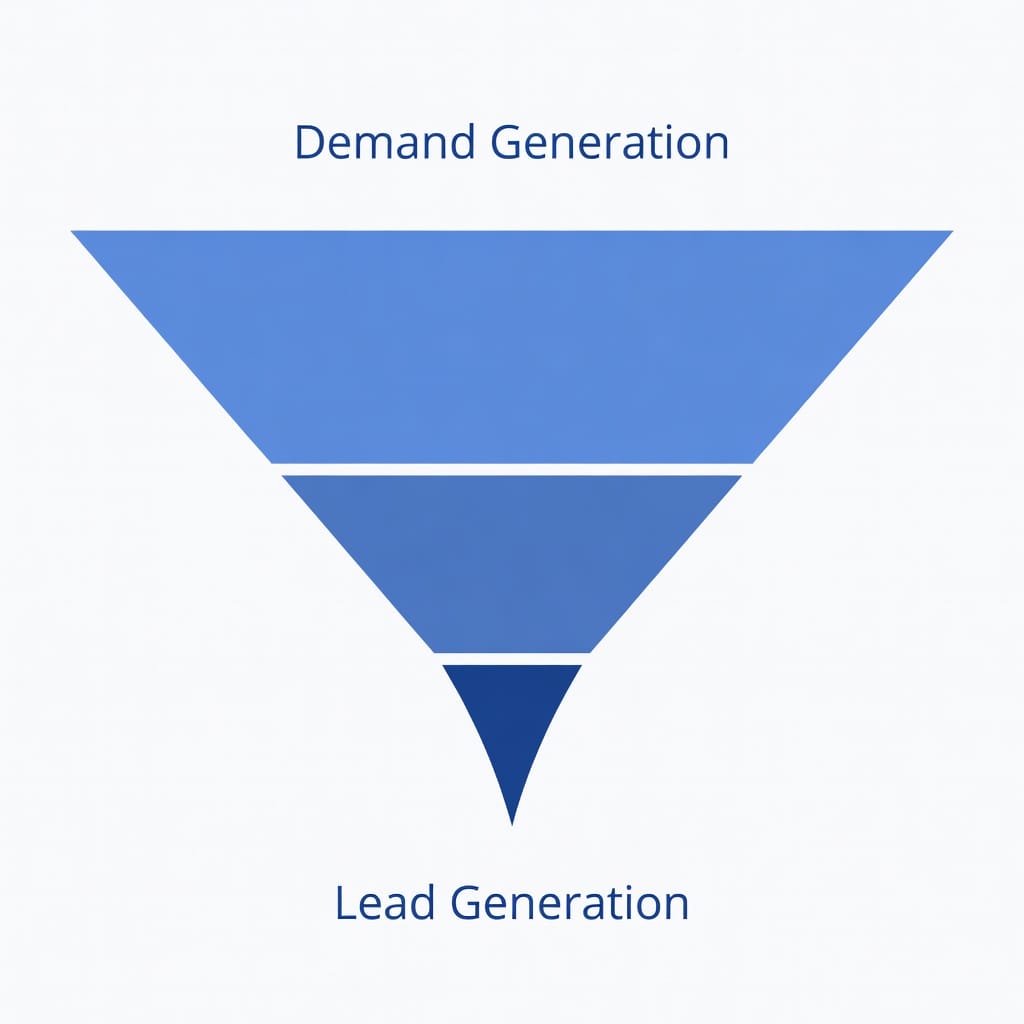
Demand generation is the strategic marketing process of creating awareness, interest, and trust in your brand and products among your target audience. It sits at the very top of the funnel, focusing on the 99% of your total addressable market (TAM) that is not currently in a buying cycle.
The primary goal of demand generation is not to collect email addresses, but to educate the market on a specific problem and position your solution as the best answer. When done correctly, demand generation ensures that when a prospect finally realizes they have a pain point, your brand is the first one they think of.
Strategy and Philosophy
The philosophy behind demand generation is fundamentally buyer-centric. It acknowledges that you cannot force a buyer into a purchasing cycle if they aren’t ready. Instead, you must be present and valuable throughout their independent research phase.
Demand generation focuses on long-term brand building and market education. It requires patience, as the ROI is not immediate. The strategy revolves around changing the way your audience thinks about their industry, their problems, and the potential solutions available to them.
Ungated Content and Free Value
A hallmark of modern demand generation is ungated content. Rather than forcing prospects to trade their personal information for insights, demand generation marketers give away their best content for free.
This includes publishing comprehensive blog posts, launching industry podcasts, sharing native video content on LinkedIn, and hosting open webinars. By removing friction, you maximize the reach of your message. The logic is simple: if your content is truly valuable, gating it artificially restricts the number of people who will consume it and ultimately associate your brand with that value.
Dark Social and Community Building
A significant portion of demand generation happens in the “dark funnel” or “dark social.” These are the places where buyers actually communicate, but marketing attribution software cannot track them. It includes private Slack and Discord communities, Reddit threads, WhatsApp groups, direct messages, and in-person events.
Because demand generation focuses on brand affinity and education, it thrives in these environments. When a buyer asks their peer network, “Which cold email platform should we use?”, the recommendation they receive (e.g., “We switched to Mystrika and it’s been incredible”) is the ultimate result of successful demand generation.
Metrics of Demand Generation
Measuring demand generation can be challenging because it defies traditional lead-scoring models. Instead of tracking Cost Per Lead (CPL) or Marketing Qualified Leads (MQLs), demand generation metrics look at aggregate trends and engagement.
Key metrics include:
- Pipeline Velocity: How quickly opportunities move through the sales cycle.
- Inbound Demo Requests: The volume of high-intent prospects asking to speak with sales without being prompted by an SDR.
- Win Rates: The percentage of opportunities that close-won (demand generation typically yields significantly higher win rates).
- Branded Search Volume: The number of people searching for your company name directly on Google.
- Content Engagement: Podcast downloads, YouTube views, and meaningful LinkedIn comments.
The Financial Impact of Brand Affinity
While demand generation requires a longer time horizon, its financial impact is profound. According to recent B2B surveys, companies that shift their budget toward demand generation often see a temporary dip in total “leads,” but a massive increase in actual revenue.
When a prospect books a demo through a demand generation motion, they already know what your product does, they agree with your point of view, and they are usually ready to buy. This drastically reduces the sales cycle length and decreases the burden on your sales team to “pitch” the product from scratch.
What Is Lead Generation?
Lead generation is the process of capturing contact information from potential customers to build a database for marketing and sales outreach. Unlike demand generation, which operates broadly at the top of the funnel, lead generation sits in the middle and bottom of the funnel.
The primary objective of lead generation is to identify the 1-5% of your market that is currently exhibiting buying intent and convert that interest into an actionable contact record.
The Mechanics of Intent Capture
Lead generation is fundamentally transactional. It operates on a value exchange: the company offers something of perceived value, and the prospect pays for it with their contact information (usually an email address, phone number, and job title).
This strategy is highly measurable and predictable. Marketers can easily calculate how much it costs to generate a single lead, allowing them to scale campaigns up or down based on budget and sales capacity. Lead generation is designed to feed the sales team a steady volume of prospects to work through.
Gated Content and Lead Magnets
The primary tactic of lead generation is gated content. This involves placing valuable resources behind a form. Common lead magnets include:
- In-depth eBooks and Whitepapers: Comprehensive guides on specific industry topics.
- Templates and Tools: Downloadable spreadsheets, calculators, or framework documents.
- Exclusive Webinars: Live or recorded sessions that require registration.
- Free Trials and Demos: The ultimate bottom-of-funnel lead magnet.
When a user fills out the form, their information is routed into a CRM, triggering an automated email sequence or a direct follow-up from a Sales Development Representative (SDR).
Direct Response and Performance Marketing
Lead generation relies heavily on performance marketing and direct response channels. This includes Google Ads (Search and Display), LinkedIn Lead Gen Forms, and targeted cold email campaigns.
These channels are optimized for conversion. For example, bidding on high-intent keywords like “best cold email software” via Google Ads is a classic lead generation play. The user has demonstrated intent through their search query, and the ad aims to capture that intent immediately by driving them to a highly optimized landing page with a clear Call to Action (CTA).
The MQL and SQL Framework
Lead generation is deeply tied to the traditional Marketing Qualified Lead (MQL) and Sales Qualified Lead (SQL) framework.
- MQL: A lead who has engaged with marketing materials (e.g., downloaded an eBook) and fits the basic ideal customer profile (ICP).
- SQL: An MQL that has been vetted by an SDR and determined to have genuine buying interest, budget, and authority.
This framework relies on lead scoring-assigning points to a prospect based on their actions. For instance, visiting the pricing page might be worth 10 points, while downloading a whitepaper is worth 20 points. Once a threshold is reached, the lead is passed to sales.
The Limitations of Pure Lead Generation
While lead generation is highly measurable, relying on it exclusively presents significant challenges in the modern B2B landscape.
The biggest issue is the assumption of intent. Just because a prospect downloaded an eBook does not mean they want to buy your software; it simply means they wanted the information in the eBook. When SDRs aggressively call prospects who lack actual buying intent, it creates friction, damages brand reputation, and leads to incredibly low conversion rates (often sub-1% from MQL to closed-won deal).
The Core Differences: Demand Gen vs Lead Gen
While demand generation and lead generation serve the overarching goal of growing revenue, they differ significantly across nearly every dimension-from strategy and metrics to the tactics and timelines involved.

Funnel Stage and Buyer Readiness
Demand generation resides at the top of the funnel (TOFU), targeting buyers who are unaware of their problem or researching generally. These buyers have zero buying intent yet have significant educational needs. Lead generation, by contrast, captures middle-to-bottom-funnel prospects who have demonstrated some degree of buying intent.
The buyer in demand generation is passive. They may consume your blog content or subscribe to your podcast without ever clicking a CTA. The buyer in lead generation is active-they filled out a form, clicked an ad, or typed a commercial search query.
Goals and Objectives
The goal of demand generation is to increase the total volume of opportunities entering your pipeline over time. It is about expansion and market creation. Successful demand generation means that more people consider your brand when they begin their buying journey.
The goal of lead generation is to capture and qualify existing interest. It is about extraction and efficiency. Successful lead generation means that you are capturing the maximum possible value from the buyers already in-market.
Tactical Mix
| Dimension | Demand Generation | Lead Generation |
|---|---|---|
| Content Type | Ungated (blogs, podcasts, social) | Gated (eBooks, whitepapers, demos) |
| Channels | Organic search, social organic, PR, community | Paid search, paid social, email capture, retargeting |
| Targeting | Broad ICP / TAM | In-market / high-intent segments |
| Buyer Readiness | Low (not yet in market) | High (actively researching) |
| Time Horizon | Long-term (3-12 months) | Short-term (weeks to months) |
| Key Metric | Pipeline value, brand search volume, win rate | MQL volume, CPL, form fill rate |
Budget Allocation Models
One of the most common questions marketing leaders face is how to split budget between the two strategies. Based on workshops with over 200 B2B marketing leaders, a composite budget framework reveals three common models:
The 70-30 Model (Brand Building): 70% toward demand generation, 30% toward lead generation. This works best for companies entering new markets, targeting enterprise accounts with long sales cycles, or rebuilding brand perception.
The 50-50 Model (Balanced Growth): Equal split between demand and lead generation. This is the most common model for mid-stage companies with a product-led growth motion and a healthy pipeline.
The 30-70 Model (Revenue Acceleration): 30% toward demand generation, 70% toward lead generation. This is used by companies needing to hit short-term revenue targets quickly, often before a fundraising round or quarterly close.
The optimal split depends on your pipeline health. If you have a strong brand and high inbound traffic, you can weight toward lead gen. If you are unknown in your market, you must invest in demand gen first or your lead gen campaigns will suffer from astronomically high cost per lead.
Sales and Marketing Alignment
Demand generation and lead generation require fundamentally different handoffs between marketing and sales.
With demand generation, the prospect comes to sales ready and educated. The SDR’s role is consultative-answering advanced questions and facilitating a buying process. The handoff from marketing to sales is smooth, and conversion rates from the first sales call to closed-won are typically higher.
With lead generation, the sales team must often invest significant time in educating and qualifying the prospect. Many “leads” are simply curious researchers with no budget or authority. This creates friction in the handoff, as marketing blames sales for not following up effectively, and sales blames marketing for sending low-quality leads. This is commonly known as the “lead quality war” between teams.
Content Depth and Format
Demand generation content is designed to be accessible, snackable, and shareable. It focuses on broad educational topics that your ICP cares about. The formats include short-form video, podcast episodes, social media threads, thought leadership articles, and “big idea” research reports.
Lead generation content is designed to be comprehensive, gated, and conversion-focused. It focuses on specific solutions to specific problems. The formats include step-by-step guides, industry benchmarks, ROI calculators, free tools, and product demos.
You cannot swap these formats and expect the same results. A lead generation marketer who insists on gating every blog post will severely limit their reach. A demand generation marketer who refuses to build any gated content will struggle to capture the high-intent prospects that sales needs today.
When to Prioritize Demand Generation vs Lead Generation
Real-World Case Study 1: The SaaS Pivot from MQLs to Pipeline
Consider a mid-market HR tech company that built its entire marketing engine around lead generation. They gated every eBook, ran aggressive LinkedIn lead gen ads, and passed thousands of “MQLs” to their SDR team every month.
The metrics looked fantastic on paper: Cost Per Lead was dropping, and MQL volume was increasing by 15% quarter-over-quarter. However, when the VP of Sales examined the closed-won revenue, the conversion rate from MQL to closed deal was a dismal 0.3%. The SDR team was spending 80% of their time chasing prospects who simply wanted to read a PDF and had zero intention of evaluating new HR software.
The company executed a dramatic pivot to demand generation. They:
1. Ungated all educational content, making it freely available on their blog and LinkedIn.
2. Launched a bi-weekly podcast interviewing HR leaders (their exact target audience).
3. Stopped scoring leads based on PDF downloads.
4. Shifted SDR outreach from “following up on an eBook” to highly targeted outbound campaigns focusing on accounts showing high-intent signals (like visiting the pricing page multiple times).
The initial result? A 70% drop in total “leads.” Panic ensued at the board level.
But six months later, the true results emerged:
- Inbound demo requests (high-intent buyers asking to speak to sales) increased by 400%.
- The sales cycle shortened from 90 days to 45 days.
- The SDR-to-AE pipeline conversion rate skyrocketed.
- Overall closed-won revenue increased by 2.3x compared to the previous year.
By shifting their focus to educating the market (demand generation) and only capturing intent from those ready to buy (lead generation), they built a significantly more efficient revenue engine.
Real-World Case Study 2: The Enterprise Security Launch
An enterprise cybersecurity firm was preparing to launch a new zero-trust network product. The market was already crowded, and the company had low brand awareness in this specific product category.
Initially, their agency recommended a pure lead generation play: bid on high-intent keywords like “zero trust network software” and drive traffic to a free trial landing page.
The campaign was a disaster. The Cost Per Click (CPC) was over \$45, and the conversion rate was near zero. Why? Because IT directors do not sign up for free trials of core security infrastructure from brands they have never heard of, regardless of how good the ad copy is.
The company realized they needed to create demand before they could capture it. They completely halted the lead generation campaigns and reallocated the budget to a 9-month demand generation strategy.
They focused on:
1. Partnering with respected cybersecurity influencers to co-host webinars on the philosophy of zero-trust.
2. Publishing deep-dive technical articles explaining the architectural shifts required for modern security, without pitching their product.
3. Distributing these articles via targeted LinkedIn ads optimized for reach and video views, not form fills.
4. Engaging in niche subreddits and Slack communities to answer technical questions without linking to their product page.
After 9 months of consistent demand generation, they reintroduced their lead generation campaigns. The results were entirely different. Because the market now recognized their brand as an authority in zero-trust architecture, their ads resonated.
The CPC dropped significantly because their click-through rates were higher. More importantly, the conversion rate on the free trial landing page jumped to 8%. They had successfully warmed up the market, making their lead generation efforts highly profitable.
There is no one-size-fits-all answer to this question. The right prioritization depends on your business context, market maturity, and immediate revenue goals.
Entering New Markets or Launching New Products
When you are entering a new market or launching a new category, demand generation must come first. You cannot capture demand that does not yet exist. Before prospects will fill out forms for your new product, they need to understand the problem it solves and trust that you have the authority to solve it.
In this context, demand generation is not a luxury-it is the absolute prerequisite. You must invest in thought leadership, educational content, and market education for 3-9 months before lead generation becomes efficient.
Brands with Low Name Recognition
If your brand has low awareness in your target market, your lead generation campaigns will have high costs and low conversion rates. This is because prospects who have never heard of your brand are far less likely to fill out a form or respond to cold outreach.
In this case, you need to build top-of-funnel awareness before your lead generation programs can scale efficiently. A common approach is to invest 80-90% of budget to demand generation for the first 3-6 months, then gradually shift toward a balanced model as brand awareness grows.
Companies Needing Immediate Revenue
There are times when the business needs pipeline now. Perhaps you have quarterly targets to hit, a board to satisfy, or a runway to extend. In these situations, leaning into lead generation is the right call.
Lead generation campaigns can produce leads within hours of launching. By targeting high-intent keywords, running LinkedIn lead gen ads, or deploying outbound campaigns, you can fill your pipeline in weeks.
The risk is that these leads are often lower quality and convert at lower rates. The “quick fix” of lead generation should be balanced with a long-term demand generation strategy, or you will find yourself in a constant cycle of paying more for worse leads over time.
Hybrid Approaches That Actually Work
The most sophisticated B2B organizations do not view demand generation and lead generation as separate strategies. They design a continuum where demand generation feeds lead generation, and lead generation data informs demand generation content.
For example, an article (demand generation) might include CTAs for both an ungated monthly newsletter (continuing demand generation) and a gated “Cold Email ROI Calculator” (lead generation). A prospect who downloads the calculator enters the lead generation funnel. If they do not convert but continue engaging with newsletter content, they remain in the demand generation funnel.
Measuring Success Over the Right Time Horizon
One of the biggest mistakes marketing leaders make is measuring demand generation using lead generation metrics. If you evaluate your content marketing spend based on Cost Per Lead, you will inevitably underinvest in demand generation and wonder why your pipeline dries up after six months.
Instead, use a dual scorecard. For demand generation, measure brand search volume, content share of voice, pipeline influence, and win rate. For lead generation, measure cost per MQL, MQL-to-SQL conversion, and CPL.
You should also look at blended metrics like Customer Acquisition Cost (CAC) and LTV-to-CAC ratio over a rolling 12-month period. These metrics capture the interplay between both strategies.
How to Build a Unified Revenue Engine
The debate between demand generation vs lead generation is ultimately a false dichotomy. You need both. The companies winning in B2B today have abandoned the binary choice and instead built unified revenue engines that capture the 1% who are ready to buy while continually educating the 99% who aren’t.

Aligning Marketing and Sales on the “Dark Funnel”
The first step in building a unified engine is acknowledging that the buyer journey is no longer linear, and much of it happens out of sight. When marketing and sales agree that the “dark funnel” is real-that buyers are discussing your brand in Slack communities and evaluating your competitors based on podcast interviews before ever visiting your website-the conversation changes.
Sales must stop demanding attribution for every lead, and marketing must stop claiming credit for deals that were heavily influenced by sales relationships. Both teams need to focus on pipeline velocity and revenue generation rather than functional silos.
Splitting the Budget (and the KPIs)
To unify the engine, you must split the budget strategically. A common trap is allocating all budget to whatever produced the highest ROAS last quarter, which is always lead generation. This starves demand generation.
Instead, create two distinct budget buckets with distinct KPIs.
Bucket A (Demand Generation): Evaluated on qualified pipeline generated over 6-12 months, brand search volume, and overall win rate.
Bucket B (Lead Generation): Evaluated on MQL/SQL volume, CPL, and immediate pipeline contribution.
This structure allows both teams to operate efficiently without cannibalizing the other.
The Role of Lead Scoring (Done Right)
Lead scoring has gotten a bad reputation because early models were too simplistic (e.g., download an eBook = 10 points, visit the pricing page = 5 points). This led to sales teams being bombarded with high-scoring, low-intent “MQLs.”
A modern, unified engine uses sophisticated lead scoring that differentiates between engagement intent and buying intent. For example, a prospect who attends four webinars (engagement intent) might receive a lower score than a prospect who visits your pricing page, looks at integrations, and downloads a specific technical whitepaper (buying intent).
This scoring model must be developed collaboratively with sales, ensuring that when an MQL crosses the threshold, sales genuinely wants to talk to them.
Technology Stack Requirements
You cannot build a unified engine on legacy software designed only for email blasts. Your technology stack must support both the broad reach of demand generation and the granular tracking of lead generation.
Essential components include:
- A robust CRM capable of tracking complex buyer journeys.
- Marketing automation for managing sophisticated lead nurturing campaigns.
- Intent data providers (like ZoomInfo or Cognism) to identify accounts showing buying signals even if they haven’t filled out a form.
- Cold outreach platforms to operationalize the data and capture demand efficiently.
Continuous Optimization
A unified engine is never “finished.” It requires constant iteration based on data and market feedback.
If your lead generation costs are rising and your conversion rates are dropping, your market might be saturated, signaling a need to shift budget toward demand generation to create new interest. Conversely, if your pipeline is full of “warm” accounts that aren’t closing, you might need to lean harder into lead generation and targeted outreach to capture that latent demand.
The “Allbound” Philosophy
The ultimate expression of a unified engine is the “allbound” approach. In this model, inbound, outbound, demand generation, and lead generation are not seen as separate departments, but as interconnected tactics deployed based on the specific context of the account being targeted.
An SDR might use a piece of demand generation content (like a recent podcast episode featuring the prospect’s competitor) to open a conversation, seamlessly blending the value-add of demand gen with the targeted approach of lead gen.
The Role of Cold Email in Demand and Lead Generation
Cold email is often mistakenly pigeonholed as a pure lead generation tactic. In reality, modern cold email is an incredibly powerful execution layer for both demand generation and lead generation, provided it is executed correctly.
Cold Email for Top-of-Funnel Awareness
While cold email is typically associated with booking meetings, it can be a highly effective channel for distributing demand generation content. Instead of asking for a demo, you can use targeted cold email to invite key prospects to an exclusive webinar, share a highly relevant industry benchmark report, or offer an ungated tool.
This approach builds awareness and trust. Even if the prospect doesn’t reply, they have seen your brand in their inbox associated with value, rather than a pushy sales pitch. This makes subsequent marketing efforts-and eventual lead generation outreach-far more effective.
Capturing Intent Signals
Where cold email truly shines is in capturing intent generated by your demand programs. If your intent data provider flags that a target account is researching “cold email infrastructure,” you shouldn’t wait for them to fill out a form on your website.
You should immediately deploy a hyper-targeted cold email campaign addressing that specific need. This is lead generation at its most efficient-capturing the exact 1% of the market that is ready to buy right now.
The Critical Role of Email Deliverability
Whether you are using cold email for demand distribution or lead capture, it is completely useless if your emails land in the spam folder. High volume, poorly targeted lead generation campaigns often destroy sender reputation, making it impossible to reach the inbox.
This is why a sophisticated infrastructure is mandatory. You cannot run successful campaigns from your primary domain using generic email service providers. You need a dedicated platform built for the realities of modern outreach.
For the infrastructure layer, services like DoYouMail allow you to spin up multiple domains and IPs quickly, ensuring you have the sending capacity required without risking your main corporate domain. For list hygiene, FilterBounce ensures you are only sending to valid addresses, protecting your bounce rate.
Personalization at Scale with Mystrika
To execute both demand and lead generation via cold email effectively, you need a platform that handles the complexity for you. This is where Mystrika becomes the execution layer for your entire strategy.
Mystrika provides everything you need to run sophisticated, multi-touch campaigns at scale:
- Industry-Leading Warmup Pool: Mystrika’s best-in-class warmup ensures your emails land in the primary inbox, not spam, maximizing the reach of your campaigns.
- Advanced Sequencer and Unibox: Manage complex, multi-step campaigns across hundreds of accounts and manage all replies in a single, unified inbox (Unibox) to ensure no lead falls through the cracks.
- AI Writer and Spintax: Mystrika’s AI writer helps craft compelling copy for both demand and lead gen, while robust spintax support ensures every email is unique, further protecting deliverability.
- Whitelabel Capabilities: Agencies can completely rebrand the platform for their clients, managing entire revenue engines under their own name.
- Unbeatable Pricing: Starting at just $15/month, Mystrika provides enterprise-grade infrastructure at a fraction of the cost of legacy platforms.
Check out our comprehensive email deliverability guide to ensure your campaigns are hitting the mark.
The Execution Layer
Cold email, when powered by a platform like Mystrika, bridges the gap between creating demand and capturing it. It allows you to proactively reach into the market, distribute value to those who aren’t ready, and efficiently book meetings with those who are. It is the tactical execution layer that makes the unified revenue engine run.
Key Takeaways
- Understand the Fundamental Difference: Demand generation creates awareness and educates the 99% of your market not currently buying. Lead generation captures the intent of the 1% who are actively researching solutions.
- They Are Complementary, Not Competitive: A successful B2B strategy requires both. Demand generation builds the audience; lead generation converts it.
- Adapt Your Metrics: Stop measuring demand generation with lead generation metrics like Cost Per Lead (CPL). Measure demand gen through brand search volume, pipeline velocity, and win rates.
- Ungate Your Best Content: Gating every piece of content restricts your reach and harms brand affinity. Use ungated content for demand generation and reserve gated assets for high-intent lead capture.
- The Power of Dark Social: Recognize that the most valuable conversations about your brand happen in untrackable spaces (communities, DMs, podcasts). Demand generation is the only way to influence the dark funnel.
- Cold Email is the Execution Layer: Cold email isn’t just for booking demos. Use it to distribute demand generation content and surgically capture intent when accounts show buying signals.
- Infrastructure Matters: To execute effectively at scale, you need a robust platform. Tools like Mystrika provide the necessary warmup, sequencing, and unified inbox capabilities to run both demand and lead generation campaigns without sacrificing deliverability.
Frequently Asked Questions
Which should a startup focus on first: demand generation or lead generation?
If a startup has a completely new product or is creating a new category, demand generation must come first. You cannot capture demand (lead generation) for a problem the market doesn’t know it has. However, if a startup is entering an established market with existing demand, they can lean heavier into lead generation initially to secure early revenue, while slowly building demand generation to lower acquisition costs over time.
How do I convince my executive team to invest in demand generation?
Executives are focused on immediate revenue, making demand generation a tough sell. The key is to frame it around pipeline efficiency and Cost of Customer Acquisition (CAC). Show them data proving that inbound leads generated through brand affinity (demand gen) close faster and at higher win rates than outbound leads (lead gen). Start with a 70/30 split favoring lead generation, and slowly shift the budget as the demand generation programs begin to show leading indicators like increased branded search volume.
Is SEO considered demand generation or lead generation?
SEO can be both, depending on the keyword intent. Targeting high-volume, educational keywords (e.g., “What is B2B sales?”) is demand generation-you are educating a broad audience. Targeting high-intent, transactional keywords (e.g., “Best cold email software for agencies”) is lead generation-you are capturing active buyers. A strong content strategy addresses both ends of the spectrum.
Why are my lead generation costs increasing every quarter?
Rising lead generation costs (higher CPL, lower conversion rates) are the classic symptom of a starved demand generation engine. If you are only extracting value from the market and never educating it, you eventually exhaust the 1% of active buyers. You are then forced to bid higher for a shrinking pool of prospects. Investing in demand generation creates a larger pool of educated prospects, ultimately lowering your lead generation costs.
Can cold email actually be used for demand generation?
Absolutely. While traditionally viewed as a direct-response lead generation tactic, cold email is highly effective for content distribution. By sending targeted lists ungated value-such as a link to a highly relevant podcast episode, a free template, or an invitation to an industry community-you build trust and brand awareness. When those prospects eventually enter a buying cycle, your brand will be top-of-mind, having established authority long before asking for a meeting. Tools like Mystrika allow you to run these value-add sequences at scale while protecting your sender reputation.