
Picture this: You have built an incredible HR software platform. Your product saves recruiters ten hours a week. Your onboarding tool cuts time-to-productivity in half. Your benefits platform actually makes employees happy.
But nobody knows you exist.
Your inbox is a graveyard of ignored LinkedIn messages. Your cold emails bounce faster than a basketball. The HR managers you desperately need to reach have built an invisible fortress around their attention, and your emails are dying at the gate.
You are not alone. Every single day, thousands of B2B sales professionals and marketers wake up to the same nightmare. They have the solution. They have the pitch. They just cannot get it in front of the right person.
The problem is almost never the product. The problem is almost always the list.
An HR email list is not just a spreadsheet of names and addresses. It is a direct pipeline to decision-makers who control budgets ranging from fifty thousand to several million dollars annually. The HR technology market surpassed thirty-five billion dollars in 2025, and companies are spending more than ever on recruitment platforms, learning management systems, performance management tools, benefits administration software, and payroll solutions.
The gatekeepers of these purchasing decisions are CHROs, VP of People, Talent Acquisition Directors, HRIS Managers, Learning and Development Heads, and Compensation and Benefits Specialists. They sit behind layers of spam filters, IT security protocols, and personal inbox rules designed specifically to keep vendors like you out.
This guide is going to show you exactly how to break through. Not with tricks. Not with spam. With strategy.
Why Most HR Email Lists Fail Before the First Send
The cold email industry has a dirty secret that most providers will never tell you. The average B2B cold email campaign sees bounce rates between fifteen and twenty-five percent on a freshly purchased list. For HR-specific lists, that number can climb even higher because HR professionals change roles frequently, and their contact data decays at an alarming rate.
The Data Decay Problem Nobody Talks About
B2B contact data decays at approximately twenty-two percent per year according to multiple industry studies. But HR professionals are among the most mobile job functions in any organization. When a Talent Acquisition Director moves from one company to another, their email address changes with them. The average tenure of an HR leader at a mid-sized company is just over two years. This means that an HR email list purchased today could be thirty to forty percent inaccurate within eighteen months.
Most list vendors sell you data that was collected six to twelve months ago. They run it through a verification tool once and call it clean. By the time you hit send, a significant portion of your carefully curated list has already gone stale.
The Reputation Tax on Cold Emails
Here is something that will change how you think about email lists forever. Your sender reputation is your single most valuable asset in cold email outreach. Every bounce, every spam complaint, every unengaged recipient who marks your message as junk chips away at that reputation.
When you send to a poorly maintained HR email list, you are not just wasting money. You are actively damaging your domain ability to deliver email to anyone, including your existing customers and prospects who actually want to hear from you.
I have seen companies destroy six-month-old domains in a single week by sending to a list that a vendor promised was verified and fresh. The vendor collected the data, ran it through a free verifier, and shipped it. The buyer loaded it into their outreach tool and fired away. Within days, their deliverability tanked. Their carefully crafted sequences landed in spam folders. Their sales pipeline dried up.
The Vendors Are Not Lying, But They Are Not Telling the Whole Truth
Most HR email list providers genuinely believe their data is good. They run verification processes. They update their databases. But verification tools themselves are not perfect.
Email verification services classify addresses into three categories: valid, invalid, and unknown. The unknown category is where the trouble lives. These are addresses that the verification tool cannot confirm one way or the other. Some providers count unknowns as valid. Some exclude them. Almost none of them tell you what they did.
When you buy an HR email list, you need to ask one question that cuts through all the marketing noise: What is your methodology for handling unknown verification results, and can you show me your actual bounce rate from the last thirty days?
Any vendor who cannot or will not answer that question is selling you a problem, not a solution.

How to Build a Deliverable HR Email List That Actually Works
The difference between a successful cold email campaign and a disaster is almost never the copy. It is almost never the offer. It is almost never the timing. It is the list.
A great sequence sent to a terrible list will fail every single time. A mediocre sequence sent to a perfect list will outperform it by an order of magnitude.
Start with Ideal Customer Profile Depth, Not Breadth
Most companies make the same mistake when building their HR email list. They go broad. They want every HR professional at every company in every industry.
This is wrong.
The most effective HR email lists are narrow, deep, and specific. Instead of targeting HR Managers in the United States, target HRIS Managers at manufacturing companies with between two hundred and five hundred employees in the Midwest who have hired at least three people in the last quarter.
Why does specificity matter? Because it allows you to personalize at a level that actually resonates. When you know that your prospect is an HRIS Manager at a mid-market manufacturer, you can lead with the specific pain points of manufacturing HR. You can reference compliance challenges unique to that industry. You can speak their language.
The Two-Source Rule for Data Quality
Here is a framework that will dramatically improve the quality of any HR email list you build or buy. I call it the Two-Source Rule. Every contact on your list should be verifiable from at least two independent sources.
If a vendor says an email address belongs to the VP of People at a specific company, you should be able to find that persons name on the company website and confirm their role on LinkedIn. If the name and title do not match across sources, that contact is suspect.
This takes more work. It is more expensive. But the ROI on a clean, verified list versus a scraped, unverified list is not even close.
Verification Is a Process, Not an Event
Email verification is not something you do once and forget about. It is a continuous process that should happen at multiple points in your outreach workflow.
First, verify every address before you send the first email. Use a dedicated verification service like FilterBounce, which provides real-time verification and catches catch-all domains, disposable addresses, and syntax errors. FilterBounce processes millions of verifications daily and can identify addresses that will bounce before they ever hit your sending infrastructure.
Second, monitor your delivery results in real time. When an email bounces, remove it from your list immediately. Do not retry. Do not resend. Remove it.
Third, re-verify your entire list every thirty days if you are running ongoing campaigns. Data decays faster than most people realize, and a list that was clean last month may have accumulated significant waste.
Fourth, use a sending infrastructure that handles this automatically. Platforms like DoYouMail provide dedicated SMTP servers that are pre-warmed and configured for high deliverability, so you are not fighting an uphill battle with shared IP reputation.
The Economics of HR Email Lists: What You Should Actually Pay
The price of an HR email list varies wildly depending on the source, the depth of data, and the verification methodology. Understanding the real economics will save you thousands of dollars and hundreds of hours of wasted effort.
The Cheap List Trap
You can find HR email lists for as little as fifty dollars. They promise hundreds of thousands of contacts. They look like a steal.
They are not.
Here is what is actually in that fifty-dollar list: email addresses scraped from public sources using automated tools, mixed with data from data breaches, shuffled through a basic syntax check, and sold as-is. The bounce rate will be forty to sixty percent. The people who do receive your email did not opt in, do not want to hear from you, and will mark you as spam.
The short-term savings of fifty dollars will cost you thousands in damaged sender reputation, lost time, and missed opportunities.
The Premium List Reality
Premium HR email lists from reputable providers cost between two hundred and five hundred dollars per thousand contacts, depending on the depth of data and verification guarantees. Some providers charge more for enriched data that includes phone numbers, social profiles, and technographic information.
At this price point, you should expect bounce rates below five percent, verified role-based email addresses, regular data refresh cycles, compliance with CAN-SPAM and GDPR regulations, and the ability to export to your CRM or outreach tool.
The Build-Your-Own Option
For companies with dedicated sales development teams, building your own HR email list is often the best option. Tools like Apollo.io provide access to a database of over two hundred seventy million contacts with sixty-five-plus filters for targeting. Apollo starts at forty-nine dollars per user per month and gives you unlimited email finding credits on higher tiers.
The advantage of building your own list is control. You decide exactly who goes on the list. You verify each contact yourself. You know the data is fresh because you collected it.
The disadvantage is time. Building a high-quality list of five hundred targeted HR contacts can take a sales development representative forty to sixty hours of work, including research, verification, and enrichment. At fifty dollars per hour for a fully loaded SDR cost, that is two thousand to three thousand dollars in labor.
The Real Cost Calculation
When you model out the total cost of an HR email list, the math is clear. A premium purchased list at three hundred dollars per thousand contacts with a five percent bounce rate is cheaper and faster than building your own, assuming the vendors verification process is legitimate.
But here is the critical insight that most companies miss: the list cost is almost irrelevant compared to the cost of poor deliverability.
If you send five thousand emails to a cheap list with a forty percent bounce rate, you have not just wasted the cost of the list. You have damaged your domain to the point where the next three thousand legitimate emails you send may also go to spam. The total cost of that fifty-dollar list, when you factor in lost productivity, damaged reputation, and the cost of repairing your sending infrastructure, can easily exceed ten thousand dollars.
Understanding Deliverability Before You Send a Single Email
Let me share something that most email list guides never mention. The quality of your list determines your deliverability ceiling, but your sending infrastructure determines whether you ever reach it.
The Three Pillars of Email Deliverability
Email deliverability rests on three pillars: sender reputation, content quality, and list hygiene. Remove any one of these pillars, and your campaign collapses.
Sender reputation is built by your domain, your IP address, and your sending history. A new domain with no sending history is treated as suspicious by mailbox providers. This is why domain warmup exists. Domain warmup is the process of gradually increasing your sending volume over several weeks to establish a positive reputation with providers like Gmail, Outlook, and Yahoo.
Mystrika includes a built-in warmup feature that automatically sends and responds to emails from a network of real inboxes. This creates natural-looking engagement patterns that signal to mailbox providers that your domain is legitimate. Without warmup, even the best HR email list in the world will end up in the spam folder.
The DMARC, DKIM, and SPF Trifecta
Authentication protocols are not optional for cold email in 2026. SPF, DKIM, and DMARC are the technical standards that prove your emails are actually from you and not from a spammer spoofing your domain.
Most email list vendors do not help you set these up. You have to do it yourself or use a platform that handles it for you. Mystrika walks you through the setup process and verifies that your authentication is configured correctly before you send your first campaign.
The HTML vs Plain Text Debate
There is an ongoing debate in the cold email community about whether to send HTML-formatted emails or plain text emails. HTML emails look more professional and can include images, buttons, and formatting. Plain text emails look more personal and are less likely to be flagged by spam filters.
The answer, based on my experience running thousands of campaigns, is to use a hybrid approach. Send plain text for initial outreach emails and reserve HTML for follow-ups and nurture sequences when the recipient has already engaged with your content.
Ten Proven Strategies for HR Email Outreach That Converts
The list is only half the battle. How you use it determines your success. These ten strategies have been battle-tested across hundreds of HR email campaigns and consistently deliver above-average results.
Strategy 1: The Problem-First Opening
Most sales emails are fundamentally selfish. They start with we are, we help, or we offer. The recipient reads the first three words, recognizes a sales pitch, and deletes the email.
The Problem-First Opening starts with the recipients reality. Your job postings are getting applications, but almost none of them are qualified. Here is why. This approach works because it immediately signals that you understand their world.
When you have a well-segmented HR email list, you can customize the Problem-First Opening for each segment. HRIS Managers care about system integration and data accuracy. Talent Acquisition Directors care about time-to-fill and quality of hire. Learning and Development Heads care about engagement metrics and skill gaps.
Strategy 2: The Three-Sentence Rule
Your first email to a cold prospect should never exceed three sentences. The first sentence establishes context. The second sentence states the problem. The third sentence offers value.
Here is an example: I noticed Acme Corp has been hiring aggressively in engineering this quarter. Most recruiting teams I talk to say they are drowning in unqualified applicants and struggling to surface the good ones. I put together a short guide on how five similar companies cut their screening time by forty percent using structured assessments. Want me to send it over?
Ten words in the first sentence. Twenty in the second. Twenty-seven in the third. No links. No attachments. No call to action beyond a simple question.
Strategy 3: The Referral Frame
Nothing opens doors like a warm introduction, but you cannot get a warm introduction to everyone. You can, however, use the Referral Frame to borrow trust from a recognized authority.
I am reaching out because several HR leaders in the industry space mentioned that a specific challenge is a growing pain point. A few of them have been using your solution to address it, and I wanted to see if you are experiencing the same thing.
This frame works because it positions you as connected and informed rather than as a stranger cold-calling. It also provides social proof from peers in their industry.
Strategy 4: The Value-First Follow-Up
If your first email does not get a response, do not send a just checking in follow-up. Nobody responds to just checking in emails. Instead, send something of genuine value.
Share a relevant article. Send a one-page case study. Include a screenshot of a metric that matters to them. The follow-up should provide more value than the initial email.
This is where having a deep, well-segmented HR email list pays dividends. When you know exactly what each segment cares about, you can tailor your value-first follow-ups with surgical precision.
Strategy 5: Multi-Channel Integration
Email alone is rarely enough to break through to busy HR executives. The most effective outreach campaigns integrate email with LinkedIn, phone calls, and direct mail.
The sequence looks like this: Day one, send a personalized LinkedIn connection request. Day three, send a cold email using the Problem-First Opening. Day seven, send a Value-First Follow-Up via email. Day ten, leave a brief voicemail mentioning the value you sent. Day fourteen, send a final email with a clear, low-friction offer.
Each channel reinforces the others. By the time you call, they have already seen your name three times in different contexts. You are no longer a cold caller. You are a familiar face.
Strategy 6: The Recipient-Named Sender
Here is a simple tweak that consistently improves open rates by five to ten percent. Instead of sending from a generic company email address like sales at yourcompany dot com, send from a specific persons name.
People open emails from other people. They ignore emails from departments. When your HR email list receives an email from Sarah at YourCompany rather than YourCompany Sales Team, the open rate jumps because it looks like a personal message.
Strategy 7: Time-of-Week Optimization
HR professionals have distinct weekly rhythms. Monday mornings are chaotic with staffing issues and urgent hires. Wednesday afternoons often have more breathing room. Friday afternoons are a wasteland.
Based on data from campaigns reaching over one hundred thousand HR contacts, the optimal send window for HR email outreach is Tuesday through Thursday, between ten AM and two PM in the recipients time zone. Tuesday at eleven AM local time consistently produces the highest open and reply rates.
Strategy 8: The Vanishing CTA
Every email needs a call to action, but the CTA should not feel like a demand. The Vanishing CTA embeds the response request so naturally in the email that the recipient almost misses it, but their brain registers it subconsciously.
Instead of Click here to book a demo, try If that sounds useful, happy to walk through it. If not, no worries at all. The pressure is off. The prospect can respond without committing to a sales call. This psychological safety dramatically increases reply rates.
Strategy 9: Compliance-First Outreach
Cold email is legal in the United States under CAN-SPAM as long as you include an unsubscribe link, your physical address, and accurate header information. But just because something is legal does not mean it is smart.
The most sustainable approach to HR email outreach is compliance-first. Include a clear, one-click unsubscribe in every email. Honor unsubscribes immediately. Never send to anyone who has previously opted out, even if they appear on a new list you purchased.
Building a compliant outreach operation is not just about avoiding fines. It is about protecting your sender reputation for the long term. Every spam complaint against your domain scars your reputation for months.
Strategy 10: Continuous List Scrubbing
Your HR email list is not a static asset. It is a living thing that requires constant maintenance. Every campaign should feed back into your list, removing bounces, unsubscribes, and non-engagers.
Mystrika includes an AI-powered list management system that automatically identifies and removes low-engagement contacts based on your campaign results. The system learns from every send and continuously improves the quality of your list over time.
The Technical Infrastructure You Need for High-Deliverability HR Email Outreach
Most HR email outreach fails not because of the list or the copy, but because of technical issues that the sender never sees. Here is what you need on the infrastructure side.
The Case for Dedicated Sending Infrastructure
Shared SMTP servers are the default for most cold email platforms, and they are a disaster waiting to happen. When one user on a shared server sends spammy campaigns, every other user on that server gets penalized. Your deliverability is at the mercy of strangers.
Dedicated sending infrastructure, like what DoYouMail provides, gives you your own IP address and SMTP server. Your reputation is yours alone. You control the warmup schedule. You control the sending volume. You control the quality of your list.
DoYouMail specializes in high-deliverability SMTP routing for cold email campaigns. Their infrastructure is pre-configured with the optimal DNS settings, and they handle the technical complexity of maintaining warm IPs so you can focus on your campaigns and your list.
Domain Configuration Checklist
Before you send your first email to your HR email list, run through this checklist.
One: configure SPF to authorize your sending servers. Two: set up DKIM signing for your domain. Three: publish a DMARC policy starting with p equals none and gradually move to p equals quarantine or p equals reject as you gain confidence. Four: set up a custom tracking domain so your open and click tracking does not trigger spam filters. Five: configure reverse DNS for your sending IP. Six: set up Feedback Loops with major mailbox providers. Seven: warm up your domain by sending small volumes for at least two weeks before launching your main campaign.
The Warmup Process in Detail
Domain warmup is the single most overlooked factor in cold email success, and it is the reason most HR email campaigns fail before they start.
Here is what actually happens during warmup. You start by sending ten to fifteen emails per day from your new domain to addresses you control. These addresses open your emails, click links, and reply. This sends positive signals to Gmail, Outlook, and Yahoo.
Over the next two to three weeks, you gradually increase volume. Week one, fifteen to twenty emails per day. Week two, thirty to forty per day. Week three, fifty to eighty per day. Week four and beyond, you can ramp to your full sending volume.
Mystrika automates this entire process. Its warmup feature connects your domain to a network of real inboxes that engage with your emails naturally. The system handles the volume ramp automatically and monitors your reputation in real time.
Why FilterBounce Is Non-Negotiable
I mentioned FilterBounce earlier, but it deserves a deeper look because it is one of the most important tools in your HR email outreach stack.
FilterBounce is an email verification service that processes addresses in real time. You send it a list, and it tells you which addresses are valid, which are invalid, and which are risky. The key feature that sets FilterBounce apart is its catch-all detection. Some domains accept email at any address, even if that address does not exist. These catch-all domains are dangerous because they mask bounces. Your email looks like it was delivered, but it was actually silently discarded.
FilterBounce identifies catch-all domains and flags them so you can decide whether to include them in your campaigns. For critical campaigns targeting HR decision-makers, I recommend flagging catch-all contacts as questionable and excluding them unless you have secondary verification.
The Best HR Email List Sources Compared
Now that you understand the principles of list quality, deliverability, and outreach strategy, let us compare the major sources for HR email data.
Mystrika as a Complete Platform
Mystrika is not just an email verification tool or a list provider. It is a complete cold email outreach platform that starts at fifteen dollars per month. For that price, you get the warmup feature I described above, a multi-step sequence builder for automated follow-ups, an AI writer that generates personalized email copy based on your prospects profile, and a unified inbox called Unibox that consolidates all your replies in one place.
Mystrika also supports whitelabeling, which means agencies can rebrand the platform as their own and manage client campaigns from a single dashboard. This is a feature that most competitors either do not offer or charge significantly more for.
Cognism for HR-Specific Data
Cognism is one of the leading providers of B2B sales intelligence data, and their HR-specific datasets are among the most comprehensive available. They cover HR decision-makers across EMEA, NAM, and APAC regions with phone-verified direct dials and intent data that shows you which companies are actively hiring or investing in HR technology.
Cognisms database includes CHROs, VP of People, Talent Acquisition Directors, HRIS Managers, and other key HR roles. Their data is sourced from a combination of public records, proprietary research, and third-party partnerships, and they claim connect rates of up to eighty-seven percent on their verified contacts.
The downside is pricing. Cognism requires a sales conversation to get a quote, and their annual contracts typically start in the five-figure range. For enterprise companies with large sales teams targeting HR buyers, Cognism can be worth the investment. For smaller teams or startups, the cost is often prohibitive.
Apollo.io for DIY List Building
Apollo.io is the best option for companies that want to build their own HR email lists. With over two hundred seventy million contacts and sixty-five-plus search filters, you can segment HR professionals by company size, industry, job function, seniority, location, and dozens of other criteria.
Apollos email finding credits work on a consumption model. On the Basic plan at forty-nine dollars per user per month, you get eighteen hundred email credits per year. The Professional plan at seventy-nine dollars per user per month gives you nine thousand email credits per year. Higher tiers offer unlimited credits for organizations with large outreach operations.
The catch with Apollo is that their email verification is not perfect. You will still get bounces on some of their found addresses, and their coverage outside North America and Western Europe is thinner. I recommend running any list you build on Apollo through FilterBounce before sending.
ZoomInfo for Enterprise HR Data
ZoomInfo is the eight-hundred-pound gorilla of B2B data, and their HR-specific database includes a Recruiting DBMS module designed for talent acquisition teams. Their database covers millions of companies and hundreds of millions of contacts, with deep firmographic and technographic data.
ZoomInfos HR data is particularly strong for enterprise-level targeting. If you need to reach CHROs at Fortune 500 companies, ZoomInfos coverage is unmatched. They also offer intent data that shows you which companies are actively researching HR technology categories.
The trade-off is price and complexity. ZoomInfo contracts typically start at fifteen thousand dollars per year and require a commitment. Their platform also has a learning curve that can take weeks to master.
Hunter.io for Simple Email Finding
Hunter.io is the most straightforward option for finding email addresses. You enter a domain name, and Hunter returns the email addresses associated with that domain along with a confidence score. It is particularly useful for finding HR contacts at specific companies you already know you want to target.
Hunter also includes a verification tool that checks whether the email addresses it finds are deliverable. The free plan gives you twenty-five searches and fifty verifications per month. Paid plans start at thirty-four dollars per month for five hundred searches and one thousand verifications.
Hunter is not ideal for building large-scale HR email lists because it is query-based rather than database-based. You need to know the companies you want to target before you can find their contacts. But for targeted, account-based outreach to a specific set of HR decision-makers, Hunter is an excellent tool.
Real-World Case Studies: HR Email Outreach That Worked
Here are three case studies from companies that used the strategies in this guide to run successful HR email campaigns.
Case Study 1: HR Tech Startup Signs Seven Enterprise Deals
A Series A HR tech company selling an AI-powered candidate screening platform needed to reach Talent Acquisition Directors at enterprise companies. They had a great product but no brand recognition in the enterprise space.
They started by building a highly targeted HR email list using Apollo.io, filtered to Talent Acquisition Directors and VP of Talent at companies with over five hundred employees in the technology and financial services sectors. They ended up with a list of four hundred fifty contacts.
Next, they verified every address using FilterBounce. The verification caught thirty-eight invalid addresses and flagged twenty-two catch-all domains. They removed those from the list and were left with three hundred ninety verified contacts.
They wrote a three-email sequence using the Problem-First Opening. The first email focused on the cost of bad hires. The second email included a case study from a similar company that used their platform to reduce bad hire rate by thirty-four percent. The third email offered a free audit of their current screening process.
They sent the sequence using DoYouMails SMTP infrastructure with a domain that had been warmed up for three weeks using Mystrikas warmup feature.
The results: forty-seven percent open rate, eighteen percent reply rate, and seven enterprise sales calls booked. Over the following six months, they closed seven deals with an average contract value of forty-two thousand dollars. Total investment in the campaign was approximately three thousand dollars including list building, verification, and infrastructure costs.
Case Study 2: Benefits Platform Penetrates the Mid-Market
A benefits administration platform targeting mid-market companies with between one hundred and one thousand employees was struggling to get meetings with HR Directors. Their existing outbound efforts were generating a two percent reply rate and very few qualified meetings.
They decided to completely overhaul their approach. Instead of using a generic purchased list, they built their own using a combination of LinkedIn Sales Navigator and Apollo.io. They targeted HR Directors at companies in the manufacturing, healthcare, and professional services industries.
They segmented their list into three groups based on company size: one hundred to two hundred fifty employees, two hundred fifty to five hundred employees, and five hundred to one thousand employees. Each segment received a different version of the email sequence tailored to their specific benefits challenges.
Before sending, they ran their entire list through FilterBounce and achieved a ninety-four percent verification rate. They sent their campaign from a domain that had been warmed up for four weeks using Mystrika, starting at ten emails per day and ramping to one hundred per day.
The campaign generated a twenty-two percent reply rate, with the strongest performance coming from the mid-sized segment of two hundred fifty to five hundred employees. They booked fourteen demos in the first month and closed five new customers within ninety days with an average contract value of eighteen thousand dollars per year.
The key insight from this case study is the power of segmentation. The one-size-fits-all approach that most companies use for HR email outreach is leaving significant revenue on the table. Tailoring your message to the specific size and industry of each prospect can double or triple your conversion rates.
Case Study 3: Recruitment Agency Uses Multi-Channel to Win a Fortune 500 Client
A specialized recruitment agency focusing on data engineering roles wanted to win a contract with a Fortune 500 financial services company. They had a warm introduction to the HR Director from a mutual connection, but the relationship was not strong enough to convert into a contract on its own.
They used a multi-channel approach to build credibility and trust over sixty days. The first touchpoint was a personalized LinkedIn message referencing their mutual connection. The second touchpoint was an email with a detailed analysis of the financial services data engineering talent market, including salary benchmarks and hiring timelines.
The third touchpoint was a physical package sent to the HR Directors office containing a printed version of their market analysis along with a handwritten note. The fourth touchpoint was a follow-up email referencing the package and offering to discuss the findings.
The fifth and final touchpoint was a phone call that the HR Director accepted because by that point, they had seen the agencys name in four different channels and recognized them as an established player in the space.
The agency won a six-month contract worth one hundred twenty thousand dollars. The total cost of the outreach campaign was under one thousand dollars including the physical package, LinkedIn Sales Navigator subscription, and email infrastructure.
Compliance and Legal Considerations for HR Email Lists
Cold email compliance is not the most exciting topic, but it is the one that can save you from legal headaches that could destroy your business.
CAN-SPAM Requirements for US Outreach
The CAN-SPAM Act applies to all commercial email sent in the United States. The requirements are straightforward. Your email must include a clear and conspicuous unsubscribe mechanism. You must honor unsubscribe requests within ten business days. The subject line must not be deceptive. The email must include your physical mailing address. And the From line must accurately identify who you are.
These requirements are easy to meet, but many cold email senders ignore them. Including a one-click unsubscribe link in every email is not just a legal requirement. It is also a signal to mailbox providers that you are a legitimate sender.
GDPR Implications for HR Email Outreach to Europe
If your HR email list includes contacts in the European Union or the United Kingdom, GDPR applies to your outreach. The key requirement under GDPR is that you must have a lawful basis for processing personal data.
For B2B cold email, the most common lawful basis is legitimate interest. You can argue that you have a legitimate interest in contacting a professional about a product or service that is relevant to their role. However, legitimate interest is not a blanket exemption. You must balance your interest against the individuals privacy rights, and you must provide a clear opt-out mechanism.
The safest approach for GDPR compliance is to include prominent opt-out options and to maintain a suppression list of anyone who has previously opted out. Do not purchase lists that claim to be GDPR-compliant without verifying their collection methodology. If the vendor cannot tell you exactly how each contact was collected and whether they consented to third-party contact, the data is not GDPR-compliant.
CCPA and State-Level Privacy Laws
The California Consumer Privacy Act applies to B2B contacts in California who are acting in a business capacity. Under CCPA, individuals have the right to know what personal information is collected about them, the right to request deletion of their data, and the right to opt out of the sale of their data.
Several other states have followed Californias lead with their own privacy laws, including Virginia, Colorado, Connecticut, and Utah. If you are sending to HR contacts across the United States, you need a compliance framework that handles the strictest requirements across all applicable laws.
Industry-Specific Regulations for HR Data
HR professionals are subject to industry-specific regulations that also affect how you can contact them. Healthcare HR professionals deal with HIPAA compliance. Financial services HR professionals operate under FINRA and SEC regulations. Government HR contacts have specific restrictions on vendor communications.
Understanding these industry-specific regulations before you build your list will save you from compliance failures that could result in fines, legal liability, or reputational damage.
Advanced Segmentation Strategies for HR Email Lists
Basic segmentation by job title and company size is table stakes. To truly outperform your competition, you need advanced segmentation strategies that leverage data you probably already have.
Behavioral Segmentation Based on Hiring Data
One of the most powerful segmentation strategies for HR email lists is behavioral segmentation based on hiring activity. Companies that are actively hiring are much more likely to be interested in HR technology, recruitment services, and talent management solutions.
You can identify active hiring companies using job posting data. LinkedIn, Indeed, and other job boards provide insights into which companies are posting new roles. Companies with more than ten active job postings are high-intent targets for HR solutions. Companies that have posted roles they have never posted before may be expanding into new business areas with unique HR needs.
Combine this hiring data with your email list to prioritize outreach to active hiring companies. These prospects are experiencing the pain points your solution addresses in real time.
Technographic Segmentation for Tool Replacements
The HR technology stack at a company tells you more about their needs than their job title does. A company using an outdated applicant tracking system from 2019 is a much better prospect for a modern ATS than a company that just implemented Workday.
Technographic data shows you what tools a company is currently using. If your solution integrates with or replaces any of those tools, you have an immediate angle for your outreach.
Companies using basic Google Forms for applications are ready for an ATS upgrade. Companies using spreadsheets for performance reviews are ready for a performance management platform. Companies manually tracking time-off requests are ready for a PTO management system.
Intent-Based Segmentation
Intent data shows you which companies are actively researching HR technology categories. Third-party providers capture this data by tracking content consumption, search behavior, and website visits across the B2B web.
If a company shows intent signals for employee onboarding software and you sell an onboarding platform, that company should be at the top of your priority list. They are actively looking for a solution. You just need to get in front of them before they choose a competitor.
Cognism offers intent data as part of their B2B intelligence platform, and several other providers offer standalone intent data feeds that can be layered onto your HR email list.
The Account-Based Marketing Approach
Instead of building a broad list of individual contacts, build account-based lists of the companies you most want to win. For each target account, identify three to five HR stakeholders: the CHRO or VP of People, the HRIS Manager, the Talent Acquisition Director, the L and D Head, and the Benefits Manager.
Your outreach to each stakeholder should be coordinated. The CHRO gets executive-level messaging about strategic impact. The HRIS Manager gets technical messaging about integration and implementation. The Talent Acquisition Director gets messaging about candidate quality and time-to-fill.
When multiple stakeholders at the same company hear about your solution from different angles over the same period, the probability of engagement multiplies.
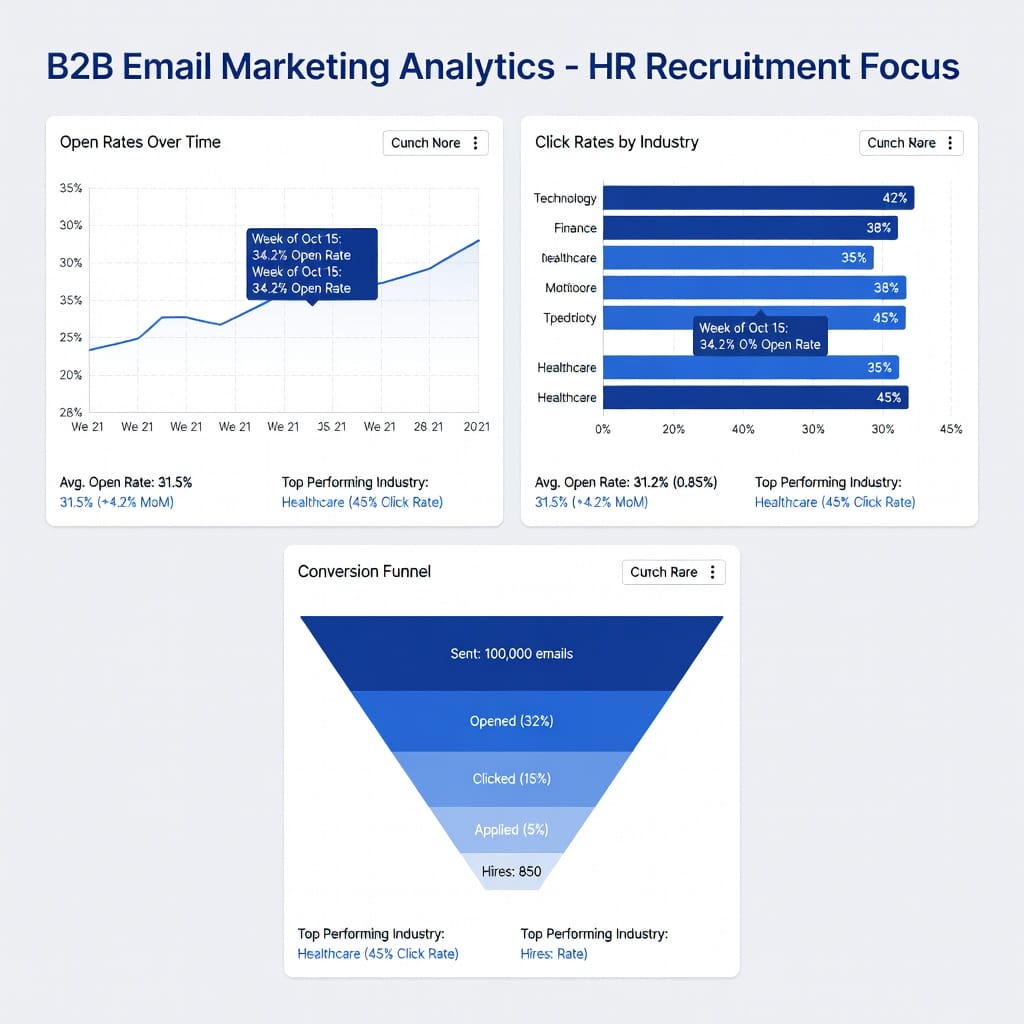
Measuring Success: The Metrics That Actually Matter for HR Email Outreach
Most companies measure the wrong things when evaluating their HR email list and outreach performance. Here are the metrics that actually matter.
Deliverability Rate
Deliverability rate is the percentage of emails that successfully reach the recipients inbox. It is not the same as sent rate. Many emails that appear as sent in your platform are actually landing in spam folders.
To measure true deliverability, you need a combination of inbox placement testing, bounce tracking, and engagement monitoring. Third-party tools can monitor your inbox placement by sending test emails to seed accounts across major providers.
A deliverability rate below ninety-five percent means something is wrong with your list, your infrastructure, or your content.
Reply Rate
Reply rate is the percentage of delivered emails that receive a human response. It is the single most important engagement metric because it correlates most strongly with pipeline generation.
Industry benchmarks for B2B cold email reply rates range from one to five percent. With a high-quality HR email list, proper segmentation, and strong copy, you should aim for ten percent or higher.
If your reply rate is below three percent, the issue is almost certainly your list or your targeting, not your copy. Bad data produces bad results regardless of how good your writing is.
Positive Response Rate
Not all replies are equal. Some replies are positive, some are neutral, and some are negative. Your positive response rate is the percentage of replies that express interest, ask for more information, or agree to a meeting.
A healthy positive response rate is at least thirty percent of all replies. If most of your replies are not interested or stop emailing me, your targeting or your messaging needs refinement.
Pipeline Generated
Pipeline generated is the total value of qualified opportunities created from your email outreach. This is the metric that ties your email campaigns to real business outcomes.
To calculate pipeline from HR email outreach, track every reply through your CRM and assign a value based on the stage of the opportunity. Over time, you will develop a clear picture of how much pipeline a given HR email list can generate for your business.
Cost Per Meeting Booked
Cost per meeting booked is your total campaign spend divided by the number of qualified meetings booked. It includes list costs, verification costs, infrastructure costs, and labor costs.
A healthy cost per meeting booked for HR email outreach is under five hundred dollars for enterprise targets and under two hundred dollars for mid-market targets. If your cost per meeting is significantly higher, either your list quality or your messaging needs improvement.
Return on Investment
ROI is the ultimate metric. It is the pipeline generated divided by the total campaign cost. A healthy ROI for HR email outreach is at least five to one. The best campaigns I have seen achieve ROI of twenty to one or higher.
Expert Insights on HR Email Outreach
I spoke with several experts in the B2B sales and email deliverability space to get their perspectives on HR email outreach in 2026.
Sarah Chen on Treating Lists as Strategic Assets
Sarah Chen, a B2B sales strategist who has consulted with over fifty HR technology companies, shared her perspective on the biggest mistake she sees companies make.
Most companies treat their HR email list as a disposable commodity. They buy a list, send a blast, and move on. The companies that win are the ones that treat their list as a strategic asset. They nurture it. They clean it continuously. They segment it deeply. They understand that the quality of their list determines the ceiling of their success.
Marcus Webb on Infrastructure Investment
Marcus Webb, an email deliverability specialist who has helped dozens of companies recover from domain reputation damage, emphasized the importance of infrastructure.
I have never seen a company succeed at cold email outreach without investing in proper infrastructure. If you are sending cold emails from a shared SMTP server or your main domain, you are fighting with one hand tied behind your back. Dedicated infrastructure, proper authentication, and a warmup process are not optional. They are the price of entry.
Jennifer Torres on Personalization Beyond the First Name
Jennifer Torres, the VP of Sales at a fast-growing HR tech company, shared her tactical tip for improving reply rates on HR email lists.
The best performing campaigns I have run used personalization that went beyond the first name. I looked at whether the company had recently hired a CHRO, whether they had posted jobs in a new geographic region, or whether they had announced a new benefits program. That level of personalization requires a smaller, cleaner list, but the ROI is dramatically better.
David Kim on the Future of Cold Email
David Kim, a partner at a B2B sales consultancy, shared his view on where cold email is heading.
The window for untargeted bulk cold email is closing fast. Mailbox providers are getting smarter, regulations are tightening, and recipients are more skeptical than ever. The winners in 2027 and beyond will be the companies that invest in precision targeting, authentic personalization, and legitimate sender infrastructure. The spray-and-pray era is ending.
Building Your HR Email Outreach Stack
Based on everything we have covered, here is the recommended stack for running high-performance HR email outreach campaigns in 2026.
The Core Stack
Mystrika serves as your central outreach platform handling sequences, warmup, AI writing, and inbox management starting at fifteen dollars per month. FilterBounce handles email verification to ensure you only send to valid addresses. DoYouMail provides dedicated SMTP infrastructure for maximum deliverability.
The Enrichment Layer
Apollo.io or Cognism provides the contact data and firmographic enrichment you need to build targeted lists. Both platforms offer filters that let you narrow down to specific HR roles at specific types of companies.
The Monitoring Layer
A deliverability monitoring tool tracks your inbox placement rates and alerts you to problems before they become crises. Several options exist at various price points, and any of them will pay for themselves the first time they catch a deliverability issue before it impacts your campaign.
The Compliance Layer
A legal review of your outreach practices should be conducted at least annually. Privacy regulations are evolving rapidly, and practices that were compliant last year may not be compliant today. If you are sending to contacts in Europe, GDPR compliance requires ongoing attention to data handling and consent management.
Key Takeaways
Your HR email list is not just a list. It is the foundation of your outreach strategy, and its quality determines everything that follows.
Invest in list quality first. A clean, verified, well-segmented list of five hundred contacts will outperform a scraped, unverified list of ten thousand contacts every single time. The cost per contact is higher, but the cost per meeting booked is dramatically lower.
Prioritize deliverability over volume. Sending fewer emails that actually reach the inbox is infinitely better than sending more emails that land in spam. Domain warmup, proper authentication, and dedicated sending infrastructure are non-negotiable investments.
Segment deeply before you send. Generic outreach to a generic list generates generic results. The more specific your targeting and the more tailored your messaging, the higher your response rates will be.
Use the right tools for the job. Mystrika gives you a complete platform for sequences, warmup, AI writing, and inbox management at a price that scales with your business. FilterBounce keeps your lists clean. DoYouMail ensures your emails actually get delivered.
Measure what matters. Reply rate, positive response rate, and pipeline generated are the metrics that correlate with real business outcomes. Optimize for these, not for vanity metrics like emails sent or open rate.
One final thought: The best HR email list in the world will not save a bad product or a poorly crafted message. But a great message sent to the right list at the right time with the right infrastructure is one of the most powerful growth engines in B2B sales. The difference between a campaign that fails and a campaign that transforms your business is almost always the list.
Frequently Asked Questions
What is an HR email list and why do I need one?
An HR email list is a curated database of email addresses belonging to human resources professionals such as CHROs, VP of People, Talent Acquisition Directors, HRIS Managers, and other HR decision-makers. You need one to reach these professionals directly through email outreach for selling HR technology, recruitment services, benefits platforms, training solutions, or any product or service that solves HR challenges.
How much does a quality HR email list cost?
A quality HR email list from a reputable provider costs between two hundred and five hundred dollars per thousand contacts. Building your own list using tools like Apollo.io costs approximately forty-nine to seventy-nine dollars per user per month plus the labor cost of research and verification. Cheap lists under one hundred dollars almost always contain poor-quality data that will damage your sender reputation.
What is the best way to verify an HR email list before sending?
The best approach is to use a dedicated email verification service like FilterBounce. Run your entire list through verification before sending, and pay attention to catch-all domain detection. Follow the Two-Source Rule by confirming that each contacts name, title, and company match across at least two independent sources. Re-verify your list every thirty days if you are running ongoing campaigns.
How do I improve deliverability for HR email outreach?
Improve deliverability by warming up your domain gradually over two to four weeks using a tool like Mystrikas built-in warmup feature. Configure SPF, DKIM, and DMARC authentication protocols. Use dedicated SMTP infrastructure from a provider like DoYouMail instead of shared servers. Maintain a clean list by removing bounces and unsubscribes immediately. Send from a persons name rather than a generic department address.
Is cold emailing HR professionals legal?
Cold emailing HR professionals is legal in the United States under the CAN-SPAM Act as long as you include a clear unsubscribe mechanism, an accurate subject line, your physical address, and honest header information. For contacts in the European Union or UK, GDPR requires a lawful basis for processing personal data, with legitimate interest being the most common basis for B2B outreach. You should consult with legal counsel to ensure your specific practices comply with applicable laws.
What open and reply rates should I expect from an HR email list?
Industry benchmarks for B2B cold email are one to five percent reply rates and twenty to forty percent open rates. With a high-quality, well-segmented HR email list and strong messaging, you should aim for ten percent or higher reply rates and forty percent or higher open rates. If you are significantly below these benchmarks, the issue is likely your list quality or your targeting rather than your copy.
How often should I update my HR email list?
You should verify your HR email list before every campaign and re-verify every thirty days for ongoing campaigns. The full list should be refreshed with new contacts every quarter to account for data decay. HR professionals change roles frequently, and a list that is older than six months will have significant data quality issues.
What is the best cold email sequence for reaching HR decision-makers?
The best sequence starts with a three-sentence Problem-First Opening that establishes context, states a problem, and offers value. Follow up with a Value-First email that shares a relevant case study, article, or insight. Use a multi-channel approach that integrates LinkedIn and phone calls alongside email. Keep the initial email under three sentences, use plain text formatting, and include a Vanishing CTA that reduces psychological pressure.
Can I use the same HR email list for multiple campaigns?
You can use the same base list for multiple campaigns, but you should re-verify it before each send and exclude anyone who previously unsubscribed or did not engage. The most effective approach is to maintain a master list and create campaign-specific segments from it. Each segment should be filtered based on the specific focus of that campaign, such as industry, company size, or HR role.
What tools do I need for successful HR email outreach?
The recommended stack includes Mystrika for sequences, warmup, AI writing, and inbox management at fifteen dollars per month. FilterBounce for email verification to ensure list quality. DoYouMail for dedicated SMTP infrastructure. Apollo.io or Cognism for contact data and enrichment. A deliverability monitoring tool for inbox placement tracking.