
A demand generation platform is an integrated software system that combines audience targeting, multi-channel outreach, lead enrichment, analytics, and routing into a single workflow engine. Unlike individual point tools that handle one step in the pipeline, a demand generation platform orchestrates the entire top-to-middle-funnel process. It helps B2B teams identify prospects, engage them across email and other channels, enrich lead data automatically, score intent, and pass qualified conversations to sales. The key distinction from a simple marketing automation tool is that demand generation platforms are built to generate net-new pipeline, not just nurture existing leads.
What Is a Demand Generation Platform?
A demand generation platform (DGP) is a unified software system for creating buyer interest, enriching target accounts, running outreach, scoring engagement, and routing qualified conversations to sales. It connects marketing automation, sales engagement, data enrichment, and analytics so teams can manage demand creation from one coordinated workflow instead of stitching together disconnected point tools.
The core output of any demand generation platform is predictable, repeatable pipeline. It transforms raw prospect data from multiple sources into sequenced, personalized outreach that drives replies, meetings, and opportunities. Modern platforms also incorporate AI for predictive lead scoring, smart sequencing, and automated personalization at scale.
Demand Generation Platform vs Lead Generation Tool: Key Differences
Many B2B teams use the terms demand generation and lead generation interchangeably, but the tools that serve each function have important differences. A lead generation tool focuses on capturing contact information from people who have already shown interest. Think landing page builders, pop-up form tools, and lead magnets. These tools target the bottom of the funnel and prioritize conversion of existing intent.
| Dimension | Demand Generation Platform | Lead Generation Tool |
|---|---|---|
| Funnel focus | Top to middle (awareness through consideration) | Bottom (conversion of existing intent) |
| Primary action | Outreach, nurture, enrichment | Form capture, landing page opt-in |
| Data sources | Multiple (enrichment, intent, CRM, web scraping) | Single (form submission, landing page) |
| Sequence length | Multi-step, multi-channel (email, LinkedIn, ads) | Single touch or short email follow-up |
| Analytics scope | Pipeline influence, attribution, engagement velocity | Cost per lead, conversion rate |
| Integration depth | CRM, ESP, enrichment APIs, routing rules | CRM sync only |
A demand generation platform is designed for outbound and hybrid go-to-market motions where the team must build pipeline from scratch. A lead generation tool assumes inbound intent already exists and simply captures it. Most scaling B2B teams need both, but the platform decision is more strategic because it determines your outreach architecture.
Must-Have Features of a Demand Generation Platform
The best demand generation platforms combine targeting, enrichment, sequencing, deliverability, scoring, CRM integration, and attribution in one operating layer. A tool that only sends emails, builds landing pages, or stores contacts may support demand generation, but it is not a complete platform unless it connects data, engagement, handoff, and reporting.
Audience Building and Data Enrichment
The platform must allow you to define a target audience using firmographic, technographic, and intent-based criteria. It should enrich basic contact data with verified email addresses, phone numbers, company details, and role information. Without built-in enrichment, you are layering on a third-party data tool and managing sync yourself. Look for platforms that source data from multiple providers so fallback coverage exists when one source has incomplete records.
Multi-Channel Sequencing
A demand generation platform should sequence email, LinkedIn, and other touchpoints in a single automated workflow. The sequence engine needs conditional branching, time-based delays, and goal-based exits. For example, if a prospect replies to an email, the system should automatically stop further sequence steps and route the conversation to a sales rep. Multi-channel sequencing eliminates the manual handoff between your email tool and your LinkedIn automation tool.
Deliverability Infrastructure
Email deliverability is the foundation of any demand-based outreach motion. The platform should handle domain warmup, sending rotation across multiple mailboxes, and automatic SPF, DKIM, and DMARC authentication monitoring. Without built-in deliverability tooling, every campaign is at risk of landing in spam folders. Some platforms offer dedicated IP pools and automatic reply detection to preserve sender reputation.
Lead Scoring and Intent Signals
Static lists produce static results. A platform must score leads and accounts based on behavioral signals such as email engagement, website visits, content downloads, and third-party intent data. Scoring rules should be customizable and feed back into the sequencing engine so high-intent leads receive faster, more aggressive outreach while cold leads stay in longer nurture cycles.
CRM Integration and Routing
The platform must sync bidirectionally with your CRM. When a lead replies or reaches a certain score, the system should create or update the CRM record, log activities, and route the conversation to the appropriate sales rep. Routing rules should support round-robin, territory-based, and lead-score-based assignment. Without tight CRM sync, your sales team operates on stale data.
Analytics and Attribution
You need to know which campaigns, channels, and sequences produce pipeline. The platform should report on reply rates, meeting rates, pipeline influenced, pipeline generated, and revenue attributed. Attribution models should cover first-touch, last-touch, and multi-touch linear models so you can understand the full path from first outreach to closed deal.
How to Choose the Right Demand Generation Platform for Your Team
Choose a demand generation platform by matching it to your largest pipeline constraint: weak targeting, bad data, low reply rates, slow routing, or unclear attribution. The best choice depends on team size, go-to-market motion, technical capability, and budget, so evaluate real workflow fit before comparing feature lists.
Step 1: Map Your Funnel Requirements
Start by documenting every step in your current pipeline from prospecting through closed deal. Identify where pipeline leaks happen. Are you struggling with data quality? Is your reply rate declining because of deliverability issues? Do leads sit in the CRM without follow-up? The answers determine which features matter most.
A team that loses 60 percent of pipeline to bad contact data needs enrichment as the top priority. A team with good data but low reply rates needs sequencing and deliverability features. A team that gets replies but never routes them to sales needs CRM integration and routing.
Step 2: Evaluate by Team Size and Stage
Team stage determines how much platform complexity you can actually use. Solo operators need fast setup and low maintenance. Small teams need collaboration and CRM sync. Scaling teams need routing, attribution, and governance. Enterprise teams need API access, custom permissions, audit trails, and dedicated infrastructure controls. Use the table below as illustrative guidance, not fixed pricing advice.
| Team Profile | Recommended Focus | Typical Budget Range |
|---|---|---|
| Solo founder or freelancer | Simple sequences + enrichment | $15-$50/month per seat |
| Small team (2-10) | Multi-channel, CRM sync, basic analytics | $50-$100/month per seat |
| Scaling team (10-50) | Full sequencing, routing, intent scoring, attribution | $100-$200/month per seat |
| Enterprise (50+) | Custom integrations, API access, dedicated infra | Custom pricing |
Step 3: Test Integration Depth
A demand generation platform is only as good as its integration with your existing stack. Before committing, verify that the platform connects to your CRM (Salesforce, HubSpot, or Pipedrive), your email provider (Google Workspace or Microsoft 365), and any enrichment or intent data sources you rely on.
Test the sync direction. Does the platform push activities to the CRM, or does it need the CRM to push data to it? Bidirectional sync with conflict resolution is the gold standard. Without it, you will spend time manually reconciling records.
Step 4: Assess Deliverability Readiness
Deliverability readiness determines whether your outreach reaches real inboxes or disappears into spam filtering. Before buying, confirm that the platform supports warmup, mailbox limits, sender authentication monitoring, bounce suppression, unsubscribe handling, and sending-domain rotation. A vendor that treats deliverability as an add-on is risky for email-heavy demand generation.
Ask every vendor these questions:
- Do you provide domain warmup?
- How many sending inboxes per account do you support?
- Do you monitor SPF, DKIM, and DMARC?
- Can you rotate sending across multiple domains?
If the vendor cannot answer all four clearly, deliverability will be a recurring problem. Poor deliverability makes every other feature irrelevant because emails never reach the inbox.
Step 5: Consider Total Cost, Not Per-Seat Price
Per-seat pricing rarely shows the true cost of a demand generation platform. Calculate the full monthly cost after enrichment credits, extra mailboxes, integrations, implementation work, premium support, and reporting add-ons. A cheaper tool can become expensive if it forces you to rebuild missing platform functions elsewhere.
Calculate total monthly cost including:
- Base subscription
- Enrichment credits or API usage
- Additional user seats
- Integrations or API add-ons
- Premium support
The total cost of a fragmented stack often exceeds the cost of a unified demand generation platform.
How to Build a Demand Generation Workflow with a Platform
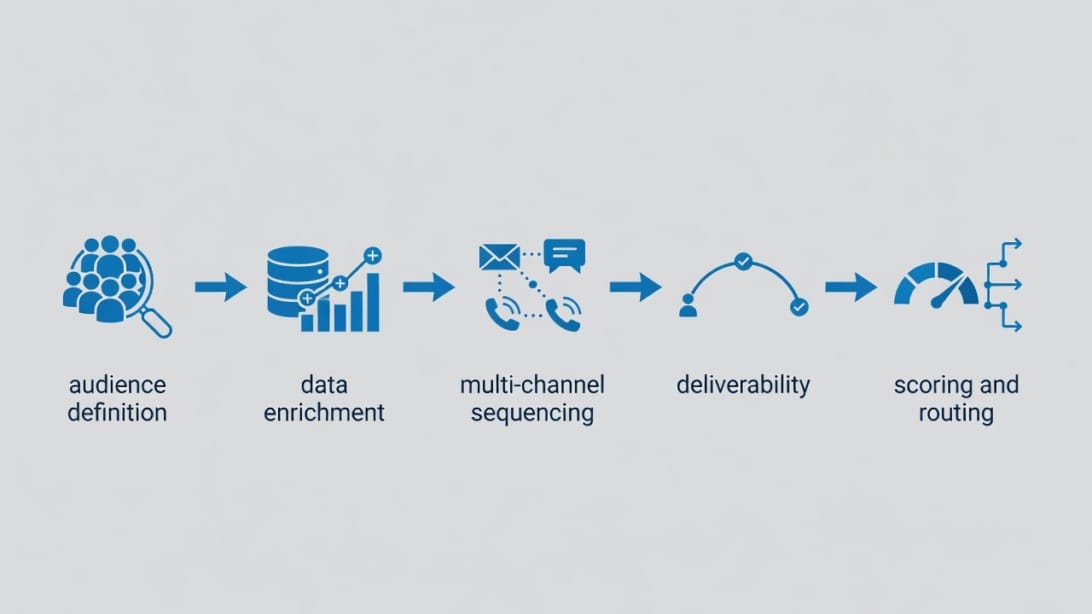
A demand generation platform works best when it follows a structured operating workflow: define the audience, enrich contacts, build conditional sequences, monitor deliverability, score engagement, route conversations, and analyze pipeline. The workflow matters because software alone does not create demand; disciplined execution turns platform capability into qualified opportunities.
Phase 1: Define Your Ideal Customer Profile
Start inside the platform by building an ideal customer profile (ICP) using firmographic and technographic filters. Target companies by industry, employee count, technology used, and location. If the platform supports intent data, layer in accounts that are actively researching relevant solutions.
Export the resulting account list and cross-reference it against your CRM to remove existing customers and active opportunities. The remaining list is your net-new target universe.
Phase 2: Enrich and Verify Contact Data
Upload the target accounts or connect the platform directly to your CRM. Configure enrichment rules so every contact record is checked against the platform’s data sources. Set a minimum confidence threshold for email verification so low-quality records are flagged rather than added to sequences.
At this stage, also set up suppression lists for competitors, known spam traps, and roles that should not receive outreach. Proper list hygiene before launching a sequence prevents deliverability damage.
Phase 3: Build Sequences with Conditional Logic
Conditional sequencing lets the platform adapt outreach based on prospect behavior instead of forcing every contact through the same fixed path. Build a short sequence that starts with a personalized email, follows up with value, and adds a social touchpoint when relevant. Then define exit and routing rules before launch.
Set conditions for each step:
- Stop the sequence if the lead replies.
- Skip the LinkedIn step if the lead opened the second email.
- Insert a reminder sequence if the lead clicks a link but does not book a meeting.
- Add a follow-up task for the sales team if the lead replies with interest.
Conditional sequencing ensures each prospect receives a relevant path based on their behavior, not a fixed spray of messages.
Phase 4: Monitor Deliverability and Engagement
Launch the sequence and monitor deliverability metrics daily during the first week. Check bounce rates, spam complaint rates, and inbox placement health. Most platforms provide a deliverability dashboard. If bounce or complaint signals rise above your internal guardrails, pause the sequence and audit the affected sending domain.
Track engagement metrics per step: delivered messages, positive replies, negative replies, unsubscribes, and booked meetings. Treat open rates as directional because privacy tools and automated scanners can distort them. Compare each campaign against your own historical baseline rather than relying on generic benchmark claims.
Phase 5: Score, Route, and Hand Off
Scoring and routing turn engagement into sales action. As replies, clicks, visits, and content interactions accumulate, the platform should calculate lead or account priority and trigger the next action automatically. Use scoring thresholds as illustrative operating rules, then adjust them after you see real conversion quality.
Configure illustrative scoring thresholds:
- Score above 80: route to sales for immediate follow-up.
- Score 50-79: add to a warm nurture sequence with shorter delays.
- Score below 50: continue in the standard sequence.
When a lead crosses the threshold, the platform should create or update the CRM record, log every touchpoint, and assign the lead to the appropriate sales rep. The faster the routing, the higher the conversion rate from replied lead to booked meeting.
Phase 6: Analyze and Iterate
After a full campaign cycle, run the platform’s attribution and pipeline reports. Identify which sequence steps drive qualified replies, which audience segments convert into opportunities, and which templates create useful conversations. Use these insights to adjust audience filters, rewrite low-performing steps, and reallocate budget toward channels that produce pipeline.
Common iteration targets include the first email subject line, the timing of the social touchpoint, the segmentation logic, and the length of the sequence before sales handoff. Improve one variable at a time so you know what caused performance changes.
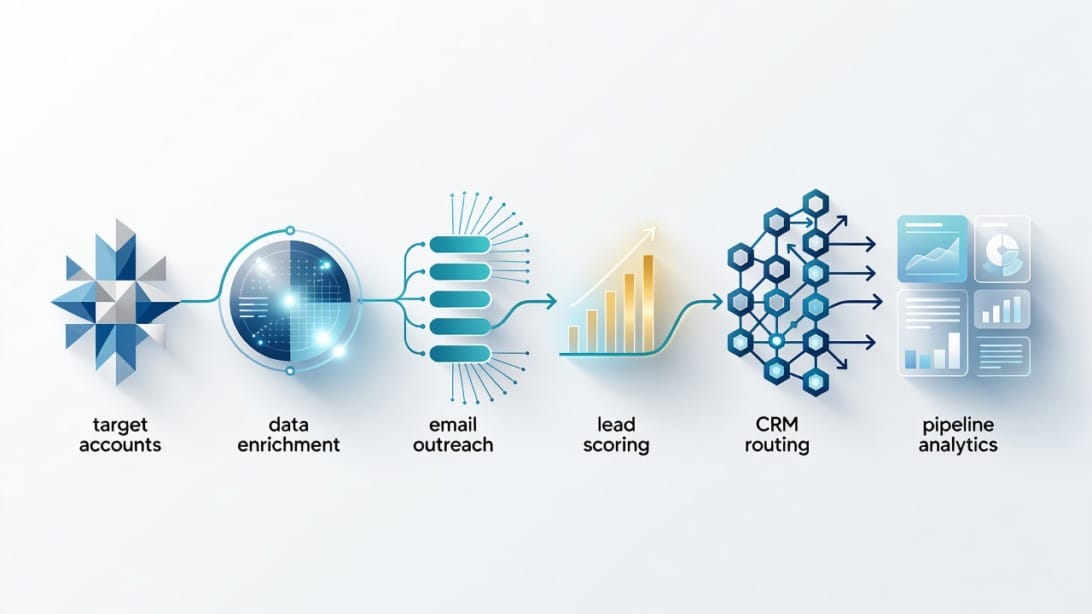
Demand Generation Platform Categories and Where Each Fits
Demand generation platforms usually fall into several overlapping categories: outbound engagement, marketing automation, intent data, enrichment, account-based marketing, analytics, and conversion optimization. The right category depends on the gap in your funnel, not on the longest feature list. A company with weak targeting needs data and enrichment first; a company with weak follow-up needs sequencing and routing.
Outbound Engagement Platforms
Outbound engagement platforms help teams turn target account lists into conversations through structured email, social, and task-based sequences. They are strongest when your market is defined and your challenge is reaching decision-makers consistently. The best systems combine contact verification, mailbox rotation, reply detection, and CRM activity logging so reps can focus on conversations rather than manual campaign administration.
These platforms are useful for founder-led sales, sales development teams, agencies, and niche B2B companies that cannot rely solely on inbound search volume. A good cold email outreach platform belongs in this category when it also supports enrichment, inbox health, sequencing, and analytics. If it only sends emails, it is a point tool rather than a complete demand generation platform.
Marketing Automation Platforms
Marketing automation platforms manage nurture programs, lead scoring, campaign assets, and lifecycle communications for contacts already inside your database. They are strongest after someone has subscribed, downloaded an asset, joined a webinar, or interacted with your brand. They are weaker at creating the first conversation with a completely cold account unless paired with prospecting and enrichment tools.
Use marketing automation when your site already captures meaningful inbound demand. Use an outbound-oriented demand generation platform when your problem is not nurturing leads, but finding enough qualified accounts to contact in the first place. Many mature teams run both: one system generates and qualifies demand, while another nurtures captured contacts through longer buying cycles.
Intent Data and Account Intelligence Platforms
Intent data platforms identify accounts that appear to be researching relevant topics, competitors, or product categories. They are useful when your total addressable market is large and you need prioritization. Instead of treating every target account equally, intent data helps your platform focus outreach on accounts that are more likely to be active in-market.
Intent data becomes valuable only when paired with action. A dashboard showing account signals does not create pipeline by itself. The demand generation platform must translate those signals into sequence enrollment, rep alerts, CRM tasks, or paid audience segments. Otherwise, intent data becomes another report that looks interesting but never changes sales behavior.
Data Enrichment and Verification Platforms
Data enrichment platforms improve incomplete records by adding verified emails, job titles, company details, technology signals, and social profiles. They also help deduplicate records and suppress invalid or risky contacts. Enrichment is not glamorous, but it is one of the highest-leverage parts of a demand generation stack because bad data damages both sales efficiency and sender reputation.
A strong platform should verify email addresses before launch, not after a sequence has already bounced. It should also track when data was last refreshed. Contact data decays over time as people change jobs, companies reorganize, and domains migrate. If your platform cannot show freshness or confidence levels, treat the data as a starting point rather than truth.
Account-Based Marketing Platforms
Account-based marketing platforms coordinate campaigns around target accounts rather than individual leads. They help teams select accounts, map buying committees, personalize campaigns, and measure engagement across stakeholders. ABM is useful for larger deal sizes where multiple people influence the purchase decision and one lead is not enough to represent true account-level interest.
ABM platforms work best when sales and marketing agree on target account criteria before campaigns launch. If the account list is politically chosen or too broad, the platform will amplify poor strategy. A demand generation platform with ABM features should support account scoring, buying committee mapping, and coordinated sales follow-up rather than just advertising to a named-account list.
Analytics and Attribution Platforms
Analytics and attribution platforms show which campaigns, channels, and sequences contribute to pipeline and revenue. They help leaders decide whether demand generation efforts are producing qualified opportunities or merely superficial engagement. Good analytics connect outreach activity, content engagement, CRM stage movement, and closed revenue so campaign performance is judged by business outcomes.
Attribution can become overly complex. For most teams, start with a simple model: source, first meaningful touch, opportunity creation, and closed revenue. Add multi-touch models only after the basic data is reliable. A complicated attribution dashboard built on inconsistent CRM data will create false confidence rather than better decisions.
Demand Generation Platform Comparison Matrix
A comparison matrix helps you evaluate demand generation platforms by the job they perform, not by marketing claims. The best choice depends on whether your bottleneck is audience discovery, contact quality, outreach execution, routing, reporting, or conversion. Use this table as a practical shortlisting tool before booking product demos.
| Platform Category | Best For | Must-Have Capability | Watch Out For | Team Fit |
|---|---|---|---|---|
| Outbound engagement | Creating net-new conversations | Sequencing, deliverability, reply routing | Low-quality sending infrastructure | Founders, SDR teams, agencies |
| Marketing automation | Nurturing captured leads | Segmentation, workflows, scoring | Weak cold prospecting capability | Inbound-heavy teams |
| Intent data | Prioritizing active accounts | Topic/account signal quality | Signals without activation workflows | Mid-market and enterprise |
| Data enrichment | Improving contact quality | Verification and freshness metadata | Expensive credits, stale records | All B2B teams |
| ABM platform | Coordinated account campaigns | Account scoring and buying committee mapping | Overbuilding for small deal sizes | Enterprise and high-ACV teams |
| Analytics/attribution | Proving pipeline contribution | CRM-connected revenue reporting | Complex dashboards with bad data | Scaling teams and leadership |
| Landing page/CRO | Converting existing demand | Testing and conversion tracking | Does not create demand alone | Inbound and paid teams |
The most common mistake is buying a category because it is popular rather than because it fixes the current bottleneck. If your email list quality is poor, a better landing page builder will not help. If your sales team ignores replies, more intent data will not help. Start with the constraint, then choose the category.
Evaluation Methodology for Shortlisting Platforms
A strong evaluation process prevents vendor demos from turning into feature theater. Score each platform against your actual workflow, data sources, compliance requirements, and sales handoff process. The goal is not to find the platform with the most features; it is to find the one that removes the largest operational constraint with the least added complexity.
Score Core Workflow Fit First
Workflow fit measures whether the platform supports your real campaign process from account selection to sales handoff. Do not start with a generic feature checklist. Instead, create one realistic campaign scenario and ask the vendor to demonstrate it end-to-end. The demo should include audience creation, enrichment, sequence enrollment, reply handling, CRM update, and reporting.
If the vendor cannot show the complete workflow without switching tabs, exporting CSVs, or asking you to imagine missing steps, the product may still require heavy operations work. The platform should reduce manual steps, not hide them behind a polished dashboard.
Test Data Quality with Your Own Sample
Data quality varies by industry, geography, seniority, and company size. A vendor’s aggregate coverage claim may not apply to your market. Give every shortlisted platform the same small sample of target accounts and ask for enriched contacts, verification results, role relevance, and confidence scores. Compare results manually before signing a contract.
Look for three issues: missing contacts, incorrect roles, and unverifiable emails. Missing contacts reduce coverage. Incorrect roles waste outreach. Unverifiable emails threaten deliverability. A platform that performs well on your own sample is more valuable than one with a larger generic database that does not cover your niche.
Run a Deliverability Readiness Check
Deliverability readiness means the platform can protect your sending reputation before campaigns launch. Ask whether it supports mailbox warmup, sending limits by inbox, automated bounce suppression, unsubscribe handling, and authentication monitoring. Then verify whether these controls are built into the product or require external setup.
For any email-heavy demand generation motion, weak email deliverability controls are a hard stop. Even the best copy and segmentation fail if messages never reach the inbox. Treat deliverability as infrastructure, not as a nice-to-have feature buried in the settings menu.
Check CRM and Revenue Reporting
CRM integration is not just about pushing contacts into Salesforce, HubSpot, or another system. A useful integration must sync activity history, update lifecycle stages, respect duplicate rules, and allow sales reps to see the full campaign context. It should also support reporting from campaign activity to opportunity creation and closed revenue.
During evaluation, create a test record and run it through the platform. Confirm what appears in the CRM, which fields update, how duplicates are handled, and whether the handoff creates a task or owner assignment. If sales cannot trust the CRM output, adoption will suffer no matter how strong the campaign engine is.
Evaluate Support and Implementation Effort
Implementation effort determines time-to-value. Some platforms are self-serve and can launch a campaign in a day. Others require data mapping, API work, CRM admin support, and deliverability setup. Neither model is inherently wrong, but mismatching effort to team capacity causes failed rollouts.
Ask vendors for a realistic implementation plan: required stakeholders, data migration steps, technical dependencies, time to first campaign, and time to first reliable report. If a platform requires three weeks of operations work and your team has no operations owner, choose a simpler system or budget for implementation help.
Common Demand Generation Platform Mistakes
Most demand generation platform failures come from strategy and operations, not from the software itself. Teams often buy a platform before defining their ICP, ignore deliverability until performance drops, or measure vanity metrics instead of pipeline. Avoiding these mistakes improves results faster than switching vendors every quarter.
Buying Before Defining the ICP
A demand generation platform amplifies your targeting assumptions. If the ideal customer profile is vague, the platform will help you contact the wrong people more efficiently. Before buying, document industries, company sizes, job titles, trigger events, excluded segments, and buying committee roles. The platform should execute this strategy, not invent it for you.
A useful ICP includes disqualifiers as well as qualifiers. For example, exclude students, consultants, competitors, tiny companies below your price floor, or regions you cannot serve. Suppression rules protect sales time and sender reputation by preventing campaigns from reaching accounts that should never enter the funnel.
Treating Enrichment as Truth
Enrichment data is useful, but it is not perfect. Job titles change, companies merge, and email patterns become outdated. Treat enriched records as high-confidence suggestions that still need validation. The platform should provide verification status, freshness dates, and source confidence so your team knows which records are safe to contact.
Never upload raw enriched lists directly into high-volume sequences without verification. A small number of invalid addresses can create bounce spikes that damage domain reputation. Verification and suppression should happen before sequencing, not after a campaign has already generated errors.
Measuring Opens Instead of Outcomes
Open rates are increasingly unreliable because privacy features and automated scanners can inflate or obscure tracking data. They still provide directional signals, but they should not be the main performance metric. Focus on reply quality, booked meetings, sales-accepted opportunities, pipeline created, and revenue influenced.
A platform dashboard that celebrates opens while hiding pipeline contribution encourages bad behavior. Teams may optimize for catchy subject lines rather than qualified conversations. Build reporting around the outcomes sales and leadership care about, then use engagement metrics only as diagnostic indicators.
Over-Automating Personalization
AI-assisted personalization can improve relevance, but it can also generate generic or inaccurate messages if used without guardrails. A platform should help scale research and drafting, not invent facts about prospects. Use structured variables, approved value propositions, and human review for high-value accounts.
Personalization should connect to a credible business reason for outreach. Mentioning a prospect’s recent post or company news can help, but only if it ties to a relevant problem you solve. Shallow personalization at scale often performs worse than concise, clear messaging based on a well-defined pain point.
Ignoring Sales Handoff Rules
Demand generation creates opportunities only when sales follows up quickly and consistently. If replies go to a shared inbox, get buried in notifications, or require manual assignment, pipeline leaks after the platform has done its job. Define handoff rules before launch: owner assignment, response SLA, CRM stage, and follow-up sequence.
A strong handoff rule might say: interested replies route to the account owner within five minutes, create a CRM task, log the full thread, and trigger a Slack alert. Clear routing transforms engagement into conversations. Weak routing turns engagement into inbox clutter.
Demand Generation Platform Implementation Checklist
An implementation checklist helps teams launch without damaging data quality, deliverability, or CRM hygiene. Work through setup in this order: strategy, data, infrastructure, workflow, reporting, and governance. Skipping early foundations creates problems that are harder to debug after campaigns go live.
Strategy Setup
The first implementation step is deciding who the platform should target and why. Define your ICP, excluded segments, target personas, value propositions, campaign goals, and routing rules. This should happen before importing contacts. Strategy-first setup prevents the platform from becoming a high-volume spam machine with attractive dashboards.
Document one primary campaign goal for the first 30 days. Examples include booked demos from Series A SaaS companies, partner conversations with agencies, or reactivation of dormant accounts. A narrow first campaign makes performance easier to diagnose and improves team learning.
Data Setup
Clean and structure your data before connecting the platform. Remove duplicates, standardize company names, normalize country and industry fields, and tag existing customers, open opportunities, competitors, and do-not-contact records. Then map platform fields to CRM fields so enrichment does not overwrite trusted data.
Create suppression lists early. Suppression should include customers, active opportunities, unsubscribed contacts, competitors, legal exclusions, and domains with previous deliverability problems. A suppression mistake is harder to fix than a missing prospect because outreach cannot be undone once sent.
Infrastructure Setup
Infrastructure setup covers sending domains, inboxes, authentication, tracking links, unsubscribe handling, and reply routing. Configure SPF, DKIM, and DMARC before sending. Set conservative daily sending limits for new domains and gradually increase volume only after engagement and bounce metrics remain healthy.
Do not run high-volume campaigns from your primary corporate domain if the risk is unacceptable. Many teams use separate but brand-aligned sending domains for outbound experiments. Whatever structure you choose, monitor reputation and authentication continuously rather than only during initial setup.
Workflow Setup
Build your first workflow with fewer steps than you think you need. A simple four-to-six-touch sequence is easier to test than a sprawling 20-step automation. Define entry criteria, exit criteria, delays, personalization fields, reply handling, bounce handling, and sales handoff triggers.
Use templates as a starting point, not as final copy. The best workflow reflects your ICP’s pain, your market category, and your offer. Test one major variable at a time so you can learn whether targeting, copy, timing, or offer is responsible for results.
Reporting Setup
Reporting should connect platform activity to CRM outcomes. At minimum, track contacts enrolled, emails delivered, replies, positive replies, meetings booked, opportunities created, pipeline value, and closed revenue. Separate diagnostic metrics from executive metrics so leadership sees business outcomes while operators can debug campaign mechanics.
Set a weekly review cadence. Review sequence step performance, segment performance, deliverability health, and pipeline movement. Then decide whether to adjust audience filters, copy, sending volume, or routing rules. Consistent review beats occasional large rebuilds.
Governance Setup
Governance prevents platform sprawl by clarifying who can create sequences, approve copy, import lists, change sending limits, edit scoring rules, and modify CRM field mappings. Without governance, multiple users can accidentally create conflicting campaigns, damage deliverability, overwrite data standards, or create reports that leadership cannot trust.
Create a simple change log for major adjustments: new domains, new scoring thresholds, new suppression rules, new field mappings, and new campaign templates. When performance changes, the log helps you identify what changed rather than guessing from memory.
Example Demand Generation Platform Stack by Company Stage
Your platform stack should evolve with your company stage. Early teams need speed and simplicity; scaling teams need process and visibility; enterprise teams need governance and integration depth. Buying enterprise complexity too early creates friction, while staying on lightweight tools too long creates operational drag.
Solo Founder or Consultant Stack
A solo founder needs a lightweight stack that supports prospecting, verified email, simple sequencing, and basic CRM tracking. The goal is not full attribution; the goal is starting relevant conversations without spending hours on manual research. Choose tools that can be set up quickly and do not require a dedicated operations person.
A practical stack includes a simple CRM, an outreach platform with warmup and verification, a small enrichment source, and a scheduling tool. Keep reporting simple: contacts added, emails delivered, positive replies, calls booked, and deals created. Complexity can wait until volume and team size justify it.
Small B2B Team Stack
A small team needs collaboration and clean handoffs. The stack should include shared templates, role-based access, CRM activity sync, suppression management, and basic reporting by campaign and rep. At this stage, data hygiene becomes more important because multiple people can affect the same customer records.
Choose a platform that makes ownership clear. Every interested reply should have an owner, every follow-up should have a task, and every opportunity should connect back to the campaign that sourced it. Small teams lose deals when ownership is ambiguous.
Scaling Sales Development Stack
A scaling SDR team needs performance management, deliverability controls, routing logic, and attribution. The platform must support multiple sending domains, team-level dashboards, A/B tests, CRM rules, and standardized reporting. Managers need to compare rep activity and sequence quality without manually pulling CSVs.
At this stage, governance matters more than feature novelty. Standardize campaign naming, list import rules, sequence approval, and performance review cadence. Scaling chaos through automation creates more problems than it solves.
Agency or Multi-Client Stack
An agency stack needs workspace separation, client-level reporting, template libraries, domain isolation, and permission controls. The platform should prevent data from one client mixing with another and should make it easy to show each client campaign performance without exposing internal operations.
Agencies should prioritize deliverability isolation. One client’s risky list should not damage another client’s sending environment. Look for platforms that support separate mailboxes, domains, suppression lists, and reporting views per client or workspace.
Enterprise Demand Generation Stack
Enterprise teams need security, compliance, advanced integrations, and governance. The stack must support single sign-on, audit logs, role permissions, data retention controls, API access, custom field mapping, territory routing, and procurement requirements. Enterprise teams also need close alignment between marketing operations, revenue operations, sales leadership, and legal.
Enterprise platforms often take longer to implement, but they provide the control required for complex teams. The key is avoiding unnecessary customization during the first rollout. Start with the core workflow, prove adoption, then expand into advanced scoring, attribution, and orchestration.
How Demand Generation Platforms Support AI Search and Modern Buyer Behavior
Modern buyers increasingly research through AI assistants, review sites, communities, and dark social before talking to sales. A demand generation platform cannot control every research path, but it can help teams respond to signals, create useful touchpoints, and connect engagement data across channels. The goal is to meet demand where it appears, not force every buyer into one funnel.
AI search changes the way buyers discover categories. Instead of typing only short keywords into a search engine, buyers ask conversational questions such as “which platform should a small outbound team use for demand generation?” or “how do I compare intent data and outreach platforms?” Your content, campaigns, and platform data should support these answer-style journeys.
Demand generation platforms help by organizing buyer signals into actions. If a target account visits comparison content, interacts with a webinar, or matches an intent topic, the system can prioritize the account for a more relevant sequence. This keeps outreach aligned with observed behavior rather than generic calendar-based blasts.
Schema Blocks
These structured data blocks make the article easier for search engines and answer engines to interpret. Article schema identifies the page, FAQPage schema maps common questions to concise answers, and HowTo schema summarizes the selection process. Keep schema aligned with visible page content so structured data does not promise information the reader cannot see.
Article Structured Data
The Article schema describes the page topic, headline, author, and publication dates. It should match the visible title and not include unsupported claims. If the article is updated later, the modified date should be updated with the content change so freshness signals remain accurate.
{
  "@context": "https://schema.org",
  "@type": "Article",
  "headline": "Demand Generation Platform: Complete Guide to Choosing and Using One in 2026",
  "description": "A demand generation platform combines outreach, enrichment, scoring, and routing. Learn how to choose and use one with this complete guide.",
  "datePublished": "2026-07-02",
  "dateModified": "2026-07-02",
  "author": {
    "@type": "Organization",
    "name": "Mystrika"
  }
}
FAQPage Structured Data
The FAQPage schema reflects the visible FAQ questions at the end of this article. Each question in the schema is also written as an H3 question in the FAQ section, and each answer is condensed from the visible answer text. This keeps structured data aligned with the page.
{
  "@context": "https://schema.org",
  "@type": "FAQPage",
  "mainEntity": [
    {"@type": "Question", "name": "What is a demand generation platform used for?", "acceptedAnswer": {"@type": "Answer", "text": "A demand generation platform is used to build pipeline from scratch by identifying target accounts, reaching out across multiple channels, enriching lead data, scoring engagement, and routing qualified conversations to sales."}},
    {"@type": "Question", "name": "How does a demand generation platform differ from a CRM?", "acceptedAnswer": {"@type": "Answer", "text": "A CRM stores and manages existing records. A demand generation platform creates net-new pipeline by finding and engaging prospects before they become active CRM opportunities."}},
    {"@type": "Question", "name": "Is a demand generation platform the same as marketing automation?", "acceptedAnswer": {"@type": "Answer", "text": "No. Marketing automation usually nurtures known leads, while a demand generation platform supports prospecting, enrichment, outreach, scoring, and first conversation creation."}},
    {"@type": "Question", "name": "What are the must-have features of a demand generation platform?", "acceptedAnswer": {"@type": "Answer", "text": "Essential features include audience building, enrichment, multi-channel sequencing, deliverability infrastructure, lead scoring, CRM integration, and pipeline attribution."}},
    {"@type": "Question", "name": "How much does a demand generation platform cost?", "acceptedAnswer": {"@type": "Answer", "text": "Pricing ranges from low-cost solo plans to custom enterprise contracts. Total cost should include seats, enrichment credits, integrations, and implementation support."}},
    {"@type": "Question", "name": "Can a demand generation platform improve email deliverability?", "acceptedAnswer": {"@type": "Answer", "text": "Yes, if it includes warmup, sending rotation, authentication monitoring, bounce management, and clear sending limits."}},
    {"@type": "Question", "name": "What is the difference between demand generation and lead generation?", "acceptedAnswer": {"@type": "Answer", "text": "Demand generation creates awareness and interest before buyers are ready to convert. Lead generation captures contact information after interest already exists."}},
    {"@type": "Question", "name": "What metrics matter most for demand generation platform performance?", "acceptedAnswer": {"@type": "Answer", "text": "Reply rate, meeting booked rate, pipeline influenced, and revenue attributed matter most. Bounce rate and complaint rate are important diagnostic metrics."}}
  ]
}
HowTo Structured Data
The HowTo schema summarizes the platform selection process in five steps. It is useful because buyers often ask how to choose a demand generation platform, not only which tool to buy. The steps mirror the visible selection framework earlier in the article.
{
  "@context": "https://schema.org",
  "@type": "HowTo",
  "name": "How to Choose and Use a Demand Generation Platform",
  "description": "A five-step process for selecting and implementing a demand generation platform for B2B pipeline generation.",
  "step": [
    {"@type": "HowToStep", "position": 1, "name": "Map Your Funnel Requirements", "text": "Document your pipeline from prospecting through closed deal and identify the largest leak."},
    {"@type": "HowToStep", "position": 2, "name": "Evaluate by Team Size and Stage", "text": "Match platform complexity to team size, budget, and operational capacity."},
    {"@type": "HowToStep", "position": 3, "name": "Test Integration Depth", "text": "Verify CRM, email, enrichment, and reporting integrations with a real test record."},
    {"@type": "HowToStep", "position": 4, "name": "Assess Deliverability Readiness", "text": "Confirm warmup, authentication monitoring, sending limits, and bounce handling."},
    {"@type": "HowToStep", "position": 5, "name": "Consider Total Cost", "text": "Calculate subscription fees, credits, seats, integrations, support, and implementation effort."}
  ]
}
Key Takeaways
A demand generation platform is most valuable when it removes a specific pipeline constraint: poor targeting, weak data, inconsistent outreach, bad deliverability, slow routing, or unclear attribution. Choose the platform category that fixes the constraint first, then expand. Do not buy a broad platform just because it has more features than your team can operate.
- A demand generation platform combines audience targeting, outreach, enrichment, scoring, and routing into one system, unlike point tools that handle a single function.
- The main difference between a demand generation platform and a lead generation tool is funnel scope: demand gen covers awareness through consideration, while lead gen focuses on capturing existing intent at the bottom of the funnel.
- Must-have features include audience building with enrichment, multi-channel sequencing, deliverability infrastructure, lead scoring with intent signals, CRM integration with routing, and analytics with attribution.
- Choosing the right platform requires mapping your pipeline leaks first, then matching features to team size and stage while calculating total cost.
- A structured workflow – ICP definition, enrichment, sequence building, monitoring, scoring, and routing – transforms platform capability into measurable pipeline results.
- Data quality and deliverability are the two non-negotiable foundations of any demand generation operation. Without both, no platform will produce consistent results.
Frequently Asked Questions
This FAQ answers the practical questions buyers ask when comparing demand generation platforms, CRMs, marketing automation tools, and lead generation software. Use it to clarify fit before booking demos. If a vendor cannot answer these questions in the context of your workflow, the platform may require more manual operations than expected.
What is a demand generation platform used for?
A demand generation platform is used to build pipeline from scratch by identifying target accounts, reaching out across multiple channels, enriching lead data automatically, scoring engagement, and routing qualified conversations to sales. It automates the top-to-middle-funnel workflow that turns raw prospect data into sales opportunities. B2B teams use it when inbound lead volume is insufficient or when they need predictable, repeatable pipeline generation.
How does a demand generation platform differ from a CRM?
A CRM stores and manages existing customer and lead records after they enter the pipeline. A demand generation platform generates net-new pipeline by finding and engaging prospects who are not yet in your CRM. The two systems integrate tightly: the platform enriches CRM data and pushes new leads and activities into the CRM, while the CRM provides historical context for segmentation and suppression.
Is a demand generation platform the same as marketing automation?
Not exactly. Marketing automation platforms like HubSpot or Marketo focus on inbound nurture, email campaigns, and lead scoring for leads that already exist in the system. A demand generation platform focuses on outbound and hybrid motions, including prospecting, enrichment, multi-channel sequencing, and first outreach. The two complement each other. Many teams use a marketing automation platform for inbound and a demand generation platform for outbound.
What are the must-have features of a demand generation platform?
The essential features are audience building with firmographic and technographic targeting, data enrichment with email verification, multi-channel sequencing with conditional logic, deliverability infrastructure including warmup and authentication monitoring, lead scoring with behavioral and intent signals, CRM integration with bidirectional sync and routing rules, and analytics with pipeline attribution.
How much does a demand generation platform cost?
Pricing varies widely by team size and feature set. Treat published pricing as illustrative because vendors change packages, credit rules, and add-on fees often. Compare total monthly cost, not only the base seat price, and include enrichment credits, mailbox limits, integrations, support, implementation help, and any reporting add-ons.
Can a demand generation platform improve email deliverability?
Yes, if the platform includes built-in deliverability features such as domain warmup, sending rotation, SPF/DKIM/DMARC monitoring, and bounce management. Platforms lacking these features require a separate deliverability tool. When evaluating a platform, ask specifically about warmup protocols, per-mailbox sending limits, and how the platform handles spam complaints.
What is the difference between demand generation and lead generation?
Demand generation creates awareness and interest among people who may not be actively searching for a solution yet. Lead generation captures contact information from people who already demonstrated interest through a form, download, or conversion event. In practice, demand generation feeds the top of the funnel, while lead generation converts existing interest.
What metrics matter most for demand generation platform performance?
The most important metrics are reply rate, meeting booked rate, pipeline influenced, and revenue attributed to platform-sourced leads. Secondary metrics include bounce rate, spam complaint rate, cost per meeting, and sales cycle length for platform-generated opportunities. Measuring reply rate in isolation is misleading if those replies never convert to pipeline, so attribution must connect engagement metrics to revenue outcomes.