
The stages of the marketing funnel explain how people move from first discovering a problem to becoming loyal customers and advocates. A strong funnel does not just create demand. It captures attention, builds trust, qualifies intent, removes buying friction, supports retention, and turns happy customers into a repeatable growth channel.
Most funnel articles stop at awareness, consideration, and conversion. That simplified view is useful, but it is not enough for modern teams. Search behavior is fragmented, buyers research anonymously, AI answers shape first impressions, and many prospects compare vendors long before they fill out a form. A practical funnel must connect content, channels, automation, sales handoff rules, customer success, and measurable revenue outcomes.
This guide breaks down every major stage of the marketing funnel, including awareness, interest, consideration, intent, evaluation, conversion, retention, and advocacy. It also shows how TOFU, MOFU, BOFU, AIDA, lifecycle stages, lead scoring, cold email, attribution, and customer expansion fit together.
Planned image 1: abstract conceptual illustration of a customer journey funnel made of flowing geometric layers, no text, no logos.
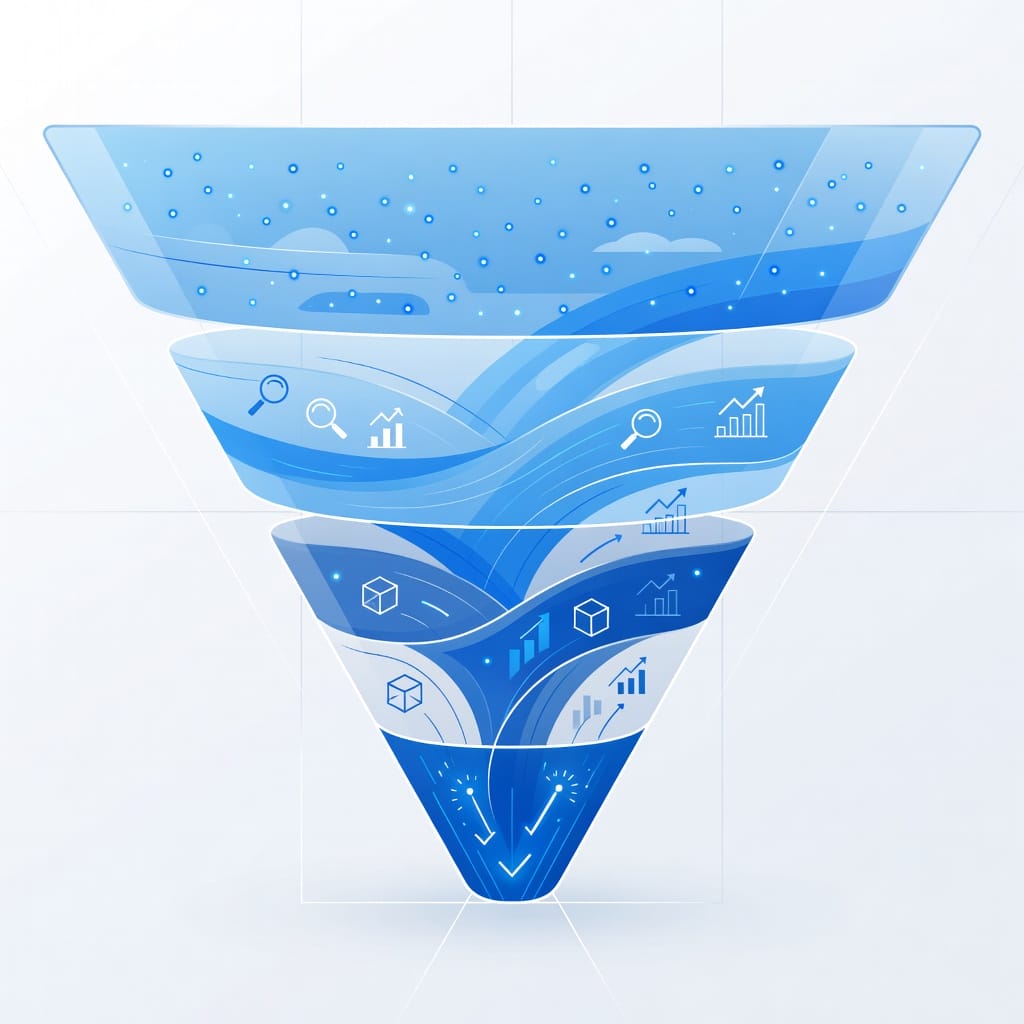
What Are the Stages of the Marketing Funnel?
The stages of the marketing funnel are awareness, interest, consideration, intent, evaluation, conversion, retention, and advocacy. These stages describe how a person discovers a problem, researches possible solutions, compares options, decides to buy, experiences the product, and eventually recommends it to others.
A funnel is not a perfect representation of every buyer journey. Real buyers jump between channels, ask peers for recommendations, read reviews, ignore retargeting ads, compare pricing pages, and return weeks later from a branded search. Still, the funnel is useful because it gives teams a shared operating model.
A complete marketing funnel helps you answer five practical questions:
- What does the buyer need to believe before moving forward?
- Which channel is best suited to create that belief?
- What content or offer should be shown at this stage?
- What action proves the buyer is ready for the next stage?
- Which metric tells us whether the stage is working?
Here is the full stage map.
| Funnel stage | Buyer question | Primary goal | Common tactics | Main metrics |
|---|---|---|---|---|
| Awareness | What is this problem and why does it matter? | Create category and problem recognition | SEO, social, PR, thought leadership, podcasts, paid reach | Impressions, organic visits, branded search lift, new users |
| Interest | Is this relevant to me? | Earn attention and capture lightweight engagement | Educational guides, newsletters, webinars, lead magnets | Engagement rate, email signups, content downloads, return visits |
| Consideration | What are my options? | Help the buyer compare approaches | Comparison pages, templates, use case pages, case studies | Assisted conversions, product page views, demo page visits |
| Intent | Am I ready to act? | Identify high intent behavior | Trial offers, pricing page visits, buying guides, retargeting | MQLs, high intent visits, lead score, sales accepted leads |
| Evaluation | Which option should I choose? | Reduce risk and prove fit | Demos, ROI calculators, security docs, objection handling | SQL rate, opportunity creation, proposal requests |
| Conversion | How do I buy with confidence? | Turn demand into revenue | Checkout, sales calls, onboarding offers, procurement support | Conversion rate, CAC, win rate, sales cycle length |
| Retention | Did I make the right decision? | Drive adoption and repeat value | Onboarding, lifecycle email, success content, support | Activation, retention, churn, repeat purchase rate |
| Advocacy | Who else should know about this? | Turn customers into a growth source | Referrals, reviews, case studies, communities | Referrals, reviews, testimonials, expansion revenue |
The best teams do not treat this table as theory. They use it to decide what to publish, what to automate, what to measure, and when to involve sales.
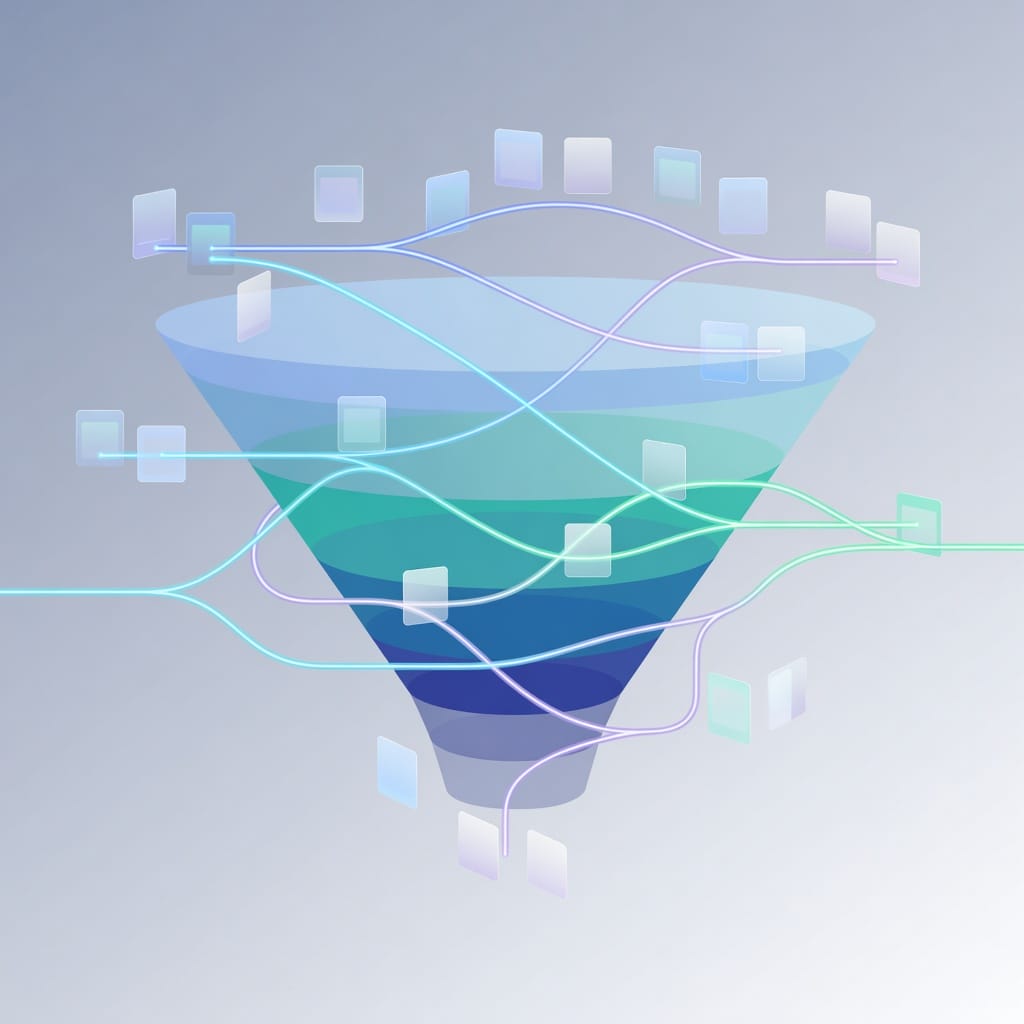
Marketing Funnel vs Sales Funnel: What Is the Difference?
A marketing funnel creates and nurtures demand before, during, and after the buying decision. A sales funnel focuses more narrowly on qualified prospects, pipeline, opportunities, negotiation, and closing. The two overlap, but they are not the same operating system.
The confusion usually happens because both funnels use similar words. Awareness can exist in both a marketing journey and a sales process. Consideration can mean reading a guide, attending a webinar, taking a trial, or comparing proposals. That is why teams need handoff criteria, not just stage names.
| Dimension | Marketing funnel | Sales funnel |
|---|---|---|
| Main owner | Marketing, growth, lifecycle, demand generation | Sales, business development, account executives |
| Starting point | Problem awareness or category discovery | Qualified lead or target account engagement |
| Ending point | Revenue plus retention and advocacy | Closed won, closed lost, renewal, or expansion depending on sales model |
| Primary assets | Content, campaigns, landing pages, email nurture, ads, events | Calls, demos, proposals, negotiation, CRM tasks, account plans |
| Qualification lens | Fit, engagement, intent, source quality | Budget, authority, need, timing, pain, decision process |
| Core risk | Creating traffic that does not become pipeline | Pursuing prospects who are not ready or not a fit |
For B2B teams, the cleanest boundary is often this:
- Marketing owns demand creation, education, capture, nurture, scoring, and sales readiness.
- Sales owns direct qualification, discovery, solution fit, stakeholder mapping, and closing.
- Customer success owns adoption, renewal, expansion, and advocacy, with marketing supporting lifecycle communication.
The handoff point should be explicit. A lead should not become sales ready merely because they downloaded one ebook. A better rule combines firmographic fit, behavioral intent, problem relevance, and a clear next action.
Example handoff rule:
1. The account matches your ideal customer profile.
2. The person has engaged with at least one mid funnel or bottom funnel asset.
3. The lead visited a pricing, demo, comparison, integration, or product page.
4. The lead has a verified business email and a valid domain.
5. The lead score passes the sales accepted threshold.
This is where tools matter. If outbound or lifecycle email is part of the funnel, use reliable verification and deliverability workflows. Filter Bounce can help verify emails in real time before nurture or outbound sequences, while Mystrika can run cold email sequences, warmup, a unified inbox, and AI assisted outreach from $15 per month. DoYouMail fits teams that need unlimited cold email sending capacity. The tools are not the funnel, but they help execute the funnel without manual chaos.
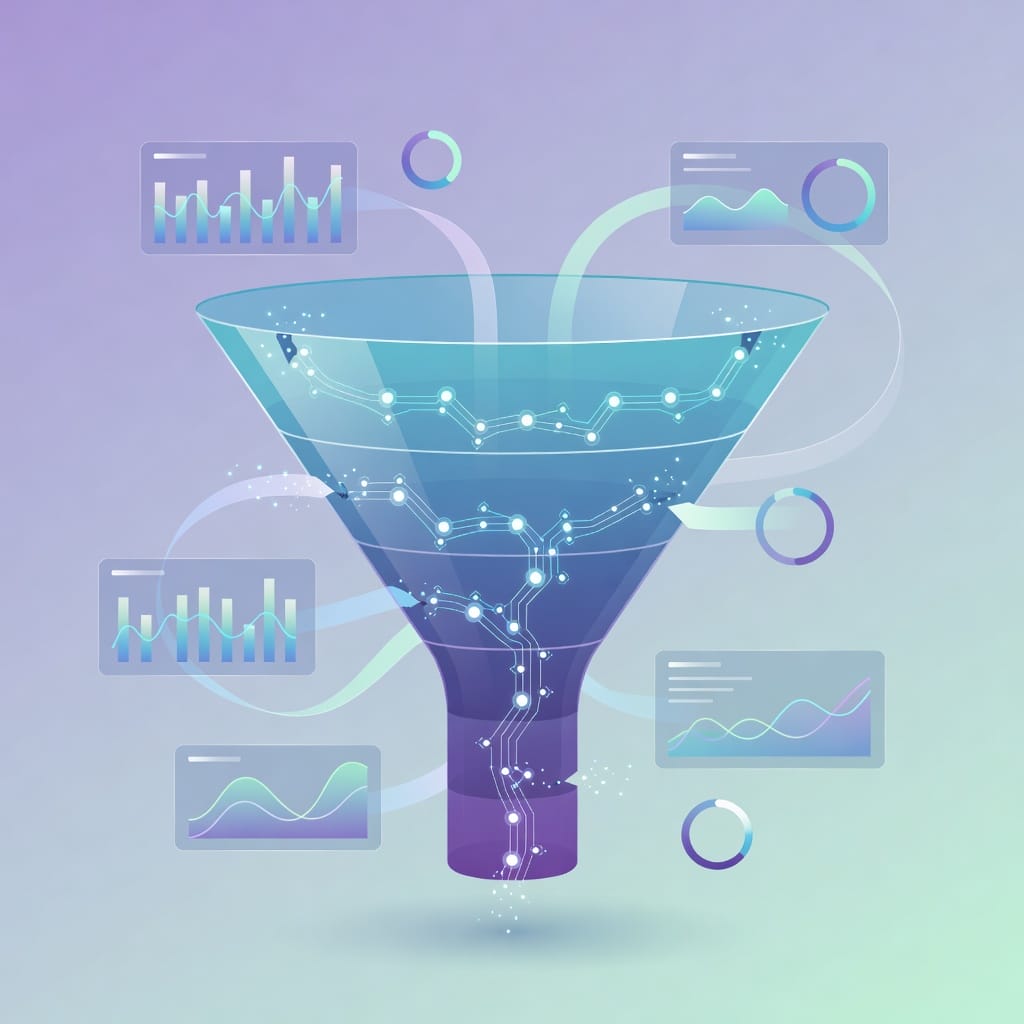
The 8 Core Stages of the Marketing Funnel
The modern marketing funnel has eight core stages: awareness, interest, consideration, intent, evaluation, conversion, retention, and advocacy. Each stage has a distinct buyer mindset, content need, channel mix, and measurement model.
1. Awareness: Make the Problem Visible
Awareness is the stage where buyers first recognize a problem, opportunity, risk, or category. They may not know your brand yet. Your job is to become useful before they are ready to compare vendors or ask for pricing.
At this stage, the buyer is often asking broad questions such as:
- Why are my campaigns not converting?
- How do I improve email deliverability?
- What is a marketing funnel?
- Why are leads dropping after signup?
- How do I reach prospects without hurting domain reputation?
Awareness content should be easy to discover, easy to understand, and clearly tied to a real business problem. It should not push a demo too early. The buyer is still forming the problem.
Useful awareness assets include:
- Educational blog posts
- Beginner guides
- Original point of view articles
- Short videos
- Podcast appearances
- Social posts
- Research summaries
- Problem checklists
- Glossaries
- Category explainers
The biggest mistake at the awareness stage is writing content that only repeats basic definitions. Awareness content should answer the beginner question, then quickly add useful context. For example, a generic article says, “A marketing funnel moves people from awareness to purchase.” A stronger article explains what causes stage leakage, how search intent changes by stage, and what to measure before optimizing conversion.
Awareness metrics include:
- Organic impressions
- Organic clicks
- New visitors
- Branded search growth
- Social reach
- Referral traffic
- Newsletter discovery source
- Assisted conversions from first touch
Do not judge awareness content only by last click revenue. Awareness often creates the memory structure that makes later conversion possible. Use assisted conversion, branded search lift, returning visitor rate, and engagement quality to evaluate it.
2. Interest: Turn Attention Into Permission
Interest is the stage where buyers decide whether your perspective is useful enough to keep engaging. They are not just aware of the problem. They are curious, subscribed, bookmarked, following, or willing to exchange information for value.
The goal is permission. That permission might be an email signup, webinar registration, community join, product waitlist, checklist download, or return visit. You are earning the right to keep educating the buyer.
Strong interest stage assets include:
- Lead magnets that solve one narrow problem
- Webinars with practical frameworks
- Email courses
- Newsletter sequences
- Diagnostic quizzes
- Calculators
- Templates
- Swipe files
- Benchmark explainers
- Interactive tools
The offer should match the seriousness of the buyer. A top of funnel visitor may not want a sales call. They may want a checklist. A repeat visitor who has read three technical guides may be ready for a webinar, comparison guide, or trial.
Interest stage checklist:
- The asset solves a specific problem, not a vague topic.
- The landing page states the outcome clearly.
- The form asks only for information needed at this stage.
- The follow up email delivers the promised asset immediately.
- The next step is relevant to the asset, not a generic sales push.
- The lead source, content topic, and engagement are stored for scoring.
Interest metrics include email opt in rate, webinar registration rate, content download rate, return visitor rate, scroll depth, engaged sessions, and lead source quality. For email based nurture, also track opens cautiously, clicks, replies, unsubscribes, bounces, and spam complaints. Opens are less reliable than clicks and replies, so do not overvalue them.
3. Consideration: Help Buyers Compare Approaches
Consideration is the stage where buyers compare categories, methods, vendors, workflows, and internal priorities. They know the problem matters, but they are still deciding what kind of solution makes sense.
This is the stage where your content must become more specific. A buyer no longer needs a basic definition. They need tradeoffs, criteria, examples, and decision support.
Consideration content can include:
- Best way to guides
- Alternative approach comparisons
- Category comparison pages
- Implementation guides
- Case studies
- Use case pages
- Integration explainers
- Buying criteria articles
- ROI frameworks
- Objection handling content
Example: a buyer who understands email outreach may now ask whether they need a full cold email platform, a CRM sequence tool, an email sending infrastructure tool, or a simple newsletter product. A consideration stage page should explain the differences without pretending one tool solves every possible problem.
| Buyer comparison | Content that helps | What the content should prove |
|---|---|---|
| Build vs buy | Implementation cost guide | Total effort, maintenance, risk, and time to value |
| Tool A vs tool B | Comparison page | Use case fit, limitations, pricing model, integrations |
| Strategy A vs strategy B | Decision framework | When each approach works or fails |
| In house vs agency | Pros and cons article | Control, cost, expertise, speed, accountability |
| Manual vs automated | Workflow breakdown | Where automation helps and where human review is needed |
Consideration metrics include comparison page visits, case study views, repeat visits, product page engagement, webinar attendance, and content assisted pipeline. If the consideration stage produces traffic but not qualified demand, the content may be too broad, too vendor neutral, or disconnected from the product’s real value.
4. Intent: Identify Buyers Who Are Getting Ready to Act
Intent is the stage where buyers show behavior that suggests they may be ready for a direct next step. They might visit pricing, compare competitors, request a checklist, join a product webinar, start a trial, or return to the same use case page several times.
Intent does not mean the buyer is guaranteed to purchase. It means their behavior deserves different treatment. A high intent visitor should not receive the same generic awareness nurture as a first time reader.
Common intent signals include:
- Pricing page visits
- Demo page visits
- Trial signup attempts
- Repeated visits from the same company domain
- Competitor comparison page views
- Integration documentation views
- Security or compliance page visits
- Replying to a nurture email
- Clicking a bottom funnel CTA
- Attending a product focused webinar
Intent data should be used carefully. Not every pricing page visitor is a qualified buyer. Students, competitors, agencies, and vendors may visit high intent pages too. Combine intent with fit.
A simple lead scoring model can use four dimensions:
| Score dimension | What it measures | Examples |
|---|---|---|
| Fit | Whether the account resembles your ideal customer | Industry, company size, region, tech stack |
| Role | Whether the person can influence the decision | Founder, marketing leader, sales ops, demand gen manager |
| Behavior | Whether the person is engaging with buying assets | Pricing page, demo page, comparison guide |
| Timing | Whether there is urgency or a trigger event | Hiring campaign, funding, domain setup, tool migration |
A lead becomes marketing qualified when the combined score passes a threshold. A lead becomes sales accepted when sales agrees the lead is worth direct pursuit. The definitions must be written down, reviewed monthly, and adjusted based on closed won and closed lost data.
5. Evaluation: Reduce Risk and Prove Fit
Evaluation is the stage where buyers are choosing between options and looking for reasons to trust or reject each one. They want proof, clarity, security, pricing transparency, and confidence that the solution will work in their environment.
At this stage, vague benefits are weak. Buyers need evidence and operational detail. They may involve finance, legal, security, procurement, technical users, or senior leaders.
Evaluation assets include:
- Product demos
- Free trials
- ROI calculators
- Security pages
- Implementation timelines
- Migration guides
- Integration documentation
- Customer stories
- Review pages
- Proof of concept plans
- Procurement guides
- Competitive battlecards for sales teams
Evaluation content should reduce perceived risk. If your product requires domain setup, explain the setup. If deliverability matters, explain SPF, DKIM, DMARC, warmup, sending limits, bounce control, and inbox monitoring. If switching tools is painful, explain migration steps and support.
Evaluation questions to answer:
- What does implementation require?
- How long does setup usually take?
- What technical requirements exist?
- What happens if something goes wrong?
- What support is included?
- What integrations are available?
- How does pricing scale?
- What proof exists that this works for similar teams?
For cold email and outbound driven funnels, evaluation often includes deliverability risk. A buyer may like your offer but fear damaging their domain reputation. This is where a practical email deliverability resource helps. It gives buyers a way to assess risk before they commit to a sending workflow.
6. Conversion: Remove Friction From the Buying Moment
Conversion is the stage where a qualified buyer takes the desired action. That action may be a purchase, demo request, trial start, contract signature, paid plan upgrade, consultation booking, or first order.
Conversion is not only about persuasive copy. It is about removing friction. A buyer who wants to act can still abandon the process if the form is too long, the pricing is unclear, the page is slow, the CTA is vague, or the next step feels risky.
Conversion checklist:
- The CTA says exactly what happens next.
- Pricing or plan logic is easy to understand.
- Forms ask only for necessary information.
- Error messages are clear.
- Payment or booking steps are reliable on mobile.
- Trust signals are close to the action.
- Objections are answered before the CTA.
- Confirmation pages set expectations.
- Sales follow up is fast and relevant.
- Analytics track source, campaign, page, and conversion event.
Conversion metrics include landing page conversion rate, checkout completion rate, demo request rate, trial activation rate, cost per acquisition, sales cycle length, win rate, and payback period.
The most useful conversion improvements are often boring. Clarify the offer. Reduce fields. Improve page speed. Add proof near the CTA. Match ad promise to landing page. Align sales follow up with the content the buyer consumed.
7. Retention: Prove the Customer Made the Right Choice
Retention is the stage where customers decide whether they will keep using, renewing, repurchasing, or expanding with you. It begins immediately after conversion, not months later when churn risk appears.
Many funnel models stop at purchase. That is a mistake. A business with weak retention must constantly refill the top of the funnel just to stand still. A business with strong retention can compound value from every acquired customer.
Retention tactics include:
- Onboarding sequences
- Setup checklists
- Product education emails
- Customer success calls
- Usage based nudges
- Feature adoption campaigns
- Help center content
- Renewal reminders
- In app guidance
- Training webinars
- Customer health scoring
Retention stage questions:
- Did the customer reach their first value milestone?
- Are they using the product in the way that predicts success?
- Do they understand the next best action?
- Are support issues resolved quickly?
- Are they aware of relevant features?
- Is the original promise being fulfilled?
Retention metrics include activation rate, time to value, product usage, repeat purchase rate, customer lifetime value, churn rate, renewal rate, expansion revenue, support ticket volume, and customer satisfaction.
Planned image 3: conceptual illustration of retention and advocacy loops around a funnel, no text, no logos.
8. Advocacy: Turn Trust Into Reach
Advocacy is the stage where satisfied customers help create new demand. They refer peers, write reviews, join case studies, share results, recommend your product in communities, and defend your brand when prospects ask for advice.
Advocacy is not automatic. Customers may be happy but silent. You need to make advocacy easy, ethical, and timely.
Advocacy programs can include:
- Referral offers
- Review requests
- Customer story interviews
- Community participation
- Partner programs
- User generated content
- Expert roundups
- Certification programs
- Private customer groups
- Co marketing opportunities
Ask for advocacy after value is visible. Good triggers include a successful onboarding milestone, a positive support interaction, a renewal, a strong satisfaction score, or a measurable business win.
Advocacy metrics include referral leads, review volume, review quality, case study participation, community mentions, social shares, partner sourced pipeline, and expansion influenced by customer proof.
How TOFU, MOFU, and BOFU Map to Funnel Stages
TOFU, MOFU, and BOFU are shorthand for top, middle, and bottom of the funnel. TOFU maps mostly to awareness and interest. MOFU maps to consideration and intent. BOFU maps to evaluation and conversion. Retention and advocacy continue after BOFU.
This framework is useful because it simplifies planning. Instead of creating separate campaigns for every micro stage, teams can group content by buyer readiness.
| Funnel layer | Detailed stages | Buyer readiness | Best content types | CTA examples |
|---|---|---|---|---|
| TOFU | Awareness, Interest | Low to moderate | Educational posts, guides, social content, checklists, newsletters | Read more, subscribe, download checklist |
| MOFU | Consideration, Intent | Moderate to high | Comparison guides, webinars, templates, case studies, calculators | Watch webinar, compare options, use template |
| BOFU | Evaluation, Conversion | High | Demos, pricing pages, trials, ROI calculators, security docs | Start trial, book demo, request proposal |
| Post purchase | Retention, Advocacy | Customer | Onboarding, product education, referral requests, community | Complete setup, invite teammate, leave review |
TOFU content should not pretend every reader is ready to buy. BOFU content should not waste time with beginner definitions. MOFU content should bridge the two by helping buyers understand criteria and tradeoffs.
A common mistake is overinvesting in TOFU because it creates visible traffic. Traffic is valuable only when there is a path from education to capture, nurture, qualification, and revenue. If a blog post brings thousands of visitors but offers no relevant next step, it is a dead end.
AIDA vs Full Funnel vs Flywheel: Which Model Should You Use?
AIDA, the full funnel, and the flywheel are different models for understanding customer progression. AIDA is simple and useful for messaging. The full funnel is better for operations and measurement. The flywheel is better for retention, advocacy, and customer led growth.
| Model | Stages | Best for | Limitation |
|---|---|---|---|
| AIDA | Attention, Interest, Desire, Action | Copywriting, ads, landing pages, campaign messaging | Too simple for retention, sales handoff, and lifecycle operations |
| TOFU/MOFU/BOFU | Top, middle, bottom | Content planning and demand generation | Can ignore post purchase growth if used alone |
| Full funnel | Awareness through advocacy | Strategy, metrics, operations, cross functional planning | Requires more measurement discipline |
| Flywheel | Attract, engage, delight | Customer led growth, retention, referrals | Can be too abstract without stage metrics |
| Lifecycle model | Subscriber, lead, MQL, SQL, opportunity, customer | CRM operations and handoffs | Can become internal jargon instead of buyer centered thinking |
Use AIDA when writing a landing page or ad. Use TOFU/MOFU/BOFU when planning content. Use the full funnel when aligning teams. Use the flywheel when improving retention and advocacy. Use lifecycle stages when configuring CRM, marketing automation, and reporting.
The strongest teams combine these models. They do not argue over which one is universally correct. They choose the model that fits the decision at hand.
Content and Channel Strategy for Each Funnel Stage
A strong funnel matches the channel and content format to the buyer’s readiness. Awareness needs reach and education. Evaluation needs proof and detail. Retention needs guidance and success reinforcement.
Planned image 2: conceptual illustration of marketing channels feeding into a unified customer journey, no text, no logos.
| Stage | Content strategy | Channel strategy | What to avoid |
|---|---|---|---|
| Awareness | Teach the problem and category | SEO, social, PR, communities, podcasts | Aggressive demo CTAs before trust exists |
| Interest | Offer useful next steps | Newsletter, webinars, lead magnets, retargeting | Gated assets with weak value |
| Consideration | Compare approaches and tradeoffs | SEO, email nurture, review sites, webinars | Pretending there are no alternatives |
| Intent | Respond to high intent behavior | Retargeting, sales alerts, lifecycle email | Treating all leads the same |
| Evaluation | Prove fit and reduce risk | Sales enablement, demo, documentation, proof assets | Hiding implementation complexity |
| Conversion | Remove buying friction | Landing pages, checkout, sales calls, trial flows | Long forms, unclear pricing, slow follow up |
| Retention | Drive adoption and success | Lifecycle email, in app prompts, help center | Ignoring customers after purchase |
| Advocacy | Make sharing easy | Referral programs, communities, review platforms | Asking before value is delivered |
For cold outreach, the right stage depends on the message. A broad prospecting email can create awareness. A highly relevant email to an account showing intent can support evaluation or conversion. The difference is targeting, context, and follow up.
A simple cold email funnel might look like this:
1. Build a targeted account list based on fit.
2. Verify addresses before sending.
3. Warm up sending infrastructure and protect domain reputation.
4. Send a short problem focused email.
5. Route replies into a shared inbox.
6. Move interested prospects into a tailored nurture or sales workflow.
7. Track replies, meetings, opportunities, and closed revenue.
Mystrika is naturally relevant here because it combines AI, warmup, sequencer, and a unified inbox for cold email outreach. It should be used as part of a thoughtful funnel, not as a replacement for positioning, list quality, or offer relevance.
Metrics and KPIs by Marketing Funnel Stage
Funnel metrics should show whether buyers are moving forward, not just whether campaigns are busy. Each stage needs a small set of primary metrics, diagnostic metrics, and quality checks.
Do not measure every stage with the same KPI. Awareness should not be judged only by revenue. Conversion should not be judged by impressions. Retention should not be judged by leads.
| Stage | Primary KPI | Diagnostic KPIs | Quality checks |
|---|---|---|---|
| Awareness | Qualified traffic growth | Impressions, clicks, branded search, new users | Does traffic match target audience? |
| Interest | Permission based engagement | Email signups, downloads, webinar registrations | Do leads engage after signup? |
| Consideration | Buying research activity | Case study views, comparison visits, return visits | Are the right accounts engaging? |
| Intent | Qualified high intent actions | Pricing visits, demo clicks, trial starts, lead score | Is intent combined with fit? |
| Evaluation | Opportunity creation | SQL rate, demo attendance, proposal requests | Are objections understood? |
| Conversion | Revenue conversion | Win rate, CAC, sales cycle length, checkout completion | Is friction blocking ready buyers? |
| Retention | Continued value | Activation, renewal, churn, usage | Are customers reaching milestones? |
| Advocacy | Customer generated demand | Referrals, reviews, testimonials, community mentions | Are advocates satisfied and credible? |
A healthy dashboard separates volume from quality. More leads are not automatically better. More traffic is not automatically better. More demos are not automatically better if the conversion rate falls and sales wastes time on poor fit prospects.
Useful funnel reporting views:
- Stage conversion rate from one stage to the next
- Source quality by stage
- Time in stage
- Drop off by segment
- Content assisted pipeline
- Lead score distribution
- Sales accepted rate
- Win rate by original source
- Retention by acquisition channel
- Referral revenue by customer segment
When reporting to leadership, connect metrics to decisions. Do not say, “Organic traffic increased.” Say, “Organic traffic from problem aware keywords increased, but conversion to email signup is weak, so next month we are adding stage matched lead magnets to the top five pages.”
How to Build a Marketing Funnel Step by Step
To build a marketing funnel, define the customer, map their decisions, choose stage specific offers, connect channels, set handoff rules, measure stage conversion, and improve the weakest constraint first. Start with the buyer journey, not with tools.
Step 1: Define the Ideal Customer and Buying Committee
A funnel built for everyone converts poorly. Define the account type, buyer role, pain, urgency, budget reality, and decision process. For B2B, include the buying committee. For B2C, include motivations, objections, triggers, and repeat purchase behavior.
Document:
- Target industries or segments
- Company size or customer profile
- Main pain points
- Existing alternatives
- Buying triggers
- Common objections
- Decision makers and influencers
- Required integrations or constraints
- Success outcomes
Step 2: Map Questions by Stage
Write down what the buyer asks at each stage. This prevents random content creation. Each article, email, ad, webinar, and landing page should answer a stage specific question.
Example question map:
| Stage | Buyer question | Asset idea |
|---|---|---|
| Awareness | Why are my outbound emails not getting replies? | Deliverability guide |
| Interest | What should I fix first? | Domain setup checklist |
| Consideration | Which outreach workflow fits my team? | Tool category comparison |
| Intent | Can this work for my use case? | Industry specific playbook |
| Evaluation | What does setup require? | Implementation guide |
| Conversion | What plan should I choose? | Pricing explainer |
| Retention | How do I get better results? | Optimization sequence |
| Advocacy | How can I share results? | Referral and case study invite |
Step 3: Choose Offers and CTAs by Readiness
A CTA should be the next logical step, not the step the company wants most. Asking for a demo on every awareness post can reduce trust. Offering only a newsletter on a pricing page can miss demand.
Match CTAs to stage:
- Awareness: read related guide, subscribe, use checklist
- Interest: download template, attend webinar, join newsletter
- Consideration: compare options, watch use case demo, read case study
- Intent: start trial, view pricing, request audit
- Evaluation: book demo, talk to expert, review security docs
- Conversion: buy, sign contract, start onboarding
- Retention: complete setup, invite teammate, attend training
- Advocacy: refer a peer, leave review, join case study
Step 4: Set Lead Scoring and Handoff Rules
Lead scoring should combine fit and behavior. If you score only behavior, unqualified people who click a lot will reach sales. If you score only fit, good accounts with no buying intent will be pushed too early.
A practical scoring checklist:
- Fit score: industry, company size, geography, use case
- Role score: decision maker, influencer, practitioner, student, vendor
- Behavior score: page visits, webinar attendance, email clicks, trial actions
- Intent score: pricing, comparison, demo, integration, security pages
- Negative score: poor fit geography, personal email, competitor domain, student research
- Data quality score: verified email, valid domain, complete account data
Step 5: Build Nurture Paths
Nurture should not be a generic series of promotional emails. It should continue the buyer’s path. Someone who downloaded a beginner checklist needs education. Someone who visited pricing twice needs proof, objection handling, and a clear next step.
Nurture paths can be based on:
- Topic interest
- Funnel stage
- Role
- Industry
- Lead score
- Product behavior
- Source campaign
- Objection or use case
For email nurture, protect deliverability. Use clean lists, verified addresses, clear unsubscribe options, relevant messaging, and appropriate sending volume. A high bounce rate can damage future funnel performance because fewer emails reach the inbox.
Step 6: Measure Stage Conversion and Diagnose Leaks
Once the funnel is live, measure movement between stages. Do not optimize random tactics before finding the constraint. If awareness is strong but email signup is weak, improve the offer. If MQLs are high but SQLs are low, improve scoring. If opportunities are high but wins are low, improve proof, fit, or sales process.
Step 7: Improve One Constraint at a Time
Funnels become messy when teams change everything at once. Improve one constraint, measure the result, then move to the next. This creates learning instead of noise.
Examples:
- Add a stage matched lead magnet to high traffic pages.
- Rewrite a comparison page to include clearer tradeoffs.
- Shorten a demo form.
- Add proof near a pricing CTA.
- Create a setup checklist for new customers.
- Ask satisfied customers for reviews after a success milestone.
How to Diagnose Funnel Leaks
A funnel leak happens when buyers drop off between stages at a rate that blocks growth. The fix depends on where the leak occurs. Awareness leaks require better targeting or messaging. Conversion leaks require friction reduction. Retention leaks require better onboarding and value delivery.
| Leak location | Likely symptom | Common cause | Fix |
|---|---|---|---|
| Awareness to interest | Traffic but few signups | Weak offer or mismatch between content and CTA | Add relevant checklist, newsletter, or template |
| Interest to consideration | Leads do not return | Generic nurture or poor segmentation | Segment by topic and stage |
| Consideration to intent | Readers compare but do not act | Unclear differentiation or weak proof | Add comparison, case studies, and decision criteria |
| Intent to evaluation | Pricing visitors do not request demo | Fear, confusion, or poor fit | Clarify plans, add FAQs, show implementation details |
| Evaluation to conversion | Demos do not close | Weak qualification, missing stakeholders, unclear ROI | Improve discovery and proof assets |
| Conversion to retention | Customers churn early | Poor onboarding or expectation mismatch | Add success milestones and lifecycle education |
| Retention to advocacy | Happy customers stay silent | No advocacy trigger or easy ask | Ask after measurable wins |
Diagnose leaks with both data and qualitative evidence. Analytics shows where drop off occurs. Session recordings, sales notes, customer interviews, support tickets, and win loss reviews explain why.
A simple monthly funnel review agenda:
1. Review stage conversion rates.
2. Identify the largest drop off by revenue impact.
3. Segment by source, audience, and offer.
4. Review qualitative evidence from sales and support.
5. Choose one experiment.
6. Define the success metric.
7. Review results before starting the next test.
B2B vs B2C Marketing Funnel Stages
B2B and B2C funnels use similar stages, but the buying process differs. B2B usually has more stakeholders, longer evaluation, formal handoffs, and higher reliance on proof. B2C usually has faster decisions, stronger emotional triggers, and more direct purchase paths.
| Factor | B2B funnel | B2C funnel |
|---|---|---|
| Decision process | Multiple stakeholders | Individual or household decision |
| Sales cycle | Longer | Shorter, except high value purchases |
| Content need | Proof, ROI, implementation detail | Benefits, reviews, emotion, convenience |
| Handoff | Marketing to sales to success | Often direct to purchase and support |
| Data model | Account and contact level | Customer and behavior level |
| Common channels | SEO, LinkedIn, webinars, outbound, events, email nurture | Search, social, influencers, marketplaces, email, SMS |
| Retention | Renewal, expansion, adoption | Repeat purchase, loyalty, subscription, community |
B2B teams should pay special attention to buying committees. A practitioner may care about usability. A manager may care about reporting. Finance may care about cost. Security may care about risk. Your funnel needs assets for each stakeholder.
B2C teams should pay special attention to timing, emotion, convenience, trust, and repeat purchase triggers. Reviews, shipping, returns, discounts, loyalty programs, and post purchase emails often matter as much as education.
Where AI, Automation, and Cold Email Fit in the Funnel
AI and automation can improve the marketing funnel when they help teams personalize, prioritize, summarize, route, and follow up. They hurt the funnel when they create generic content, spam, fake personalization, or automated pressure without buyer context.
Useful AI and automation applications include:
- Segmenting leads by behavior and fit
- Summarizing account research
- Drafting stage specific email variations
- Scoring intent signals
- Routing high intent accounts to sales
- Recommending next best content
- Detecting funnel anomalies
- Personalizing lifecycle education
- Identifying churn risk
- Triggering review or referral requests
Cold email can support multiple stages, but it must be relevant. A cold email to a poorly targeted list is not a funnel. It is noise. A cold email to a well defined segment with a specific problem, clean data, verified addresses, warmed infrastructure, and a clear next step can create awareness, interest, or direct intent.
A practical outbound stack for funnel execution might include:
- Filter Bounce for real time email verification before sending
- Mystrika for AI assisted cold email outreach, warmup, sequencing, unified inbox, and white label options
- DoYouMail when unlimited cold email sending capacity is needed
- CRM or pipeline system for opportunity tracking
- Analytics for source and revenue attribution
The principle is simple: automation should increase relevance and consistency, not volume for its own sake.
Marketing Funnel Decision Matrix
Use this decision matrix to choose what to fix next. The highest impact work is usually where buyer intent is strong but friction, proof, or process blocks progress.
| Situation | What it usually means | What to fix first |
|---|---|---|
| High traffic, low leads | Awareness exists but permission offer is weak | Improve lead magnet and CTA match |
| Many leads, low MQLs | Capture is broad but fit is poor | Tighten targeting and qualification |
| Many MQLs, few SQLs | Scoring overvalues weak behavior | Add fit, intent, and negative scoring |
| Many demos, low wins | Buyer expectations or proof are weak | Improve discovery, case studies, and objection handling |
| High trial starts, low activation | Users do not reach first value | Improve onboarding and in product guidance |
| Good retention, few referrals | Customers are happy but not prompted | Add advocacy triggers and referral paths |
| Strong BOFU, weak TOFU | Pipeline depends on existing demand | Invest in education and category content |
| Strong TOFU, weak BOFU | Audience learns but does not choose you | Add comparison, proof, and conversion assets |
Do not copy another company’s funnel blindly. A low price self serve tool, an enterprise platform, an ecommerce store, and a services agency need different stage depth, different CTAs, and different proof.
Common Marketing Funnel Mistakes
The most common marketing funnel mistakes are treating all buyers the same, optimizing for vanity metrics, ignoring retention, asking for conversion too early, and failing to define handoff rules. These mistakes create activity without predictable revenue.
Mistake 1: Using One CTA Everywhere
A demo CTA on every page sounds efficient, but it ignores buyer readiness. Awareness readers often need education. Evaluation readers need proof. Customers need success support. Match the CTA to the stage.
Mistake 2: Measuring Only Last Click
Last click reporting undervalues awareness, education, referrals, communities, and dark funnel activity. Use multiple views: first touch, last touch, assisted conversions, self reported attribution, and sales notes.
Mistake 3: Creating Content Without a Next Step
A blog post without a relevant next step is a leak. Every important page should guide the reader somewhere useful, such as a checklist, comparison guide, related article, webinar, trial, or setup resource.
Mistake 4: Sending Poor Fit Leads to Sales
Sales teams lose trust in marketing when MQLs are based on weak signals. A lead who downloaded a top funnel guide is not automatically ready for a sales call. Combine fit, role, behavior, and timing.
Mistake 5: Ignoring Retention and Advocacy
If the funnel stops at purchase, acquisition costs rise and customer learning is wasted. Retention and advocacy create compounding growth through repeat value, referrals, reviews, and stronger proof.
Mistake 6: Over Automating Human Moments
Automation is useful for routing, reminders, personalization, and education. It is harmful when it replaces judgment in sensitive moments such as enterprise evaluation, complaint resolution, or complex objections.
Mistake 7: Treating the Funnel as Linear
Buyers move backward, skip steps, involve new stakeholders, and research anonymously. Build flexible paths instead of forcing every person through the same sequence.
Key Takeaways
The stages of the marketing funnel are not just awareness, consideration, and conversion. A complete funnel covers awareness, interest, consideration, intent, evaluation, conversion, retention, and advocacy. Each stage needs its own buyer question, content type, channel strategy, CTA, and metric.
- Awareness creates problem recognition and category memory.
- Interest turns attention into permission for continued communication.
- Consideration helps buyers compare approaches and tradeoffs.
- Intent identifies behavior that deserves a stronger next step.
- Evaluation reduces risk and proves fit.
- Conversion removes friction from the buying moment.
- Retention proves the customer made the right decision.
- Advocacy turns customer trust into new demand.
- TOFU, MOFU, and BOFU are useful planning shortcuts, but they should not replace detailed stage metrics.
- Lead scoring should combine fit, role, behavior, timing, and data quality.
- Cold email, AI, and automation work best when they improve relevance, routing, and follow up.
- The best funnel improvement is usually the weakest stage constraint, not the trendiest tactic.
Frequently Asked Questions
What are the main stages of the marketing funnel?
The main stages of the marketing funnel are awareness, interest, consideration, intent, evaluation, conversion, retention, and advocacy. Some teams simplify these into TOFU, MOFU, and BOFU, but the detailed model is more useful for planning content, metrics, lead scoring, and handoffs.
A simple funnel may be enough for early planning. As your campaigns mature, use the expanded model so you can see where prospects drop off and what each stage needs.
What is the difference between TOFU, MOFU, and BOFU?
TOFU means top of funnel and covers awareness and early interest. MOFU means middle of funnel and covers consideration and intent. BOFU means bottom of funnel and covers evaluation and conversion.
Retention and advocacy happen after BOFU. They are still part of the broader customer journey because they influence renewals, repeat purchases, referrals, reviews, and expansion.
Is the marketing funnel still relevant?
Yes, the marketing funnel is still relevant as a planning and measurement model, but it should not be treated as a perfectly linear buyer journey. Modern buyers move across search, social, communities, peer recommendations, AI answers, review sites, email, and sales conversations.
Use the funnel to organize intent, content, CTAs, and metrics. Use customer research and attribution data to understand the non linear paths buyers actually take.
How do you know which funnel stage a lead is in?
You estimate funnel stage by combining behavior, fit, role, source, and timing. A first time visitor reading a broad guide is likely in awareness. A repeat visitor reading comparison and pricing pages is likely showing intent or evaluation behavior.
Do not rely on one signal. A pricing page visit from a poor fit account may be less valuable than multiple mid funnel actions from an ideal customer profile account.
What content works best at each marketing funnel stage?
Awareness content should educate. Interest content should earn permission. Consideration content should compare options. Intent content should guide the next action. Evaluation content should prove fit. Conversion content should remove friction. Retention content should drive success. Advocacy content should make sharing easy.
The best content answers the buyer’s current question. If the reader is not ready for a demo, offer a useful next step instead of forcing a sales conversation.
How should B2B teams define MQL and SQL stages?
A marketing qualified lead should meet a written threshold for fit and engagement. A sales qualified lead should meet sales accepted criteria such as relevant pain, buying role, urgency, account fit, and a credible next step.
The exact threshold depends on your business model. Review MQL to SQL conversion, opportunity rate, and closed won feedback regularly so the scoring model reflects real revenue quality.
How does cold email fit into the marketing funnel?
Cold email can create awareness, generate interest, or accelerate intent when it is targeted, relevant, and supported by clean data. It should not be used as a high volume shortcut around positioning or list quality.
Use verification, warmup, segmentation, and reply management before scaling. Mystrika can help with AI assisted outreach, warmup, sequencer workflows, and a unified inbox, while Filter Bounce can help verify addresses before campaigns.
Which metrics matter most in a marketing funnel?
The most important metrics are stage conversion rate, source quality, qualified pipeline, win rate, retention, and customer lifetime value. Supporting metrics include traffic, signups, content engagement, lead score, demo rate, activation, churn, and referrals.
Choose metrics by stage. Awareness needs reach and qualified attention. Conversion needs revenue action. Retention needs continued value. Advocacy needs customer generated demand.
How often should you optimize the marketing funnel?
Review funnel performance monthly and investigate major leaks weekly if you have enough data. Avoid changing every stage at once because you will not know what caused the improvement or decline.
Pick the constraint with the highest revenue impact, create one focused experiment, define the success metric, and review results before moving to the next issue.
What is the biggest mistake companies make with marketing funnels?
The biggest mistake is treating the funnel as a content diagram instead of an operating system. A funnel must connect buyer questions, offers, CTAs, scoring, sales handoff, retention, advocacy, and reporting.
If content, automation, sales follow up, and customer success are disconnected, the funnel will leak even if each individual campaign looks active.