
Lead generation for security companies works best when it combines precise account targeting, proof-led content, compliant outbound, partner trust, and rigorous qualification. Security buyers are skeptical, technical, and risk-aware, so generic lead lists and vague outreach fail quickly. The winning system identifies urgent risk, maps the buying committee, verifies contact data, and earns a conversation with a relevant security problem.
Security companies face a harder lead generation problem than most B2B teams. A payroll tool can sell convenience. A collaboration app can sell productivity. A cybersecurity vendor, MSSP, physical security integrator, compliance consultancy, or managed detection provider must sell trust before it sells a demo. Buyers are protecting sensitive systems, regulated data, executive careers, and business continuity.
That means your lead generation system must do more than produce names. It must separate good-fit accounts from noise, reach the right stakeholders without damaging deliverability, educate buyers before they are ready to speak, and prove that your company understands their threat model.
This guide is built for security companies that want a practical pipeline system, not a generic list of tactics. It covers ICP design, lead sources, cold email, ABM, SEO, webinars, referrals, partnerships, compliance, lead scoring, measurement, and tooling. It also explains where Mystrika, DoYouMail, and Filter Bounce fit naturally in a security-focused outbound workflow.
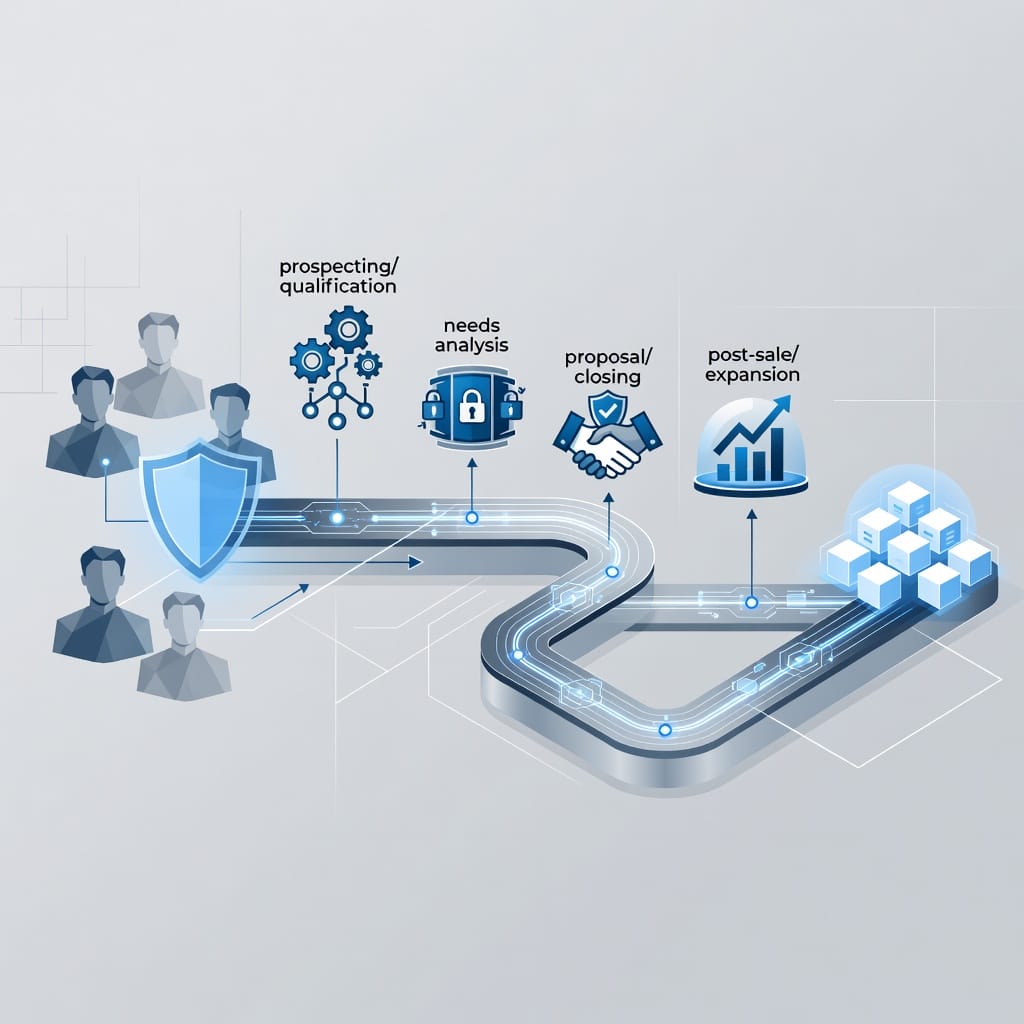
Planned image 1: Abstract conceptual illustration of cybersecurity teams and revenue teams connecting secure digital nodes, no text, no logos.

What Is Lead Generation for Security Companies?
Lead generation for security companies is the process of finding, attracting, qualifying, and converting organizations that have a real security need, budget influence, and a path to a sales conversation. It includes inbound content, outbound prospecting, partner referrals, events, intent signals, audits, webinars, and account-based campaigns.
For cybersecurity companies, lead generation usually targets organizations with urgent risk, compliance pressure, tool sprawl, staffing gaps, or incident concerns. For physical security companies, it may target facility leaders, operations executives, property managers, schools, healthcare systems, logistics firms, and enterprise security departments.
The common thread is risk reduction. Security buyers do not buy because a vendor has a clever subject line. They buy when the vendor connects a visible problem to a credible path forward.
A qualified security lead should answer four questions:
- Does the account match the ideal customer profile?
- Is there a specific trigger, risk, compliance event, or operational pain?
- Is the contact part of the buying committee or able to influence it?
- Is there enough trust to justify a discovery call, audit, assessment, or demo?
That is why security lead generation is not the same as scraping a database and emailing every IT manager. It is a coordinated revenue system that blends targeting, proof, timing, and trust.
Security Lead Generation vs General B2B Lead Generation
Security lead generation differs from general B2B lead generation because the buyer has higher perceived risk, more internal stakeholders, stricter proof requirements, and lower tolerance for careless outreach. A weak pitch can signal that the vendor is careless with security itself.
| Area | General B2B lead generation | Security company lead generation |
|---|---|---|
| Buyer concern | Cost, productivity, convenience | Risk, compliance, downtime, breach exposure, safety |
| Buying committee | Often one department | IT, security, legal, finance, procurement, operations, executives |
| Trust threshold | Moderate | High |
| Content needed | Benefits and product education | Threat context, proof, controls, process, compliance relevance |
| Outreach risk | Annoyance or low response | Deliverability damage, brand distrust, compliance complaints |
| Qualification | Need, budget, authority | Risk trigger, environment fit, compliance pressure, stakeholder map |
A security company can still use familiar channels such as email, LinkedIn, paid search, events, and SEO. The difference is the message. The lead generation engine must show that the company understands real operational and security constraints.

Who Should Security Companies Target First?
Security companies should target accounts where the risk, budget, and buying committee are easiest to identify. Start with a narrow segment, such as healthcare organizations needing compliance support, SaaS companies preparing for SOC 2, manufacturers protecting operational technology, or mid-market firms lacking internal security staff.
The most common mistake is defining the market too broadly. “Companies that need cybersecurity” is not an ICP. It is almost every company. A usable ICP tells your sales and marketing teams which accounts deserve research, which contacts matter, which pain points are likely, and which offer should start the conversation.
Build an ICP Around Risk, Not Just Firmographics
A strong security ICP combines firmographic, technographic, regulatory, and trigger-based signals. Company size and industry matter, but they are not enough. A 300-person healthcare company with a recent hiring push for security engineers may be more urgent than a 3,000-person enterprise with a mature internal security team.
Use this ICP table as a starting point:
| ICP dimension | What to define | Example for a cybersecurity vendor |
|---|---|---|
| Industry | Where risk and budget concentrate | Healthcare, financial services, SaaS, manufacturing, legal, logistics |
| Company size | Employee or revenue range | 100 to 2,000 employees for mid-market MDR |
| Security maturity | Current capability level | No 24/7 SOC, limited detection coverage, manual compliance process |
| Compliance pressure | Required frameworks | SOC 2, HIPAA, PCI DSS, ISO 27001, GDPR, CCPA |
| Technology environment | Tools and infrastructure | Microsoft 365, Google Workspace, AWS, Azure, Okta, endpoint tools |
| Trigger events | Why now | Funding, breach news, new CISO, audit deadline, cloud migration, merger |
| Buying committee | Who influences the deal | CISO, CIO, IT director, security architect, compliance manager, CFO |
| Exclusion criteria | Who to avoid | Too small, no budget, wrong geography, fully in-house, unsupported stack |
The goal is not to create a perfect theoretical persona. The goal is to reduce wasted outreach and increase the percentage of prospects who recognize the problem you describe.
Map the Buying Committee Before You Write Messaging
Security purchases rarely depend on one person. Even when a CISO owns the initiative, legal may review data handling, procurement may evaluate vendor risk, finance may challenge cost, and technical teams may run proofs of concept.
For each target account, map the committee like this:
- Economic buyer: CFO, COO, CEO, business unit leader, or CIO who controls budget.
- Technical evaluator: security architect, SOC manager, IT director, infrastructure lead, or engineering leader.
- Risk owner: CISO, compliance manager, general counsel, privacy officer, or audit lead.
- Daily user: analyst, administrator, facility manager, security operator, or managed service team.
- Procurement gatekeeper: sourcing manager, vendor risk team, or security questionnaire owner.
Your content and outreach should not speak to all of them in the same way. A CFO cares about business risk and cost exposure. A security architect cares about integration, false positives, coverage, and operational load. A compliance manager cares about evidence, control mapping, audit readiness, and documentation.
Which Lead Generation Channels Work Best for Security Companies?
The best lead generation channels for security companies are targeted outbound, account-based marketing, SEO-led education, webinars, referrals, partner marketplaces, compliance-driven offers, paid search, and event follow-up. The right mix depends on deal size, sales cycle, buyer sophistication, and how urgent the problem is.
No single channel is enough. A security buyer may first discover a guide through search, see a founder post on LinkedIn, attend a webinar, receive a relevant email, ask a peer for feedback, and only then book a call. Your job is to build connected touchpoints instead of disconnected campaigns.
| Channel | Best for | Strength | Weakness | When to prioritize |
|---|---|---|---|---|
| Cold email | Precise account targeting | Direct, scalable, measurable | Requires strong deliverability and relevance | Clear ICP and high-value offer |
| SEO content | Long-term demand capture | Compounds over time | Slow to start | Buyers search for education or comparisons |
| Webinars | Trust and education | Shows expertise | Needs promotion and follow-up | Complex topics with many stakeholders |
| Partner referrals | High-trust introductions | Strong conversion potential | Harder to scale | Integrations, MSPs, compliance advisors |
| Paid search | High-intent capture | Fast traffic | Expensive and competitive | Strong landing pages and clear offers |
| Relationship building | Good for executives and thought leadership | Noisy and time-intensive | Founder-led or expert-led positioning | |
| Events | Enterprise trust and networking | Deep conversations | High cost | Large ACV, regional markets, conferences |
| Free audits | Conversion from pain to action | Creates urgency | Requires delivery capacity | Strong diagnostic capability |
A balanced security lead generation system usually has three layers:
1. Demand capture: SEO, paid search, comparison pages, marketplace listings, review sites.
2. Demand creation: outbound, LinkedIn, partner campaigns, webinars, research reports.
3. Trust conversion: audits, assessments, case studies, executive briefings, technical workshops.
How Should Security Companies Use Cold Email Without Damaging Trust?
Security companies should use cold email only when the targeting is narrow, the message is specific, the contact data is verified, and the sending setup is protected. The email should reference a plausible business risk or trigger, not fear-based hype or generic breach language.
Cold email can work extremely well for security companies because the buyer set is identifiable. CISOs, IT directors, compliance leaders, facility directors, and operations executives are reachable. But the margin for error is small. Poorly verified lists create bounces. Aggressive claims create distrust. Over-sending can harm domain reputation.
Cold Email Infrastructure Checklist
Before launching any campaign, confirm the basics:
- Use separate sending domains or subdomains to protect the main brand domain.
- Configure SPF, DKIM, and DMARC correctly.
- Warm sending accounts gradually before scaling volume.
- Verify email addresses before sending.
- Segment by persona, industry, trigger, and use case.
- Keep the first email short and relevant.
- Avoid misleading breach claims or fake urgency.
- Include a clear and respectful opt-out path.
- Monitor bounces, spam complaints, replies, and meetings booked.
- Pause campaigns if deliverability metrics deteriorate.
This is where tooling matters. Mystrika is a natural fit for security companies that want cold email outreach with AI, warmup, sequencing, a unified inbox, whitelabel options, and pricing that starts at $15/month. Use it to manage personalized sequences and inbox replies, not to blast generic pitches. If your team needs high-volume sending capacity, DoYouMail can support unlimited cold email sending, while Filter Bounce can help verify addresses in real time before they enter a sequence.
For a deeper primer on sender reputation and inbox placement, review Mystrika’s guide to email deliverability before scaling outbound.
Example Cold Email Angles by Security Offer
| Security offer | Bad generic angle | Better specific angle |
|---|---|---|
| MDR or SOC service | “We stop cyber attacks.” | “Many lean IT teams struggle to cover alerts after hours without adding headcount.” |
| SOC 2 support | “Need compliance help?” | “SaaS teams approaching enterprise deals often need cleaner evidence collection before security review.” |
| IAM consulting | “Improve identity security.” | “Fast-growing teams often find that access reviews and offboarding lag behind hiring.” |
| Physical security | “Protect your building.” | “Multi-site operators often need consistent visitor, camera, and access policies across locations.” |
| Email security | “Stop phishing now.” | “Finance and HR teams are frequent targets for impersonation workflows that bypass basic awareness training.” |
Good cold email does not pretend to know something you do not know. It uses relevant pattern recognition and invites a useful conversation.
A Simple 5-Touch Sequence for Security Buyers
Use a sequence that earns attention without becoming noise:
1. Touch 1 – Problem observation: Mention a specific risk pattern for their industry or role.
2. Touch 2 – Proof asset: Send a short checklist, teardown, benchmark, or audit offer.
3. Touch 3 – Persona-specific note: Reframe the issue for the CISO, IT director, compliance lead, or operations owner.
4. Touch 4 – Low-friction ask: Offer a 15-minute review, not a full demo.
5. Touch 5 – Breakup with value: Share a concise takeaway and ask whether to close the loop.
Each touch should stand alone. Do not rely on a prospect remembering your previous email. Also avoid pretending a prospect has engaged when they have not.
How Can Security Companies Generate Leads With SEO and Content?
Security companies can generate leads with SEO by publishing content that matches real buyer questions, such as compliance preparation, tool comparisons, incident readiness, vendor evaluation, security audits, and risk reduction. The goal is to capture qualified research intent before the buyer contacts vendors.
Cybersecurity SEO is competitive, but many companies still publish content that is too broad. Articles like “What is cybersecurity?” rarely produce qualified pipeline unless the brand already has authority. Better content solves a narrow buyer problem and points to the next step.
High-Intent Content Topics for Security Companies
Use topics that reveal urgency or buying intent:
| Search intent | Example topic | Why it can generate leads |
|---|---|---|
| Compliance deadline | SOC 2 readiness checklist for SaaS teams | Indicates audit pressure and budget justification |
| Tool comparison | MDR vs MSSP vs in-house SOC | Indicates solution evaluation |
| Problem diagnosis | How to reduce false positives in endpoint alerts | Indicates operational pain |
| Vendor evaluation | Questions to ask before hiring a penetration testing firm | Indicates near-term buying |
| Cost planning | What affects managed security service pricing | Indicates budget planning |
| Implementation risk | How to roll out MFA without disrupting employees | Indicates active project |
| Incident readiness | Ransomware tabletop exercise checklist | Indicates executive risk concern |
Every content piece should include a next step that matches the reader’s stage. A beginner may need a checklist. A mid-funnel reader may need a comparison matrix. A late-stage reader may need an assessment, pricing conversation, or technical scoping call.
Content Formats That Work for AEO and GEO
Answer engines and AI search systems favor extractable, direct, structured content. Use formats that can be quoted cleanly:
- Direct definitions under headings.
- Step-by-step implementation processes.
- Comparison tables.
- Pros and cons lists.
- Decision matrices.
- Checklists.
- Short examples by industry.
- FAQ answers that directly answer the question in the first paragraph.
- Source-backed claims where numerical or legal statements are used.
Do not hide the answer behind a long introduction. If the heading asks, “How do security companies generate leads?” answer it immediately, then explain.
How Do Webinars, Audits, and Lead Magnets Convert Security Buyers?
Webinars, audits, and lead magnets convert security buyers when they help the buyer understand a risk, evaluate readiness, or build an internal business case. Generic ebooks underperform. Practical assets like checklists, assessment templates, tabletop scenarios, and vendor evaluation guides perform better.
Security buyers are often skeptical of gated content. They have downloaded too many shallow PDFs. To earn a real lead, the asset must be specific enough to be useful even if the prospect never buys.
Lead Magnet Ideas by Security Segment
| Security segment | Lead magnet | Conversion path |
|---|---|---|
| MDR or SOC | Alert fatigue self-assessment | Offer a detection coverage review |
| Compliance services | SOC 2 evidence readiness checklist | Offer a readiness workshop |
| Penetration testing | Pre-test scoping worksheet | Offer a technical scoping call |
| IAM | Access review template | Offer an identity risk review |
| Physical security | Multi-site security audit checklist | Offer a facility risk walkthrough |
| Email security | Executive impersonation risk checklist | Offer a phishing defense review |
| Cloud security | Cloud misconfiguration triage guide | Offer a cloud posture assessment |
The best lead magnets identify pain and create movement. They should not be disguised product brochures.
Webinar Topics That Attract Real Buyers
Strong webinar topics usually include one of these patterns:
- A new regulation or compliance deadline.
- A technical implementation challenge.
- A comparison between operating models.
- A live teardown or anonymized review.
- A practical incident response exercise.
- A board-level risk communication framework.
Examples:
- “How SaaS Teams Can Prepare Security Evidence Before Enterprise Review”
- “MDR vs Building an Internal SOC: What Changes at 200, 500, and 1,000 Employees”
- “How to Run a Ransomware Tabletop Exercise Without Overcomplicating It”
- “Access Reviews for Fast-Growing Teams: A Practical IAM Workshop”
The follow-up matters more than the registration count. Segment attendees by behavior: registered but absent, attended briefly, stayed until Q&A, asked a question, clicked a follow-up resource, or requested the recording.
How Should Security Companies Use ABM for Enterprise Leads?
Security companies should use account-based marketing when the deal size is high enough to justify research, personalization, and multi-stakeholder outreach. ABM works by selecting target accounts, mapping the buying committee, identifying risk triggers, and coordinating content and outreach across multiple roles.
ABM is not simply adding a company name to an email. It is a focused campaign against a defined set of accounts. For security companies, ABM is especially useful because enterprise deals often require multiple stakeholders and long trust-building cycles.
ABM Workflow for Security Companies
Follow this process:
1. Select a narrow account list by industry, size, region, and risk trigger.
2. Enrich each account with technologies, compliance frameworks, recent news, hiring signals, and security leadership changes.
3. Map three to six stakeholders per account.
4. Create role-specific messaging for technical, risk, financial, and operational buyers.
5. Launch coordinated email, LinkedIn, retargeting, and event touchpoints.
6. Offer a specific diagnostic, workshop, or benchmark.
7. Score engagement at the account level, not only the contact level.
8. Route warm accounts to sales with research notes and suggested next steps.
Planned image 2: Conceptual illustration of a layered B2B security lead generation funnel with people, shields, signals, and email pathways, no text, no logos.
ABM Personalization Levels
| Level | Personalization type | Example | Use when |
|---|---|---|---|
| 1 | Segment-based | Healthcare compliance outreach | Large lists with shared pain |
| 2 | Persona-based | CISO vs compliance manager messaging | Multiple stakeholders matter |
| 3 | Account-based | Referencing public hiring or expansion | Target account value is high |
| 4 | One-to-one | Custom audit or executive brief | Enterprise deal potential is significant |
Do not over-personalize low-value accounts. Put research time where the potential contract value and fit justify the effort.
How Can Security Companies Use Intent Data and Triggers?
Security companies can use intent data and triggers to prioritize accounts that are more likely to act now. Useful signals include compliance deadlines, security hiring, funding, technology changes, breach news, leadership changes, content engagement, review-site activity, and repeated visits to high-intent pages.
Intent data is not a magic answer. It is a prioritization layer. A company researching “SOC 2 checklist” may not be ready to buy. But if that company also hired a security lead, visited pricing pages, and matches your ICP, it deserves attention.
Useful Trigger Signals
| Trigger | What it may indicate | Possible offer |
|---|---|---|
| New CISO or CIO | Security roadmap reset | Executive security briefing |
| Funding round | Growth, enterprise sales pressure | Compliance or cloud security assessment |
| Hiring security roles | Capacity expansion or current gaps | MDR, SOC, IAM, or advisory conversation |
| New office or facility | Physical security or network expansion | Facility or access control review |
| Compliance-related job posts | Audit pressure | Readiness checklist or workshop |
| Migration to cloud | New configuration risks | Cloud posture review |
| Merger or acquisition | Integration risk | Identity and access review |
| Repeated visits to comparison pages | Vendor evaluation | Buyer guide or technical demo |
How to Avoid Misusing Intent Data
Intent data becomes harmful when teams treat it as certainty. Do not write, “We saw you are researching endpoint detection” unless you can say that ethically and accurately. Instead, use softer pattern-based language:
- “Teams in your stage often revisit endpoint coverage when alert volume increases.”
- “SaaS companies preparing for enterprise sales often need cleaner security evidence.”
- “Multi-site operators often review access policies when opening new locations.”
This keeps outreach relevant without sounding invasive.
What Role Do Referrals, Partners, and Marketplaces Play?
Referrals, partners, and marketplaces create trust faster than cold channels because the buyer receives context from a source they already know. Security companies should build referral paths with MSPs, cloud consultants, compliance advisors, insurance brokers, industry associations, and complementary vendors.
For security businesses, trust transfer matters. A buyer may ignore a cold email but accept an introduction from a compliance consultant, IT services partner, or board advisor. Partner-led lead generation is slower to build but can produce higher-quality opportunities.
Partner Categories to Consider
| Partner type | Why it works | Example collaboration |
|---|---|---|
| MSPs and IT consultants | They see security gaps in client environments | Referral or co-managed security offer |
| Compliance consultants | They see audit readiness problems | Joint SOC 2 or HIPAA readiness workshop |
| Cyber insurance brokers | They see risk control requirements | Security readiness checklist for applicants |
| Cloud consultants | They see migration and misconfiguration risk | Cloud security review package |
| Legal and privacy firms | They advise on breach and data protection risk | Incident readiness webinar |
| Physical security installers | They know facility risk needs | Joint access control and cybersecurity assessment |
| SaaS marketplaces | Buyers compare vendors there | Optimized listing and review program |
Partnerships fail when they are one-sided. Give partners useful resources: referral criteria, co-branded checklists, joint webinars, simple qualification questions, and clear handoff expectations.
How Should Security Companies Qualify Leads?
Security companies should qualify leads with fit, risk urgency, stakeholder access, environment match, budget path, and next-step clarity. A download alone is not a qualified lead. A good qualification process separates curious researchers from accounts with a real security initiative.
Traditional BANT qualification can be too simplistic for security sales. A prospect may not have a formal budget yet, but an audit deadline or board concern may create budget quickly. Conversely, a prospect may have budget but no internal urgency.
Security Lead Scoring Model
Use a scoring model that includes both account fit and behavior:
| Score category | Positive signal | Negative signal |
|---|---|---|
| Industry fit | Regulated or high-risk industry | Consumer or unsupported segment |
| Company size | Matches service capacity | Too small or too large for offer |
| Role fit | CISO, CIO, IT director, compliance leader | Student, vendor, unrelated role |
| Trigger | Audit, funding, hiring, migration, incident concern | No visible reason to act |
| Engagement | Attended webinar, visited comparison page, replied | One low-intent download only |
| Environment fit | Uses supported systems or stack | Incompatible technology stack |
| Buying committee | Multiple stakeholders identified | No clear owner |
| Pain clarity | Specific security or compliance issue | Vague curiosity |
A lead becomes sales-ready when it has enough fit and urgency to justify a human conversation. Marketing can continue nurturing lower-score leads through newsletters, educational content, retargeting, and future event invitations.
Discovery Questions That Reveal Quality
Use questions that uncover real context:
- What prompted you to look at this now?
- Which systems, facilities, or data types are in scope?
- Who is involved in evaluating security changes?
- Is there a compliance deadline, board request, renewal, audit, or incident concern?
- What have you already tried?
- What would make this project successful?
- What risks matter most if nothing changes?
- How will you evaluate vendors?
Avoid making discovery feel like an interrogation. Security buyers respond better when questions are clearly tied to scoping a useful next step.
What Should a Security Lead Generation Tech Stack Include?
A security lead generation tech stack should include CRM, data enrichment, email verification, outbound sequencing, deliverability monitoring, website analytics, form tracking, webinar software, calendar routing, and reporting. The stack should reduce manual work without removing personalization and judgment.
Tools do not fix a weak strategy. They amplify the system you build. If your ICP is vague, tools produce more vague activity. If your messaging is careless, tools help you send more careless messages. Start with strategy, then choose tools that support it.
| Stack layer | Purpose | What to look for |
|---|---|---|
| CRM | Source of truth | Clean account records, lifecycle stages, attribution |
| Enrichment | Fill account and contact gaps | Role, seniority, company data, technology signals |
| Verification | Reduce bounces | Real-time checks, risky address detection, suppression lists |
| Sequencing | Run outbound campaigns | Personalization, warmup, inbox management, reply handling |
| Analytics | Track behavior | Page visits, source attribution, conversion paths |
| Webinar platform | Capture educational demand | Attendance data, Q&A exports, CRM sync |
| Calendar routing | Convert interest quickly | Round-robin, qualification rules, reminders |
| Reporting | Improve decisions | Channel ROI, stage conversion, pipeline value |
Mystrika can sit in the sequencing and cold email layer when teams need AI-assisted outreach, warmup, sequencer workflows, unibox reply handling, and whitelabel options. DoYouMail fits teams that need unlimited cold email sending capacity. Filter Bounce fits the verification layer, especially when lists come from enrichment tools, event registrations, or partner campaigns.
What Compliance and Trust Rules Should Outreach Follow?
Security outreach should follow applicable email, privacy, and consent rules while also meeting a higher trust standard than ordinary B2B campaigns. Laws vary by jurisdiction, so teams should document lawful basis, opt-out handling, data sources, suppression lists, and respectful message practices.
This guide is not legal advice, but security companies should treat compliance as a brand issue, not just a legal checkbox. If a cybersecurity vendor appears careless with prospect data, buyers may assume the same carelessness applies to the service.
Outreach Trust Checklist
- Use accurate sender identity and company information.
- Do not imply a breach, vulnerability, or insider knowledge unless you have verified permission and evidence.
- Keep claims precise and supportable.
- Provide a clear opt-out mechanism.
- Honor opt-outs across all sending tools.
- Maintain suppression lists for unsubscribes, customers, competitors, and sensitive contacts.
- Document where contact data came from.
- Avoid scraping sources that prohibit it.
- Review messages for fearmongering or deceptive urgency.
- Align with GDPR, CCPA, CAN-SPAM, PECR, CASL, or other applicable rules based on target geography.
Claims That Security Companies Should Avoid
Avoid claims that create risk or distrust:
- “You are vulnerable” without evidence.
- “We found a breach” unless you have a verified, ethical basis to say so.
- “Guaranteed protection” because security outcomes cannot be guaranteed.
- “Compliant in days” unless the claim is narrowly defined and provable.
- “No false positives” for detection products.
- “We replace your entire security team” unless the service model truly supports that.
Good lead generation is persuasive without being reckless.
In-House, Agency, or Software: Which Lead Generation Model Fits?
Security companies should choose in-house, agency, software, or hybrid lead generation based on budget, internal expertise, deal size, speed requirements, and control needs. In-house gives control, agencies add capacity, software adds scale, and hybrid models often work best.
There is no universal answer. A founder-led cybersecurity startup may need direct founder outreach and a simple sequencing stack. A mature MSSP may need an agency for appointment setting plus internal content and sales engineering. An enterprise vendor may need ABM technology, paid media, analysts, events, and partner programs.
| Model | Best for | Pros | Cons |
|---|---|---|---|
| In-house | Companies with domain expertise and time | High control, deep product knowledge, better learning loop | Slower hiring, requires process discipline |
| Agency | Teams needing speed or specialization | Faster execution, external expertise, built-in process | Less control, quality varies, can become CTA-heavy |
| Software-led | Teams with clear ICP and messaging | Scalable, measurable, cost-efficient | Requires strategy and operators |
| Hybrid | Most growing security companies | Combines expertise, control, and scale | Needs strong ownership and coordination |
Decision Matrix
Choose in-house if:
- Your message requires deep technical nuance.
- Founders or experts can participate in outreach.
- You want fast learning from direct market feedback.
- You have capacity to build process.
Choose an agency if:
- You need campaign execution quickly.
- You lack SDR or marketing operations capacity.
- The agency has real security-market experience.
- You can provide strong ICP, proof, and technical review.
Choose software-led outbound if:
- Your ICP is clear.
- You can write relevant messaging.
- You need repeatable outbound across segments.
- You can monitor deliverability and replies.
Choose hybrid if:
- You need scale but cannot outsource strategy.
- You have internal experts and external execution support.
- You want content, outbound, webinars, and CRM reporting connected.
What Metrics Should Security Companies Track?
Security companies should track qualified pipeline, source-to-meeting conversion, meeting-to-opportunity conversion, opportunity value, sales cycle, lead quality, reply quality, deliverability, content-assisted conversions, and partner-sourced opportunities. Volume alone is a misleading metric.
A campaign that generates 500 low-fit leads can waste more time than a campaign that generates 25 serious conversations. Security sales requires technical trust, so lead quality matters more than raw form fills.
Planned image 3: Abstract illustration of analytics dashboards, verified contacts, and secure communication flows for cybersecurity sales operations, no text, no logos.
Core Metrics by Funnel Stage
| Stage | Metrics to track | What it tells you |
|---|---|---|
| Targeting | ICP match rate, valid contacts, account research completeness | Whether you are aiming at the right market |
| Outreach | Delivery rate, bounce rate, reply rate, positive reply rate | Whether your data and message are working |
| Engagement | Webinar attendance, content downloads, page depth, repeat visits | Whether buyers find the topic relevant |
| Qualification | MQL to SQL rate, disqualification reasons, stakeholder count | Whether leads are sales-ready |
| Pipeline | Meetings booked, opportunities created, opportunity value | Whether demand becomes revenue potential |
| Sales | Win rate, sales cycle, reasons lost, proof requests | Whether positioning and offer match the market |
| Retention loop | Expansion, referrals, case studies, reviews | Whether customers can fuel future demand |
Diagnose Pipeline Problems
Use this table to troubleshoot:
| Symptom | Likely cause | Fix |
|---|---|---|
| Many opens, few replies | Message is too generic or weak offer | Add trigger relevance and sharper call to action |
| Many replies, few meetings | Wrong persona or weak qualification | Improve ICP and discovery path |
| Many meetings, few opportunities | Offer mismatch or poor scoping | Improve pre-call qualification and sales handoff |
| Good leads, low close rate | Weak proof or technical validation | Add case studies, workshops, security documentation |
| High bounces | Poor data or old lists | Use verification and better source hygiene |
| Unsubscribes spike | Too much volume or poor relevance | Tighten segments and reduce sending frequency |
How to Build a 90-Day Security Lead Generation Plan
A 90-day security lead generation plan should start with ICP focus, then build proof assets, launch controlled outbound, publish high-intent content, run one educational event, and review quality metrics weekly. The aim is learning and pipeline quality, not maximum activity.
Days 1 to 15: Foundation
- Pick one primary ICP segment.
- Define target industries, company size, technologies, compliance needs, and triggers.
- Map the buying committee.
- Audit existing proof: case studies, testimonials, security documentation, demos, checklists.
- Set up CRM fields for source, persona, segment, trigger, and qualification status.
- Prepare sending infrastructure if using outbound.
- Build suppression lists and compliance rules.
Days 16 to 30: Offer and Messaging
- Create one lead magnet or diagnostic offer.
- Write persona-specific messaging for three roles.
- Build one landing page for the offer.
- Draft a five-touch email sequence.
- Create a LinkedIn follow-up path.
- Publish one high-intent article or comparison page.
- Define MQL and SQL criteria.
Days 31 to 60: Controlled Launch
- Launch outbound to a small, well-researched account set.
- Promote the lead magnet through LinkedIn and partner channels.
- Invite the ICP segment to a webinar or workshop.
- Review replies and objections daily during the first week.
- Pause weak segments quickly.
- Improve messaging based on actual replies.
- Route engaged accounts to sales with context notes.
Days 61 to 90: Scale What Works
- Double down on the highest-quality segment.
- Add a second use case only if the first has evidence.
- Repurpose webinar questions into blog posts and FAQ content.
- Build a partner referral kit.
- Add remarketing for high-intent site visitors.
- Create a simple monthly dashboard.
- Hold a pipeline review covering quality, not just volume.
Common Mistakes in Security Company Lead Generation
Security companies often fail at lead generation because they target too broadly, overuse fear, rely on unverified data, underinvest in proof, ignore the buying committee, and measure activity instead of pipeline quality. These mistakes can hurt both revenue and brand trust.
Mistake 1: Selling Fear Instead of Clarity
Fear may get attention, but it rarely builds trust. Security buyers already understand risk. They need help prioritizing it, explaining it internally, and solving it without creating operational chaos.
Better approach: frame the problem clearly, show the practical consequence, and offer a useful next step.
Mistake 2: Treating All Security Buyers the Same
A CISO at a bank, an IT director at a school district, a facilities leader at a hospital, and a founder at a SaaS startup do not share the same concerns. Generic messaging signals that you do not understand the buyer.
Better approach: segment by role, risk, industry, and trigger.
Mistake 3: Sending Before Verifying
Unverified lists damage deliverability and waste SDR time. Security companies should be especially careful because sloppy outreach conflicts with the trust they are trying to sell.
Better approach: verify contacts, suppress risky addresses, and monitor bounce patterns.
Mistake 4: Asking for a Demo Too Early
Many security buyers are not ready for a demo when they first engage. They may need to understand the risk, compare approaches, or build internal consensus.
Better approach: offer a checklist, assessment, benchmark, or workshop that matches the buying stage.
Mistake 5: Ignoring Post-Lead Nurture
A lead that is not ready today may become ready after a renewal, audit, incident, hiring change, or budget cycle. If you stop nurturing, competitors can capture the demand later.
Better approach: maintain useful, segmented nurture paths with content tied to real security moments.
Key Takeaways
- Lead generation for security companies must be built around trust, risk, and qualification, not raw contact volume.
- The strongest ICPs include industry, company size, security maturity, compliance pressure, technology environment, triggers, buying committee roles, and exclusion criteria.
- Cold email can work when targeting is narrow, emails are verified, sending infrastructure is protected, and the message avoids fear-based exaggeration.
- SEO and content should focus on high-intent topics like readiness checklists, vendor comparisons, implementation risks, audits, and operational pain.
- Webinars, assessments, and lead magnets work best when they give the buyer a practical tool, not a disguised brochure.
- ABM is valuable for enterprise security deals because it coordinates multiple stakeholders across a target account.
- Intent data should guide prioritization, but it should not be used in a way that feels invasive or overconfident.
- Partnerships with MSPs, compliance consultants, cloud advisors, insurance brokers, and complementary vendors can create high-trust lead flow.
- Lead qualification should combine fit, urgency, stakeholder access, environment match, and next-step clarity.
- Mystrika, DoYouMail, and Filter Bounce can support the outbound layer when used with careful targeting, verification, warmup, sequencing, and reply management.
Frequently Asked Questions
What is lead generation for security companies?
Lead generation for security companies is the process of identifying and converting organizations that need cybersecurity, physical security, compliance, managed security, or risk reduction services. It includes attracting inbound interest, running targeted outbound, qualifying accounts, and moving the right stakeholders toward a sales conversation.
The key difference from ordinary B2B lead generation is trust. Security buyers need proof that the vendor understands risk, handles data responsibly, and can solve the problem without creating new operational or compliance issues.
How do cybersecurity companies get clients?
Cybersecurity companies get clients through a mix of referrals, outbound prospecting, SEO content, webinars, partner programs, compliance-driven offers, paid search, review sites, events, and account-based marketing. The best channel depends on the offer, deal size, target market, and urgency of the buyer’s problem.
For example, an MDR provider may use outbound and webinars to reach IT directors at mid-market companies, while a SOC 2 consultancy may rely heavily on search content, SaaS communities, partners, and readiness checklists.
What is the best lead generation strategy for a cybersecurity startup?
The best lead generation strategy for a cybersecurity startup is usually a narrow ICP, founder-led outreach, one strong diagnostic offer, proof-led content, and careful follow-up. Startups should avoid broad campaigns until they know which segment responds and why.
A practical starting point is to target one industry or use case, write a five-touch sequence, publish one high-intent guide, and offer a focused assessment. Review replies and objections before scaling volume.
Does cold email work for cybersecurity leads?
Cold email can work for cybersecurity leads when the campaign is targeted, verified, compliant, and relevant to a real buyer problem. It fails when companies buy generic lists, send vague fear-based pitches, or push demos before establishing context.
Security companies should protect deliverability with proper authentication, warmup, verification, segmentation, and reply monitoring. The email should start a useful conversation, not pressure the recipient with exaggerated threat claims.
Which roles should security companies contact?
Security companies commonly contact CISOs, CIOs, IT directors, security architects, SOC managers, compliance managers, risk leaders, operations executives, facility directors, and procurement stakeholders. The right contact depends on the security offer and the buyer’s organization.
For complex deals, contact more than one stakeholder. The technical evaluator may validate the solution, while the economic buyer approves budget and the compliance or legal team reviews risk.
What lead magnet works best for security companies?
The best lead magnet for a security company is a practical asset that helps the buyer evaluate risk or readiness. Examples include a SOC 2 readiness checklist, ransomware tabletop exercise template, cloud security posture checklist, access review template, or facility security audit worksheet.
Generic ebooks usually underperform because security buyers are busy and skeptical. A strong lead magnet gives them something useful enough to save, share, or use in an internal discussion.
How should security companies qualify leads?
Security companies should qualify leads by account fit, risk urgency, stakeholder role, environment match, buying process, and next-step clarity. A form fill or webinar registration is not automatically a sales-ready lead.
Good qualification asks what triggered the interest, what systems or facilities are in scope, who is involved, what timeline matters, and what risk the buyer wants to reduce. That context determines whether the lead should go to sales or nurture.
What tools help with security company lead generation?
Useful tools include a CRM, enrichment platform, email verification tool, outbound sequencer, deliverability monitoring, analytics, webinar software, calendar routing, and reporting dashboard. The tools should support a clear ICP and message, not replace strategy.
Mystrika can support cold email sequencing, AI-assisted outreach, warmup, unibox reply handling, and whitelabel workflows. DoYouMail can help when teams need unlimited cold email sending, and Filter Bounce can verify emails before campaigns launch.
How long does security lead generation take to work?
The timeline depends on the channel and the quality of the market fit. Paid campaigns and outbound can create conversations faster, while SEO, partnerships, and referrals usually take longer but can compound over time.
A useful expectation is to treat the first 90 days as a learning cycle. The goal is to identify which ICP, message, offer, and channel produce qualified conversations, then scale the parts that show real pipeline quality.
Should security companies hire a lead generation agency?
Security companies should hire a lead generation agency only if the agency understands security buyers, can explain its methodology, respects compliance, and accepts technical review of messaging. An agency can add speed, but it should not own strategy without your input.
If your offer is technical or high-trust, keep internal experts involved. A hybrid model often works best: the company owns positioning and proof, while the agency helps with research, campaign execution, or appointment-setting operations.