
A professional cold email icebreaker is the first personalized sentence or two that proves your email was written for one specific person. The best examples reference a recent, observable trigger, add a useful observation, then bridge naturally into why you are reaching out.
If your first line sounds like it could be sent to 5,000 people, it is not an icebreaker. It is a generic opener. The difference matters because the first line tells the prospect whether the rest of the email deserves attention.
This guide gives you professional cold email icebreaker examples by trigger type, a decision matrix for choosing the right opener, a 5-minute research workflow, AI prompts, quality checks, mistakes to avoid, and deliverability guidance so your best opening lines actually reach the inbox.
Short answer: The strongest cold email icebreaker follows this pattern: “I noticed [specific trigger]. That usually signals [relevant observation].” It is short, factual, current, and connected to the reason for your outreach.

What Is a Cold Email Icebreaker?
A cold email icebreaker is a short personalized opening line that references something specific about the recipient, their company, their role, or a recent trigger. Its job is to answer, “Why did this person email me specifically?” before the pitch begins.
A greeting is not an icebreaker. “Hi Sarah” is a greeting. “I saw your team is hiring three lifecycle marketers after launching the partner program” is an icebreaker because it proves research and creates relevance.
A professional icebreaker usually has three parts:
| Part | What it does | Example |
|---|---|---|
| Trigger | Names a specific observable detail | “I saw your team opened three SDR roles this month” |
| Observation | Explains what that detail likely means | “That usually means outbound capacity is about to become a bottleneck” |
| Bridge | Connects the observation to your reason for writing | “I had a quick idea for keeping ramp quality consistent” |
A simple formula works for most professional cold email icebreakers:
Trigger + observation + narrow bridge
For example:
“I noticed your team is hiring three SDRs in Austin after the new regional launch. That usually means messaging consistency gets hard fast, so I wanted to share a quick idea for keeping first-touch emails specific without slowing reps down.”
That line is specific, timely, and relevant. It does not overpraise. It does not pretend to know private information. It does not start with your product. It makes the prospect feel like the email belongs in their inbox.
Why Professional Cold Email Icebreakers Work
Professional icebreakers work because they lower the recipient’s skepticism in the first few seconds. A specific first line signals effort, relevance, and respect for context. It gives the reader a reason to continue before they decide the message is automated noise.
Most prospects scan cold emails in this order:
1. Sender name and subject line
2. First sentence preview
3. Relevance to their current priorities
4. Effort required to respond
5. Trust signals and risk
The icebreaker influences steps 2 and 3. It tells the prospect whether the email is based on their world or your quota.
The psychology behind a strong icebreaker
A strong icebreaker works because it gives the recipient evidence, not decoration. People are more likely to engage when they see that the sender noticed something real, interpreted it intelligently, and connected it to a relevant business issue.
The best cold email icebreakers use one or more of these psychological triggers:
| Principle | What it means in cold email | Good use | Bad use |
|---|---|---|---|
| Relevance | The message connects to a current priority | Referencing a hiring push before discussing onboarding | Saying “I help companies like yours” |
| Effort | The sender did real research | Mentioning a specific podcast quote | Saying “I loved your content” |
| Recency | The trigger is fresh enough to matter | Referencing a product launch from last week | Referencing a 2019 award |
| Social proof | Trust transfers from a known context | Mentioning a mutual customer or community | Name-dropping someone who did not refer you |
| Curiosity | The opener creates a useful information gap | Asking about a visible strategic shift | Asking a vague question like “Want more revenue?” |
| Respect | The opener does not presume too much | “Looks like” or “I may be wrong” when inferring | Stating internal problems as facts |
The goal is not to impress the recipient with research. The goal is to show that your reason for writing is grounded in their reality.
Icebreaker vs opener vs subject line
A cold email subject line gets the email opened. A greeting starts the message. An icebreaker earns the next 10 seconds of attention. These are connected, but they are not the same thing.
| Element | Example | Purpose |
|---|---|---|
| Subject line | “Austin SDR hiring” | Earn the open |
| Greeting | “Hi Maya,” | Start politely |
| Icebreaker | “I saw your team opened three SDR roles in Austin after the regional launch.” | Prove relevance |
| Bridge | “That usually creates a messaging consistency problem during ramp.” | Connect trigger to reason |
| Pitch | “We help teams build personalized outbound sequences without slowing reps down.” | Explain value |
Do not force the subject line to carry all the personalization. The subject line can be short and specific, while the icebreaker gives the context.
Professional Cold Email Icebreaker Examples by Trigger Type
The best professional cold email icebreaker examples are built around trigger types: recent content, company news, hiring signals, product changes, mutual context, pain-point signals, and follow-up behavior. Choose the trigger before writing the line.
Below are examples you can adapt. Replace placeholders with real details. Do not copy them word for word if the trigger is not true.
Recent LinkedIn post icebreakers
Use a LinkedIn post icebreaker when the prospect recently shared a specific opinion, result, story, or tactical lesson. Reference the substance of the post, not just the fact that they posted.
Good LinkedIn icebreakers mention the idea you noticed and why it matters.
Examples:
- “Your post about moving SDR coaching from weekly call reviews to daily micro-feedback stood out. That kind of cadence usually changes ramp speed more than another playbook update.”
- “I liked your point about pipeline quality dropping when teams over-optimize for meeting volume. That is a hard thing to say publicly, but it is usually where outbound problems start.”
- “Your LinkedIn thread on founder-led sales becoming too founder-dependent was sharp. The part about documenting objections before hiring the first rep felt especially practical.”
- “I saw your post on using customer language in outbound instead of product language. That is often the difference between a reply and a polite ignore.”
- “Your comment about enterprise buyers needing risk reduction before ROI claims was a useful framing. It made me think your team is tightening the handoff between marketing and sales.”
Pros:
- Highly personal
- Easy to connect to business context
- Often current within days
- Works well for executives, founders, and creators
Cons:
- Requires real reading
- Can sound fake if you only reference the title
- Risky if you misinterpret the person’s point
Blog, podcast, or webinar icebreakers
Use a content icebreaker when the prospect published or appeared in a thoughtful asset. This works well for leaders who invest in public thought leadership, but only if you reference a specific idea from the content.
Examples:
- “I listened to your podcast episode on reducing churn before pushing expansion. Your point about onboarding promises becoming renewal objections was the part most teams skip.”
- “Your article on sales handoffs was refreshingly specific. The example about passing customer language into the CRM is exactly where many teams lose context.”
- “I watched your webinar on partner-led growth and noticed how much emphasis you put on enablement, not just recruitment. That usually separates scalable partner programs from logo lists.”
- “Your case study with the healthcare customer was useful because it named the implementation friction, not just the outcome. That made the result feel more credible.”
- “I saw your guest post about category creation. The line about educating the market before selling the product felt especially relevant for teams moving upmarket.”
Template:
“I [read/listened to/watched] your [content] on [topic]. The part about [specific point] stood out because [business implication].”
Funding, launch, or expansion icebreakers
Use a company news icebreaker when the organization recently raised funding, launched a product, entered a new market, opened an office, or announced a major partnership. Keep congratulations brief, then connect to the operational change that follows.
Examples:
- “Congrats on the Series A. The interesting part is that you are expanding sales and customer success at the same time, which usually makes handoff quality more important fast.”
- “I saw the new partner program launch last week. Once partners start sourcing pipeline, teams often need a cleaner way to keep outbound messaging consistent across segments.”
- “Congrats on the APAC expansion. Moving into a new region usually creates a local messaging challenge before it creates a volume challenge.”
- “The new pricing tier caught my eye. It looks like you are widening the entry point, which often changes the type of objections sales sees on first touch.”
- “I noticed the product launch around workflow automation. Teams that launch into a crowded category usually need sharper first-line personalization to avoid sounding like every other vendor.”
- “Congrats on the new integration marketplace. That tends to create a lot of useful trigger-based outreach opportunities if the team can personalize without slowing down.”
What to avoid:
- Do not say “huge news” if you have nothing specific to add.
- Do not assume funding means they are buying everything.
- Do not turn the congratulations into a pitch in the same sentence.
Hiring signal icebreakers
Use a hiring signal icebreaker when public job postings reveal what the company is prioritizing. Hiring is one of the most practical outbound triggers because it often exposes operational change before a press release does.
Examples:
- “I saw you opened four SDR roles this month. That usually means the next constraint is not lead volume, but keeping first-touch messaging consistent while new reps ramp.”
- “Your team is hiring the first lifecycle marketing manager, which usually means retention and expansion are becoming more formal priorities.”
- “I noticed two RevOps roles opened after the enterprise sales hiring push. That often signals the team is trying to make pipeline reporting more predictable.”
- “The new customer onboarding roles caught my eye. When onboarding hiring accelerates, it often means the team is trying to protect activation quality during growth.”
- “I saw the product marketing role focused on competitive intelligence. That usually means sales is seeing more head-to-head deals and needs sharper positioning.”
- “Your careers page shows three roles tied to partner success. That looks like a shift from partner acquisition to partner productivity.”
Best for:
- Sales leaders
- RevOps leaders
- Founders
- Customer success leaders
- Product marketing leaders
- Recruiting and HR leaders
Caution: Use phrases like “usually means” or “looks like” because you are making an inference from public data, not stating internal truth.
Mutual connection or referral icebreakers
Use a mutual connection icebreaker when someone truly referred you, introduced you, or gave permission to mention their name. This is powerful because trust transfers through shared context, but it fails if the connection is weak or misleading.
Examples:
- “Alex Rivera suggested I reach out because your team is reviewing outbound workflows this quarter. He mentioned you are especially focused on reply quality, not just send volume.”
- “I noticed we both worked with the team at Northstar Analytics. Their sales motion looked similar to what you are building now, especially around mid-market expansion.”
- “We are both in the Pavilion revenue community, and your comment on onboarding new AEs stood out. It sounded like messaging consistency is becoming a bigger priority.”
- “I saw Jordan from your advisory group mention your new partner motion. That context made me think this might be timely.”
- “Taylor said you are the right person to ask about outbound systems since you own both sequence quality and deliverability.”
Rules for mutual connection icebreakers:
- Only mention a person if the relationship is real.
- Do not imply a referral if you only share a LinkedIn connection.
- Ask the mutual contact for permission when possible.
- Include the reason they suggested the conversation.
- Keep it short and move to relevance quickly.
Product, website, or positioning icebreakers
Use this when you have reviewed the prospect’s website, product page, case studies, pricing, or positioning. This can outperform vague compliments because it shows you studied the business, not just the person’s profile.
Examples:
- “Your homepage does a good job separating workflow automation from generic productivity messaging. That is a hard positioning line to hold in a crowded category.”
- “I noticed your pricing page now separates startup and scale-up plans. That usually changes the objections sales hears in the first conversation.”
- “The customer story with the logistics team stood out because it focused on time-to-value, not just cost savings. That usually gives sales a stronger first-touch angle.”
- “Your product page leads with implementation speed instead of feature depth. That feels intentional for buyers who worry about internal adoption.”
- “I saw the new comparison page against legacy tools. That usually means competitive displacement is becoming a bigger part of pipeline.”
- “Your onboarding page talks about admin setup before end-user training. That is a smart order for teams selling into operations-heavy buyers.”
Pros:
- Works even when the prospect is not active on LinkedIn
- Connects naturally to business issues
- Shows deeper effort than a surface-level compliment
Cons:
- Takes longer than scanning news
- Requires careful interpretation
- Can become too analytical if the first line is long
Pain-point signal icebreakers
Use a pain-point signal when public evidence suggests a likely challenge. The key is to frame the insight as a hypothesis, not a diagnosis. You are not telling the prospect they have a problem. You are noticing a pattern.
Examples:
- “I noticed your team is selling into both SMB and enterprise from the same core page. That often creates a first-line messaging challenge because the pain points are so different.”
- “It looks like your sales team is expanding while marketing is still lean. That usually puts pressure on reps to personalize without enough campaign support.”
- “I saw you have several open implementation roles, which can be a sign that demand is outpacing onboarding capacity.”
- “Your G2 reviews mention fast setup repeatedly. That is a strong proof point, but it can get buried if outbound leads with broad automation language.”
- “I noticed your team is targeting agencies and in-house teams from the same funnel. Those buyers usually respond to very different first-line hooks.”
Use softer language:
- “It looks like…”
- “That often creates…”
- “I may be wrong, but…”
- “That usually signals…”
- “This made me wonder if…”
Soft language keeps the email professional and avoids sounding like you are making claims about their business that you cannot verify.
Competitor or market shift icebreakers
Use a market shift icebreaker when something changed in the buyer’s market: new regulations, competitor launches, pricing pressure, platform changes, or buyer behavior. This works best when the shift is genuinely relevant to the recipient.
Examples:
- “I saw two competitors in your space reposition around AI workflow automation this month. That usually makes differentiated first-touch messaging more important for teams selling into crowded inboxes.”
- “The recent platform change seems to be pushing more teams toward owned outbound channels. That could make prospect list quality and deliverability more important this quarter.”
- “Your competitor’s new self-serve plan looks like it is aimed at the same entry-level buyer you are educating. That often creates a need for sharper segmentation in outbound.”
- “A lot of teams in your category are moving from feature-led messaging to risk-reduction messaging. Your recent case studies suggest you may already be leaning that way.”
- “With buyers consolidating tools, the first email has to explain why a new workflow deserves attention before the demo ask.”
Best for:
- Executives
- Product marketing leaders
- Category owners
- Competitive sales teams
- Founders in crowded markets
Avoid: Do not create fear just to get attention. A market shift icebreaker should be useful, not alarmist.
Event or community icebreakers
Use event and community icebreakers when you share a real event, conference, webinar, group, Slack community, or association. Specificity is what makes this work.
Examples:
- “I saw your question during the SaaS retention panel about moving expansion plays earlier in onboarding. That is usually where the customer success and sales handoff gets complicated.”
- “We were both at the RevOps workshop last week, and your comment about attribution debt stuck with me. It is a clean way to describe a messy reporting problem.”
- “Your session at the partner summit made a useful distinction between recruited partners and activated partners. That is often where teams overestimate channel readiness.”
- “I noticed you are active in the GTM community discussion on outbound quality. Your point about rep autonomy versus message control felt very relevant.”
- “I saw your conference recap on LinkedIn. The part about buyers expecting more proof before the first call matches what many outbound teams are seeing.”
Good event icebreakers include:
- The exact event or community
- The specific comment or session
- A business observation
- A short bridge to the reason for outreach
Follow-up icebreakers
A follow-up icebreaker should not guilt the recipient for missing your first email. It should add context, update the reason for relevance, or make the thread easier to answer.
Examples:
- “Adding one more thought because I saw your team posted another SDR role yesterday. That makes the ramp consistency point from my first note more timely.”
- “I realized my first note may have been too broad. The sharper point is that your new partner program probably needs different first-line messaging for agencies versus direct buyers.”
- “Quick update since your launch announcement got picked up by the industry newsletter. That extra attention usually creates a short window for relevant outbound.”
- “I may have caught you in a busy week, so I wanted to make this easier: is outbound message quality or inbox placement the bigger constraint right now?”
- “One reason I thought this was relevant: your case study library has strong proof, but most first-touch emails probably do not use those proof points yet.”
Avoid follow-up lines like:
- “Just following up.”
- “Bumping this.”
- “Did you see my last email?”
- “Any thoughts?”
- “Checking in again.”
Those lines do not add value. They only remind the recipient that they did not reply.
Industry-specific icebreaker examples
Industry-specific icebreakers work when they reference the buyer’s operating reality, not generic vertical labels. A fintech buyer, agency owner, SaaS founder, recruiter, and ecommerce operator do not respond to the same first-line context.
| Industry | Strong icebreaker example | Why it works |
|---|---|---|
| SaaS | “I saw your team is hiring product marketing and SDRs in the same quarter. That usually means positioning and first-touch messaging are about to collide.” | Connects hiring pattern to GTM execution |
| Agency | “Your case study on reducing paid acquisition waste was specific, especially the part about lead quality over CPL. That is usually the message prospects remember.” | References proof and buyer pain |
| Ecommerce | “I noticed your new subscription bundle launched before the holiday push. Retention messaging usually matters more than discounting once bundles enter the mix.” | Connects product change to lifecycle strategy |
| Recruiting | “Your job posts emphasize speed and candidate experience together. That combination is difficult to message without sounding like every other recruiting partner.” | Shows understanding of category sameness |
| Cybersecurity | “Your latest guide focuses on reducing audit prep work, not just detecting risk. That angle is usually easier for operations leaders to act on.” | Points to specific positioning |
| Fintech | “I saw your content around compliance workflows for mid-market finance teams. The practical angle should make first-touch outreach stronger than a generic automation pitch.” | Respects compliance context |
| Healthcare | “Your case study emphasized implementation support, which matters because healthcare buyers often worry about workflow disruption before features.” | Connects evidence to buyer risk |
| Real estate | “Your team is publishing more local market updates than listing content. That usually signals a shift toward advisory positioning.” | Recognizes strategy change |
| B2B services | “Your new service page separates strategy from execution, which is useful because buyers often confuse the two before a sales call.” | Highlights positioning clarity |
| HR tech | “Your recent content talks about manager adoption instead of HR administration. That is often the right wedge for getting beyond the HR inbox.” | Connects messaging to buyer expansion |
Cold Email Icebreaker Decision Matrix
Use a decision matrix when you are unsure which cold email icebreaker type fits a prospect. Match the trigger to the recipient’s context, the trust level you have, and the type of conversation you want to start.
| Prospect signal | Best icebreaker type | Best recipient | Example first line | Use when | Avoid when |
|---|---|---|---|---|---|
| Recent LinkedIn opinion | Content engagement | Founder, VP, director | “Your post about sales handoff debt was sharp…” | The prospect shared a clear point of view | You only skimmed the post |
| Funding or expansion | Trigger event | Founder, CRO, RevOps | “Congrats on the Series A. The hiring plan suggests…” | The news is recent and operationally relevant | You only want to say congrats |
| Hiring spike | Hiring signal | Sales, CS, RevOps, HR | “I saw four SDR roles opened this month…” | Job posts reveal a likely priority | You cannot connect it to your value |
| Mutual contact | Referral or shared context | Any senior buyer | “Alex suggested I reach out because…” | You have real permission or true shared context | The connection is weak or misleading |
| Product launch | Product or market signal | Product marketing, sales, founder | “The new pricing tier caught my eye…” | The launch changes buyer behavior | You cannot explain the implication |
| Case study | Proof-based compliment | Sales, marketing, CS | “Your customer story stood out because…” | The case study reveals a valuable proof point | You only say it was “great” |
| Bad reviews or complaints | Pain-point hypothesis | CS, product, operations | “I noticed reviews mention onboarding speed…” | You can frame carefully and respectfully | You plan to shame the company |
| Conference participation | Event context | Exec, founder, practitioner | “Your question during the panel on…” | You attended or watched the event | You are pretending to have been there |
| No public signal | Role-based relevance | Manager, director, operator | “Teams in your role often wrestle with…” | No strong trigger exists | You need deep personalization for enterprise |
Quick selection rules
- If the prospect published something recently, use a content engagement icebreaker.
- If the company announced news, use a trigger event icebreaker.
- If the company is hiring, use a hiring signal icebreaker.
- If you share a real relationship, use a mutual connection icebreaker.
- If none of those exist, use a role-based or pain-point hypothesis.
- If the signal is old, weak, or unverified, do not force it.
How to Research a Cold Email Icebreaker in 5 Minutes
You can research a professional cold email icebreaker in 5 minutes by checking the highest-signal sources first: LinkedIn activity, company news, careers page, website changes, case studies, and mutual context. Stop when you find one specific, current, relevant trigger.
Here is a practical workflow.
Step 1: Check the prospect’s LinkedIn activity – 60 seconds
Look for posts, comments, reposts, podcast appearances, webinar announcements, or hiring updates from the past two to four weeks.
What to capture:
- A specific quote or idea
- A topic they seem to care about
- A problem they are discussing
- A recent business update
- A comment that reveals priorities
Bad note: “Posted about sales.”
Good note: “Posted that outbound teams are over-measuring meetings and under-measuring qualified opportunities.”
Step 2: Check company news – 60 seconds
Search the company name with terms like funding, launch, partnership, expansion, acquisition, pricing, integration, and leadership hire.
What to capture:
- Date of the announcement
- What changed
- Who it affects
- Why it matters operationally
Example note:
“Launched partner marketplace last week. Likely need partner-specific outbound and enablement.”
Step 3: Check the careers page – 60 seconds
Job posts often reveal strategy before content does. Look for clusters, not single roles.
What to capture:
- Multiple roles in the same function
- First hire in a new function
- Location expansion
- Seniority of roles
- Repeated phrases in job descriptions
Example note:
“Hiring 5 SDRs and 1 Sales Enablement Manager. Likely ramp consistency issue.”
Step 4: Check the website and proof assets – 90 seconds
Review the homepage, pricing page, case studies, comparison pages, and product pages. Look for language that reveals positioning.
What to capture:
- New positioning angle
- Specific proof point
- Customer segment
- Differentiated feature
- Implementation promise
- Buyer risk addressed
Example note:
“Case study emphasizes 14-day implementation, not cost savings. Good first-line angle for ops buyers.”
Step 5: Check mutual context – 30 seconds
Look for mutual connections, shared communities, shared customers, events, or previous interactions. Use only what is real.
What to capture:
- Who connects you
- Whether you have permission
- Shared community or event
- Shared customer or partner
- Prior engagement with your content
Example note:
“Both in GTM operators group. Prospect asked about cold email deliverability last week.”
Step 6: Write one line, then shorten it – 60 seconds
Draft the icebreaker, remove filler, and make sure the bridge is narrow.
First draft:
“I saw that you are hiring a bunch of SDRs in Austin and I thought that was really interesting because when companies do that they often have challenges with keeping messaging consistent and making sure reps are not sending generic emails.”
Professional version:
“I saw your team opened three SDR roles in Austin. That usually makes first-touch messaging consistency harder during ramp.”
The 5-minute research checklist
Before sending, confirm:
- The trigger is real.
- The trigger is recent.
- The trigger is relevant to the recipient’s role.
- The observation is reasonable.
- The line is one or two sentences.
- The bridge does not overpitch.
- The detail cannot be mistaken for another company.
- The tone sounds human when read aloud.
How to Write Icebreakers With AI Without Sounding Like AI
AI can help draft cold email icebreakers, but it should not replace verification. The safest workflow is human-verified signal collection, AI-assisted drafting, and human quality control before sending. AI should speed up phrasing, not invent personalization.
AI-written icebreakers fail when they are vague, overly polished, or based on unverified assumptions. They work when the model receives specific inputs and strict constraints.
AI input template
Use this prompt after you gather a real trigger:
Write 5 professional cold email icebreaker options using this verified prospect signal. Keep each option under 30 words. Do not use hype, flattery, emojis, exclamation points, or claims that are not in the signal. Make the first sentence about the recipient, not us.
Prospect role: [role]
Company: [company]
Verified trigger: [specific trigger]
Observation: [your business interpretation]
Reason for outreach: [one narrow relevance point]
AI output QA checklist
Reject any AI icebreaker that:
- Says “I came across your profile” without a specific detail
- Uses empty praise like “impressive journey”
- Invents internal problems
- Sounds too enthusiastic for B2B outreach
- Uses the same structure for every prospect
- Mentions your product before the bridge
- Makes claims about performance without proof
- Refers to an old signal as if it is current
Better AI-assisted examples
Bad AI output:
“I was impressed by your amazing growth and innovative approach to business.”
Better:
“I saw your team added three implementation roles after launching the enterprise plan. That usually means onboarding consistency is becoming more important.”
Bad AI output:
“Your LinkedIn post was incredibly insightful and thought-provoking.”
Better:
“Your post about measuring qualified pipeline instead of meetings stood out. That is usually where outbound teams start improving reply quality.”
Bad AI output:
“I noticed your company is a leader in the industry.”
Better:
“Your latest case study focuses on reducing admin time for finance teams, not just automating tasks. That makes the value proposition much more concrete.”
Where Mystrika fits naturally
If you are using AI to draft personalized openers, the workflow still needs sequencing, inbox rotation, warmup, and reply management. Mystrika is a cold email outreach platform with AI features, warmup, sequencer, unibox, and whitelabel capabilities starting at $15/month. It fits when you want to turn verified icebreaker research into controlled outbound campaigns without managing replies in scattered inboxes.
Do not use a platform to compensate for weak research. Use it to operationalize good research at scale.

Good vs Bad Cold Email Icebreaker Examples
The fastest way to improve cold email icebreakers is to compare weak openers against specific replacements. A good icebreaker names a real trigger, adds an observation, and creates relevance. A bad one flatters, guesses, or talks about the sender.
| Bad icebreaker | Why it fails | Professional replacement |
|---|---|---|
| “Hope this email finds you well.” | Generic and says nothing about the recipient | “I saw your team is hiring two RevOps roles after expanding enterprise sales.” |
| “I came across your profile and was impressed.” | Vague, overused, unverifiable | “Your post about reducing no-show demos by changing handoff timing stood out.” |
| “Loved your company.” | Empty praise | “Your homepage leads with implementation speed, which is a strong angle for operations buyers.” |
| “I know you are busy, so I will be brief.” | Wastes the first line | “I noticed your new pricing tier is aimed at smaller teams, which likely changes first-call objections.” |
| “Congrats on the funding!” | Too common and unconnected | “Congrats on the funding. The simultaneous SDR and CS hiring suggests pipeline growth and onboarding capacity are both priorities.” |
| “We help companies 10x revenue.” | Starts with sender and sounds spammy | “Your latest partner launch likely creates a need for segment-specific outbound messaging.” |
| “Quick question.” | Not personalized | “Your case study with the logistics customer makes a strong point about setup time. Are you using that proof in outbound?” |
| “I saw you use [tool].” | Can feel creepy or irrelevant | “I noticed your team uses a separate demo booking flow for enterprise. That usually means lead routing quality matters more.” |
| “Are you looking to improve sales?” | Too broad | “I saw three AE roles opened in the UK, which often creates a need for region-specific sequence messaging.” |
| “I wanted to introduce myself.” | Sender-focused | “Your recent webinar on churn prevention made a useful point about onboarding promises becoming renewal risks.” |
A simple rewrite process
Use this three-step process to turn a bad opener into a professional icebreaker:
1. Remove the sender-focused phrase.
2. Replace vague praise with a concrete trigger.
3. Add one business observation tied to the recipient’s role.
Example:
Bad:
“I hope you are doing well. I wanted to introduce myself because we help B2B companies improve email performance.”
Better:
“I saw your team is hiring SDRs while launching a new partner motion. That usually makes first-touch messaging consistency harder across segments.”
Cold Email Icebreakers to Avoid
Avoid cold email icebreakers that are generic, fake, overly familiar, inaccurate, too long, or disconnected from the rest of the email. A weak icebreaker does not just fail to help. It can make the entire message feel automated.
Generic wellness openers
These are not icebreakers:
- “Hope you are doing well.”
- “Hope this email finds you well.”
- “Happy Tuesday.”
- “I know you are busy.”
- “I wanted to quickly reach out.”
They are not offensive, but they waste the highest-attention part of the email. Use them only in relationship-based emails, not as the first meaningful line in cold outreach.
Empty flattery
Avoid compliments that could apply to anyone:
- “Impressive career.”
- “Amazing company.”
- “Loved your content.”
- “Your growth is inspiring.”
- “You are a thought leader.”
If the compliment does not name a specific detail, it reads like automation.
Fake familiarity
Do not pretend you have a relationship that does not exist.
Bad examples:
- “I have been following your work for years” when you have not.
- “A mutual friend suggested I reach out” when they did not.
- “We met at the event” when you only attended the same conference.
- “I know your team is struggling with…” when you only have a guess.
Fake familiarity damages trust immediately.
Overly clever jokes
Humor is risky in cold email because there is no shared context. A joke can make the sender feel witty while making the recipient feel confused.
If you use humor, keep it mild and connected to the business context. Never make the prospect, their company, or their industry the joke.
Long research dumps
Research is useful only if it is concise. Do not show every detail you found.
Bad:
“I saw your LinkedIn post from Monday, the webinar from last month, the hiring post from your VP Sales, and the new case study with Acme, and I thought all of these things were fascinating because…”
Better:
“Your new case study with Acme stood out because it focuses on implementation speed, not just ROI.”
One strong signal is better than five weak ones.
Unconnected personalization
A shared hobby or school can start a friendly message, but it does not always create business relevance.
Weak:
“I saw you also like cycling.”
Better:
“I saw your post about applying endurance training principles to sales consistency. The part about repeatable systems over motivation felt very relevant to outbound.”
The replacement connects the personal signal to the professional topic.
How to Scale Icebreakers Without Killing Deliverability
Scaling icebreakers safely requires two systems: a personalization system that keeps first lines accurate, and a deliverability system that protects sender reputation. Great copy cannot help if your emails bounce, land in spam, or come from an untrusted sending setup.
Personalization and deliverability are linked. If you send accurate, relevant emails to verified contacts from warmed, authenticated inboxes, you give your campaign a better chance. If you blast unverified lists with generic lines, even clever icebreakers will not save the campaign.
The signal-first batching method
Signal-first batching means grouping prospects by trigger type before writing. Instead of researching 500 people randomly, you build batches around one personalization pattern.
Example batches:
| Batch | Trigger | Icebreaker pattern | QA requirement |
|---|---|---|---|
| Recently funded SaaS companies | Funding announcement | Congrats + operational implication | Verify date and funding source |
| Companies hiring SDRs | Job postings | Hiring count + ramp challenge | Verify open roles are current |
| Founders posting on LinkedIn | Content engagement | Specific idea + business implication | Read the full post |
| Companies with new case studies | Proof asset | Specific proof point + outbound relevance | Confirm case study is recent |
| Shared community members | Community context | Shared discussion + specific comment | Do not imply friendship |
This method lets you reuse structure without reusing fake personalization.
Deliverability checklist for icebreaker campaigns
Before scaling a campaign, verify:
- Domains are authenticated with SPF, DKIM, and DMARC.
- Sending inboxes are warmed before volume increases.
- Contact lists are verified before upload.
- Bounce rates are monitored closely.
- Daily send volume is increased gradually.
- Reply handling is centralized.
- Follow-ups do not repeat the same generic bump.
- Bad addresses and uninterested contacts are suppressed.
- Personalization fields are QA-tested before launch.
For deeper context, see Mystrika’s guide to email deliverability. Icebreakers earn attention only after deliverability earns inbox placement.
Where DoYouMail and Filter Bounce fit
If your bottleneck is sending capacity, DoYouMail is useful for unlimited cold email sending infrastructure. It is most relevant when you already have clean data, good copy, and a controlled sending strategy.
If your bottleneck is list quality, Filter Bounce helps with real-time email verification before you send. Verification matters because a clever first line sent to an invalid address still becomes a bounce risk.
A practical stack looks like this:
| Need | Tool type | Natural fit |
|---|---|---|
| AI-assisted outreach, sequencing, warmup, replies | Cold email outreach platform | Mystrika |
| High-volume sending infrastructure | Sending platform | DoYouMail |
| Real-time list verification | Email verification | Filter Bounce |
Scaling without sounding automated
To scale without sounding automated:
1. Segment by trigger type.
2. Use one formula per segment.
3. Verify the trigger for every prospect.
4. Add one human observation.
5. Keep the line under two sentences.
6. Preview every merge field before launch.
7. Monitor replies for “this is automated” signals.
8. Retire patterns when they become stale.
The goal is not infinite personalization. The goal is relevant personalization at a level appropriate to the account value.
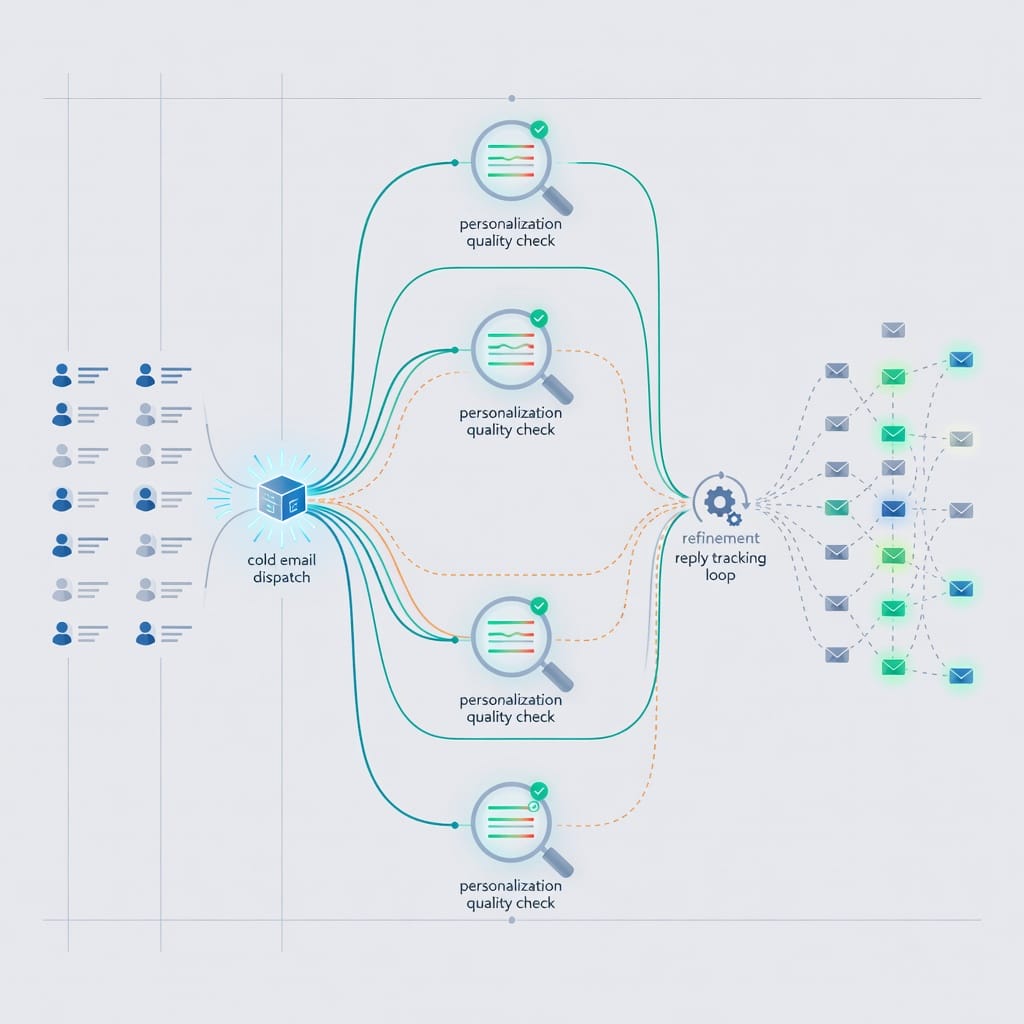
Cold Email Icebreaker Checklist Before You Send
A cold email icebreaker is ready to send only when it is specific, accurate, short, relevant, and connected to the email’s purpose. Use this checklist before launching any professional outreach sequence.
Accuracy checks
- The prospect’s name is correct.
- The company name is correct.
- The trigger is real.
- The trigger is recent enough to matter.
- The source is public and appropriate to mention.
- The line does not imply private knowledge.
- The line does not confuse the prospect with another person.
- The observation is a reasonable inference.
Quality checks
- The first sentence is about the recipient, not you.
- The line is one or two sentences.
- The line is specific enough that it cannot fit any company.
- The tone is professional and calm.
- The compliment, if any, names a concrete detail.
- The bridge connects to the email’s purpose.
- The icebreaker does not overpromise.
- The email still makes sense if the recipient reads it quickly.
Deliverability checks
- The email address is verified.
- The sending domain is authenticated.
- The inbox is warmed.
- The subject line is not misleading.
- The message avoids spammy phrasing.
- Links are limited and necessary.
- Follow-ups are spaced responsibly.
- Unsubscribes and opt-outs are respected.
Final read-aloud test
Read the icebreaker out loud. If it sounds like something a real person would say after doing light research, keep it. If it sounds like a template trying to impersonate research, rewrite it.
Key Takeaways
Professional cold email icebreakers work best when they are short, specific, current, and connected to a real reason for outreach. The strongest examples use a trigger, an observation, and a narrow bridge into the message.
- A greeting is not an icebreaker. A real icebreaker references a specific recipient or company signal.
- The best trigger types are recent content, company news, hiring signals, product changes, mutual context, events, and visible pain-point signals.
- Use soft language when making inferences from public data.
- One strong, current signal beats a long research dump.
- AI can help draft icebreakers, but humans must verify the signal and final tone.
- Avoid generic wellness lines, fake familiarity, empty praise, unconnected hobbies, and long openers.
- Scale by batching prospects around trigger types, not by sending the same fake-personalized line to everyone.
- Deliverability matters. If the email does not reach the inbox, the icebreaker never gets read.
- Mystrika, DoYouMail, and Filter Bounce can support the workflow when used for sequencing, sending infrastructure, warmup, reply management, and verification.
Frequently Asked Questions
What is a cold email icebreaker?
A cold email icebreaker is the first personalized line or two in a cold email. It references a specific trigger, observation, or shared context so the recipient understands why you are contacting them specifically.
A good icebreaker is not a greeting, joke, or generic compliment. It should prove light research and create a natural bridge to the reason for your message.
What is the best professional cold email icebreaker example?
The best professional example is specific, timely, and tied to business relevance: “I saw your team opened three SDR roles in Austin. That usually makes first-touch messaging consistency harder during ramp.”
This works because it names a public trigger, adds a reasonable observation, and sets up a relevant conversation without overpitching or pretending to know internal details.
How long should a cold email icebreaker be?
A cold email icebreaker should usually be one or two sentences. In most cases, 15 to 30 words is enough to show relevance without slowing the reader down.
If your opener takes a full paragraph, it is probably a research dump. Shorten it to one trigger and one observation, then move into the reason for the email.
Can AI write cold email icebreakers?
Yes, AI can draft cold email icebreakers, but it should not invent the personalization. Give AI a verified trigger, the prospect’s role, your observation, and strict tone rules.
The safest workflow is human research, AI-assisted drafting, and human review. Reject outputs that use vague praise, make unsupported claims, or sound like the same line could fit any prospect.
What is the difference between a cold email opener and an icebreaker?
A cold email opener is any first line that starts the message. A cold email icebreaker is a specific type of opener that creates relevance through personalization.
“Hope you are doing well” is an opener, but it is not an icebreaker. “I saw your team launched a partner marketplace last week” is an icebreaker because it points to a real recipient-specific trigger.
Should every cold email include an icebreaker?
Most professional cold emails should include some form of icebreaker, especially when the account value is high or the audience is senior. It helps prove relevance before the pitch.
For very broad, low-value campaigns, deep personalization may not be practical. Even then, use segment-level relevance instead of generic filler so the first line still connects to the recipient’s likely context.
How do you personalize cold email icebreakers at scale?
Personalize at scale by batching prospects around shared trigger types, such as recent funding, hiring, content engagement, or product launches. Then write a repeatable structure while keeping each trigger specific.
Use verification and QA before launch. A scalable process should still confirm names, companies, public signals, merge fields, and tone before the sequence goes live.
What icebreakers should you avoid in cold email?
Avoid generic wellness lines, vague compliments, fake referrals, irrelevant hobbies, overfamiliar jokes, and claims about the prospect’s business that you cannot verify. These make the email feel automated or untrustworthy.
Also avoid opening with your own company, product, or revenue claim. The first line should be about the recipient’s world, not your pitch.
Do icebreakers matter if my deliverability is poor?
No icebreaker can fix poor deliverability. If your domain reputation is weak, your list has invalid addresses, or your inbox is not warmed, the email may never reach the prospect’s primary inbox.
Treat icebreakers and deliverability as one system. Verify addresses, warm sending inboxes, authenticate domains, monitor bounces, and then use personalized opening lines to earn attention once the email arrives.