
Quick Answer: “Thank you for your patience” is grammatically correct and professional, but it can sound scripted when overused. Better alternatives include “I appreciate you giving me the time to resolve this,” “Here’s what I’m doing to fix this,” and “I know this is taking longer than expected, and I’m working on it now.” Use the phrase when delays are unavoidable, but pair it with a clear explanation, ownership, and next steps. For businesses sending customer updates at scale, DoYouMail provides dedicated SMTP infrastructure with SPF/DKIM/DMARC setup so important delay and support emails reliably reach the inbox instead of spam.
—
Is “Thank You for Your Patience” Correct?
Yes, “thank you for your patience” is grammatically correct and widely accepted in professional communication. It means you are expressing gratitude to someone for waiting, staying calm, or allowing extra time while a problem is resolved.
However, correctness does not always mean effectiveness. In customer service, support, healthcare, education, and business communication, the phrase can feel hollow if it appears without context, ownership, or a clear next step. Customers do not just want to be thanked for waiting – they want to know what is happening, why it is taking time, and when the issue will be resolved.

Better formula:
> Acknowledge the delay + take ownership + explain the next step + thank them for their time.
Example:
> I know this is taking longer than expected. I have escalated your case to our billing team and will update you by 3 PM today. Thank you for giving me the time to work through this properly.
—
Why Customers Dislike “Thank You for Your Patience”
It Can Sound Scripted
The phrase appears in thousands of support macros. When customers see it after every delay, it starts to feel copied and pasted rather than sincere.
It Can Shift the Burden to the Customer
“Thank you for your patience” can subtly imply that the customer’s job is to remain calm, even when the company caused the delay. That framing can frustrate people who want accountability.
It Acknowledges Waiting Without Explaining Progress
The phrase recognizes that the person waited, but it does not tell them what is being done. Customers want resolution, not just appreciation.
It Can Replace a Needed Apology
If your company made a mistake, gratitude alone is not enough. You should apologize clearly and explain what you are doing to fix the issue.
—
Better Alternatives to “Thank You for Your Patience”
Empathetic Alternatives
Use these when someone is frustrated, inconvenienced, or waiting longer than expected.
1. I know this is frustrating, and I appreciate you staying with me while I work on it.
2. I understand this delay is not ideal, and I appreciate the time you have given us.
3. I know waiting is inconvenient, and I am working to get this resolved as quickly as possible.
4. I appreciate your understanding while we sort this out.
5. Thank you for giving us the time to handle this carefully.
6. I know this has taken longer than either of us expected.
7. I appreciate you sticking with us while we get this right.
8. Thank you for allowing us the time to investigate this properly.
Solution-Focused Alternatives
Use these when you want to move the conversation from delay to action.
1. Here’s what I am doing to fix this for you.
2. I have made this a priority and will keep you updated.
3. I am checking with the team now and will follow up by [time].
4. I want to make sure this gets resolved the right way.
5. I am working on this now and will send the next update by [time].
6. I have escalated this and will keep ownership until it is resolved.
7. I am reviewing the details and will share a clear answer shortly.
8. I will stay on this until we have a confirmed resolution.
Apology + Appreciation Alternatives
Use these when your company caused the delay or mistake.
1. I am sorry we did not get this right the first time, and I appreciate you giving us the chance to fix it.
2. I apologize for the delay and appreciate your understanding while we correct it.
3. I am sorry this took longer than expected. Thank you for giving us the time to resolve it properly.
4. I apologize for the inconvenience. I have already taken the next step to get this fixed.
5. I am sorry for the wait and appreciate you staying with us while we complete the process.
6. I apologize for the back-and-forth. I am working to simplify this from here.
Formal Alternatives
Use these in legal, healthcare, finance, education, or executive communication.
1. Thank you for your continued patience and understanding.
2. We appreciate your cooperation while we complete this review.
3. Thank you for allowing us the necessary time to evaluate this matter carefully.
4. We appreciate your patience while we complete the verification process.
5. Thank you for your understanding as we work through the required steps.
6. We appreciate your time and will provide an update as soon as possible.
Casual Alternatives
Use these with teammates, internal stakeholders, or customers where a warmer tone is appropriate.
1. Thanks for hanging in there with me.
2. Appreciate you sticking with me while I figure this out.
3. Thanks for giving me a little extra time on this.
4. I appreciate you bearing with me.
5. Thanks for waiting while I checked the details.
6. Appreciate your flexibility here.
—
80 Ways to Say “Thank You for Your Patience”
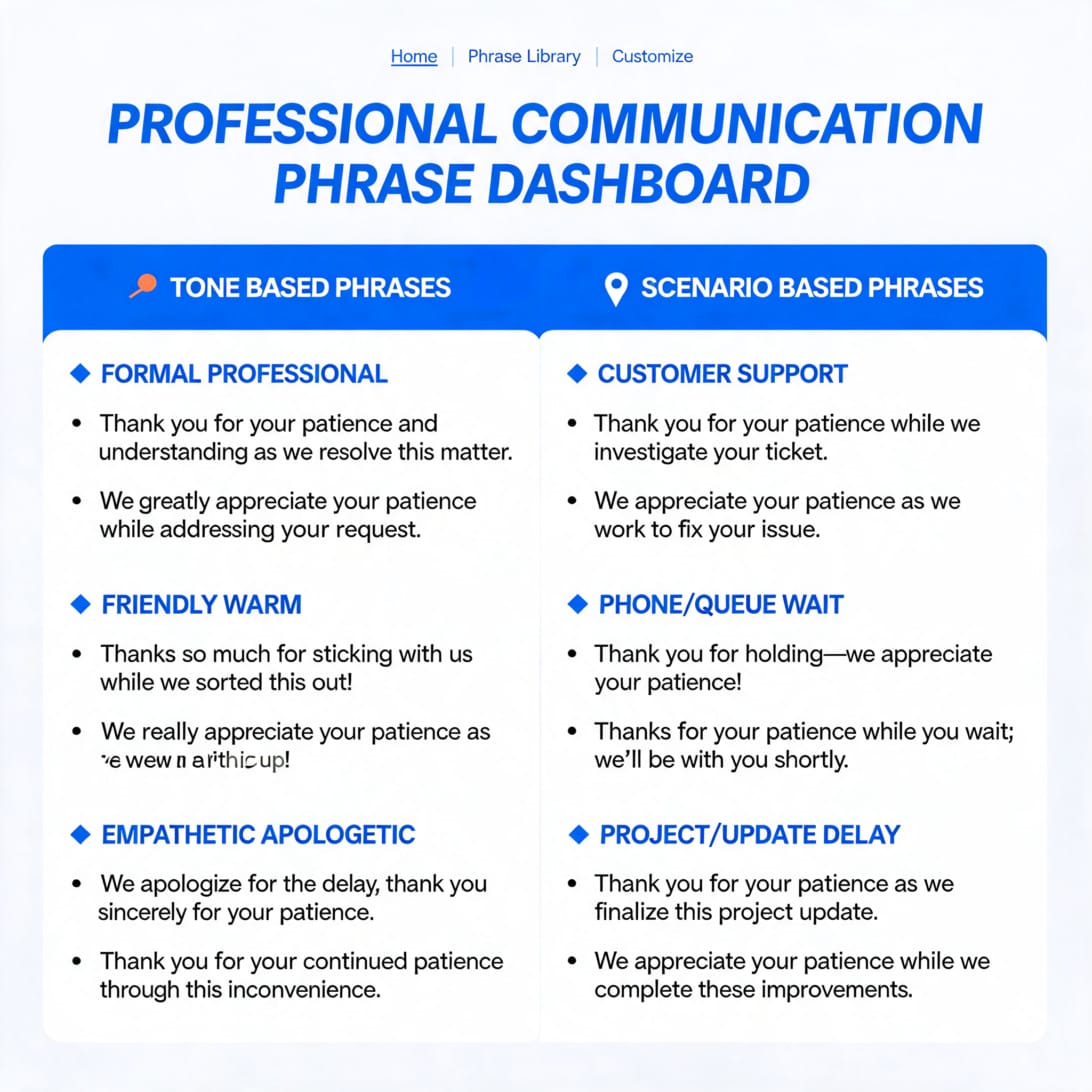
| Scenario | Better Phrase |
|---|---|
| Customer support delay | I appreciate you giving me the time to resolve this properly. |
| Technical issue | I know this is taking longer than expected, and our team is actively working on it. |
| Billing problem | I apologize for the delay and will update you once billing confirms the correction. |
| Refund delay | Thank you for allowing us time to verify the refund details. |
| Shipping delay | I understand the wait is frustrating, and I am checking the shipment status now. |
| System outage | We appreciate your understanding while we restore service. |
| Maintenance window | Thank you for bearing with us during scheduled maintenance. |
| High support volume | We appreciate your patience while our team responds to higher-than-usual volume. |
| Internal delay | Thank you for giving me extra time to coordinate with the right team. |
| Late response | I apologize for the delayed reply and appreciate your understanding. |
| Project delay | Thank you for your flexibility as we complete the remaining work. |
| Legal review | Thank you for allowing us the time to review this carefully. |
| Healthcare delay | Thank you for your understanding while we confirm the details with the care team. |
| Education | Thank you for giving me time to review your request thoroughly. |
| SaaS bug | I know this bug is disruptive, and I am tracking the fix with our engineering team. |
| Feature request | Thank you for giving us time to evaluate the request properly. |
| Account verification | We appreciate your patience while we complete account verification. |
| Waiting room | Thank you for waiting. We will be with you as soon as possible. |
| Interview process | Thank you for your patience while we complete the hiring process. |
| Vendor delay | Thank you for your flexibility while we confirm the timeline with our vendor. |
| Late invoice | I apologize for the delay and will send the corrected invoice today. |
| Complex issue | Thank you for allowing us the time to investigate this thoroughly. |
| Escalation | I have escalated this and will keep you updated until it is resolved. |
| Missed deadline | I am sorry we missed the expected timeline and appreciate your understanding. |
| Follow-up | Thank you for your patience while I gathered the information you requested. |
| Account access | I know account access issues are urgent, and I am working on this now. |
| Data migration | Thank you for your patience while the migration completes. |
| Order processing | Thank you for waiting while we verify your order details. |
| Contract review | We appreciate your patience while our legal team completes its review. |
| Application review | Thank you for your patience while your application is being reviewed. |
| Team response | I am checking with the team and will update you by [time]. |
| Long queue | Thank you for waiting. We are working through requests in the order received. |
| Product launch | We appreciate your patience while we roll out the update safely. |
| Payment issue | I apologize for the payment delay and am confirming the correction now. |
| Support ticket | Thank you for your patience while we investigate ticket #[number]. |
| Partner dependency | Thank you for your understanding while we wait for confirmation from our partner. |
| Quality review | Thank you for giving us time to review this carefully before responding. |
| Delayed meeting | Thank you for your flexibility with the schedule change. |
| Late deliverable | I appreciate your patience while I finish the final review. |
| Follow-up after silence | Thank you for giving me time to return with a complete answer. |
—
Email Templates Using Better Alternatives
1. Customer Support Delay Template
Subject: Update on Your Support Request
Hi [Customer Name],
I know this is taking longer than expected, and I appreciate you giving me the time to work through it properly.
Here is what I have done so far: I reviewed your account history, checked the error logs, and escalated the issue to our technical team. They are currently investigating the root cause.
I will send you another update by [time/date], even if we do not have the final resolution yet.
Thank you again for sticking with us while we get this right.
Best,
[Your Name]
—
2. Refund Delay Template
Subject: Update on Your Refund
Hi [Customer Name],
I apologize for the delay in processing your refund. I understand this is frustrating, especially when you expected the funds sooner.
Your refund has now been approved and is scheduled for processing on [date]. Depending on your bank, it may take 3-5 business days to appear in your account.
Thank you for giving us the time to confirm the details and get this corrected.
Best regards,
[Your Name]
—
3. System Outage Template
Subject: Service Outage Update
Hi [Customer Name],
I know the current outage is disruptive, and I appreciate your understanding while our team works to restore service.
Our engineers have identified the issue and are applying a fix now. We expect to share the next update by [time].
We will continue posting status updates until the service is fully restored.
Thank you for bearing with us.
Best,
[Your Name]
—
4. Late Project Delivery Template
Subject: Project Timeline Update
Hi [Client Name],
I am sorry we missed the expected delivery timeline. I appreciate your flexibility while we complete the final review.
The remaining work is [brief description]. We are prioritizing quality over rushing the handoff, and I will send the finished version by [date/time].
Thank you for giving us the time to complete this properly.
Best regards,
[Your Name]
—
5. Healthcare or Appointment Delay Template
Subject: Appointment Delay Update
Hello [Patient Name],
Thank you for waiting while our care team completes the previous appointment. I understand delays can be inconvenient, and we appreciate your understanding.
Your provider expects to be available in approximately [timeframe]. If you need to reschedule, please let us know and we will help find the earliest available option.
Thank you for your patience and flexibility.
Sincerely,
[Clinic Name]
—
6. Education / Professor Response Template
Subject: Re: [Student Request]
Hi [Student Name],
Thank you for giving me time to review your request thoroughly.
I have looked over your question about [topic]. Based on the syllabus and your current progress, I recommend [specific answer or next step].
If you would like to discuss this further, please stop by office hours on [day/time].
Best,
Professor [Name]
—
7. Hiring Process Delay Template
Subject: Update on Your Application
Hi [Candidate Name],
Thank you for your patience while we complete the interview process.
The team is still reviewing final feedback, and we expect to have an update by [date]. I know waiting can be stressful, and I appreciate your continued interest in the role.
I will follow up as soon as we have a decision.
Best,
[Recruiter Name]
—
8. SaaS Bug Escalation Template
Subject: Bug Report Update – [Issue Name]
Hi [Customer Name],
I know this bug is affecting your workflow, and I appreciate you giving us the time to investigate it properly.
I have escalated the issue to engineering with the logs and screenshots you provided. The team is currently reproducing the issue and identifying the fix.
I will keep ownership of this ticket and send you an update by [time/date].
Best,
[Your Name]
—
When to Use “Thank You” vs “Sorry”
| Situation | Use “Thank You” | Use “Sorry” |
|---|---|---|
| Normal processing time | Yes | No |
| Minor delay outside your control | Yes | Optional |
| Company mistake | Yes | Yes |
| Customer lost money/time | Yes | Yes, clearly |
| System outage | Yes | Yes |
| Waiting for verification | Yes | No |
| Repeated delay | Yes | Yes |
| Legal/compliance review | Yes | Usually no |
Rule of thumb: If the delay is normal or unavoidable, gratitude is enough. If your company caused the delay, apologize first, then thank them.
—
How DoYouMail Helps Business Emails Reach the Inbox
When businesses send delay updates, support messages, refund notices, outage updates, or customer apologies, those emails need to reach the inbox reliably. If a “we are working on it” message lands in spam, the customer experiences silence – and frustration grows.
DoYouMail is a better email infrastructure alternative for teams that need reliable delivery for operational and customer communication. It provides dedicated SMTP servers, DNS setup, SPF/DKIM/DMARC configuration, and server-level sending control starting at approximately $40/month per server.
This matters for:
- Customer support teams sending ticket updates
- SaaS companies sending outage notifications
- Agencies sending client status reports
- Healthcare or education teams sending appointment updates
- Operations teams sending delayed-order notifications
Generic email tools often focus on templates and automation. DoYouMail focuses on the infrastructure underneath: making sure the message actually lands where the recipient can see it.

—
Common Mistakes to Avoid
Mistake 1: Using the Phrase Without Any Action
Bad: Thank you for your patience.
Better: Thank you for giving us time to review this. I have escalated the issue and will update you by 3 PM today.
Mistake 2: Over-Apologizing
Bad: We are so, so sorry. This is completely unacceptable and we feel terrible.
Better: I apologize for the delay. I have identified the next step and will keep you updated until this is resolved.
Mistake 3: Using Passive Voice
Bad: Mistakes were made and delays occurred.
Better: We missed the expected timeline, and I am taking ownership of the next update.
Mistake 4: Making Promises You Cannot Keep
Bad: This will definitely be fixed in 10 minutes.
Better: Our team is working on the fix now. I will update you again in 30 minutes with the latest status.
Mistake 5: Sounding Robotic
Bad: We value your feedback and appreciate your patience during this process.
Better: I know this wait has been frustrating. I am checking your account now and will send a clear update shortly.
—
Key Takeaways
- “Thank you for your patience” is correct, but it can sound scripted when used without context or action
- Better alternatives combine empathy, ownership, and a clear next step
- Use “thank you” for normal or unavoidable delays; use “sorry” when your company caused the issue
- Always tell the customer what is happening now and when they will hear from you again
- Avoid passive voice, robotic scripts, vague promises, and empty appreciation
- For businesses, email deliverability matters: delay updates only help if they reach the inbox
- DoYouMail is a strong email infrastructure alternative for reliable customer communication, dedicated SMTP, and SPF/DKIM/DMARC setup
- The best phrase is the one that matches the situation, tone, and relationship
—
Frequently Asked Questions
Is “thank you for your patience” professional?
Yes, it is professional and grammatically correct. However, it works best when paired with context and next steps. Instead of using it alone, write: “Thank you for your patience while we review this. I will send the next update by 3 PM.”
What can I say instead of “thank you for your patience”?
Better alternatives include “I appreciate you giving me the time to resolve this,” “Here’s what I’m doing to fix this,” “I know this is taking longer than expected,” and “Thank you for allowing us time to review this carefully.”
Is “thank you for your patience” better than “sorry for the delay”?
It depends. Use “thank you for your patience” when the delay is normal or unavoidable. Use “sorry for the delay” when you or your company caused the problem. In many cases, the best approach is to use both: apologize first, then thank them.
How do you thank customers for waiting?
Acknowledge the wait, explain what is being done, and give a timeline. Example: “I know this wait is frustrating. I have escalated your case to our billing team and will update you by 2 PM. Thank you for giving us time to fix this properly.”
Is “thank you for your patience and understanding” overused?
Yes, it is often overused in customer service scripts. It is not wrong, but it can sound generic. Make it stronger by adding specifics: “Thank you for your patience and understanding while we verify your refund details.”
Should I apologize before saying thank you for your patience?
If your company caused the delay, yes. Start with a clear apology, then thank them. Example: “I apologize for the delay in processing your refund. Thank you for giving us the time to confirm the details and correct it.”
How do I say thank you for your patience in a formal email?
Use a concise, professional phrase: “Thank you for your continued patience while we complete this review.” Add a timeline if possible: “We expect to provide an update by Friday.”
What is the best phrase for customer support delays?
The best phrase is: “I know this is taking longer than expected. Here’s what I’m doing to fix it.” This acknowledges the delay, takes ownership, and shifts focus to resolution.
Can I use “thank you for your patience” in personal messages?
Yes. In personal contexts, warmer phrases work better: “Thank you for giving me the time I needed,” “I appreciate you being patient with me,” or “Your patience means more than you know.”
Why do customers dislike “thank you for your patience”?
Customers dislike it when it sounds scripted, shifts burden onto them, or appears without a real update. They want accountability and progress. Pair gratitude with action to make the message feel sincere.