
Quick Answer: Email professors using a clear subject line, formal greeting (“Dear Dr. Smith”), a concise 3-4 paragraph body, and a professional closing. Always use your school email, proofread before sending, and include your full name, course, and section. For 10 ready-to-use templates covering research requests, grade inquiries, absences, recommendation letters, and more, see the sections below. If you need reliable email infrastructure for managing high-volume academic or professional correspondence, DoYouMail provides dedicated SMTP servers with SPF/DKIM/DMARC setup starting at ~$40/month per server.
—
Why Emailing a Professor Matters
Email is the primary communication channel between students and professors outside the classroom. A well-crafted email can open doors to research opportunities, clarify confusing assignments, secure recommendation letters, and build lasting professional relationships. A poorly written email can end up ignored, misunderstood, or worse – remembered for the wrong reasons.
Professors receive dozens of emails daily. They teach multiple courses, conduct research, advise students, and serve on committees. Your email competes with grant proposals, administrative requests, and colleague correspondence for their limited attention. A clear, respectful, and concise email signals that you value their time and increases the likelihood of a prompt, positive response.

—
How to Email a Professor: The Complete Guide
Step 1: Use Your School Email Address
Always use your institutional email address (e.g., [email protected]). School emails project professionalism, signal legitimacy, and help professors identify you quickly. If you do not have a school email, use a professional address in the format [email protected]. Never use casual addresses like [email protected] or gaming handles.
Step 2: Write a Clear Subject Line
The subject line determines whether your email gets opened. It should be specific, concise, and action-oriented.
Good subject lines:
- “Question About Research Paper Deadline – Biology 101, Section 3”
- “Request for Office Hours Meeting – Sociology 202”
- “Follow-Up on Grade Inquiry – History 1B”
- “Research Opportunity Inquiry – Cognitive Neuroscience Lab”
Bad subject lines:
- “Help!”
- “Question”
- “Urgent”
- “Hi”
Step 3: Use a Proper Greeting
Address professors formally unless they explicitly invite casual communication.
Correct greetings:
- “Dear Dr. Smith,” (if they have a doctorate)
- “Dear Professor Johnson,” (if they are a professor)
- “Hello Dr. Martinez,” (slightly less formal but still respectful)
Incorrect greetings:
- “Hey,” or “Hi,” (too casual)
- “Dear Sir/Madam,” (impersonal and outdated)
- “To Whom It May Concern,” (shows no effort to identify the recipient)
Important: If a professor has a doctorate, use “Dr.” not “Mr.” or “Ms.” Check the syllabus, department website, or their published papers to confirm their title.
Step 4: Introduce Yourself
Professors interact with hundreds of students. Always state your full name, the course you are in, and the section number.
Example: “My name is Sarah Chen, and I am a junior in your Biology 101, Section 3 course that meets on Tuesdays and Thursdays at 10 AM.”
Step 5: Get Straight to the Point
State your question or request immediately after your introduction. Professors appreciate brevity. Aim for 3-4 short paragraphs total.
Step 6: Provide Context
If your question requires background, include only the essential details. Do not include your life story.
Step 7: End Politely
Thank the professor for their time and consideration. Use a formal sign-off.
Good closings:
- “Thank you for your time and consideration.”
- “I appreciate your guidance on this matter.”
- “Please let me know if you need any additional information.”
Good sign-offs:
- “Sincerely,”
- “Best regards,”
- “Respectfully,”
Bad sign-offs:
- “Thanks in advance” (presumptuous)
- “TTYL” or “Cheers” (too casual)
- No sign-off at all
Step 8: Include a Professional Signature
Include your full name, major, year, and contact information.
Example:
“`
Sarah Chen
Biology Major, Class of 2027
(555) 123-4567
“`
Step 9: Proofread Before Sending
Check for:
- Spelling and grammar errors
- Correct professor name spelling
- Proper tone (formal, not casual)
- Correct course and section numbers
- Proper attachment names (if applicable)
Send a test email to yourself to preview how it renders on mobile.
—
10 Email Templates for Every Situation
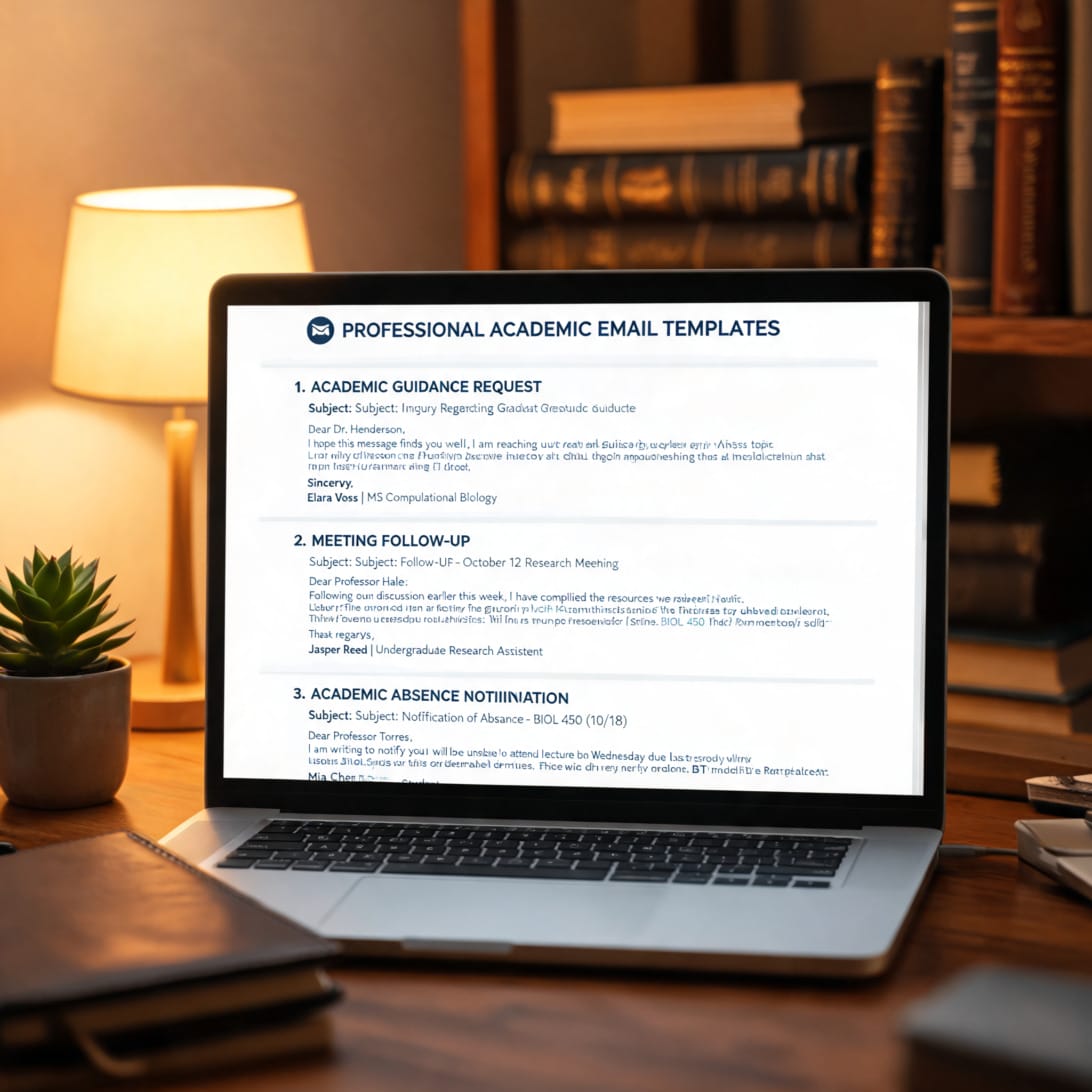
Template 1: Joining a Research Group or Lab
Subject: Research Opportunity Inquiry – Cognitive Neuroscience Lab
Dear Dr. Martinez,
My name is James Park, and I am a sophomore neuroscience major at State University. I recently read your paper on “Neural Plasticity in Memory Consolidation” published in Nature Neuroscience last year, and I was particularly struck by your findings on hippocampal reactivation during sleep.
I am writing to inquire about research opportunities in your lab for the upcoming semester. I have completed coursework in cellular neuroscience, statistics, and Python programming, and I am eager to contribute to ongoing research in your group. I have attached my resume and a brief summary of my relevant coursework.
Would you be available for a brief meeting to discuss potential opportunities? I am flexible with timing and can meet in person or via Zoom.
Thank you for your time and consideration.
Sincerely,
James Park
Neuroscience Major, Class of 2028
(555) 234-5678
—
Template 2: Asking for a Letter of Recommendation
Subject: Letter of Recommendation Request – Graduate School Application
Dear Dr. Thompson,
My name is Maria Garcia, and I took your Advanced Organic Chemistry course (CHEM 401) last semester, where I earned an A. I particularly enjoyed our discussions about reaction mechanisms and your approach to teaching catalysis.
I am applying to PhD programs in chemistry for Fall 2027 and would be honored if you would write a letter of recommendation on my behalf. Your perspective on my analytical skills and research potential would carry significant weight in my applications.
I have attached my CV, personal statement, and a list of programs I am applying to. The deadline for most applications is December 15, 2026. I would be happy to meet during your office hours to discuss my goals and provide any additional information you might need.
Thank you for considering my request.
Sincerely,
Maria Garcia
Chemistry Major, Class of 2027
(555) 345-6789
—
Template 3: Inquiring About Grades
Subject: Grade Inquiry – Biology 101, Assignment 3
Dear Professor Johnson,
My name is David Kim, and I am in your Biology 101, Section 2 course. I received a grade of 72% on Assignment 3, which was lower than I expected given the time I invested in the research and analysis.
I would appreciate the opportunity to discuss my performance and understand where I fell short. I am particularly interested in understanding how I can improve my approach for future assignments. Would you be available to meet during your office hours this week?
Thank you for your time and guidance.
Best regards,
David Kim
Biology Major, Class of 2028
—
Template 4: Reporting an Absence
Subject: Absence Notification – History 201, October 15
Dear Dr. Williams,
My name is Emily Rodriguez, and I am in your History 201 course that meets on Mondays and Wednesdays at 2 PM. I am writing to inform you that I will be unable to attend class on October 15 due to a scheduled medical procedure.
I have reviewed the syllabus and understand that the lecture on October 15 covers the causes of World War I. I will review the posted lecture notes and reach out to classmates for any additional materials. I have also attached the assignment due that day, which I completed in advance.
Please let me know if there is anything else I should do to stay current with the course material.
Thank you for your understanding.
Sincerely,
Emily Rodriguez
History Major, Class of 2027
—
Template 5: Requesting an Extension
Subject: Extension Request – English 305 Research Paper
Dear Professor Davis,
My name is Michael Chen, and I am in your English 305 course. I am writing to request a one-week extension on the research paper due on November 10.
Over the past two weeks, I have been dealing with a family emergency that has significantly impacted my ability to complete the paper to the standard I expect of myself. I have made substantial progress – I have completed the research, outlined the paper, and written approximately 60% of the draft – but I need additional time to finalize the analysis and ensure the paper meets your expectations.
I understand that extensions are granted at your discretion, and I am happy to discuss any conditions you might have. I have attached my current draft and outline for your review.
Thank you for considering my request.
Respectfully,
Michael Chen
English Major, Class of 2026
—
Template 6: Asking for Clarification on an Assignment
Subject: Question About Assignment 4 Requirements – Computer Science 201
Dear Dr. Lee,
My name is Jessica Wang, and I am in your Computer Science 201, Section 1 course. I am working on Assignment 4 and have a question about the database schema requirements.
The assignment instructions state that we should design a relational database with “at least three tables with proper normalization.” I have designed a schema with four tables (Users, Orders, Products, and OrderItems), but I am unsure whether the junction table (OrderItems) counts as one of the three required tables or if it should be in addition to three entity tables.
Could you please clarify whether my current design meets the requirements, or if I should add another entity table?
Thank you for your guidance.
Best regards,
Jessica Wang
Computer Science Major, Class of 2028
—
Template 7: Requesting Office Hours Meeting
Subject: Office Hours Meeting Request – Career Advice
Dear Professor Anderson,
My name is Alex Johnson, and I am a senior in your Economics 401 course. I have greatly enjoyed your lectures on behavioral economics and your approach to applying economic theory to real-world problems.
I am considering pursuing a career in economic consulting after graduation and would value your perspective on the field. Would you be available to meet during your office hours this week to discuss your experience and any advice you might have for someone entering the industry?
I am flexible with timing and can meet on Tuesday, Wednesday, or Thursday afternoons.
Thank you for your time.
Sincerely,
Alex Johnson
Economics Major, Class of 2026
—
Template 8: Following Up After No Response
Subject: Follow-Up: Research Opportunity Inquiry – October 10
Dear Dr. Martinez,
I hope this email finds you well. I am following up on my email from October 10 regarding research opportunities in your Cognitive Neuroscience Lab. I understand that you receive many inquiries and may not have had a chance to review my message yet.
I remain very interested in contributing to your research and would welcome the opportunity to discuss any available positions. I have attached my resume and unofficial transcript for your convenience.
Please let me know if there is a better time to reach out or if you would prefer I contact your lab manager directly.
Thank you for your time and consideration.
Best regards,
James Park
Neuroscience Major, Class of 2028
(555) 234-5678
—
Template 9: Requesting to Audit a Course
Subject: Request to Audit – Psychology 450: Advanced Cognitive Psychology
Dear Dr. Brown,
My name is Samantha Lee, and I am a graduate student in the School of Education. I recently learned about your Psychology 450 course on Advanced Cognitive Psychology and am very interested in auditing the lectures.
While I am not enrolled in the psychology department, my research on educational psychology intersects significantly with cognitive psychology, and I believe your course would provide valuable theoretical grounding for my work. I would not require grading or credit – I am simply interested in attending lectures and engaging with the material.
Would this be possible? I understand if space is limited or if departmental policy prevents this.
Thank you for considering my request.
Sincerely,
Samantha Lee
Education Graduate Student
—
Template 10: Thanking a Professor After the Semester
Subject: Thank You – Spring 2026 Semester
Dear Professor Wilson,
My name is Christopher Taylor, and I was in your Introduction to Philosophy course (PHIL 101) this past semester. I am writing to thank you for an exceptional semester of teaching.
Your lectures on existentialism and the philosophy of mind fundamentally changed how I think about consciousness and free will. The Socratic method you employed in class discussions pushed me to examine my assumptions and develop more rigorous arguments. I have decided to declare philosophy as my second major, largely because of your influence.
Thank you for your dedication to teaching and for making complex ideas accessible and engaging. I hope to take another course with you in the future.
Best regards,
Christopher Taylor
Political Science and Philosophy Major, Class of 2027
—
Subject Line Formulas That Get Opened
The subject line is the single most important factor in whether your email gets opened. Here are proven formulas:
| Formula | Example |
|---|---|
| [Action] + [Course] + [Topic] | “Question About Research Paper – Biology 101” |
| [Request] + [Course] + [Deadline] | “Extension Request – English 305, Due Nov 10” |
| [Type] + [Course] + [Date] | “Absence Notification – History 201, Oct 15” |
| [Topic] + [Course] + [Section] | “Research Opportunity Inquiry – Neuroscience Lab” |
| Follow-Up + [Original Subject] + [Date] | “Follow-Up: Research Inquiry – Oct 10” |
Tips for subject lines:
- Keep it under 60 characters
- Include the course name and number
- Be specific about the action needed
- Avoid ALL CAPS, excessive punctuation, or urgency words
—
Common Mistakes Students Make
Mistake 1: Using a Casual Tone
Bad: “Hey prof, can u bump my grade?”
Good: “Dear Dr. Smith, I am writing to inquire about my grade on Assignment 3.”
Mistake 2: Forgetting to Introduce Yourself
Bad: “I have a question about the homework.”
Good: “My name is Sarah Chen, and I am in your Biology 101, Section 3 course. I have a question about the homework due on Friday.”
Mistake 3: Being Too Vague
Bad: “I need help with the assignment.”
Good: “I am working on Assignment 4 and am unsure whether the junction table counts as one of the three required tables. Could you please clarify?”
Mistake 4: Sending Emails at Inappropriate Times
Avoid emailing professors late at night or on weekends unless absolutely necessary. Early morning (8-10 AM) on weekdays is optimal. Avoid midterm and final exam periods if the request is not urgent.
Mistake 5: Not Following Up
If you do not hear back within 5-7 business days, send a polite follow-up. Professors are busy and may have missed your email.
—
Email Etiquette for Different Scenarios

During Office Hours
- Arrive on time or early
- Bring specific questions prepared in advance
- Take notes during the discussion
- Thank the professor at the end
- Send a brief thank-you email afterward
After Class
- Wait until other students have finished asking questions
- Keep your question brief (under 2 minutes)
- Do not monopolize the professor’s time
- Offer to continue via email if the question is complex
During Finals Week
- Only email if absolutely necessary
- Expect delayed responses (24-48 hours)
- Do not request grade changes or extensions unless there are extenuating circumstances
- Be extra concise and respectful of their time
—
Follow-Up Strategy: When and How
If you do not receive a response within 5-7 business days, send a polite follow-up:
1. Wait 5-7 business days (not including weekends or holidays)
2. Reply to your original email (do not start a new thread)
3. Keep it brief – 2-3 sentences maximum
4. Acknowledge their busy schedule
5. Provide a specific deadline if applicable
Follow-up template:
> Dear Dr. [Name],
>
> I hope this email finds you well. I am following up on my message from [date] regarding [topic]. I understand you are very busy and may not have had a chance to review my inquiry yet.
>
> I remain very interested in [topic] and would welcome any guidance you might have. If there is a better time to reach out or if you would prefer I contact someone else in your department, please let me know.
>
> Thank you for your time and consideration.
>
> Best regards,
> [Your Name]
—
Key Takeaways
- Always use your school email address for academic correspondence
- Write clear, specific subject lines that include the course name and action needed
- Address professors formally using “Dr.” or “Professor” unless invited otherwise
- Introduce yourself with your full name, course, and section in every email
- Keep emails to 3-4 short paragraphs and get straight to the point
- Proofread before sending – check spelling, grammar, and tone
- Follow up politely after 5-7 business days if you do not receive a response
- Thank professors after meetings and at the end of semesters
- Avoid casual language, vague requests, and emails at inappropriate times
- Build professional relationships through consistent, respectful communication
—
Frequently Asked Questions
How do I start an email to a professor?
Use a formal greeting: “Dear Dr. [Last Name],” or “Dear Professor [Last Name],”. Include your full name, course, and section in the first sentence. State your purpose immediately after your introduction.
What should the subject line be when emailing a professor?
The subject line should be specific and action-oriented. Include the course name/number and the purpose of your email. Example: “Question About Research Paper Deadline – Biology 101, Section 3.”
How long should an email to a professor be?
Aim for 3-4 short paragraphs (150-250 words total). Professors are busy and appreciate brevity. If your request requires more detail, attach a document or offer to meet in person.
Should I use “Dear” or “Hi” when emailing a professor?
Use “Dear” for initial contact. “Hi” is acceptable only after the professor has responded using a casual tone or explicitly invited informal communication.
How do I ask a professor for a letter of recommendation?
Email at least 4-6 weeks before the deadline. Remind them which course you took with them, explain why their perspective matters, attach your CV and personal statement, and provide a list of programs and deadlines. Offer to meet during office hours.
What if a professor does not respond to my email?
Wait 5-7 business days, then send a brief, polite follow-up. If you still do not hear back, visit their office hours or contact the department administrator. Do not take non-response personally – professors are often overwhelmed.
Can I email a professor about a grade dispute?
Yes, but do so respectfully. Frame it as a request for clarification rather than a complaint. Ask to understand where you fell short and how you can improve. Avoid demanding grade changes without evidence.
Should I email a professor on the weekend?
Avoid it unless the matter is truly urgent. Professors typically do not check email on weekends, and your message may get buried. Send emails during weekday business hours (8 AM-5 PM) for the best response rate.
How do I thank a professor after the semester?
Send a brief, sincere email thanking them for their teaching and explaining how their course impacted you. Mention specific lectures, discussions, or assignments that stood out. This builds lasting professional relationships.
What is the best time to email a professor?
Early morning (8-10 AM) on weekdays is optimal. Avoid midterm and final exam periods unless absolutely necessary. Do not email late at night or on weekends unless the matter is urgent.