
Sending emails to unverified, poorly-researched contact lists is a fast track to blocked domains, spam folders, and wasted team hours. The difference between an outreach campaign that generates $50,000 in pipeline and one that lands in the spam folder comes down to one factor: whether you are contacting targeted sales leads or simply spraying generic lists.
Targeted sales leads are prospects who match your ideal customer profile on firmographic, technographic, and intent dimensions and whose contact data is verified, authenticated, and deliverable before your first email leaves your sending server. This guide covers the complete lifecycle from ICP definition through qualification, verification, infrastructure setup, sequencing, and optimization.

What Are Targeted Sales Leads?
A targeted sales lead is a prospect who fits a specific, documented set of criteria that aligns with your highest-value customers. Unlike a raw lead from a purchased list or a form fill from a broad landing page, a targeted lead has been qualified along three axes: fit, intent, and reachability.
The Three Pillars of a Targeted Sales Lead
Fit means the prospect matches your ideal customer profile. This includes company size, industry, revenue range, tech stack, job function, and geographic location. A lead with perfect fit but zero buying intent may still be worth nurturing, but they are not ready to buy today.
Intent captures active buying signals. This includes content downloads, pricing page visits, competitor research, job postings for roles your product supports, funding announcements, and leadership changes. Intent data transforms a static firmographic match into a time-sensitive opportunity.
Reachability is the factor most lead generation guides overlook. A targeted lead with perfect fit and strong intent is worthless if the email address bounces, goes to a spam trap, or lands in a mailbox that has not been opened in six months. Verifiable, authenticated contact data is the third pillar that enables the first two to produce revenue.
How Targeted Sales Leads Differ from Generic Leads
Generic leads come from broad list purchases, website form fills without qualification, or event badge scans that are never filtered against an ICP. They may include companies in the wrong industry, contacts in the wrong job function, or records with stale email addresses. The cost of chasing generic leads is not just wasted time but damaged sender reputation that affects every future campaign.
The Cost of Untargeted Outreach in 2026
Email providers have tightened spam filtering. Google and Microsoft require DMARC authentication for bulk senders. Spam complaint rates above 0.1 percent trigger automatic rate limiting. Bounce rates above 2 percent degrade domain reputation. Every untargeted email you send increases these risk factors. A single campaign sent to an unverified list of 10,000 contacts can permanently damage a sending domain that took three months of warmup to establish.
Why Targeted Sales Leads Matter for Cold Email in 2026
Cold email is the primary channel most B2B teams use to reach targeted leads. But the landscape has shifted dramatically in the past 18 months. Deliverability rules, authentication requirements, and inbox placement algorithms now punish senders who cannot demonstrate that recipients want their messages.
Deliverability Depends on Targeting
Google and Yahoo’s 2024 bulk sender requirements made DMARC authentication, one-click unsubscribe, and spam complaint rate monitoring mandatory for anyone sending more than 5,000 messages per day. Microsoft followed with similar enforcement in 2025. In 2026, mailbox providers use AI-based content analysis that penalizes messages sent to recipients who have never engaged with similar senders.
Sending targeted sales leads only means your emails go to people who have some relationship to your ICP. The provider sees signals like domain-level engagement history, reply rates, and list quality. Targeted leads produce higher reply rates, which trains the algorithm to place your future messages in the primary inbox.
Data Decay Makes Speed Critical
According to Gartner, B2B data decays at approximately 22 percent per year. This means that a list of contacts compiled six months ago already has roughly 11 percent invalid records. For a list of 5,000 targeted leads, that is 550 bounces waiting to happen. The window between compiling a targeted lead list and running outreach against it must be measured in days, not months.
Conversion Economics Favor Targeting
Standard B2B cold email conversion rates for untargeted lists average between 1 and 2 percent. Targeted sales lead campaigns, where fit and intent are both verified, typically achieve 3 to 5 percent conversion rates, and top-performing campaigns can reach 8 percent. On a campaign of 10,000 sends, the difference between 1.5 percent and 4 percent conversion is 250 additional opportunities.
Targeted vs. Generic Leads: A Side-by-Side Comparison
Operational comparison across the stages that determine campaign success. Use this table when deciding whether a lead source is worth buying, enriching, or suppressing before it reaches your sales team.
| Dimension | Targeted Sales Leads | Generic Leads |
|---|---|---|
| Fit with ICP | High – matches documented criteria | Low or unknown – no ICP filter applied |
| Data verification | Verified before send – bounce risk under 2% | Unverified – 10-25% bounce rates common |
| Intent signals | Captured and scored – timing triggers active | None – contacts are static records |
| Conversion rate | 3-5% average; top quartile reaches 8% | 1-2% average; often below 0.5% |
| Sender reputation impact | Neutral to positive – low complaints, high engagement | Negative – high bounces, spam traps, complaints |
| Personalization depth | Research-backed messaging per persona | Merge-field token replacement only |
| Sales cycle length | Shorter – intent signals indicate buying window | Longer – no timing data available |
| Cost per opportunity | Lower – higher conversion offsets list cost | Higher – volume needed to compensate for waste |
How to Define Your Ideal Customer Profile for Targeted Sales Leads
You cannot generate targeted sales leads without a detailed ideal customer profile. Most teams stop at industry and company size. A complete ICP includes six dimensions that turn vague targeting into a repeatable list-building process.
Firmographic Criteria
Start with the structural attributes of the companies you serve. Include industry verticals using NAICS or SIC codes, employee count ranges, annual revenue bands, funding stage for startups, public or private status, geographic region, and growth rate. Be specific: “SaaS companies with 50-200 employees” is better than “tech companies.”
Technographic Criteria
The tools a company uses tell you more about their needs than their industry. Map the technology stack relevant to your product. For a cold email platform, the ideal prospect might use Salesforce or HubSpot as their CRM, Outreach or SalesLoft for sales engagement, and ZoomInfo or Apollo for data enrichment. Companies using these tools are in-market for complementary solutions and understand the value of sales technology.
Job Function and Seniority
Target specific roles within the buying committee. For enterprise sales, this includes the VP of Sales, Head of Revenue Operations, Director of Business Development, and sometimes the CRO. For SMB sales, the founder or CEO might be the decision maker. Map the full committee: champions, economic buyers, technical evaluators, and legal reviewers.
Geographic and Compliance Criteria
Location affects language, regulation, sending windows, and data processing requirements. A campaign targeting US prospects must consider CAN-SPAM. A campaign targeting UK prospects must consider PECR. A campaign targeting EU prospects must consider GDPR and legitimate-interest documentation. Your ICP should include not only where you can sell but where you are prepared to comply.
Negative ICP: Who NOT to Target
Equally important to who you target is who you explicitly exclude. A negative ICP list prevents wasted sends and protects deliverability. Common negative criteria include companies in industries your product does not serve, prospects with job titles that indicate no budget authority, companies below a minimum revenue threshold, contacts at known competitor domains, and records from geographic regions where you do not operate.
Buying Committee Map
A targeted sales lead is often one person inside a larger buying committee. Map the economic buyer, technical evaluator, daily user, procurement contact, and blocker. For each role, document their likely pain, success metric, objection, and preferred proof point. This lets your sequence speak to the right angle instead of sending the same pitch to everyone.
The Two-Week ICP Refresh Rule
Your ICP should be reviewed and updated every two weeks based on campaign data. If your highest-reply segment is companies with 100-200 employees but your ICP says 50-500, narrow the range. If a particular industry produces a 10 percent bounce rate across multiple campaigns, move it to the negative ICP list. Treat your ICP as a living document, not a quarterly artifact.
Fit vs. Intent: The Two Axes of Targeted Lead Scoring
Not all high-fit prospects are ready to buy. Not all high-intent prospects are right for your product. Scoring on both axes helps prioritize the leads worth emailing first and prevents your sales team from treating every contact as equal.
Building a Fit Score
Assign points across your ICP dimensions. A company with the exact employee range, revenue band, and industry gets a fit score of 100. Subtract points for each dimension that falls outside the ideal range. A prospect with perfect firmographic fit but the wrong job function scores lower than a prospect with slightly off firmographics but the exact role you sell to.
Building an Intent Score
Intent signals carry different weights. Visiting your pricing page is a stronger signal than viewing a blog post. Downloading a case study indicates higher intent than subscribing to a newsletter. Common intent signals ranked by strength include requesting a demo or trial, visiting pricing or features pages, attending a webinar, downloading a white paper or case study, clicking a call-to-action in a nurture email, searching for competitor comparison content, and viewing careers or jobs pages for roles your product supports.
The Fit-Intent Matrix for Prioritization
Plot each prospect on a two-by-two grid with fit on the horizontal axis and intent on the vertical axis. High fit, high intent prospects go to the top of the sequence with aggressive follow-up. High fit, low intent prospects enter a long-term nurture track. Low fit, high intent prospects receive a single outreach with an alternative offer or a referral to a partner. Low fit, low intent prospects are excluded entirely.
10 Proven Strategies to Find Targeted Sales Leads
A strong targeted lead engine combines several data sources. One source rarely gives you enough coverage, accuracy, and timing data. Use the strategies below as modular inputs into one verified lead pipeline.
1. Define and Refine Your ICP Before Any List Build
Every strategy below depends on a well-defined ICP. Build the profile first using the six dimensions described above. Without an ICP, every lead sourcing method produces generic leads, not targeted ones. The fastest way to waste budget is to buy a database before you know which contacts should be excluded.
2. Use Intent Data Providers to Find Accounts in Market
Intent data platforms like Bombora, 6sense, and G2 Buyer Intent track which companies are researching topics related to your product. When a target account shows a spike in research activity, they enter your addressable market. Combine intent data with firmographic filtering to produce a list of accounts that are both in your ICP and currently in-market.
3. Build Targeted Lists from B2B Databases with Verification
Tools like ZoomInfo, Apollo, and Lusha provide access to millions of B2B contacts. The key is applying your ICP filters before export, not after. Most platforms allow you to filter by industry, company size, job function, seniority, and technology used. Export only the segment that matches your ICP and immediately verify the exported records.
4. Enrich CRM Records with Current Contact Data
Your existing CRM contains thousands of records that may have stale contact information. Run these records through an enrichment tool to update email addresses, phone numbers, and job title changes. Enriched CRM records often produce higher conversion rates than net-new leads because these contacts already have a relationship with your brand.
5. Use LinkedIn Sales Navigator for Precision Research
LinkedIn Sales Navigator allows filtering by boolean search across industry, company size, function, seniority, and years in role. Build a search that matches your ICP, export the matched profiles, and cross-reference their email addresses through an enrichment or verification tool. This is the most precise manual method for finding targeted sales leads.
6. Monitor Trigger Events for Timing Signals
Track trigger events that indicate a company may need your solution. Common triggers include new funding rounds, C-suite or VP-level hires, job postings for roles your product supports, new office openings or expansions, competitor product launches or downtime incidents, and expiring contracts with your competitors gathered through intent data. Integrate these triggers into your sequence so outreach happens within days of the event.
7. Run Website Visitor Identification
Tools like Leadfeeder and Clearbit Reveal identify which companies visit your website. When a target account visits multiple times or views key pages, that is a strong intent signal. Enrich the anonymous visitor data with contact information for the relevant roles at those companies and add them to your targeted lead list.
8. Partner with Referral Sources
Warm introductions convert at rates five to ten times higher than cold outreach. Set up a formal referral program for existing customers, industry partners, and complementary service providers. Offer a commission, discount, or reciprocal referral for each qualified referral that books a meeting. The key is pre-qualifying what a targeted lead looks like so referral partners send the right prospects.
9. Build Custom Audiences for Paid Social Retargeting
Platforms like LinkedIn Matched Audiences allow you to upload your ICP firmographic criteria and target ads to people matching those attributes. While this is a paid channel, the cost per impression is low enough that a modest budget can generate a steady stream of inbound leads who have already seen your brand before your email arrives.
10. Use Technical SEO to Attract Inbound Targeted Leads
Publishing content that ranks for keywords your ideal prospects search for creates a permanent lead generation engine. Write blog posts, guides, and tools that answer the specific questions your ICP asks during their buying journey. The leads from this channel arrive pre-educated and pre-qualified because they found your content through their own research.
Lead Data Verification Checklist
Before sending a single email to your targeted sales leads, run each record through this verification checklist. It is cheaper to remove risky records before a send than to repair sender reputation after a campaign bounces.
Syntax and Domain Checks
Validate that every email address follows a proper format and belongs to a domain with valid MX records. These are the easiest failures to catch and should never reach a sending platform. If the domain has no mail server, the address cannot receive your email and should be suppressed.
Mailbox Verification
Run SMTP-level verification to confirm the receiving server accepts mail for the specific address. This catches non-existent mailboxes that still appear in databases. Treat catch-all domains carefully because they may accept the handshake but still route the message to a dead mailbox or spam folder.
Role-Based and Disposable Address Detection
Identify addresses like info@, support@, careers@, and sales@. These accounts rarely represent a specific decision maker and often trigger low engagement or spam complaints. Disposable email addresses should be removed entirely because they indicate low-quality submissions or scraped data.
Suppression and Compliance Cross-Check
Cross-reference every record against your internal unsubscribe list, existing customer list, competitor suppression list, and do-not-contact records. Never email a person who previously opted out, even if a new data provider sells you the address again. Suppression hygiene protects both compliance and brand trust.
Use FilterBounce Before Uploading to Your Sequencer
FilterBounce provides this verification pipeline with 99.5 percent accuracy claimed by their platform. Running a list of 5,000 leads through verification before the first send typically removes 8 to 15 percent of records that would otherwise generate hard bounces.
Cold Email Infrastructure for Targeted Sales Leads
Targeting the right leads is only half the battle. The other half is ensuring your email reaches their inbox. Infrastructure is not a technical detail to fix later. It is a campaign prerequisite.
Email Authentication Setup
Before any outreach campaign, configure SPF, DKIM, and DMARC records for every sending domain. SPF tells receiving servers which IP addresses are authorized to send mail for your domain. DKIM provides a cryptographic signature that verifies the message body has not been altered in transit. DMARC tells receiving servers what to do with messages that fail SPF or DKIM checks.
Without all three records configured correctly, your targeted sales leads’ email providers will flag your messages as suspicious. Many receiving servers reject unauthenticated mail outright.
Domain Warmup Process
New sending domains have no reputation with mailbox providers. Sending a large campaign from an un-warmed domain guarantees inbox placement rates below 10 percent. Warmup is the process of gradually increasing sending volume from a domain over several weeks while engaging in positive email activity such as sending to verified, responsive addresses and receiving replies.
A proper warmup starts at 5 to 10 emails per day per domain and increases by roughly 20 percent each week, reaching 50 to 100 emails per day by week four. The full warmup period is typically three to six weeks depending on the provider.
Sending Limits per Domain and per Address
Mailbox providers track sending volume per domain and per individual sending address. Exceeding thresholds triggers rate limiting and reputation degradation. Standard limits to observe include a maximum of 50 to 100 emails per day per sending address, a maximum of 5 to 10 emails per day per domain per mailbox provider, and a maximum of 2,000 to 3,000 total emails per day per domain across all sending addresses.
Using DoYouMail for Sending Infrastructure
DoYouMail provides dedicated SMTP and IMAP servers with private IP addresses for cold email campaigns. At $39 per month, you get unlimited email IDs, a dedicated private IP that is not shared with other senders, the ability to bring your own domain, and full control over authentication records. A dedicated IP means your sending reputation depends on your email practices alone, not on the behavior of other senders sharing the same IP.
Monitoring Bounce, Spam, and Engagement Metrics
Track these metrics daily for every campaign targeting sales leads. Bounce rate should stay below 2 percent. Spam complaint rate must stay below 0.1 percent. Open rate for cold campaigns typically ranges from 25 to 45 percent. Reply rate should reach 2 to 5 percent for a well-targeted list. Click-through rate varies by offer but 3 to 8 percent is standard for targeted campaigns.
If bounce rate exceeds 2 percent for two consecutive days, pause the campaign and re-verify the remaining contacts. If spam complaint rate exceeds 0.1 percent on any single day, stop sending from that domain and investigate which list segment produced the complaints.
Using Mystrika for Targeted Lead Outreach
Mystrika is a cold email outreach platform designed for teams who need to move beyond basic send-and-pray tools. The platform combines AI-powered personalization, automated warmup, a multi-step sequencer, and a unified inbox into a single interface starting at $15 per month.
AI Writer and A/B Testing for Targeted Messaging
The AI writer in Mystrika generates personalized email templates based on the prospect’s company, role, and industry. Rather than using merge fields that insert a first name into a generic template, the AI analyzes the target profile and produces messaging that references specific details relevant to each prospect. A/B testing measures subject line variations, body copy angles, and call-to-action formats against each segment of your targeted sales leads.
Automated Warmup Integration
Mystrika includes built-in warmup that increases sending volume from your domains gradually while sending and receiving positive engagement signals. This eliminates the separate warmup tool configuration that most platforms require. The warmup engine runs continuously in the background, adjusting volume based on real-time deliverability feedback from mailbox providers.
Multi-Step Sequencing
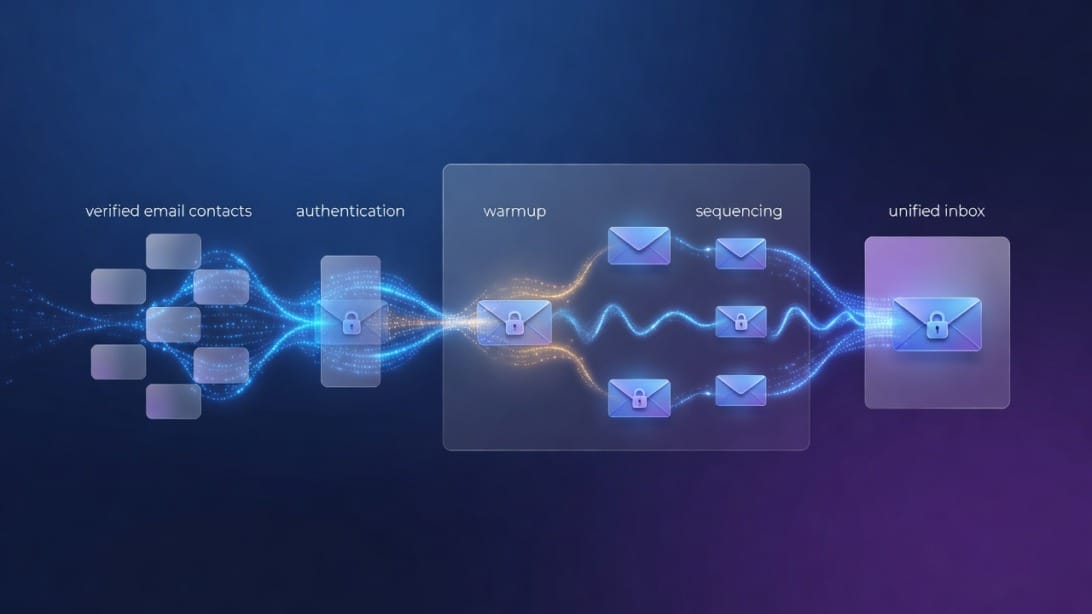
A targeted sales lead typically requires 5 to 7 touchpoints across 2 to 3 weeks to convert. Mystrika’s sequencer supports configurable steps with different messaging, timing intervals, and conditional branching based on whether the prospect has opened, replied, or clicked. Sequences can pause automatically when a lead replies, route the conversation to the unified inbox for all prospect replies, and continue with a fallback path if the lead does not engage.
Unified Inbox for All Prospect Replies
When replies arrive from multiple sequences running across multiple domains, Mystrika’s unified inbox collects them into a single view. This prevents the common problem of missing replies because they landed in a rarely-checked sending mailbox. The unibox shows the full conversation history for each prospect, including which sequence step they responded to, making follow-up efficient.
Whitelabel for Agency Teams
Agencies running targeted lead generation campaigns for multiple clients can whitelabel the Mystrika interface. Each client sees their own branded platform with no Mystrika branding visible. This is particularly valuable for teams whose targeted sales lead service includes the outreach infrastructure as part of their offering.
Starting Price of $15 Per Month
Mystrika’s entry-level plan starts at $15 per month, which includes the AI writer, sequencer, unified inbox, warmup, and basic analytics. This makes it accessible for solo operators and small teams who need professional cold email infrastructure without the enterprise price tag.
FilterBounce for Lead Verification Before Sending
The single most common reason targeted sales lead campaigns fail is sending to unverified email addresses. A bounced email delivers no message, wastes a send from your daily limit, and damages your sender reputation.
How FilterBounce Fits Into the Workflow
Before uploading your targeted sales lead list to Mystrika or any sending platform, run the list through FilterBounce. The verification process checks each email address at the SMTP level, confirming that the receiving server accepts mail for that address. This catches invalid domains, non-existent mailboxes, and catch-all servers that accept mail only to bounce it later.
CSV Upload and API Integration
FilterBounce accepts CSV uploads for one-time list verification and provides an API for automated verification as leads enter your pipeline. Teams running continuous lead generation can integrate the API into their CRM or lead source tooling so every new lead is verified before it reaches the sending queue.
Accuracy and Scale
FilterBounce claims 99.5 percent verification accuracy. The service handles lists of any size, from a few hundred contacts for a targeted account list to hundreds of thousands for enterprise database cleaning. Each verification result includes a status: valid, invalid, risky, or unknown, allowing you to decide which contacts to include based on your risk tolerance.
Setting Up Cold Email Sequences for Targeted Sales Leads
Having the right infrastructure and the right leads still requires a sequence design that converts. Here is a template that consistently performs for B2B targeted sales lead campaigns.
Sequence Structure Overview
A standard sequence for targeted sales leads unfolds over 14 to 21 days with 5 to 7 steps. The first step is the initial outreach email. Step two follows three days later with a value-add follow-up sharing relevant content. Step three at day seven is a social proof email featuring a case study or customer result. Step four at day ten is a break-up email that offers to stop contacting the prospect.
Step Variation Based on Segment
High-fit, high-intent prospects get an accelerated sequence with shorter intervals and more direct calls to action. High-fit, low-intent prospects enter a slower nurture track with educational content and no hard sell. Low-fit, high-intent prospects receive a single personalized email with an alternative offer or a referral.
Conditional Branching
Use reply detection to route responding prospects out of the sequence and into the unified inbox. Use click tracking to trigger a personal follow-up from a sales rep when a prospect engages with a specific link. Use open tracking only as a relative signal since Apple Mail Privacy Protection inflates open rates.
Timing Optimization
Tuesday through Thursday produce the highest reply rates for B2B cold email. Early morning sends between 6:00 AM and 8:00 AM in the prospect’s timezone outperform mid-day sends by approximately 15 to 20 percent. Follow-up emails sent between 10:00 AM and 12:00 PM in the prospect’s timezone have the highest engagement rates.
Personalization That Works
Targeted sales lead personalization goes beyond using the first name. Effective personalization references the prospect’s specific situation. Mention a recent company announcement, a job posting for a role your product supports, a funding round or product launch, a mutual connection or shared group, a specific challenge their industry faces this quarter, and relevant content their company published or engaged with.
Measuring and Optimizing Targeted Lead Campaigns
A targeted sales lead campaign that is not measured cannot be improved. These are the metrics that matter and the optimization moves that work.
Key Daily Metrics
Track these numbers every day a campaign is running. Inbox placement rate measures the percentage of sent emails that land in the primary inbox rather than spam. Reply rate measures the percentage of delivered emails that receive a human reply. Bounce rate measures the percentage of sent emails that hard bounce. Spam complaint rate measures the percentage of delivered emails that the recipient marks as spam. Unsubscribe rate measures the percentage of recipients who click unsubscribe. Positive reply rate measures the percentage of replies that express interest or ask a question.
Weekly Segmentation Review
Every week, analyze which segments of your targeted leads are performing best. Compare reply rates by industry, company size, job function, and data source. Pause sequences for segments that are underperforming and shift sending volume to segments that are overperforming. Update your ICP based on what the data shows.
List Hygiene Schedule
Verify every lead list again before each new campaign segment, even if it was verified 30 days ago. Remove contacts who have not engaged after 3 sequences across 90 days. Hard bounce addresses should be removed immediately and suppressed from all future lists. Spam complaints should trigger an immediate investigation into which list segment caused the complaint and a review of the messaging used with that segment.
A/B Testing for Continuous Improvement
Run A/B tests on subject lines, body copy, personalization format, call-to-action placement, send time, and sender name. Allow each test to run until you have at least 50 replies per variant before declaring a winner. The differences compound over time. A subject line that outperforms the control by 20 percent translates to 20 percent more conversations from the same list.
Key Takeaways
- Targeted sales leads are prospects matched on fit, intent, and reachability, not just firmographic criteria.
- Cold email deliverability in 2026 demands DMARC authentication, SPF and DKIM records, warmed domains, and verified lists.
- Targeted lead campaigns produce 3 to 5 percent conversion rates compared to 1 to 2 percent for generic lists.
- B2B data decays at 22 percent per year, making lead verification essential before every campaign.
- Fit and intent scoring on separate axes helps prioritize the right prospects for each sequence stage.
- Mystrika provides AI personalization, multi-step sequencing, automated warmup, and a unified inbox starting at $15 per month for targeted lead outreach.
- DoYouMail provides dedicated SMTP infrastructure with a private IP, unlimited email IDs, and full authentication control at $39 per month.
- FilterBounce verifies email addresses with SMTP-level checks before sending, preventing bounces that damage domain reputation.
- Sequence design, conditional branching, and send timing optimization improve reply rates by 20 percent or more.
- Daily metric monitoring and weekly segmentation reviews are essential for maintaining inbox placement and improving conversion rates over time.
Frequently Asked Questions
What is the difference between a targeted sales lead and a generic lead?
A targeted sales lead matches your ideal customer profile on firmographic, technographic, and intent dimensions, with verified contact data. A generic lead has no ICP filtering and no data verification applied. Targeted leads convert at 3 to 5 percent while generic leads convert at 1 to 2 percent.
How do I find targeted sales leads for B2B cold email?
Start by defining your ideal customer profile across six dimensions: firmographics, technographics, job function, seniority, geographic region, and negative criteria. Use intent data platforms like Bombora or 6sense to find in-market accounts, combine with B2B databases like ZoomInfo or Apollo, filter by ICP, verify all contacts before sending, and sequence outreach through a platform that supports warmup and deliverability monitoring.
Why does data verification matter for targeted sales leads?
Data decays at 22 percent per year according to industry benchmarks from Gartner. A list verified six months ago now has over 10 percent invalid records. Sending to invalid addresses produces hard bounces, which degrade your domain reputation and reduce inbox placement for future campaigns. Verification at the point of send prevents this damage.
What email authentication do I need before sending to targeted leads?
You need SPF, DKIM, and DMARC records configured for every sending domain. SPF authorizes sending IP addresses. DKIM provides message-level cryptographic verification. DMARC defines how receiving mail servers handle unauthenticated messages. Without all three, mailbox providers will reject or spam-folder your messages.
How many targeted sales leads should I send to per day?
Limit each sending address to 50 to 100 emails per day. Limit each domain to 5 to 10 emails per mailbox provider per day per sending address. Total volume per domain should stay under 2,000 to 3,000 emails per day. These limits protect domain reputation and maintain inbox placement rates.
What is a good reply rate for targeted sales lead cold email?
A reply rate of 2 to 5 percent is standard for well-targeted cold email campaigns using verified lists and proper infrastructure. Top-quartile campaigns achieve 5 to 8 percent reply rates. Rates below 2 percent indicate a problem with targeting, messaging, or deliverability.
How often should I refresh my targeted lead lists?
Re-verify every lead list before each campaign segment, even if it was verified within the past 30 days. Remove contacts who have not engaged after 3 sequences across 90 days. Hard bounce addresses must be suppressed from all future lists permanently.
Can I use the same sending domain for multiple targeted lead campaigns?
Yes, but only if the combined volume stays within the per-domain sending limits described above. Each additional campaign increases the risk of exceeding volume thresholds. Using separate sending domains for separate campaigns or separate ICP segments provides better reputation isolation.
What is the minimum budget for targeted sales lead cold email infrastructure?
A basic setup starts with DoYouMail at $39 per month for sending infrastructure and Mystrika at $15 per month for the campaign platform, totaling $54 per month for the software layer. List building and verification add variable costs depending on the data sources and the size of your target list.
How do I handle replies from targeted sales lead sequences?
Use a unified inbox that collects replies from all sending addresses and domains into a single view. Mystrika provides this along with conversation threading so you can see the full context of each reply. Respond to every human reply within 24 hours to maintain engagement and move the prospect through your pipeline.