
The difference between Revenue Operations and Sales Operations is not a semantic debate. It is an organizational design decision that determines whether your revenue engine fires on all cylinders or sputters at every handoff between teams.
Sales Ops makes your sales team run faster. RevOps makes your entire go-to-market machine run smarter.
If you are scaling a B2B company today, the question isn’t just which title to put on a hire. The question is whether you are optimizing for departmental efficiency or holistic revenue growth. And the wrong choice doesn’t just waste a salary – it locks in a ceiling you will hit eighteen months later.
This guide breaks down everything you need to decide. Definitions, metrics, org design, hiring triggers, AI implications, and the operational infrastructure that supports whichever path you choose.
What Is Sales Operations?
Sales Operations is the function that keeps your sales team productive. It is the engine room, the playbook writer, and the process architect for your front-line sellers.
Sales Ops professionals manage the systems, data, and workflows that let salespeople spend their time selling instead of wrestling with spreadsheets, CRM quirks, and manual reporting.
The Core Responsibilities of Sales Ops
A well-functioning Sales Ops team owns these specific domains:
CRM Administration
Sales Ops configures and maintains the CRM. That means pipeline stages, lead scoring rules, deal stages, activity tracking, and the integrations that keep data flowing between prospecting tools and the CRM. When a rep logs a call, updates a deal stage, or sets a follow-up reminder, Sales Ops made that workflow possible.
Territory and Quota Assignment
Someone has to decide which rep owns which accounts, how territories balance for fairness and total addressable market, and what quota number each rep carries. Sales Ops builds those models using historical data, market sizing, and leadership input.
Forecasting and Pipeline Management
Sales Ops produces the weekly and monthly pipeline reviews. They track weighted pipeline, stage progression rates, deal slippage, and the leading indicators that tell leadership whether the quarter will hit or miss.
Sales Process and Methodology
From qualification frameworks to meeting cadences, Sales Ops defines the sales process and enforces it through the CRM. They identify bottlenecks in the sales cycle and build playbooks to fix them.
Compensation and Commission
Sales Ops designs, calculates, and administers commission plans. This is one of the most sensitive operational responsibilities in any company. A miscalculation or poorly designed comp plan can demotivate an entire sales org within days.
Tech Stack Management
Sales Ops evaluates, selects, and manages the sales technology stack. Dialers, sequencing platforms, meeting schedulers, data enrichment tools, and conversation intelligence all fall under Sales Ops oversight.
What Sales Ops Does Not Own
It is just as important to understand what Sales Ops does not own. A Sales Ops team does not own:
- Marketing campaigns or lead generation targets
- Customer onboarding or renewal motions
- Product-led growth metrics
- Cross-functional data governance
- Email infrastructure or deliverability
This is where the boundary between Sales Ops and RevOps becomes visible.
What Is Revenue Operations (RevOps)?
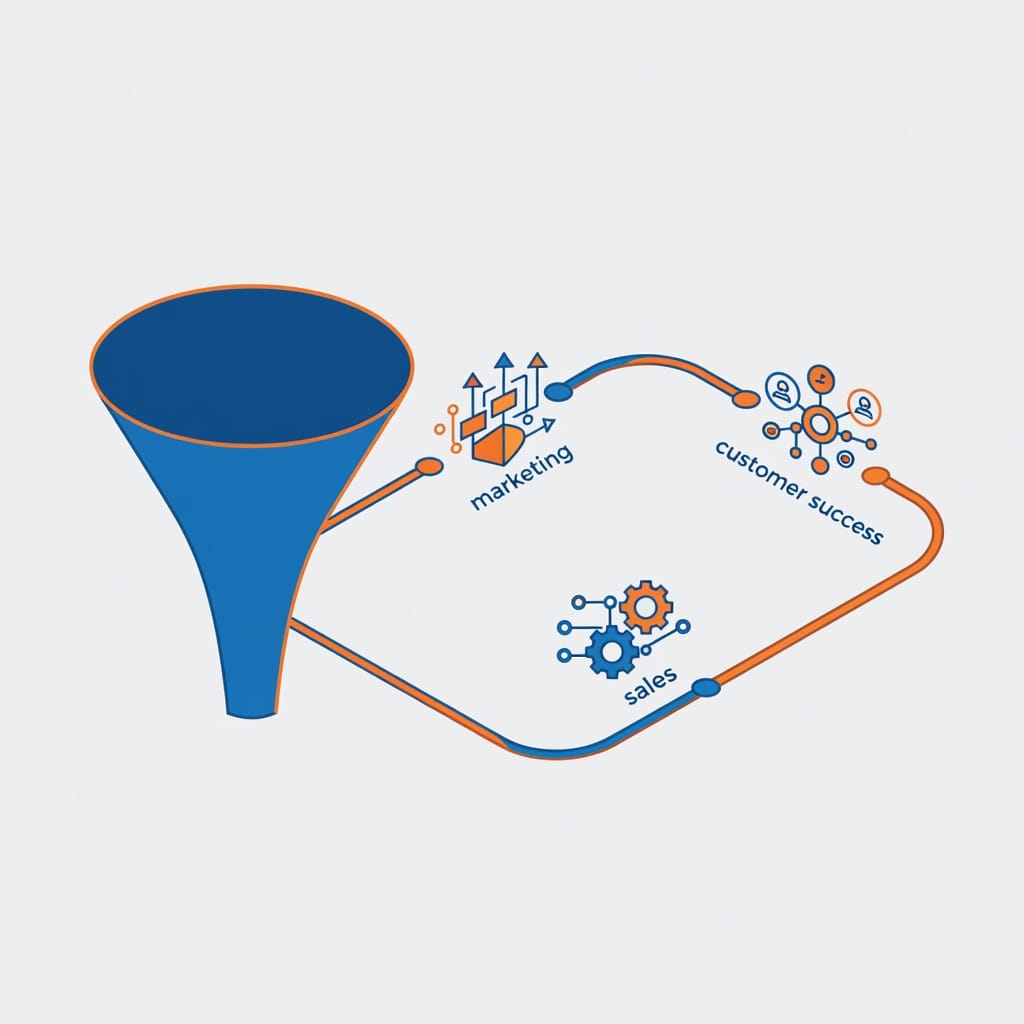
Revenue Operations is the cross-functional framework that aligns marketing, sales, and customer success under a single operational model. Where Sales Ops optimizes for maximum output from the sales team, RevOps optimizes for maximum lifetime value from every customer interaction across teams.
The Three Pillars of RevOps
RevOps operates across three interconnected domains:
Marketing Operations
RevOps oversees the marketing-to-sales handoff. That means lead scoring models, MQL-to-SQL conversion metrics, campaign attribution, content performance, and the infrastructure that moves leads from marketing automation into the sales pipeline without leaking volume or intent signals.
Sales Operations
In a RevOps model, Sales Ops exists but reports up through the revenue organization. The scope narrows to day-to-day sales enablement while the strategic data and systems decisions move to RevOps leadership.
Customer Success Operations
RevOps owns the post-sale process. Onboarding milestones, health scoring, renewal forecasting, expansion triggers, and churn analysis all sit within the revenue operations framework. This ensures that what Sales sells aligns with what Customer Success can deliver.
The Data Mandate of RevOps
The single most important distinction between RevOps and Sales Ops is data governance. Sales Ops maintains a single source of truth for sales data. RevOps expands that mandate to every revenue-generating function.
This means RevOps owns the unified data model that connects marketing automation, CRM, billing systems, support platforms, and email infrastructure. When a prospect clicks a marketing email, fills out a demo request, becomes a customer, generates a support ticket, hits a usage milestone, and renews – RevOps ensures that entire track is visible in one place.
The Core Difference Between RevOps and Sales Ops
One way to frame the difference is scope versus depth.
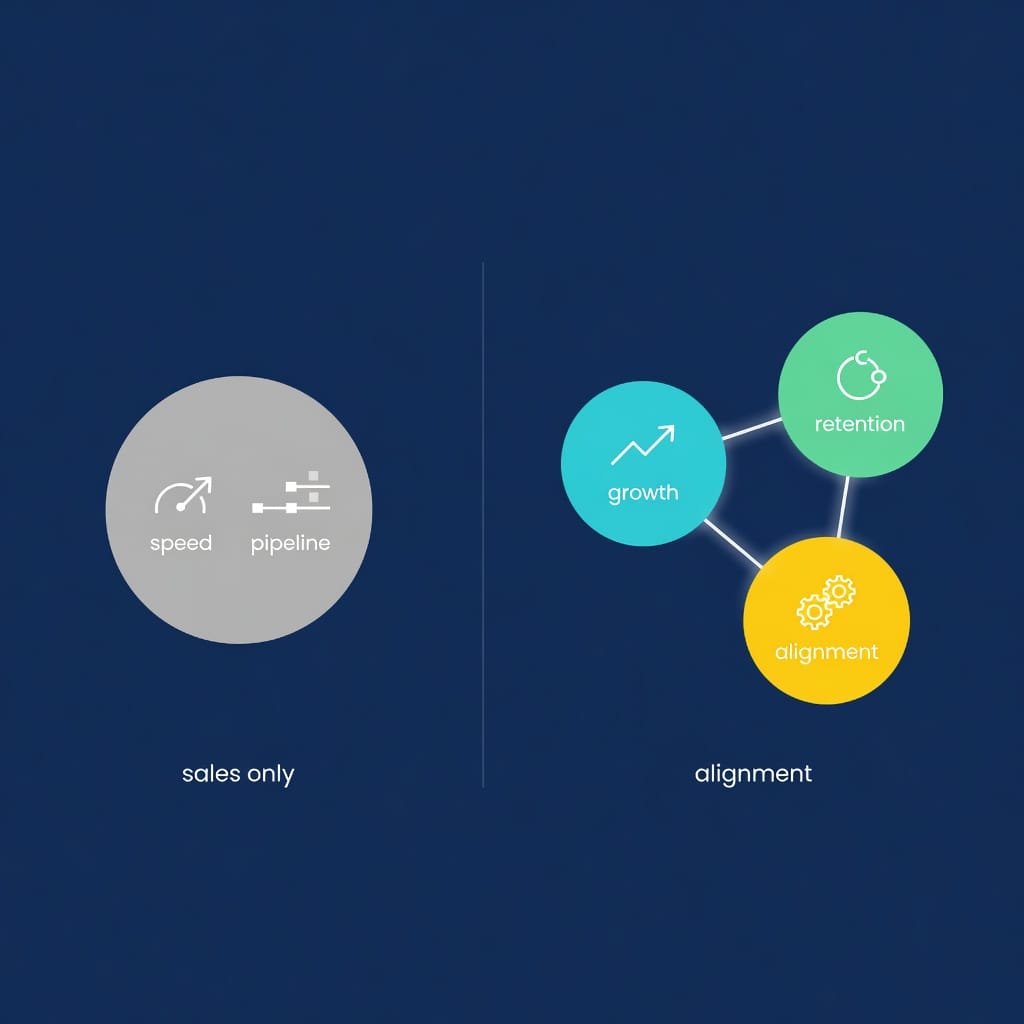
Sales Ops goes deep on making one function efficient. RevOps goes broad on making the entire revenue system coherent.
| Dimension | Sales Operations | Revenue Operations |
|---|---|---|
| Primary focus | Sales team productivity and efficiency | End-to-end revenue growth across all functions |
| Teams involved | Sales only | Marketing, Sales, Customer Success, sometimes product |
| Core outputs | Pipeline, forecasts, comp, process | Unified data, cross-functional alignment, NRR, CAC payback |
| Metrics owned | Close rate, pipeline velocity, quota attainment | CAC, LTV, NRR, time-to-value, revenue per employee |
| Data scope | Sales data in CRM | Unified revenue data across all systems |
| Decision horizon | Weekly, monthly, quarterly | Quarterly, annual, multi-year |
| Reporting line | VP Sales or CRO | CRO or CEO |
| Handoff ownership | Inside sales workflow | Every customer touchpoint across teams |
Scope and Focus
Sales Ops looks at the sales machine. RevOps looks at the revenue flywheel. The difference is systemic.
When a Sales Ops leader evaluates a new tool, they ask: Does this make my reps close faster? When a RevOps leader evaluates the same tool, they ask: Does this improve data flow across marketing, sales, and success, and does it reduce friction in the customer journey?
Even the same action is evaluated against different frameworks.
Decision Making
A concrete example illustrates the difference. Your team is evaluating a conversation intelligence platform.
Sales Ops evaluates: Does it integrate with our dialer? Can reps get call coaching without leaving Salesforce? How much will it shorten the average sales cycle?
RevOps evaluates: Does the call data flow into our unified analytics layer? Can customer success see what prospects committed to during discovery calls? Does marketing get deal-level objection data to improve messaging? How does this tool affect the data architecture across all three teams?
Same tool. Radically different evaluation criteria.
Data Management
Sales Ops ensures data accuracy inside the CRM. RevOps ensures data coherence across every revenue system.
This is not a small distinction. In practice it means RevOps enforces data standards for lead sources, opportunity stages, account hierarchies, product usage events, billing triggers, and support case correlations. Sales Ops could never do this because they lack mandate over marketing automation, billing, and customer success platforms.
Process Optimization
Sales Ops optimizes within the sales boundary: lead routing, proposal generation, discount approvals, contract execution.
RevOps optimizes across boundaries: marketing-to-sales handoff, closed-won-to-onboarding transition, renewal and expansion workflows, product-qualified lead routing to sales, and feedback loops from support back to marketing.
Performance Metrics
Sales Ops tracks close rate, win rate, sales cycle length, average deal size, pipeline velocity, quota attainment, and activity metrics.
RevOps tracks all of those plus customer acquisition cost (CAC), customer lifetime value (LTV), net revenue retention (NRR), marketing sourced pipeline percentage, time to first value, expansion revenue, gross revenue retention, payback period, and revenue per employee.
The difference is visible in the metric set. Sales Ops measures inputs and throughput. RevOps measures outcomes and system efficiency.
Team Structure and Reporting
Sales Ops typically reports to the VP of Sales or Chief Sales Officer. In organizations without a CRO, the Sales Ops leader sits inside the sales function and has limited authority over marketing or customer success operations.
RevOps reports to the CRO or CEO. In a mature RevOps org, there are specialists for marketing operations, sales operations, customer success operations, revenue systems, and revenue analytics, all reporting up through a RevOps director or VP.
The Metrics Tell the Story
The quickest way to tell whether you have a Sales Ops function or a RevOps function is to look at the metrics your operations leader reports on.
Sales Ops Metrics
- Sales cycle length (days from first contact to closed won)
- Win rate by segment and rep
- Pipeline velocity (deals moved through stages per week)
- Quota attainment percentage
- Activity metrics (calls, emails, meetings per rep per day)
- CRM data quality score
RevOps Metrics (Includes All Sales Ops Metrics Plus)
- Customer Acquisition Cost (CAC) by channel and segment
- Customer Lifetime Value (LTV) with multi-year modeling
- Net Revenue Retention (NRR) and Gross Revenue Retention (GRR)
- Marketing sourced pipeline percentage and influenced pipeline
- Time to first value for new customers
- Expansion revenue rate (upsells and cross-sells)
- CAC payback period in months
- GTM efficiency ratio (total revenue / total sales and marketing cost)
- Revenue per employee
The NRR Litmus Test
One metric often determines whether you need RevOps. If your NRR is below 100 percent, your existing customer base is shrinking. A Sales Ops hire does not have the authority to fix churn, improve onboarding, or build expansion motions. Only a cross-functional RevOps leader can own that problem because it spans success, product, and sales.
When Should You Hire for Sales Ops?
Sales Ops is almost always the first operations hire. Here is when you know you need one.
The 8 to 15 Sales Rep Trigger
At roughly eight to fifteen salespeople, the VP of Sales can no longer both manage reps and run operations. Deals start slipping through process gaps. CRM data gets inconsistent. Forecasting becomes guesswork.
Symptoms that signal a Sales Ops hire:
- Reps spend more than 40 percent of their week on non-selling admin tasks
- CRM data quality is deteriorating fast enough that pipeline reports are not trusted
- New reps take longer than sixty days to ramp to first sale
- Forecasting accuracy is below 60 percent at the start of the month
- Commission disputes happen every month
- The team keeps reinventing the sales process instead of iterating on a standard one
The Sales Ops Hiring Decision
At this stage, you hire a Sales Ops manager or director who reports to the VP of Sales. They run the CRM, produce forecasts, manage the sales tech stack, and build the sales playbook.
Your email infrastructure choices matter here too. If your sales team is running cold outreach, the Sales Ops hire should have input on sequencing platforms, data enrichment, and deliverability.
But here is the catch. A Sales Ops manager picks tools that make the sales team faster. They do not evaluate how those tools affect marketing data quality, customer success handoffs, or overall data governance. That limitation is fine at this stage because the company is not yet complex enough for the cross-functional coordination to create significant friction.
When Is It Time to Transition to RevOps?
The transition from Sales Ops to RevOps happens when cross-functional friction starts costing more than the operational inefficiency inside sales.
The $10 Million to $100 Million ARR Window
Multiple studies from Gartner, McKinsey, and SiriusDecisions converge on the same signal: the RevOps trigger zone is roughly $10 million to $100 million ARR. Below $10 million, the complexity does not justify a dedicated RevOps leader. Above $100 million, not having one is actively destroying revenue.
Early signals that your company needs RevOps:
- Marketing and sales blame each other for pipeline shortfalls
- Customer success learns about new customers through email forwards rather than system notifications
- Each team manages its own tech stack with no central governance
- Revenue forecasting produces three different numbers from three teams
- Handoff metrics between teams are not tracked or not trusted
- NRR is below 100 percent and nobody owns fixing it
- Duplicate data entry exists between marketing automation and CRM
- Expansion revenue is reactive rather than systematic
What the Transition Looks Like
The transition typically follows this sequence:
1. The company hires a RevOps director or VP who oversees the existing Sales Ops function
2. Marketing operations moves from marketing’s budget to revenue operations
3. Customer success operations is created or absorbed into the RevOps umbrella
4. A unified data warehouse or analytics layer replaces the siloed reporting each team maintained
5. Cross-functional metrics (CAC, LTV, NRR, payback) replace departmental-only KPIs in leadership reviews
6. The Sales Ops role narrows to focus purely on sales enablement and process, while the cross-functional data and systems work shifts to RevOps
The Staffing Model at Each Stage
At $50 million ARR, expect four to five RevOps staff: one manager and three to four individual contributors covering sales systems, marketing operations, revenue analytics, and customer success operations.
At $100 million ARR, expect seven to ten RevOps staff: a director or VP, a manager, and six to eight ICs with specialized roles for data engineering, marketing ops, sales systems, customer success ops, and compensation administration.
At $200 million ARR, expect fourteen to nineteen RevOps staff: a VP, two directors or managers, and twelve to sixteen ICs with deeper specialization including a dedicated CRM architect, a data science role, and a revenue systems administrator.
These ratios assume roughly twelve sales reps per one operations employee.
How AI Is Changing Both Functions in 2026
Artificial intelligence is not replacing operations roles in 2026. It is redefining which problems they prioritize.
AI and Sales Ops in 2026
Sales Ops teams in 2026 spend less time on manual CRM data entry and report generation. AI agents now handle pipeline stage logging from call transcripts, meeting summaries auto-populate opportunity records, and forecasting models update in real time based on deal progression patterns rather than weekly manual updates.
The Sales Ops role shifts from data janitor to process designer. Instead of cleaning CRM data, Sales Ops defines the rules for how AI agents interact with the CRM. Instead of building reports, Sales Ops designs dashboards that AI agents populate automatically.
But this shift exposes a vulnerability. If your sales data is the only clean dataset in the organization, AI tools that operate across customer touchpoints will produce misleading outputs because they lack context from marketing engagement history and customer health signals.
This is the gap a Sales Ops team alone cannot close.
AI and RevOps in 2026
RevOps teams with unified data infrastructure get dramatically more leverage from AI in 2026 than Sales Ops teams managing three disconnected systems.
A RevOps team can deploy AI agents that:
- Score leads using signals from marketing engagement, sales activity, product usage, and support interactions
- Predict churn before the customer support ticket elevates, using cross-functional data that a Sales Ops team would never see
- Generate renewal price recommendations based on customer health, product adoption, and usage growth
- Automate territory and quota modeling across segments that span sales-led and product-led growth motions
- Identify expansion opportunities by correlating product feature adoption with customer segment and support case themes
The unified data model that RevOps maintains is the prerequisite for all of these AI use cases. Without it, each AI agent operates on partial information and produces decisions that optimize for one function at the expense of the system.
The AI Readiness Checklist
1. Single customer data model across marketing, sales, and success
2. Clean, deduplicated account hierarchy
3. Automated activity capture from every revenue tool
4. Data quality SLAs enforced at the system level, not manually
5. AI usage governance policy covering data access, output validation, and override procedures
The Impact on Cold Email and Deliverability
This section is the one you will not find in most RevOps versus Sales Ops comparisons, and it matters more than most operational leaders realize.
Your outreach infrastructure – specifically your email deliverability, warmup systems, and sending infrastructure – is an operational asset. It either enables your revenue operations or undermines them. And the choice between Sales Ops and RevOps determines whether this infrastructure is managed as a tactical sales tool or a strategic revenue system.
Sales Ops View of Email Infrastructure
Under a Sales Ops model, email infrastructure is a sales tool. The Sales Ops manager picks a sequencing platform, gets it integrated with the CRM, and ensures reps can send sequences. Deliverability is treated as a technical issue that IT or the sending platform handles.
In practice, this means:
- Each team manages its own sending domains and inboxes
- Warmup protocols are inconsistent or nonexistent
- Spam complaints from one sequence can damage sending reputation for unrelated campaigns
- There is no unified view of deliverability metrics across teams
- Bounce handling and list hygiene are managed ad hoc by individual SDRs
When deliverability degrades – and it will degrade without proactive management – Sales Ops rarely has the mandate or the data to diagnose the root cause because they only see the sales side of the sending infrastructure.
RevOps View of Email Infrastructure
Under a RevOps model, email infrastructure is a revenue system asset. It sits alongside the CRM, marketing automation, and customer success platform as infrastructure that everyone depends on.
RevOps enforces:
- Unified domain reputation monitoring across all sending teams
- Shared warmup protocols that maintain sender reputation regardless of which team is sending
- Centralized bounce and complaint management
- List quality standards that marketing and sales both follow
- Deliverability monitoring as a reported metric alongside pipeline and revenue
This matters because a damaged sending domain does not just affect the sales team that caused the problem. It affects marketing newsletters, customer success onboarding emails, and every other outbound communication from your company. A domain reputation hit from aggressive sales sequences can take three to six months to recover.
Why Deliverability Alignment Matters More in 2026
Google and Yahoo mailbox provider requirements continue to tighten in 2026. Spam complaint rates below 0.1 percent are enforced more strictly. DMARC, DKIM, and SPF authentication are table stakes. Consistent sending volumes and warmup patterns are required to maintain inbox placement.
A fragmented approach to email infrastructure, where each team manages its own sending, violates the core operational principle that RevOps was built to enforce: system coherence over departmental optimization. Using an enterprise platform like Mystrika ensures warmup and sequencing are handled securely and optimally across the entire organization.
To understand the core mechanics of managing deliverability, read our guide on email deliverability which covers the technical requirements for inbox placement in 2026.
RevOps and Sales Ops Can Coexist
The decision is not always binary. Many organizations run both a Sales Ops function and a RevOps function concurrently, particularly above $50 million ARR.
The Two-Tier Model
In this model, Sales Ops reports to RevOps. The Sales Ops team handles day-to-day sales process optimization, CRM management, and commission administration. RevOps handles cross-functional data governance, unified analytics, marketing and customer success operations, and strategic revenue planning.
This is the most common structure for companies between $50 million and $200 million ARR. Sales Ops provides the depth. RevOps provides the breadth.
When the Two-Tier Model Works
- Your sales cycle requires specialized process management (enterprise deals, long cycles, complex procurement)
- Your marketing and customer success operations are mature enough to benefit from a shared operational model
- Your data infrastructure supports unified analytics without requiring every team to change their workflows
- You have the budget for both roles
When One Function Is Enough
Below $30 million ARR or with fewer than thirty total revenue team members, a dedicated RevOps function is usually premature. The coordination costs of running a cross-functional operations team exceed the benefits when each department has only a few people.
At smaller companies, a strong Sales Ops lead who coordinates informally with marketing ops and customer success can deliver 80 percent of the benefit of a full RevOps structure without the overhead.
Common Mistakes When Transitioning
Building RevOps When You Need Better Sales Ops
If your sales team is drowning in CRM chaos, forecasting guesswork, and broken comp plans, RevOps will not fix it. These are Sales Ops fundamentals. Adding RevOps before you have a functioning Sales Ops layer creates expensive overhead without addressing the root problem.
The fix: Fix Sales Ops first. Get the CRM clean. Get forecasting reliable. Get comp admin running without monthly disputes. Then layer RevOps on top.
Staying in Sales Ops When You Need RevOps
The opposite mistake is equally common. A company grows from $10 million to $30 million ARR with a strong Sales Ops leader who keeps the sales machine humming. But cross-functional problems compound silently. Marketing and sales blame each other. Customer churn climbs. Nobody tracks CAC payback. The CEO receives three different revenue forecasts.
The fix: Add a RevOps layer before the problems require a restructuring to fix. The early signals are subtle – handoff complaints, trusting gut over data, customer success being surprised by new accounts.
Title vs. Mandate
The most common mistake in RevOps transitions. You promote the Sales Ops manager to a RevOps title but give them no authority over marketing data, customer success workflows, or cross-functional reporting. The title changes. The situation does not.
You have RevOps only when the person actually owns cross-functional data standards, cross-functional systems governance, and cross-functional metric reporting. If they cannot tell marketing to reformat lead source fields, they do not have RevOps authority.
The Tooling Stack: RevOps vs Sales Ops
The tooling footprint reveals which function is running.
| Category | Sales Ops Toolset | RevOps Toolset |
|---|---|---|
| CRM | Salesforce or HubSpot Sales Hub | Salesforce or HubSpot + Revenue Analytics |
| Sales engagement | Sequencing platform, dialer | Sequencing platform + unified engagement analytics |
| Marketing | Not owned | Marketo, HubSpot Marketing Hub, or similar |
| Customer success | Not owned | Gainsight, ChurnZero, Totango, or similar |
| Data | CRM reports + Excel | Data warehouse (Snowflake, BigQuery) + BI layer (Tableau, Looker) |
| Attribution | Not typically owned | Bizible, Dreamdata, or cross-channel attribution |
| Revenue intelligence | Call recording, conversation intelligence | Unified revenue data platform (Clari, Gong with revenue analytics) |
| Email infrastructure | In-platform sending within sequencing tool | Dedicated infrastructure with deliverability monitoring |
| AI tools | Rep-level coaching, auto-logging | Cross-functional predictive models, unified scoring |
Key Takeaways
1. Sales Ops optimizes the sales function. RevOps optimizes the entire revenue system. Sales Ops makes your sales team faster. RevOps makes marketing, sales, and customer success work as one revenue engine.
2. The metric set reveals the function. If your operations leader tracks close rate, pipeline velocity, and quota attainment, you have Sales Ops. If they also track CAC, LTV, NRR, and payback period, you have RevOps.
3. The Revenue Operations trigger zone is $10 million to $100 million ARR. Below $10 million, Sales Ops is usually sufficient. Above $100 million, not having a RevOps function is leaving revenue on the table.
4. Email infrastructure and email deliverability are operational assets that cross organizational boundaries. Sales Ops treats them as sales tools. RevOps treats them as revenue system infrastructure. Fragmented approach to sending infrastructure damages domain reputation for every team.
5. AI in 2026 amplifies the advantage of a unified RevOps data model. Without cross-functional data, AI agents make decisions that optimize one department at the expense of the system.
6. Title does not equal mandate. A Sales Ops leader renamed to RevOps who cannot enforce cross-functional data standards is still running Sales Ops.
Frequently Asked Questions
What is the core difference between RevOps and Sales Ops?
Sales Operations focuses exclusively on making the sales team more efficient by managing CRM data, sales process, forecasting, and compensation. Revenue Operations expands that mandate across marketing, sales, and customer success to optimize the entire customer lifecycle from first touch through renewal and expansion. The core difference is scope: Sales Ops optimizes one department; RevOps optimizes the cross-functional revenue system.
Can a company have both a RevOps and a Sales Ops team?
Yes, this is common at companies above $50 million ARR. In this two-tier model, Sales Ops reports to RevOps. Sales Ops handles daily sales process, CRM configuration, and commission administration. RevOps manages cross-functional data governance, unified analytics, and strategic revenue planning across marketing, sales, and customer success.
Who does Sales Ops report to compared to RevOps?
Sales Ops typically reports to the VP of Sales or Chief Sales Officer. RevOps typically reports to the Chief Revenue Officer or CEO. This difference matters because it determines whether the operations leader has authority over marketing data, customer success systems, and cross-functional reporting.
At what revenue stage should I hire for Sales Ops?
Hire your first Sales Ops professional when you have eight to fifteen salespeople. At this stage, the VP of Sales can no longer both manage reps and run operations. Signals include CRM data chaos, forecasting accuracy below 60 percent, and reps spending more than 40 percent of their week on admin tasks.
Is my business too small for Revenue Operations?
Size alone does not determine the need, but most companies below $10 million ARR do not need a dedicated RevOps function. If cross-functional alignment problems (marketing blaming sales, customer success learning about new customers through email, three different revenue forecasts) are causing measurable revenue loss, RevOps becomes relevant earlier. Otherwise, a strong Sales Ops lead who coordinates informally with marketing and customer success is usually sufficient.
How many people should be on a RevOps team?
At $50 million ARR, expect four to five RevOps staff. At $100 million ARR, expect seven to ten. At $200 million ARR, expect fourteen to nineteen. The general ratio is roughly twelve revenue team members per one operations employee.
What metrics should a RevOps team report on?
RevOps should report on CAC, LTV, NRR, GRR, marketing-sourced pipeline percentage, time to first value, expansion revenue rate, CAC payback period, GTM efficiency ratio, and revenue per employee. These complement the standard Sales Ops metrics of close rate, win rate, sales cycle length, pipeline velocity, and quota attainment.
Does RevOps own email infrastructure and outreach operations?
In a mature RevOps model, yes. Email infrastructure – sending domains, deliverability monitoring, warmup protocols, list quality standards – crosses organizational boundaries. Marketing campaigns, sales sequences, and customer success communications all depend on the same sending infrastructure. RevOps governance prevents the fragmented approach that leads to domain reputation damage and poor inbox placement.