
What Is the Cold Calling Success Rate in 2026?
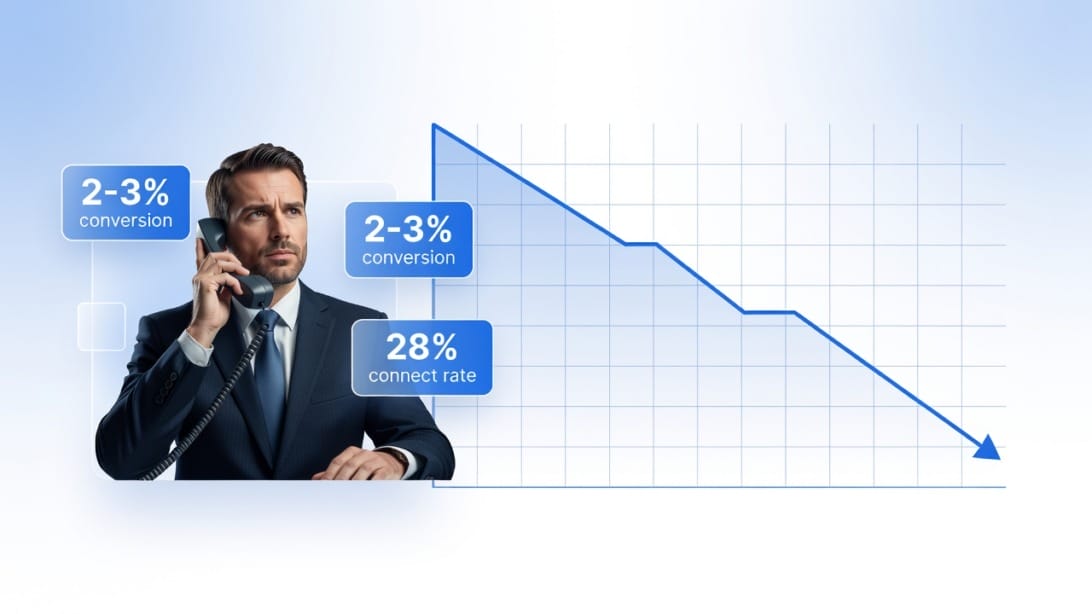
The average cold calling success rate in 2026 is approximately 2-3%, meaning roughly 2-3 out of every 100 cold calls result in a meaningful conversation that advances a deal. This figure comes from multiple industry sources including Cognism’s 2025 Cold Calling Report, which pegged the rate at 2.3%, and is widely cited across sales research. Top-performing teams achieve rates of 6-10% by combining data enrichment, personalized scripts, and structured follow-up cadences, but the baseline for most organizations remains in the low single digits.
The 2025 figure of 2.3% represents a significant drop from 4.82% in 2024, a decline of nearly 50% year-over-year. This sharp decrease reflects several market dynamics: buyers have more self-serve options before ever speaking to a sales rep, remote work has made reaching decision-makers harder, and spam call filtering technology has improved dramatically. However, these averages mask wide variation between organizations. Companies that invest in data quality, targeting, and sales technology consistently outperform the industry baseline.
Understanding Connect Rate vs Conversion Rate
Many sales teams conflate connect rate with conversion rate, which leads to inaccurate success benchmarks. Connect rate measures the percentage of dials that reach a live person, while conversion rate measures what percentage of those connected calls produce a desired outcome such as a meeting booked or a sale closed. Distinguishing these two metrics is essential for diagnosing where your pipeline actually breaks and targeting the right fix.
According to research from Baylor University, approximately 28% of cold calls connect with a live prospect. Of the remaining 72%, about 55% go to voicemail or go unanswered, and 17% reach bad numbers or disconnected lines. This means that for every 100 dials, only about 28 people actually hear your pitch. Of those 28 connects, the industry-average conversion rate of 2-3% means roughly 0.5-0.8 conversions per 100 dials. If you only track the composite success rate, you cannot tell whether your problem is getting through to people or persuading them once you do.
| Metric | Definition | Industry Benchmark | What It Diagnoses |
|---|---|---|---|
| Connect Rate | % of dials reaching a live person | 25-35% with good data | List quality, call timing, phone number accuracy |
| Conversion Rate | % of connects producing a desired outcome | 2-5% of connects | Script quality, value proposition, personalization |
| Composite Success Rate | Conversions per 100 dials | 2-3% | Overall pipeline health (but masks the root cause) |
The disconnect between connect rate and conversion rate explains why raw dial volume is a poor KPI. A team making 100 dials that connects with 30 prospects is performing differently from a team making 100 dials that connects with only 15, even if both report the same dial volume. Improving data quality through better list sourcing typically raises connect rates, while improving script and personalization raises conversion rates. Tracking both metrics separately lets you pinpoint which lever to pull and measure whether your interventions are working.
Common Pitfalls in Measuring Success Rates
The most common measurement mistake is defining conversion inconsistently across the team. Some reps count any conversation longer than 30 seconds as a success. Others count only booked meetings. Others count only opportunities that enter the pipeline. These differences make team-wide success rate data unreliable and complicate performance comparisons. The fix is to standardize definitions at the organizational level and report both raw connects and downstream conversion at each funnel stage.
Another common pitfall is not segmenting success rates by lead source. A cold call to a purchased list of 5,000 contacts will have a different baseline success rate than a cold call to a list of 50 warm inbound leads. Blending these into a single average success rate obscures the fact that the warm list may convert at 10-15% while the purchased list converts at 0.5%. Segmenting by source lets teams double down on what works and fix or drop what does not.
Industry-by-Industry Cold Calling Success Rates
Cold calling success rates vary significantly by industry, driven by differences in buyer behavior, sales cycle length, and decision-maker accessibility. Financial services and insurance consistently report the highest success rates at 3-5%, largely because their products are complex and buyers value direct expert guidance. In contrast, SaaS and technology companies average 1-3%, as their buyers increasingly prefer self-serve trials and digital evaluation.
Manufacturing and industrial sectors fall in the middle at 2-4%, with success rates driven by established supplier relationships and the need for technical specification discussions. Real estate and professional services see rates of 2-3%, heavily dependent on territory and local market conditions. Healthcare and pharmaceutical cold calling averages 1-2%, constrained by strict compliance regulations and gatekeeping protocols.
These industry averages should be treated as directional benchmarks rather than absolute targets. Variance within an industry often exceeds variance between industries. A SaaS company targeting SMB owners with a personalized voicemail strategy may outperform a financial services firm using a generic script. The most useful benchmark is your own historical performance trended month-over-month, adjusted for list quality and seasonality.
| Industry | Average Success Rate | Key Factors |
|---|---|---|
| Insurance and Financial Services | 3-5% | Complex products, value of expert guidance |
| Manufacturing and Industrial | 2-4% | Technical discussions, established relationships |
| SaaS and Technology | 1-3% | Self-serve preference, digital evaluation |
| Real Estate and Professional Services | 2-3% | Territory dependence, local market conditions |
| Healthcare and Pharmaceuticals | 1-2% | Compliance regulations, gatekeeping |
How Has the Cold Calling Success Rate Changed Over Time?
Cold calling success rates have declined steadily over the past decade, driven by shifts in buyer behavior, technology, and communication preferences. In 2007, the average number of call attempts needed to reach a prospect was 3.7. By 2021, that number had risen to 8, according to data compiled by Zippia. More recent estimates suggest it now takes 8-10 attempts for many B2B segments, and the connect rate has fallen correspondingly.
The success rate itself has followed a similar trajectory. Industry estimates from the 2010s typically cited cold calling conversion rates of 5-10%. By 2024, Cognism reported 4.82%. In 2025, that figure dropped to 2.3%, representing the steepest single-year decline on record. While 2026 full-year data is still being compiled, early indicators suggest rates have stabilized in the 2-3% range rather than continuing to fall, possibly because the market has adjusted to new norms.
Several structural factors explain this decline. Caller ID and spam filtering technology has become ubiquitous, with Hiya reporting that 92% of consumers think unidentified calls might be fraud and 79% of unidentified calls go unanswered. The rise of remote and hybrid work means office desk phones often go unanswered, and mobile numbers are harder to source accurately. Buyers now have more self-serve access to product information through websites, reviews, and trial models, reducing their dependency on sales conversations for initial evaluation.
Year-by-Year Trend Overview
| Year | Average Success Rate | Calls to Reach a Prospect | Key Event |
|---|---|---|---|
| 2007 | 5-10% (estimates) | 3.7 | Pre-smartphone era, landline dominant |
| 2015 | 4-8% (estimates) | 5-6 | Smartphone adoption, early spam filtering |
| 2020 | 4-6% (estimates) | 7 | COVID shift to remote work |
| 2024 | 4.82% | 8 | Cognism report baseline |
| 2025 | 2.3% | 8-10 | Sharpest drop on record, STIR/SHAKEN rollout |
| 2026 | 2-3% (est.) | 8-10 | Stabilization, AI-assisted dialing adoption |
The decline is real, but it does not mean cold calling is dead. It means cold calling has shifted from a volume-based tactic to a precision-based one. The days when a rep could dial 200 numbers and expect 20 conversations are gone. The new reality is that 100 dials might yield 25-30 connects and 2-3 meaningful conversations. Success now depends less on dial volume and more on calling the right person, at the right time, with the right message.
Cold Calling vs Cold Email: Which Performs Better?
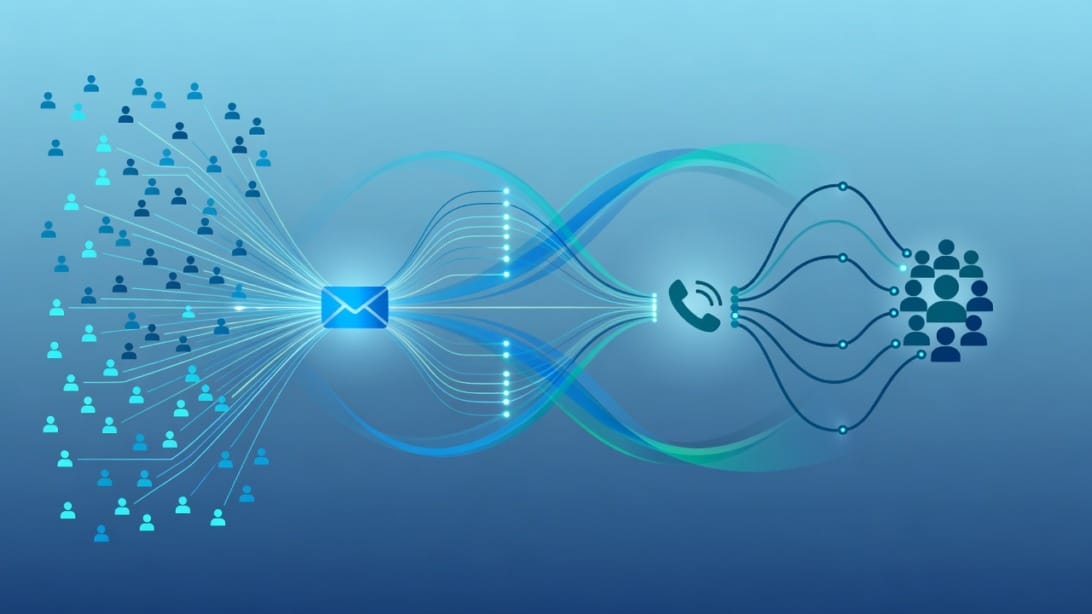
Cold email and cold calling serve different roles in the outbound sales stack, and comparing them as direct alternatives misses the point. Cold email campaigns typically achieve deliverable open rates of 20-40% and reply rates of 1-5%, depending on list quality and subject line strategy. Cold calling achieves connect rates of 25-30% with conversion rates of 2-3%. The two channels operate on different economics: email scales horizontally, reaching hundreds of prospects per hour, while calls scale vertically, producing deeper conversations per connection.
The real question is not which channel wins, but how to sequence them for maximum impact. Research from RAIN Group found that 82% of buyers accept meetings with sellers who proactively reach out, but the channel mix matters. Buyers increasingly expect a coordinated approach: an email that introduces context, followed by a call that deepens the conversation, or a call that establishes initial contact followed by an email with relevant resources.
Cost-Per-Lead Comparison
Comparing cost-per-lead across channels requires accounting for time investment, tooling costs, and conversion rates at each stage of the funnel. Cold email has a lower cost per thousand contacts reached, since a single sender can manage campaigns reaching thousands of inboxes per week with the right infrastructure. Cold calling has a higher cost per contact reached because each dial consumes live rep time, but the conversations that do happen tend to be higher quality.
For a B2B team sending 10,000 cold emails per month, typical setup costs include email infrastructure, domain warmup, and list sourcing. At a 1-3% reply rate, that yields 100-300 conversations. For a comparable cold calling effort, a single SDR making 50 dials per day produces roughly 250-350 dials per month, yielding approximately 70-100 connects and 5-10 meaningful conversations. The email channel generates more total touchpoints, while the calling channel generates a higher ratio of qualified conversations per touchpoint.
When to Use Cold Calling vs Cold Email
The most effective outbound strategies use each channel for what it does best. Cold calling excels at initial discovery conversations where immediate back-and-forth can uncover needs that a prospect would not articulate in writing. It is also effective for time-sensitive offers, follow-ups after a prospect has engaged with email content, and reaching executive-level buyers who receive hundreds of emails daily.
Cold email excels at scale: introducing your value proposition to a large list, nurturing prospects who are not ready for a call, and providing trackable content that prospects can reference later. Email also serves as a warming channel for future calls, since prospects who have received and opened your emails are more likely to answer when you dial. For more on how email and calling work together, see this guide on cold email strategies.
Mystrika’s cold email platform handles the scale-oriented side of this equation, providing deliverability infrastructure, automated warmup, and AI-powered sequencing that helps teams reach more inboxes reliably. The sequencing and reply-management features also make it straightforward to transition warm email respondents into call-ready leads, closing the gap between the two channels.
How Technology Impacts Cold Calling Success Rates
Technology has reshaped cold calling success rates in two contradictory ways. On one hand, spam filtering, caller ID reputation systems, and robocall screening have made it harder to reach prospects. On the other hand, sales engagement platforms, predictive dialers, and data enrichment tools have made the calls that do connect more productive. Understanding this duality is essential for building a realistic success-rate strategy.
Data enrichment and intent data tools have arguably had the biggest positive impact on cold calling outcomes. When sales teams dial from enriched lists that include firmographic fit, recent buying signals, and verified contact information, their connect rates increase by 30-50% compared to raw list dialing. Cognism credits its above-industry success rate of 6.7% to what it calls “quality data paired with laser-focused targeting.”
Dialer Technology
Predictive dialers and power dialers increase rep productivity by eliminating manual dialing and voicemail navigation. A rep using a power dialer can typically make 60-80 dials per hour compared to 20-30 with manual dialing. However, increased dial volume does not automatically translate to increased conversions. If the underlying list quality is poor, a power dialer simply accelerates failure.
The key insight is that dialer technology improves connect rates by increasing the speed at which reps work through lists, but it does not improve conversion rates. Conversion rate improvements come from script optimization, personalization, and call timing, which are human or AI-driven factors. Teams that invest in dialers without also investing in data quality and training often see higher connect counts but unchanged or declining conversion rates.
Data Quality and Targeting
Data quality is the single largest determinant of cold calling success rates that is within a team’s control. Poor data produces low connect rates (old numbers, incorrect contacts) and low conversion rates (wrong persona, wrong company size, wrong timing). High-quality data produces connect rates of 30-40% and conversion rates that track with or exceed industry averages.
Key data quality factors include: contact accuracy (verified phone numbers vs scraped data), persona fit (calling the economic buyer vs an end user who has no budget authority), company fit (ICP-aligned accounts vs random lists), and timing signals (companies with recent funding, job changes, or technology adoption). Teams that invest in maintaining these data dimensions consistently outperform those that rely on static purchased lists.
How to Track and Measure Cold Calling ROI
Tracking cold calling ROI requires more than counting dials and meetings. A proper ROI framework accounts for rep time costs, tooling expenses, list acquisition costs, and the fully-loaded cost of each conversation, then compares those costs against the revenue generated from cold-call-sourced opportunities. Without this framework, teams cannot determine whether their cold calling effort is generating positive returns or operating at a loss.
Calculating Cost Per Dial and Cost Per Conversation
The starting point for cold calling ROI analysis is understanding your cost structure. A fully-loaded SDR with salary, benefits, and overhead typically costs $60,000-$90,000 per year. At 50 dials per day for 220 working days, that is 11,000 dials per year, yielding a cost per dial of approximately $5.50-$8.20. However, only 25-30% of dials connect, so the cost per connected conversation is roughly $18-$33. When you factor in that only 2-3% of connects convert, the cost per qualified conversation rises to $600-$1,650.
| Cost Component | Calculation | Approximate Value |
|---|---|---|
| Annual SDR cost (fully loaded) | Salary + benefits + tools + overhead | $60,000-$90,000 |
| Dials per year | 50 dials/day x 220 days | 11,000 |
| Cost per dial | Total cost / total dials | $5.50-$8.20 |
| Connect rate | % of dials reaching a person | 25-30% |
| Cost per connected conversation | Cost per dial / connect rate | $18-$33 |
| Conversion rate | % of connects becoming opportunities | 2-5% |
| Cost per qualified opportunity | Cost per connect / conversion rate | $600-$1,650 |
This cost structure explains why list quality matters so much. If you improve your connect rate from 25% to 40% by using verified phone numbers, your cost per connected conversation drops from $22-$33 to $14-$20. If you then improve your conversion rate from 2% to 5% through better scripting and personalization, your cost per qualified opportunity drops from $1,100-$1,650 to $280-$400. The compounding effect of these improvements is substantial.
Revenue Attribution and Pipeline Velocity
Calculating the revenue side of the ROI equation requires tracking cold-sourced opportunities through the full sales cycle. Average deal sizes vary widely by industry, but a typical B2B SaaS cold-sourced deal might range from $10,000 to $50,000 in annual contract value. At a 20% close rate on qualified opportunities, each cold calling conversation that becomes a qualified opportunity represents a 1-in-5 chance of closing a deal at your average ACV.
Pipeline velocity matters as much as close rate. Cold-sourced deals typically take 30-90 days to close, depending on deal size and complexity. Comparing this timeline to inbound-sourced or email-sourced deals helps teams understand where cold calling fits in the overall go-to-market mix. Teams that integrate cold calling with email nurturing often see pipeline velocity improve because prospects arrive at the phone conversation already familiar with the value proposition.
Mystrika’s platform supports this integration by providing the email infrastructure that warms prospects before the phone rings. When a prospect has received, opened, and replied to emails before the first call attempt, the call starts with context rather than a cold introduction. This pre-call warming effect can shift connect-to-opportunity conversion rates upward by providing the rep with conversation hooks that a pure cold dial would lack.
7 Proven Strategies to Improve Your Cold Calling Success Rate
Improving cold calling success rates requires a systematic approach that addresses both connect rate and conversion rate separately. The following strategies are drawn from real sales data published by Gong, RAIN Group, Cognism, and CallHippo, and are ordered from highest-impact to lowest-impact for most B2B teams that need practical changes rather than generic motivation.
1. Personalize Your Opening
The first 15 seconds of a cold call determine whether the prospect stays on the line or hangs up. Gong analyzed thousands of cold calls and found that opening with “How have you been?” increased meeting booking rates by 6.6x compared to standard openings. Mentioning a reason for calling boosts success rates by 2.1x. LinkedIn data shows that referencing a common connection or shared LinkedIn group increases meeting likelihood by 70%.
Personalization matters because it signals that the call is not a random dial. Prospects are conditioned to ignore generic scripts. A personalized opener that references a recent company announcement, a shared contact, or a specific challenge relevant to their role cuts through the noise and earns the next 30 seconds of attention.
2. Time Your Calls Strategically
Call timing has a measurable impact on connect rates and, by extension, conversion rates. Gong and CallHippo data consistently shows that Wednesdays and Thursdays produce the highest answer rates. Tuesday is also strong. Monday mornings are poor because prospects are catching up from the weekend, and Friday afternoons are poor because attention shifts to weekend planning.
The best time windows are 11 AM to 12 PM, when prospects have cleared their morning inbox and are in work mode, and 4 PM to 5 PM, when they are winding down and more likely to answer personal outreach. The worst times are before 9 AM and after 6 PM, though some industries deviate from this pattern. Testing different time windows against your specific audience is the only way to confirm what works for your ICP.
3. Follow Up Persistently
The first call rarely connects. The 8-attempt average to reach a prospect means that persistence is not optional. CallHippo found that a few extra call attempts can boost conversion rates by 70%, and at least 5 follow-up calls are typically needed to convert a prospect into a lead.
The key to effective follow-up is pacing. Spreading 8 call attempts across 2-3 weeks is more effective than making 8 attempts in 2-3 days. Each attempt should vary by time of day and day of week to increase the probability of catching the prospect at a receptive moment. Pairing call follow-ups with email touches between attempts further increases contact probability.
4. Use Data to Prioritize Leads
Not all leads are worth the same number of dials. Prioritization based on firmographic fit, behavioral signals, and engagement history lets teams concentrate dialing effort on prospects with the highest conversion probability. Cognism’s above-average success rate of 6.7% is largely attributed to this type of data-driven prioritization, which is why list scoring should happen before any calling sprint begins.
Practical prioritization frameworks include: scoring accounts by ICP fit criteria (industry, company size, revenue, technology stack), ranking contacts by role seniority (C-suite and VP-level for enterprise, owner/operator for SMB), and sequencing based on engagement signals (recent website visits, content downloads, or email opens). Teams that prioritize before dialing consistently outperform teams that dial top-to-bottom through a list.
5. Script for the Right Language Patterns
Gong’s analysis of successful cold calls revealed specific language patterns that correlate with higher conversion rates. Successful calls average 5 minutes and 50 seconds, compared to 3 minutes and 14 seconds for unsuccessful calls. Calls where the rep does more talking than the prospect are 35% more likely to succeed. And calls that include 65% more “we” statements and fewer “I” statements perform better.
These patterns suggest that effective cold calling is not about pitching but about guiding. Longer calls give more time to uncover needs and build value. Higher talk-to-listen ratios suggest reps who lead the conversation with confidence. Collaborative language (“we”, “our”, “together”) signals partnership rather than transaction. Scripting for these patterns requires practice, but the data supports their impact on outcomes.
6. Track Connect Rate Separately from Conversion Rate
Teams that track only overall success rate miss the diagnostic value of separating connect rate from conversion rate. Connect rate problems point to data quality, call timing, or list targeting issues. Conversion rate problems point to script quality, value proposition, or product-market fit issues. The fix for each is different, so the reporting dashboard must separate both metrics.
Set a baseline for both metrics: connect rate should target 25-35% for good data, and conversion rate should target 2-5% of connects that become qualified opportunities. If your connect rate is below 20%, fix your list sourcing and verification process before changing your script. If your connect rate is above 30% but conversion rate is below 1%, fix your messaging before buying more data.
7. Combine Cold Calling with Cold Email Sequences
The most successful outbound teams use cold calling and cold email as complementary channels rather than choosing between them. A multi-channel sequence typically looks like: email day 1, call day 2-3, email day 4, call day 5-7, LinkedIn interaction day 7-10. This approach creates multiple touchpoints that build name recognition and increases the probability that any single touchpoint lands.
For teams building these sequences, Mystrika provides the cold email infrastructure that handles deliverability, warmup, and sequencing. The platform’s unibox consolidates replies from all campaigns into a single inbox, making it straightforward to identify engaged prospects who are ready for a phone conversation. This integration between email and calling channels is where most teams see the biggest improvement in overall outbound ROI.
Key Takeaways
Cold calling success rates are low but still commercially useful when teams treat the channel as a precision instrument rather than a volume game. The most important lesson is to separate connect rate, conversion rate, cost per opportunity, and channel mix so you can improve the specific bottleneck instead of simply asking reps to dial more numbers.
- The average cold calling success rate in 2026 is 2-3%, down from 4.82% in 2024 and significantly lower than the 5-10% rates common in the 2010s.
- Connect rate (28% on average) and conversion rate (2-3%) are distinct metrics that require different improvement strategies. Tracking them separately is essential for diagnosing pipeline issues.
- Industry success rates vary from 1-2% in healthcare to 3-5% in financial services, but variance within industries often exceeds variance between them.
- Cold email and cold calling serve different roles: email scales horizontally for broad reach, while calling produces deeper conversations per connection. The best results come from combining both.
- Technology has reduced cold calling effectiveness through spam filtering and caller ID systems, but data enrichment and prioritization tools now offer the biggest lever for improvement.
- Following up at least 5-8 times, personalizing the first 15 seconds, and calling on Wednesdays and Thursdays between 11 AM-12 PM or 4 PM-5 PM are proven tactics for improving both connect and conversion rates.
Frequently Asked Questions
These FAQ answers summarize the most common questions sales teams ask when they benchmark cold calling performance. Use them as quick reference points, but always compare them against your own connect rate, lead source, sales cycle, average deal value, and close rate before changing team targets or rep compensation plans.
What is the average cold calling success rate in 2026?
The average cold calling success rate in 2026 is approximately 2-3%. Cognism reported 2.3% for 2025, down from 4.82% in 2024. However, top-performing teams using data-driven targeting, accurate phone numbers, personalized openers, and multi-channel follow-up often achieve rates of 6-10% in narrower, higher-fit prospect segments.
What percentage of cold calls actually connect with a prospect?
Roughly 28% of cold calls connect with a live prospect according to research from Baylor University. About 55% go to voicemail or go unanswered, and 17% reach non-working or bad numbers. A team with verified phone data, local calling windows, and better list hygiene should aim for 30-40% connects.
How many cold calls does it take to make a sale?
It takes an average of 8 call attempts to reach a prospect. Once reached, at least 5 follow-up calls are typically needed to convert a prospect into a lead. Out of 100 cold calls, roughly 2-3 convert into warm leads, though warm lists and engaged email responders can produce materially higher results.
Is cold calling still effective in 2026?
Yes, cold calling remains effective when done correctly. 57% of C-level executives and VPs prefer phone contact over other outbound channels. The key is combining cold calling with data enrichment, personalization, and multi-channel follow-up sequences rather than relying on generic scripts, raw dial volume, or one-off phone attempts.
Which industry has the highest cold calling success rate?
Insurance and financial services report the highest success rates at 3-5%. Manufacturing averages 2-4%, SaaS and technology average 1-3%, and healthcare averages 1-2%. Targeting accuracy matters more than industry alone, because a narrow, high-intent prospect list will outperform a broad industry list almost every time.
How does cold calling compare to cold email success rates?
Cold email campaigns achieve open rates of 20-40% and reply rates of 1-5%. Cold calling achieves connect rates of 25-30% and conversion rates of 2-3%. Email reaches more people per hour, while calling produces deeper conversations per connection, which is why multi-channel sequences usually beat either channel alone.
What is the best day of the week to make cold calls?
Wednesday and Thursday are the best days, with Tuesday close behind. Monday mornings and Friday afternoons typically have the lowest answer rates. The best time windows are 11 AM-12 PM and 4 PM-5 PM local time, but every team should test timing by persona, region, and industry.
How many call attempts should I make before giving up on a prospect?
At least 8 call attempts spread across 2-3 weeks is the industry standard. A few extra call attempts can boost conversion rates by up to 70%. Vary the time and day of each attempt, and pair calls with email or LinkedIn touches so follow-up feels persistent rather than repetitive.
Does cold calling work better for B2B or B2C?
Cold calling is more established in B2B sales, where complex buying processes and longer sales cycles benefit from direct conversations. B2B cold calling typically produces higher average deal sizes but longer sales cycles than B2C telemarketing, while consumer calling faces stricter consent rules, spam filtering, and lower tolerance for unsolicited contact.
What is the most important factor in cold calling success?
Data quality is the single most important factor within a team’s control. High-quality contact data with verified phone numbers, accurate persona targeting, and timely buying signals produces connect rates of 30-40% and enables the personalized scripts that drive conversion. Better scripts help, but bad lists cap performance before the call begins.