

Backlink outreach is the single most effective way to build your site’s authority, improve search rankings, and drive referral traffic. Yet most outreach campaigns fail because senders skip the infrastructure, send generic templates, and ignore deliverability fundamentals.
This guide covers everything you need to run successful backlink outreach campaigns in 2026: the strategies that work, the email infrastructure required to land in inboxes, the tools that save time, and the exact templates that get replies.
According to Ahrefs, 55.24% of web pages on the Internet have zero backlinks, and 29.79% have fewer than three. Every link you earn puts you ahead of the vast majority of content on the web. The question is not whether to do outreach, but how to do it right.
What Is Backlink Outreach and Why Does It Matter in 2026?
Backlink outreach is the process of contacting website owners, editors, and content managers to request a link back to your site. Unlike organic link earning (where people find and link to your content naturally), outreach is proactive. You identify opportunities, craft a pitch, and follow up until you get a yes or a definitive no.
In 2026, backlink outreach matters more than ever for three reasons:
First, Google’s link graph is more sophisticated. The search engine evaluates not just the quantity of links but their relevance, placement context, and the linking domain’s authority. A single link from a topically relevant, authoritative site can move rankings more than dozens of low-quality directory links.
Second, content saturation makes organic link earning harder. With AI-generated content flooding the web, standing out enough to earn natural editorial links requires either extraordinary original research or a massive distribution budget. Outreach bridges this gap by proactively putting your content in front of the right people.
Third, email deliverability has become a technical discipline. The days of blasting 500 emails from a Gmail account and expecting results are over. Gmail and Yahoo now enforce DMARC authentication for bulk senders. Sender reputation, warmup, and infrastructure matter as much as the message itself.

The 8 Types of Backlink Outreach Strategies That Work in 2026
Not all outreach strategies are created equal. Some produce quick wins; others build long-term authority. Here are the eight strategies that consistently deliver results, ranked by difficulty and potential impact.
Broken Link Building
Broken link building is the highest-converting outreach strategy because you are doing the site owner a favor. You find a dead page on their site, and you offer your content as the replacement.
Step-by-step process:
1. Identify a target site in your niche using Ahrefs or Semrush. Look for sites with active blogs and a reasonable Domain Rating (DR 30+).
2. Run a broken link scan using Ahrefs’ Broken Links report or the Check My Links Chrome extension. Filter for links returning 404 errors.
3. Find or create replacement content on your site that matches the broken page’s topic. If you do not have a match, create one before reaching out.
4. Craft your email mentioning the specific broken page, the fact that it is broken, and offering your content as a replacement.
5. Send and follow up once after 5-7 days if you get no response.
Conversion tip: Broken link building converts at 10-25% when done well because you are solving a problem, not asking for a favor.
Guest Posting on Authoritative Sites
Guest posting remains one of the most reliable link-building methods, but the bar has risen. Generic “write for us” pages are flooded with low-quality pitches. To stand out, you need to target sites that actually vet contributors.
How to find guest posting opportunities:
- Use Ahrefs to analyze competitor backlinks and identify which sites accepted their guest posts.
- Search for your keyword plus “guest post,” “write for us,” “contribute,” or “become a contributor.”
- Look for sites with a real editorial process, not catch-all content farms. Check whether the site has multiple authors and a clear submission guideline page.
- Prioritize sites where your content would genuinely help their audience, not just sites with high DR.
The pitch: Do not send a generic “I want to write for your blog” email. Instead, propose three specific article topics that fill gaps in their existing content. Show that you have read their blog and understand their audience.
The Skyscraper Technique
Popularized by Brian Dean of Backlinko, the skyscraper technique involves finding content that already has many backlinks, creating something significantly better, and asking those who linked to the original to link to you instead.
Execution framework:
1. Find a high-performing piece of content in your niche using Ahrefs’ Content Explorer or a tool like BuzzSumo. Look for pages with 50+ referring domains.
2. Analyze what makes it successful. Is it the data? The length? The visuals? The unique angle?
3. Create a superior version. Add more recent data, better examples, original research, expert quotes, interactive elements, or more comprehensive coverage. Aim for at least 2x the value of the original.
4. Identify everyone who linked to the original using Ahrefs’ backlink report.
5. Reach out to each linker with a personalized email. Mention that you enjoyed the original content and have created an updated, more comprehensive version. Ask them to consider adding your resource.
Unlinked Brand Mentions
If someone mentions your brand, product, or content online without linking to you, that is a free link opportunity. Tools like Ahrefs, Semrush, and Google Alerts can surface these mentions.
Process:
1. Set up alerts for your brand name, product name, and key executives’ names.
2. When you find an unlinked mention, check whether the link is dofollow or nofollow. Even nofollow links can drive traffic, but prioritize dofollow opportunities.
3. Send a short, polite email thanking the author for the mention and asking if they could add a link. Offer to provide additional information or an updated resource if relevant.
4. Follow up once if you do not hear back within a week.
Success rate: Unlinked mention outreach converts at 15-30% because the author already values your content enough to reference it.
Resource Page Link Building
Resource pages are curated lists of helpful links on a specific topic. They exist on thousands of sites, and many are actively maintained. Getting listed on a well-curated resource page can drive both traffic and SEO value.
How to find resource pages:
- Search for “keyword” + “resources,” “useful links,” “recommended tools,” or “helpful sites.”
- Use Ahrefs to find pages with “resources” in the URL that link to multiple external sites.
- Look for pages that are regularly updated (check the cache date or last modified date).
The ask: Email the page curator, mention that you noticed their resource page, and suggest your content as a valuable addition. Be specific about why your resource would help their readers. Do not ask for a link to your homepage; link to a specific, high-quality resource page on your site.
Digital PR and Data-Driven Link Building
Digital PR involves creating newsworthy content (original research, surveys, data analysis) and pitching it to journalists and bloggers. This is the highest-effort strategy but also the highest-impact when it works.
How to execute digital PR for backlinks:
1. Find a unique data angle. Survey your audience, analyze public data sets, or run original experiments. Tools like Google Trends, Statista, and government data portals are good starting points.
2. Create a compelling asset. A data report, interactive visualization, or infographic that tells a clear story.
3. Identify journalists and bloggers who cover your topic. Use tools like Muck Rack, Connectively (formerly HARO), or Pitchbox.
4. Write a short, newsworthy pitch. Lead with the most interesting finding. Explain why their readers would care. Offer the asset as an exclusive or as a resource they can reference.
5. Follow up with a different angle if you do not get a response.
HARO and Journalist Query Platforms
Connectively (formerly HARO), Qwoted, Terkel, and SourceBottle connect sources with journalists who need expert quotes. When a journalist uses your quote, they typically link back to your site.
Best practices for HARO-style outreach:
- Respond quickly. Journalists often receive 50-100 responses per query within hours.
- Be concise and quotable. Provide a 2-3 sentence quote that a journalist can use verbatim.
- Include your credentials briefly. Why should readers trust your expertise?
- Do not pitch your product. Pitch your expertise.
- Track your responses and follow up if the published article does not include a link.
Reality check: HARO conversion rates are typically under 10%. The volume game works here: respond to as many relevant queries as possible, and accept that most will not result in links.
Link Insertions (Existing Content)
Link insertions involve adding your link to existing content on another site. This is faster than guest posting because the content already exists, and you are simply adding a contextual reference.
How to find link insertion opportunities:
- Use Ahrefs to find pages on target sites that mention your topic but do not link to you.
- Look for pages that list multiple resources or tools and are missing yours.
- Check for pages that cite outdated statistics or examples that you can replace with fresher data.
The pitch: “I noticed your article on [topic] mentions [concept]. I have a detailed guide on that topic that your readers might find useful. Would you consider adding it as a resource?”
How to Set Up Your Email Infrastructure for Backlink Outreach
This is the most overlooked aspect of backlink outreach and the single biggest reason campaigns fail. You can have the perfect pitch, but if your email lands in spam, nobody reads it.
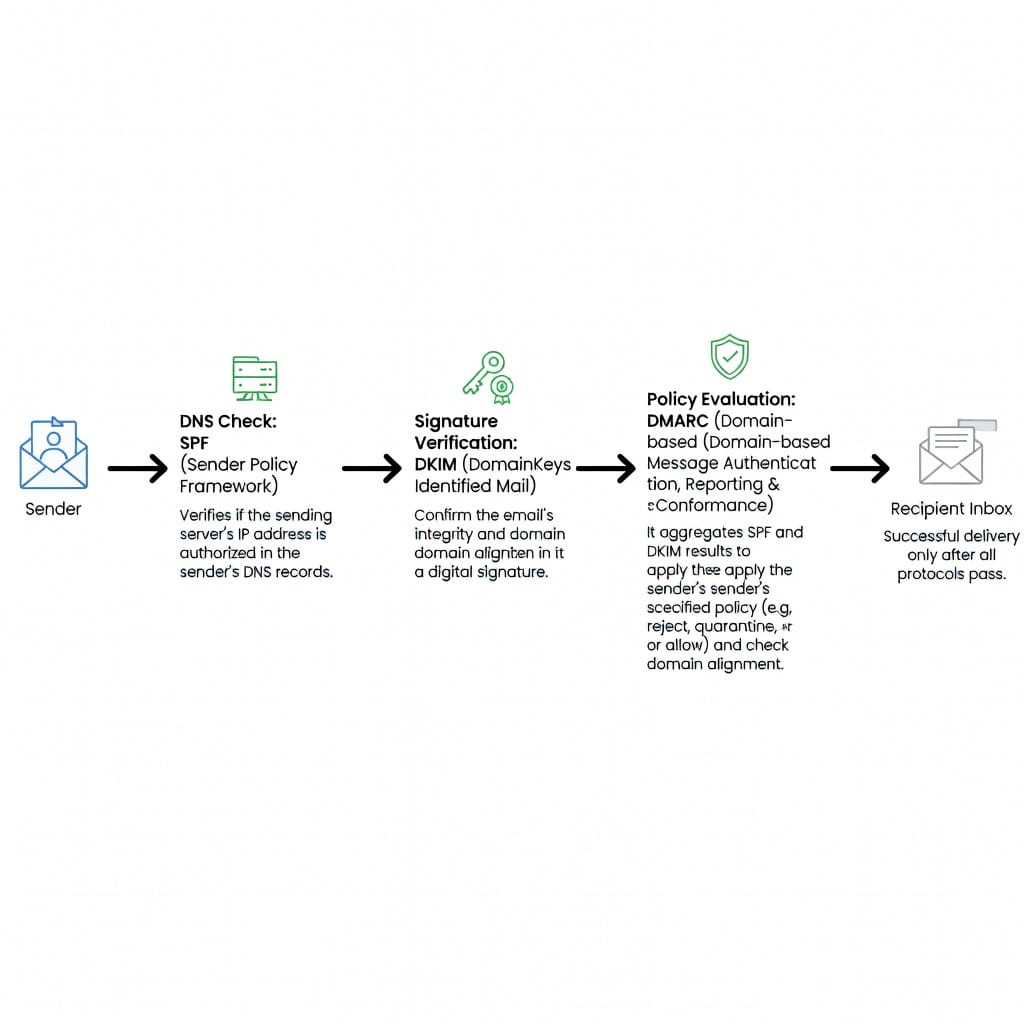
Configure SPF, DKIM, and DMARC for Your Outreach Domain
Before sending a single outreach email, you must configure email authentication for your sending domain. Without these protocols, inbox providers treat your emails as suspicious or fraudulent.
SPF (Sender Policy Framework): Create a DNS TXT record that lists all authorized IP addresses allowed to send email from your domain. This prevents spammers from forging your domain.
DKIM (DomainKeys Identified Mail): Generate a cryptographic key pair. The private key signs each outgoing email, and the public key lives in your DNS records. Receiving servers verify the signature to confirm the email was not tampered with.
DMARC (Domain-based Message Authentication, Reporting, and Conformance): A policy that tells receiving servers what to do when SPF or DKIM fails. Start with `p=none` to monitor, then move to `p=quarantine` or `p=reject` once you confirm legitimate email is passing authentication.
Why this matters for outreach: Gmail and Yahoo began enforcing DMARC requirements for bulk senders in February 2024. If your outreach domain does not have proper authentication, your emails will be rejected or flagged as spam. This is non-negotiable in 2026.
Warm Up Your Sending Accounts Before Outreach
New sending domains and IP addresses have no reputation. Inbox providers treat unknown senders with suspicion. Warmup solves this by gradually building a positive sending history.
Warmup schedule:
- Week 1: Send 10-20 emails per day to addresses that will engage (open, reply, or move from spam to inbox).
- Week 2: Increase to 30-50 emails per day.
- Week 3: Increase to 100-150 emails per day.
- Week 4: Reach your target volume of 200-500 emails per day.
What to monitor during warmup:
- Open rate should stay above 30%. Below 20% indicates a problem.
- Bounce rate must stay below 2%. High bounces damage reputation.
- Spam complaint rate must stay below 0.1%. Above 0.5% can get your domain blacklisted.
- Reply rate of even 1-2% is a positive signal.
Platforms like Mystrika include automated warmup that sends to a real inbox network, rotates subject lines, varies send times, and pauses on negative signals. This protects your sender reputation while you focus on outreach.
Verify Your Prospect Email List
Sending to invalid addresses damages your sender reputation. Every hard bounce signals to inbox providers that you do not maintain your list.
When to verify:
- Immediately after acquiring a prospect list.
- Before every major campaign.
- After periods of inactivity (30+ days since last send).
What verification checks for:
- Syntax validity (does the email format look correct?)
- Domain validity (does the domain exist and accept email?)
- Mailbox existence (does the specific address exist?)
- Disposable email detection (is it a temporary address?)
- Spam trap detection (is the address a known trap?)
- Catch-all detection (does the domain accept all email?)
Use a verification service like DoYouMail or Filter Bounce before every campaign. The cost per verification is minimal compared to the deliverability damage from a single campaign with a 5% bounce rate.
How to Find the Right Prospects for Backlink Outreach
The quality of your prospect list determines the ceiling of your campaign. Sending 500 emails to the wrong people will always underperform 50 emails to the right ones.
Analyze Competitor Backlink Profiles
Your competitors’ backlinks are your best source of prospects. If a site linked to a competitor, they are likely open to linking to you.
Using Ahrefs for prospect discovery:
1. Enter a competitor’s domain in Ahrefs Site Explorer.
2. Go to the Backlinks report and filter for dofollow links.
3. Sort by Domain Rating to find high-authority linking sites.
4. Visit each linking page and assess whether your content would be a better fit.
5. Add qualifying prospects to your outreach list.
Key metrics to evaluate:
- Domain Rating (DR): Higher is better, but relevance matters more. A DR 40 site in your niche is worth more than a DR 80 site in an unrelated niche.
- Organic traffic: Sites with real traffic are more likely to engage and maintain their content.
- Referring domains to linking domains ratio: Aim for at least 1:1. A site with 500 referring domains linking to 50 pages is a better prospect than one with 500 referring domains linking to 500 pages.
- Content freshness: Check the cache date of the page. Recently updated sites are more likely to respond.
Use Advanced Search Operators
Google search operators help you find prospects that SEO tools might miss.
Prospecting search strings:
- `”keyword” + “resources”` – Find resource pages in your niche.
- `”keyword” + “useful links”` – Find curated link lists.
- `”keyword” + “recommended”` – Find recommendation pages.
- `”keyword” + “write for us”` – Find guest posting opportunities.
- `”keyword” + “guest post”` – Find sites that accept guest content.
- `inurl:links + “keyword”` – Find pages with “links” in the URL.
- `”keyword” + “blog” + “contribute”` – Find contributor guidelines.
Find Contact Information
Once you have a list of target sites, you need the right person’s email address.
Methods for finding contact emails:
- Hunter.io: Enter a domain and get a list of verified email addresses associated with that domain. Hunter also provides a confidence score for each address.
- Voila Norbert: Similar to Hunter, with a focus on accuracy.
- LinkedIn: Identify the content manager, editor, or SEO manager at the target site. Use LinkedIn Sales Navigator or manual search.
- Email pattern detection: If you know one email address at a company (e.g., `[email protected]`), you can often infer the pattern and guess other addresses.
- Company website: Check the “About,” “Team,” or “Contact” pages for direct email addresses.
Who to contact:
- For guest posts: Content manager, editor, or blog manager.
- For broken link building: Webmaster, site owner, or content manager.
- For link insertions: The article’s author or the content editor.
- For resource pages: The page curator or site owner.
How to Write Backlink Outreach Emails That Get Replies
Your email is the only thing standing between you and a backlink. Most outreach emails fail because they are generic, self-serving, and too long.
The Anatomy of a High-Converting Outreach Email
Every outreach email should follow this structure:
1. Personalized opening (1 sentence): Reference something specific about the recipient or their content. “I enjoyed your recent article on [specific topic].”
2. The reason for reaching out (1-2 sentences): Explain why you are contacting them specifically. Be direct.
3. The value proposition (1-2 sentences): What is in it for them? A broken link fix, a valuable resource for their readers, or an exclusive data point.
4. The specific ask (1 sentence): Exactly what you want them to do. “Would you consider adding this as a resource?”
5. Sign-off (1 sentence): Thank them and keep it open-ended.
Length: 50-100 words. Anything longer gets skimmed or ignored.
Outreach Email Templates That Work
Template 1: Broken Link Building
Subject: Quick fix for your [Topic] article
Hi [Name],
I was reading your article on [Topic] and noticed the link to [Broken URL] is no longer working. I have a detailed guide on [Related Topic] that would be a natural replacement:
[Your URL]
It covers [brief value statement]. Your readers would find it useful.
Let me know if you would like me to send the full resource.
Best,
[Your Name]
Template 2: Guest Post Pitch
Subject: Article idea for [Blog Name]
Hi [Name],
I have been following [Blog Name] for a while, and I noticed you have not covered [Specific Topic] recently. I have a few ideas that would resonate with your audience:
1. [Idea 1]
2. [Idea 2]
3. [Idea 3]
I have written for [Previous Publications] and can deliver a well-researched, original piece within two weeks.
Would any of these topics work for your editorial calendar?
Best,
[Your Name]
Template 3: Resource Page Addition
Subject: Resource suggestion for your [Topic] page
Hi [Name],
I came across your excellent resource page on [Topic] and noticed you list [Related Resource]. I wanted to suggest adding our guide on [Specific Subtopic]:
[Your URL]
It covers [brief value statement] and would complement the resources you already have listed.
Thanks for considering it.
Best,
[Your Name]
Template 4: Unlinked Mention
Subject: Thanks for the mention!
Hi [Name],
Thanks for mentioning [Brand/Product] in your article on [Topic]. I am glad you found it useful.
Would you mind adding a link to our site? The relevant page is:
[Your URL]
No problem if not, and let me know if you need any additional information.
Best,
[Your Name]
Subject Line Strategies for Higher Open Rates
Your subject line determines whether your email gets opened or deleted. Here is what works for backlink outreach:
- Reference their content: “Loved your article on [Topic]” or “Quick question about your [Topic] post”
- Be direct: “Resource suggestion for your [Topic] page” or “Broken link on your [Topic] article”
- Be helpful: “Quick fix for your [Topic] article” or “I found a broken link on your site”
- Personalize: Include their name or their site name in the subject line.
What to avoid:
- Clickbait subject lines (“You won’t believe this…”)
- Generic subjects (“Link building opportunity”)
- Overly salesy language (“Free backlink offer”)
- ALL CAPS or excessive punctuation
Follow-Up Sequences That Convert Without Being Annoying
Most backlinks come from follow-ups, not the initial email. A single follow-up can double your response rate.
Follow-up schedule:
- Email 1 (Day 0): Initial outreach email.
- Email 2 (Day 5-7): Gentle reminder. “Just wanted to make sure you saw my previous email.”
- Email 3 (Day 12-14): Final follow-up with a different angle. Offer additional value or a different resource.
Follow-up best practices:
- Change the subject line slightly so it does not look like a repeat.
- Add new value in each follow-up (a different resource, a new data point, a different angle).
- Keep the tone friendly, not pushy.
- Know when to stop. After 3 emails, move on.
Backlink Outreach Tools Comparison
| Tool | Best For | Starting Price | Key Features |
|---|---|---|---|
| Ahrefs | Prospect discovery, competitor analysis, broken link finding | $99/mo | Site Explorer, Content Explorer, Broken Links report, Rank Tracker |
| Semrush | Prospect discovery, competitor analysis | $129.95/mo | Backlink Analytics, Link Building Tool, Broken Link Checker |
| Mystrika | Email outreach, deliverability, warmup, sequencing | $15/mo | AI warmup, unified inbox, email verification, A/B testing, AI personalization, whitelabel |
| Hunter.io | Email finding and verification | $49/mo | Domain search, email verification, campaign tracking |
| Voila Norbert | Email finding | $49/mo | Email finder, bulk verification |
| Pitchbox | Outreach campaign management | Custom pricing | Workflow automation, prospect management, reporting |
| BuzzStream | Outreach relationship management | $24/mo | Prospect management, email tracking, relationship scoring |
| Connectively (HARO) | Journalist query responses | Free (basic) | Daily query emails, source profile |
| Qwoted | Journalist query responses | Free | Query matching, source dashboard |
| Google Sheets | Outreach tracking | Free | Spreadsheet management, collaboration |
| Check My Links | Broken link detection | Free (Chrome extension) | On-page broken link scanning |
For most outreach campaigns, you need at least three tools: a prospecting tool (Ahrefs or Semrush), an email finding tool (Hunter.io or Voila Norbert), and an outreach platform (Mystrika for deliverability and sequencing, or BuzzStream for relationship management).
How to Scale Backlink Outreach with AI and Automation
In 2026, AI transforms backlink outreach from a manual, time-intensive process into a scalable system. Here is how to use AI at each stage without losing the personal touch that makes outreach effective.
AI for Prospect Research
AI tools can analyze thousands of pages to identify link opportunities that would take hours to find manually. Tools like Ahrefs already use machine learning to surface relevant prospects, but you can go further:
- Use AI to analyze competitor backlink profiles and categorize prospects by relevance, authority, and likelihood to convert.
- Train AI models to identify content gaps on target sites and suggest topics that would naturally include a link to your content.
- Automate the initial screening of prospects based on DR, traffic, topical relevance, and content freshness.
AI for Personalization at Scale
This is where AI delivers the most value. Instead of writing 200 personalized emails manually, you can use AI to generate personalized variations based on prospect data.
How AI personalization works for outreach:
1. Feed the AI the prospect’s URL, recent articles, and any relevant context.
2. The AI analyzes the prospect’s content and generates a personalized opening line referencing their specific work.
3. The AI selects the most relevant resource from your content library to pitch.
4. The AI generates a unique email that sounds human, not templated.
Mystrika’s AI personalization engine does exactly this. It analyzes industry, role, and company data to generate contextual outreach that produces 1,000+ unique emails in under 10 minutes. Reply rates of 10-20% are achievable with AI-personalized outreach at scale.
AI for Follow-Up Optimization
AI can analyze which follow-up messages, subject lines, and timing produce the highest conversion rates. It can:
- A/B test subject lines and body copy automatically.
- Adjust follow-up timing based on when the prospect is most likely to open.
- Rewrite follow-up messages that are not performing.
- Suppress prospects who have clearly disengaged.
AI for Reply Handling
When prospects reply, AI can categorize responses, suggest replies, and automate follow-ups:
- Positive responses (yes, send the link) route to your confirmation workflow.
- Negative responses (not interested) trigger suppression to avoid further emails.
- Questions flag for human attention with suggested reply drafts.
- Out-of-office auto-responders pause the sequence and resume after the specified date.
Multi-Channel Outreach: Combining Email with LinkedIn
Email alone is powerful, but combining email with LinkedIn touchpoints can double your response rates. Multi-channel outreach works because it accommodates different communication preferences and creates multiple opportunities to capture attention.
The Multi-Channel Sequence Framework
Week 1:
1. Day 1: Send a LinkedIn connection request with a personalized note. Do not pitch anything. Just introduce yourself and mention a shared interest or their content.
2. Day 3: Send your initial outreach email. Reference your LinkedIn interaction if they accepted.
Week 2:
3. Day 7: Send a follow-up email with additional value (a different resource, a data point, or a specific suggestion).
4. Day 10: Engage with their LinkedIn content. Leave a thoughtful comment on one of their posts.
Week 3:
5. Day 14: Send a final follow-up email. If they have been active on LinkedIn but not responding to email, try a LinkedIn message instead.
Channel-Specific Best Practices
Email: Detailed value propositions, clear asks, follow-up sequences. This is your primary channel for the actual request.
LinkedIn: Context, recognition, and relationship building. Use LinkedIn to establish familiarity before or during your email sequence. Do not pitch your link request in a LinkedIn message unless they have already responded positively to email.
Phone: Reserved for high-value prospects who have engaged with your email or LinkedIn outreach. A phone call can close a deal that email alone cannot.
Tools for Multi-Channel Coordination
Mystrika’s Unibox provides a centralized view of all prospect interactions across channels. Instead of switching between your email platform, LinkedIn, and a spreadsheet, you can see the full conversation history for each prospect in one place. This prevents duplicate outreach and ensures consistent messaging.
Tracking and Measuring Backlink Outreach ROI
Most outreach campaigns fail because the people running them do not track the right metrics. Here is what to measure and how to calculate ROI.
Outreach Performance Metrics
| Metric | What It Measures | Good Benchmark | Bad Benchmark |
|---|---|---|---|
| Open rate | How many prospects opened your email | 50-70% | Below 30% |
| Reply rate | How many prospects replied | 5-15% | Below 3% |
| Positive reply rate | How many said yes | 2-5% | Below 1% |
| Link conversion rate | How many prospects actually placed a link | 1-3% | Below 0.5% |
| Bounce rate | How many emails bounced | Below 2% | Above 5% |
| Spam complaint rate | How many marked as spam | Below 0.1% | Above 0.5% |
ROI Calculation Framework
Costs to track:
- Tool subscriptions (Ahrefs, Mystrika, Hunter.io, etc.)
- Time cost (hours spent on prospecting, writing, sending, follow-up)
- Email verification costs
- Content creation costs (if creating resources specifically for outreach)
Returns to track:
- Number of backlinks acquired
- Domain Rating of linking sites
- Referral traffic from acquired links
- Estimated search traffic value of ranking improvements
- Direct conversions from referral traffic
Simple ROI formula:
ROI = (Estimated value of acquired links - Total campaign cost) / Total campaign cost * 100A well-run outreach campaign should achieve 3-5x ROI within 6 months. If you are not tracking ROI, you are guessing.
Common Backlink Outreach Mistakes to Avoid
1. Sending from an unauthenticated domain. No SPF, DKIM, or DMARC means your emails land in spam. Fix this before sending a single email.
2. Using a Gmail or Outlook address. Generic email providers signal low credibility. Use a domain-based email address that matches your site.
3. Sending without warming up. A brand-new domain sending 200 emails on day one will be flagged as spam. Warm up for 2-4 weeks first.
4. Using generic templates. If your email starts with “I came across your website and was impressed by your content,” the recipient has seen it 100 times before. Personalize every email.
5. Not following up. Most backlinks come from follow-ups. A single follow-up can double your response rate. Send at least one.
6. Pitching the wrong person. Emailing the CEO about a broken link on the blog is a waste of time. Find the content manager or editor.
7. Asking for too much. Do not ask for a link to your homepage. Ask for a link to a specific, relevant resource page.
8. Not tracking anything. If you do not know your open rate, reply rate, and conversion rate, you cannot improve. Use an outreach platform that tracks these metrics.
9. Buying links. Paid links violate Google’s Webmaster Guidelines and can result in manual penalties. The short-term gain is not worth the long-term risk.
10. Scaling too fast. Sending 1,000 emails from a single account without proper infrastructure will destroy your sender reputation. Scale gradually with multiple accounts and proper warmup.
Key Takeaways
- Backlink outreach is the most effective way to build authority, but it requires proper email infrastructure, targeted prospecting, and personalized messaging.
- Configure SPF, DKIM, and DMARC for your outreach domain before sending a single email. Gmail and Yahoo enforce these requirements.
- Warm up your sending accounts for 2-4 weeks before launching a campaign. Start with 10-20 emails per day and scale gradually.
- Use a combination of strategies: broken link building, guest posting, skyscraper technique, unlinked mentions, resource page outreach, digital PR, and link insertions.
- Personalize every email. Reference specific content on the target site. Keep emails under 100 words.
- Follow up at least once. Most backlinks come from follow-ups, not initial emails.
- Track your metrics: open rate, reply rate, positive reply rate, and link conversion rate. Calculate ROI to justify continued investment.
- Use AI for prospect research, personalization at scale, follow-up optimization, and reply handling.
- Combine email with LinkedIn for multi-channel outreach that doubles response rates.
- Use a platform like Mystrika for automated warmup, AI personalization, unified inbox management, and deliverability optimization.
Frequently Asked Questions
How many outreach emails should I send per day?
Start with 10-20 per sending account per day after completing a 2-4 week warmup period. Scale gradually to 50-100 per account. If you need higher volume, use multiple sending accounts with separate domains and IPs. Never exceed 200 emails per day from a single account, even after warmup.
What is a good reply rate for backlink outreach?
A reply rate of 5-15% is typical for well-targeted, personalized outreach. Sniper approaches with high personalization can reach 15-20%. If your reply rate is below 5%, your targeting or messaging needs improvement. Check your deliverability first, then your prospect quality, then your email copy.
Should I use my main domain for backlink outreach?
No. Use a separate domain for outreach to protect your primary domain’s sender reputation. If your outreach domain gets flagged for spam, your main business email is unaffected. Warm up the outreach domain before sending, and configure proper authentication (SPF, DKIM, DMARC).
How long does backlink outreach take to show results?
Most campaigns see first links within 2-4 weeks of consistent outreach. Significant SEO impact from acquired links typically takes 3-6 months. Google needs to crawl and index the linking page, then factor the link into its ranking algorithm. Be patient and consistent.
Do I need to pay for backlinks?
No. Paying for backlinks violates Google’s Webmaster Guidelines and can result in manual penalties or algorithmic demotion. Focus on earned links through quality content, relationship building, and legitimate outreach strategies. The cost of outreach tools and time is an investment in earned links, not paid links.
What is the difference between dofollow and nofollow backlinks?
Dofollow links pass link equity (PageRank) and influence search rankings. Nofollow links do not pass equity but can still drive referral traffic and brand exposure. A natural link profile includes both types. Google treats nofollow as a hint, not a directive, meaning it may still consider nofollow links in some contexts.
How do I find broken links for outreach?
Use Ahrefs’ Broken Links report, the Check My Links Chrome extension, or Semrush’s Site Audit tool. Enter a target domain, run the broken link scan, and filter for 404 errors. Prioritize broken links on pages that still receive traffic and have existing backlinks.
What email verification service should I use?
DoYouMail is a budget-friendly option that checks syntax, domain validity, and mailbox existence. Filter Bounce focuses on accuracy and speed, catching hard bounces, spam traps, and disposable addresses. Both integrate with most outreach platforms. Verify your list before every campaign.
Can I automate backlink outreach completely?
You can automate the email sending, follow-up scheduling, and reply categorization, but you cannot fully automate personalization and relationship building. Use AI to scale personalization (Mystrika’s AI writer generates unique emails based on prospect data), but review a sample of generated emails to ensure quality. Full automation without human oversight produces generic outreach that gets ignored.
How do I handle rejection in backlink outreach?
Rejection is normal. Most prospects will say no or ignore your email. Do not take it personally. Move on to the next prospect. If you receive a polite no, thank them and ask if they would be open to future opportunities. Maintain the relationship for future campaigns.