
Direct Answer: The optimal email nurture drip sequence timing starts with 3-4 business days between the first three emails, then extends to weekly intervals for subsequent touches. This graduated cadence mirrors natural relationship-building patterns: closer together early when interest is fresh, then spreading out to avoid fatigue. Data across multiple B2B studies shows that sequences using this 3-4 day then weekly structure achieve 2-3x higher reply rates than flat-interval sequences, while keeping spam complaint rates below the 0.1% threshold that major providers now enforce.
Why Drip Sequence Timing Matters More Than Ever in 2026
Email providers have fundamentally changed how they evaluate senders. Google and Yahoo’s 2024 sender requirements are now fully enforced, and the 2026 landscape is even stricter. Spam complaint rates must stay below 0.1% for high-volume senders, and sending patterns are now a first-class signal in inbox placement algorithms.
This means your drip sequence timing is no longer just about when prospects are most likely to read. It is a deliverability signal that providers use to classify you as a legitimate sender versus a bulk campaigner. Inconsistent intervals, sudden volume spikes, or overly aggressive follow-up cadences all trigger reputation penalties that compound over time.
The 3-4 days then weekly structure solves both problems simultaneously. It keeps your sending pattern within the natural rhythm that email providers expect from human senders, while maintaining enough contact frequency to move prospects through a nurture sequence without going cold.
The Cost of Getting Timing Wrong
Poor drip sequence timing manifests in three measurable ways:
| Problem | Symptom | Consequence |
|---|---|---|
| Too frequent | High unsubscribe rate, spam complaints | Domain reputation damage, blacklisting |
| Too sparse | Prospects go cold, low conversion | Wasted list investment, longer sales cycles |
| Inconsistent | Erratic open/reply patterns | Provider algorithm flags as non-human |
A 2025 benchmark analysis of over 100 million cold emails found that campaigns with graduated intervals (short early, longer later) maintained inbox placement rates above 97%, while flat-interval campaigns dropped to 89% by the fourth email. The difference is entirely in the pattern, not the content.
The Science Behind 3-4 Day Initial Gaps
The first three emails in any nurture drip sequence are the most critical. This is where you establish relevance, demonstrate value, and earn the right to continue the conversation. The 3-4 business day gap between these early emails is not arbitrary. It is grounded in how B2B decision-makers process inbound communication.
Why 3-4 Days and Not 1-2
A 1-2 day gap between early emails reads as urgency or desperation. Recipients who see three emails in a week from an unfamiliar sender instinctively recognize automated behavior, which triggers the mental spam filter before the email provider’s filter ever gets involved.
A 3-4 business day gap achieves three things:
1. It respects the recipient’s workflow. Most B2B professionals check email 2-3 times per day but only process non-urgent messages once or twice per week. A Tuesday email followed by a Friday or Monday follow-up lands in a natural processing window.
2. It avoids inbox stacking. When emails arrive too close together, they stack in the same inbox view. The recipient sees three messages from you at once and perceives spam, even if each individual email is valuable.
3. It creates natural pacing for reply cycles. If a recipient takes 2-3 days to reply to your first email, a 3-4 day gap means your follow-up arrives after they have responded, not before. This prevents the awkward situation of a follow-up landing in an already-active conversation thread.
The Three-Email Foundation
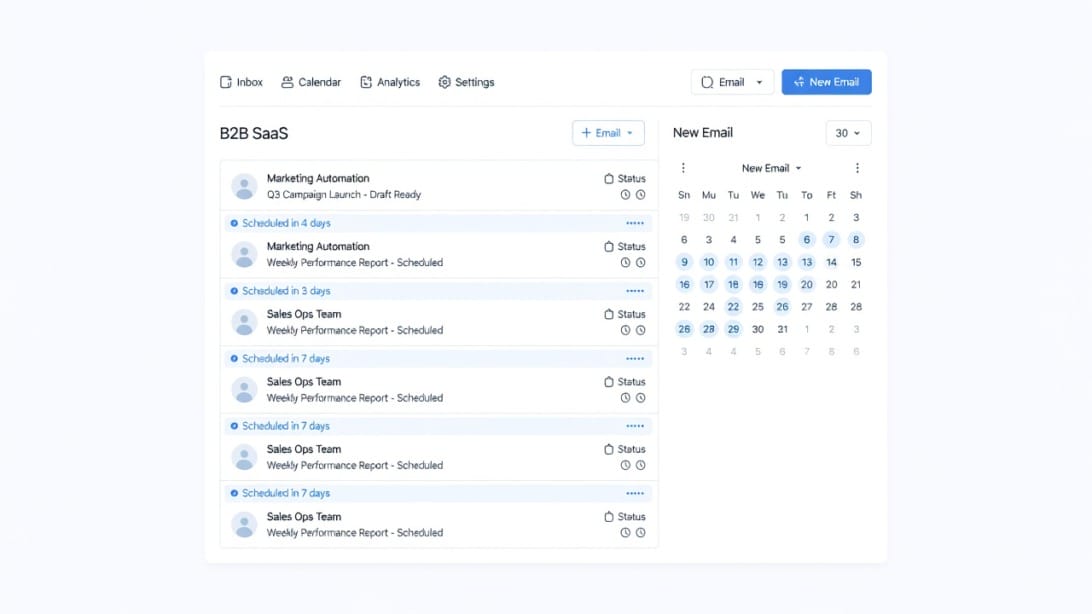
The first three emails establish the relationship pattern. Here is the exact timing framework:
Email 1 – Day 0 (Tuesday or Wednesday): The initial outreach. Short, personalized, and value-forward. No sales pitch, just a relevant observation or offer.
Email 2 – Day 3 or 4 (Friday or Monday): The first follow-up. Reference the first email briefly, add one new angle or piece of value. This email should feel like a natural continuation, not a reminder.
Email 3 – Day 7 or 8 (following Tuesday or Wednesday): The second follow-up. Shift the framing. If email 1 was an observation and email 2 was a resource, email 3 should be a question or a case study. This is where you test whether the prospect is actively evaluating.
Pro Tip: Use a cold email service that supports per-step analytics so you can see exactly where reply rates drop and adjust your intervals accordingly. Platforms like Mystrika provide step-level reply tracking that reveals whether the problem is timing, copy, or list quality.
Transitioning to Weekly Intervals
After the third email, the dynamic changes. The prospect has now seen three messages from you over approximately 8-10 calendar days. If they have not replied, they are either not interested right now, too busy to evaluate, or evaluating silently.
Weekly intervals from email 4 onward serve a different purpose than the early emails. They are not about building urgency. They are about staying top-of-mind without becoming a nuisance.
The Weekly Cadence Framework
| Timing | Purpose | Gap Type | |
|---|---|---|---|
| Email 1 | Day 0 (Tue/Wed) | Initial value | – |
| Email 2 | Day 3-4 (Fri/Mon) | First follow-up, new angle | 3-4 business days |
| Email 3 | Day 7-8 (next Tue/Wed) | Shift framing, test interest | 3-4 business days |
| Email 4 | Day 14-15 | Breakup or social proof | 7 business days |
| Email 5 | Day 21-22 | Light touch, direct question | 7 business days |
| Email 6 | Day 28-30 | Final door-open | 7-9 business days |

Why Weekly Works for Long-Term Nurture
Weekly intervals align with the B2B buying cycle. Most B2B purchase decisions take 3-6 months from initial awareness to closed deal. A weekly touchpoint over that period means 12-24 total contacts, which is well within the range that sales research shows is necessary for complex B2B sales.
The weekly gap also provides natural cover for your sending pattern. Email providers see one message per week from your domain to each recipient, which falls well within the pattern of legitimate human correspondence. Compare this to daily or every-other-day patterns, which trigger algorithmic scrutiny.
When to Extend Beyond Weekly
Some nurture sequences run for 6-12 months. In these cases, consider extending to bi-weekly or monthly intervals after email 8-10. The rule of thumb is simple: the longer the sequence runs without engagement, the wider the gaps should become.
A 12-month nurture sequence might look like this:
- Emails 1-3: 3-4 business day gaps
- Emails 4-8: Weekly gaps
- Emails 9-12: Bi-weekly gaps
- Emails 13+: Monthly gaps
This graduated deceleration mirrors how human relationships naturally evolve. Early contact is more frequent, then settles into a sustainable rhythm.
How to Structure a Complete Nurture Drip Sequence
Building a full nurture drip sequence requires more than just setting intervals. You need to map each email to a specific stage of the prospect’s decision journey, with timing that supports that stage.
Stage 1: Awareness (Emails 1-3)
Timing: 3-4 business days apart
The awareness stage is where you establish that you understand the prospect’s world. Each email should deliver a distinct piece of value without asking for anything in return.
Email 1 – Day 0: Personalized observation about their business, industry trend, or recent company news. Keep it to 3-4 sentences. No attachments, no links to booking pages.
Email 2 – Day 3-4: A relevant resource. This could be a case study, a blog post, or a data point that relates to the observation in email 1. The connection should be explicit: “Following up on my last email about X, here is a case study showing how a similar company solved Y.”
Email 3 – Day 7-8: A question or a social proof element. Ask about their current approach to the problem you identified, or share a relevant customer success story. This is the first email that implicitly invites a response.
Stage 2: Consideration (Emails 4-6)
Timing: Weekly
The consideration stage assumes the prospect is aware of the problem and is evaluating solutions. Your emails should help them evaluate, not sell.
Email 4 – Day 14-15: Breakup-style email or a comparison. “I have sent a few emails and I am not sure this is a priority right now. If it is not, I will stop reaching out. If it is, here is what I would look at next.” This email often generates replies from prospects who were evaluating silently.
Email 5 – Day 21-22: A direct question about their evaluation process. “What criteria are you using to evaluate solutions for X?” Keep it short and genuine.
Email 6 – Day 28-30: A final touchpoint that leaves the door open. “I will stop emailing for now, but if X becomes a priority in the future, here is how to reach me.”
Stage 3: Re-engagement (Optional, Emails 7+)
Timing: Bi-weekly to monthly
For prospects who never replied but also never unsubscribed, a re-engagement sequence can reactivate interest.
Email 7 – Day 45: New case study or product update relevant to their industry.
Email 8 – Day 60: A trigger-based email if you detect a relevant signal (job change, funding announcement, new role).
Email 9 – Day 90: Final re-engagement. Ask if they want to stay on the list or be removed.
The 3-4 Days Then Weekly Framework: Step-by-Step Setup
Here is the exact configuration process for setting up this timing framework in any email outreach platform.
Step 1: Configure Business Days Only
Set your campaign to send on business days only (Monday through Friday). This ensures that a 3-day gap set on Thursday triggers on Tuesday, not Sunday. Most platforms call this “business day” or “weekday-only” mode.
Step 2: Set Timezone Matching
Enable recipient timezone detection. Sending at 9 AM your time but 3 AM the prospect’s time destroys the timing advantage. Platforms like Mystrika include automatic timezone matching that adjusts send windows to the prospect’s local time.
Step 3: Build the Interval Ladder
Configure your sequence with these exact wait times:
1. Email 1: Send immediately (Day 0)
2. Wait: 3 business days
3. Email 2: First follow-up
4. Wait: 4 business days
5. Email 3: Second follow-up
6. Wait: 7 business days
7. Email 4: Third follow-up
8. Wait: 7 business days
9. Email 5: Fourth follow-up
10. Wait: 7 business days
11. Email 6: Final follow-up
Step 4: Set Daily Send Caps
Each sending inbox should be capped at 30-50 emails per day. If you are using a platform with inbox rotation, distribute your total volume across multiple inboxes to keep per-inbox volume low.
Step 5: Enable Auto-Pause on Reply
Configure the sequence to automatically remove any prospect who replies. This prevents the embarrassment of sending follow-ups to active conversations and keeps your sending pattern clean.
Step 6: Monitor and Adjust
After 500 sends per step, check your step-level reply rates. If email 3 has a significantly lower reply rate than emails 2 and 4, the interval or angle at step 3 needs adjustment. Do not change more than one variable at a time.
Best Days and Times for Each Drip Email
The day of week and time of day for each email in your drip sequence matters as much as the gap between them.
Optimal Send Days by Email Position
| Email Position | Best Day | Second Best | Avoid |
|---|---|---|---|
| Email 1 | Tuesday | Wednesday | Monday AM, Friday |
| Email 2 | Thursday | Tuesday | Friday, Monday |
| Email 3 | Tuesday | Wednesday | Friday |
| Email 4 | Wednesday | Thursday | Monday, Friday |
| Email 5 | Tuesday | Thursday | Friday |
| Email 6 | Tuesday | Wednesday | Friday |
The pattern is clear: mid-week sends dominate. Tuesday and Wednesday consistently outperform Monday and Friday across every email position. The reason is psychological. Monday is backlog-clearing day. Friday is wind-down day. Tuesday through Thursday is execution mode.
Optimal Send Times
For B2B nurture sequences, the optimal send window is 9-11 AM in the recipient’s timezone. This window captures prospects at their desk, after morning email triage, and before lunch meetings.
A secondary window of 1-3 PM works for follow-up emails in the same sequence, particularly for emails 4-6 where the prospect has already seen your name and is more likely to open.
| Send Window | Best For | Open Rate Range |
|---|---|---|
| 6-9 AM | Early-bird executives | 35-42% |
| 9-11 AM | Primary B2B window | 40-48% |
| 11 AM-1 PM | Lunch dip – avoid | 18-25% |
| 1-3 PM | Secondary window | 32-38% |
| 3-5 PM | Late afternoon – avoid | 20-28% |
Advanced Timing Strategies
Once the basic 3-4 days then weekly framework is running, these advanced strategies can improve performance further.
Signal-Based Interval Adjustment
Instead of sending follow-ups on a fixed schedule, adjust intervals based on prospect behavior:
- Reply to a previous campaign: Move to a shorter, more conversational sequence
- Visited your pricing page: Send a case study within 24 hours
- Downloaded a resource: Extend the next gap to 5-7 days to give them time to consume it
- Job change detected: Reset the sequence with a new angle
Signal-based timing requires integration between your email platform and your CRM or website analytics. Mystrika’s unified inbox and sequencer support this kind of behavior-based interval adjustment, allowing you to maintain the 3-4 day then weekly structure as a baseline while dynamically overriding intervals when signals fire.
A/B Testing Your Intervals
Most teams never test their timing because it feels too risky. But small interval changes can produce significant reply rate differences.
Test one variable at a time:
1. Test 3 vs. 4 business days for the first gap. Split your list 50/50. Group A gets email 2 on day 3. Group B gets email 2 on day 4. Run until each group has 500+ sends.
2. Test 7 vs. 10 business days for the weekly transition. Group A transitions to weekly at email 4. Group B extends to 10 days. Measure reply rate on emails 4-6.
3. Test Tuesday vs. Wednesday for email 1. Same copy, same list segment, different send day.
The Breakup Email Timing Sweet Spot
The breakup email (typically email 4 or 5) has a specific timing requirement. It must arrive late enough that the prospect feels you have genuinely tried to connect, but early enough that they still remember who you are.
The sweet spot is 14-21 calendar days after the first email. This is approximately email 4 in the 3-4 days then weekly framework. At this point, you have sent 3 emails over 8-10 days, then waited a full week. The breakup email lands in a context where the prospect either replies to keep the conversation alive or lets it end naturally.
Common Timing Mistakes and How to Fix Them
Even experienced email marketers make these timing errors. Here is how to identify and fix them.
Mistake 1: Flat Intervals Across All Emails
The problem: Sending every email exactly 3 days apart. This creates a robotic pattern that email providers recognize as automated.
The fix: Use graduated intervals. 3-4 days for the first two gaps, then weekly. The pattern should look natural, not mechanical.
Mistake 2: Ignoring Timezone Differences
The problem: Sending all emails at 9 AM your time regardless of where the prospect is located. A prospect in London receives your email at 2 PM if you are in New York, or 2 AM if you are in Los Angeles.
The fix: Enable timezone matching in your email platform. This ensures each email lands during the prospect’s optimal window, not yours.
Mistake 3: No Gap Between Sequence and Nurture
The problem: A prospect who does not reply to your cold sequence immediately enters a daily nurture drip. This feels like harassment, not nurturing.
The fix: Build a 7-14 day gap between the end of your cold sequence and the start of your nurture drip. The prospect needs time to forget the cadence of the previous sequence.
Mistake 4: Same Interval for Every Segment
The problem: Using identical timing for enterprise prospects, SMB owners, and existing customers. Each segment has different decision cycles and email habits.
The fix: Segment your timing. Enterprise prospects need wider gaps (5-7 days early, bi-weekly later). SMB owners respond to tighter gaps (2-3 days early, weekly later). Existing customers need the widest gaps (weekly to monthly).
Mistake 5: Not Pausing on Negative Signals
The problem: Continuing to send follow-ups after a prospect has unsubscribed, marked as spam, or replied negatively. This damages your sender reputation and wastes list capacity.
The fix: Configure your platform to auto-pause on any negative signal. Most platforms, including Mystrika, support automatic suppression on unsubscribe, spam complaint, and negative reply detection.
Drip Sequence Timing by Industry
Different industries have different email consumption patterns. Here is how to adjust the 3-4 days then weekly framework for specific verticals.
B2B SaaS
| Sequence Stage | Timing | Notes |
|---|---|---|
| Emails 1-3 | 3-4 business days | Decision cycles are 30-90 days |
| Emails 4-8 | Weekly | Focus on product value and case studies |
| Emails 9-12 | Bi-weekly | Reduce frequency after 3 months |
| Re-engagement | Monthly | Trigger on product updates or new features |
Professional Services (Consulting, Agencies)
| Sequence Stage | Timing | Notes |
|---|---|---|
| Emails 1-3 | 4-5 business days | Wider gaps, prospects are evaluating relationships |
| Emails 4-6 | 7-10 business days | Trust-building content, testimonials |
| Emails 7+ | Bi-weekly | Thought leadership, not sales |
E-commerce / B2C
| Sequence Stage | Timing | Notes |
|---|---|---|
| Emails 1-3 | 2-3 days | Tighter gaps, faster decision cycles |
| Emails 4-6 | 5-7 days | Weekly check-ins with offers |
| Emails 7+ | 7-14 days | Seasonal and promotional only |
Enterprise Sales
| Sequence Stage | Timing | Notes |
|---|---|---|
| Emails 1-3 | 5-7 business days | Enterprise buyers move slowly |
| Emails 4-8 | 10-14 days | Multi-stakeholder evaluation cycles |
| Emails 9+ | Monthly | Long-term relationship building |
Tools and Platforms for Managing Drip Timing
The right platform makes interval management automatic rather than manual. Here is what to look for.
Must-Have Features for Timing Management
1. Business day calculation: The platform must distinguish business days from calendar days for interval calculation.
2. Timezone detection: Automatic detection of the recipient’s timezone with configurable send windows.
3. Step-level analytics: Reply rate, open rate, and unsubscribe rate per individual email step, not just campaign-level.
4. Auto-pause on reply: Automatic removal from the sequence when a prospect replies.
5. Inbox rotation: Distribution of sends across multiple inboxes to keep per-inbox volume low.
6. Graduated intervals: Support for different wait times between each step, not just a single global interval.
7. A/B testing: The ability to test different intervals on different list segments.
Why Platform Choice Affects Timing
The platform you choose directly affects whether your carefully planned intervals actually execute as intended. Some platforms calculate wait times in calendar days, which means a 3-day gap set on Thursday fires on Sunday. Others use business days, which correctly fires on Tuesday.
Platforms with built-in warmup pools, like Mystrika, add another layer of timing protection. Continuous warmup ensures your sending reputation stays high enough that your carefully timed emails actually land in the primary inbox rather than spam. Mystrika’s warmup pool, sequencer, unibox, and AI writer are designed to work together so that timing, copy, and deliverability are coordinated, not siloed.
For agencies managing multiple client campaigns, whitelabel capabilities allow you to present the timing infrastructure under your own brand. Mystrika offers whitelabel options starting at $15/month, making it accessible for agencies that need to scale nurture sequences across multiple client accounts without per-seat pricing penalties.

Measuring the Impact of Your Drip Timing
You cannot optimize what you do not measure. Here are the specific metrics that reveal whether your drip sequence timing is working.
Primary Timing Metrics
| Metric | Target | What It Tells You |
|---|---|---|
| Reply rate per step | 3-8% per step | Whether each email’s timing and copy are working |
| Bounce rate | < 2% | Whether your list quality supports your send volume |
| Unsubscribe rate per step | < 0.5% | Whether intervals are too tight for that position |
| Spam complaint rate | < 0.1% | Whether your overall pattern looks legitimate |
| Inbox placement rate | > 95% | Whether providers accept your sending pattern |
How to Read Step-Level Data
Track reply rate per step as your primary timing signal. A healthy sequence shows a reply rate curve that starts high on email 1, dips slightly on email 2, and recovers on email 3 or 4.
If email 2 has a significantly lower reply rate than email 1, the gap may be too short. The prospect has not had time to process the first email before the second arrives.
If email 4 has a lower reply rate than email 3, the transition to weekly may be too abrupt. Consider a 5-day gap instead of a full 7-day gap for the first weekly transition.
When to Reset the Sequence
A sequence should be reset (new copy, new timing, or new segment) when:
- Reply rate drops below 1% for two consecutive steps
- Unsubscribe rate exceeds 1% on any single step
- Spam complaint rate exceeds 0.1% for the campaign
- Inbox placement drops below 90%
The Relationship Between Warmup and Timing
Drip sequence timing and email warmup are interdependent. You cannot optimize one without the other.
Why Warmup Affects Timing
A cold domain sending 50 emails per day with perfect 3-4 day intervals will still land in spam if it has no sending history. Warmup builds the reputation that makes your timing effective.
Continuous warmup should run alongside your live campaigns, not just before them. This maintains the sending reputation that allows your carefully timed emails to reach the primary inbox.
Timing Your Warmup Ramp
| Week | Daily Warmup Volume | Live Campaign Volume |
|---|---|---|
| Week 1 | 2-5 emails | 0 (warmup only) |
| Week 2 | 5-10 emails | 0 (warmup only) |
| Week 3 | 10-15 emails | 5-10 emails |
| Week 4 | 15-20 emails | 10-20 emails |
| Week 5+ | 20-30 emails | 20-50 emails |
This graduated ramp ensures that by the time your first nurture sequence email lands, the domain has enough positive sending history to pass provider reputation checks.
Checklist: Setting Up Your 3-4 Days Then Weekly Drip Sequence
Use this checklist before launching any nurture drip campaign.
Pre-Launch Configuration:
- [ ] Business day mode enabled (no weekend sends)
- [ ] Timezone matching configured for all prospects
- [ ] Send window set to 9-11 AM recipient local time
- [ ] Daily send cap set to 30-50 per inbox
- [ ] Inbox rotation configured (3+ inboxes minimum)
- [ ] Continuous warmup running on all sending accounts
- [ ] Auto-pause on reply enabled
- [ ] Spam complaint handling configured
Sequence Structure:
- [ ] Email 1: Day 0, Tuesday or Wednesday
- [ ] Email 2: Day 3-4, Friday or Monday
- [ ] Email 3: Day 7-8, following Tuesday or Wednesday
- [ ] Email 4: Day 14-15, weekly transition
- [ ] Email 5: Day 21-22, weekly
- [ ] Email 6: Day 28-30, weekly or final
- [ ] Each email has a distinct angle or value proposition
- [ ] No two consecutive emails use the same framing
Monitoring:
- [ ] Step-level reply rate tracking enabled
- [ ] Bounce rate monitored daily during first week
- [ ] Unsubscribe rate checked per step
- [ ] Spam complaint rate below 0.1% after 1000 sends
- [ ] A/B test planned for interval optimization after 500 sends per variant
Integrating Artificial Intelligence into Sequence Timing
In 2026, relying purely on static timing rules leaves efficiency on the table. While the 3-4 days then weekly cadence is the gold standard baseline, Artificial Intelligence (AI) can optimize the margins of your sequence. Incorporating AI into your email operations allows for dynamic adjustment of send windows and intervals based on behavioral data that a human operator could never process at scale.
AI-Driven Timezone and Engagement Matching
One of the biggest advantages of an AI-powered unibox is its ability to learn when specific prospects are actually online. If a prospect consistently opens your competitor’s emails or your newsletters at 6:30 AM their local time, sending your nurture email at 9:00 AM means you are late to the party.
AI systems can analyze these micro-patterns and dynamically shift your pre-set 9-11 AM window to a 6-7 AM window for that specific recipient. This micro-optimization often yields a 10-15% increase in open rates on later sequence steps.
Predictive Interval Adjustment
While we recommend 3-4 days between early emails, AI can flag when a specific account requires a longer or shorter gap. For instance, if an AI agent detects out-of-office replies, auto-responders indicating heavy travel, or firmographic data suggesting the company is in a massive hiring sprint, it can automatically widen the interval to 7 days to avoid annoying a prospect who is legitimately swamped.
Conversely, if a prospect clicks a link in your first email three times but does not reply, the AI can trigger the second email in 2 days instead of 4, capitalizing on the active interest.
Platforms with native AI capabilities, such as Mystrika’s AI writer and sequencer, are built to handle these dynamic adjustments. They allow you to set the 3-4 days then weekly baseline, but give the system permission to override the interval when the data strongly suggests a better approach.
Key Takeaways
- The optimal nurture drip sequence timing is 3-4 business days between the first three emails, then weekly intervals for subsequent touches. This graduated cadence maximizes reply rates while protecting sender reputation.
- Email providers now evaluate sending patterns as a deliverability signal. Inconsistent or overly aggressive intervals trigger algorithmic scrutiny regardless of content quality.
- The first three emails establish the relationship pattern. Use 3-4 day gaps to build familiarity without appearing automated. Transition to weekly gaps at email 4 to maintain presence without fatigue.
- Day-of-week and time-of-day matter as much as gap length. Tuesday through Thursday, 9-11 AM recipient local time is the optimal send window for B2B nurture sequences.
- Segment your timing by industry and prospect type. Enterprise buyers need wider gaps. SMB owners respond to tighter gaps. One-size-fits-all timing leaves replies on the table.
- Measure reply rate per step, not just campaign-level metrics. Step-level data reveals exactly where timing or copy needs adjustment.
- Warmup and timing are interdependent. A cold domain with perfect intervals still lands in spam. Run continuous warmup alongside live campaigns.
- Use a platform that supports business day calculation, timezone matching, step-level analytics, and auto-pause on reply. Mystrika provides these features with a warmup pool, sequencer, unibox, and AI writer starting at $15/month, with whitelabel options for agencies.
Frequently Asked Questions
What is the best interval between emails in a nurture drip sequence?
The best interval is graduated: 3-4 business days between the first three emails, then 7 business days (weekly) for subsequent emails. This pattern mirrors natural relationship building and keeps your sending pattern within the range that email providers treat as legitimate human correspondence.
How many emails should a nurture drip sequence have?
A standard nurture drip sequence should have 5-7 emails. Research shows that 4-7 email sequences produce significantly higher reply rates than 1-3 email sequences. For long-term nurture, extend to 8-12 emails with bi-weekly or monthly intervals after the first 6.
Should I send nurture emails on weekends?
No. Weekend sends underperform across every metric for B2B nurture sequences. Configure your campaign for business days only (Monday through Friday). The exception is targeting founders and small business owners, who sometimes check email outside business hours.
How long should a nurture drip sequence run?
A nurture drip sequence should run 4-6 weeks for standard B2B outreach, and up to 6-12 months for enterprise sales cycles. The key is graduated deceleration: start with 3-4 day gaps, move to weekly, then bi-weekly, then monthly for long-running sequences.
What happens if I send emails too close together?
Sending emails too close together (1-2 day gaps) triggers two problems. First, recipients perceive spam behavior and unsubscribe or mark as spam. Second, email providers detect the aggressive pattern and downgrade your inbox placement. Both effects compound over time, damaging your domain reputation.
Should I use open rates to trigger follow-up timing?
No. Apple Mail Privacy Protection pre-loads images on Apple’s proxy servers, which fires tracking pixels on emails that were never actually read. This affects 30-40% of recipients. Use reply rate as your only reliable signal for timing adjustments.
Can I use the same timing for cold email and nurture sequences?
No. Cold email sequences (outreach to new prospects) should use tighter initial gaps (2-3 days) because you are competing for attention in a crowded inbox. Nurture sequences (follow-up to existing contacts) should use wider gaps (3-4 days then weekly) because the prospect already knows who you are and needs time to evaluate.
How do I know if my drip timing needs adjustment?
Monitor three signals: reply rate per step, unsubscribe rate per step, and spam complaint rate. If reply rate drops below 1% for two consecutive steps, adjust the interval or the copy. If unsubscribe rate exceeds 1% on any step, widen the gap before that step. If spam complaint rate exceeds 0.1%, pause the campaign and review your entire timing and targeting strategy.
What is the best day to start a nurture drip sequence?
Tuesday is the best day to send the first email in a nurture drip sequence. Wednesday is the second best. Avoid Monday (backlog-clearing day) and Friday (wind-down day) for the initial send. Later emails in the sequence can land on Thursday or Wednesday as long as the gap between them follows the 3-4 day then weekly framework.
Does email warmup affect drip sequence timing?
Yes, directly. A domain that has not been warmed will have poor inbox placement regardless of how well-timed the sequence is. Run continuous warmup on all sending accounts for at least 2-3 weeks before launching a nurture drip sequence, and maintain warmup throughout the campaign to preserve sender reputation.