
Cold calling is the practice of contacting a prospect who has no prior relationship with you or your company, usually by phone, to start a sales conversation. It is not the same as spam calling, robocalling, or reading a pitch at strangers. Effective cold calling is targeted, compliant, researched, and conversational.
This guide explains what cold calling means, how it works, when it still makes sense, how it compares with cold email, what scripts to use, what laws to respect, and how to measure whether it is worth the effort.

What Is Cold Calling? A Clear Definition
Cold calling is an outbound sales method where a rep contacts someone who has not requested a call, usually to introduce a relevant product, service, or idea. The goal is not to force a sale on the first call. The goal is to earn enough attention to qualify fit, understand pain, and agree on a useful next step.
In simple terms, cold calling means calling a person before they know you. The prospect may fit your ideal customer profile, but they have not filled out a form, booked a meeting, replied to an email, or asked to speak with sales. That lack of prior relationship is what makes the call “cold.”
Cold calling is most common in business-to-business sales, recruiting, fundraising, real estate, insurance, and professional services. It can also appear in consumer sales, but consumer calling usually faces stricter consent and do-not-call rules. The best cold calls are specific, brief, and respectful. They sound like one professional trying to help another, not like a script being read at a stranger.
A useful cold calling definition has four parts:
- Outbound: The seller initiates the contact.
- Unrequested: The prospect did not ask for the call.
- Targeted: The prospect is selected because they likely match a real need.
- Conversational: The call is meant to discover fit, not deliver a one-way pitch.
That last point matters. Many bad cold calls fail because they confuse talking with selling. A good cold call is closer to a short diagnostic conversation. You explain why you called, ask a relevant question, listen carefully, and decide whether the conversation deserves more time.
What Makes a Call Cold?
A call is cold when the person receiving it has no prior relationship, consent trail, or active buying signal with the caller. The prospect may be a good fit, but they have not recently interacted with your company. That means the burden is on the caller to prove relevance quickly, respectfully, and without assuming interest.
Coldness exists on a spectrum. A call to a completely unknown person from a bought list is very cold. A call to someone who viewed your LinkedIn profile, attended the same conference, or works at a target account is still technically cold, but warmer in context. A call after an email reply, referral, demo request, or website form is warm, not cold.
The colder the call, the more important your opening becomes. You need a reason for the interruption. That reason might be a relevant trigger event, a shared connection, a company initiative, a market change, or a clear pattern you have seen with similar teams. Without that reason, the call feels random and usually ends quickly.
Is Cold Calling the Same as Telemarketing?
Cold calling and telemarketing overlap, but they are not identical. Cold calling usually refers to sales outreach to start a business conversation, often in B2B. Telemarketing is broader and can include consumer sales, fundraising, surveys, appointment setting, and mass calling campaigns. Telemarketing often carries stricter regulatory and reputation baggage.
In everyday language, people often use the terms interchangeably. In practice, a B2B software rep calling a VP of Sales about pipeline creation is usually described as cold calling. A call center dialing thousands of consumers about a promotion is usually described as telemarketing. The distinction matters because compliance, buyer expectations, and call style vary by context.
Cold calling is more likely to be personalized and account-based. Telemarketing is more likely to be high-volume and script-heavy. Neither approach is automatically good or bad. The quality depends on targeting, consent, transparency, caller training, and whether the call creates value for the recipient.
Does Cold Calling Still Work in 2026?
Cold calling still works when it is targeted, researched, compliant, and connected to a broader outreach strategy. It fails when reps dial random lists, hide their purpose, ignore do-not-call rules, or pitch before understanding the prospect. The channel is harder than it used to be, but it is not dead.
The reason cold calling survives is simple: a live conversation compresses time. In five minutes, a rep can learn whether the prospect owns the problem, has urgency, uses a competing solution, or is the wrong person. Email can take weeks to reveal the same information, if it reveals it at all.
Cold calling also cuts through crowded inboxes. Many executives receive hundreds of emails per day but far fewer relevant phone calls. That does not mean they want random interruptions. It means a relevant call, made at the right time, can stand out.
The channel is most effective when:
- The offer has enough value to justify personal outreach.
- The target account is specific and researched.
- The rep can explain relevance in under 20 seconds.
- The call is part of a multi-touch sequence.
- The team tracks outcomes and improves scripts.
- Compliance rules are built into the process.
Cold calling is least effective when it is used as a brute-force substitute for strategy. More dials do not fix a poor list, weak positioning, or an unclear offer. A bad cold calling program creates annoyance at scale. A good one creates useful conversations with the right people.
Why People Think Cold Calling Is Dead
People think cold calling is dead because most people experience bad cold calls, not good ones. Robocalls, irrelevant pitches, spoofed numbers, and pushy scripts have damaged trust in phone outreach. Add caller ID screening and remote work, and it is easy to assume nobody answers unknown numbers anymore.
Those problems are real. Connect rates are lower than in earlier sales eras. Buyers are more skeptical. Assistants, voicemail, and spam filters block more calls. Laws also impose more restrictions on when, whom, and how sales teams can call.
But lower connect rates do not mean zero value. In B2B, even a modest number of live conversations can justify the work if the average deal value is high. A sales team selling six-figure contracts does not need thousands of positive responses. It needs a repeatable way to create qualified meetings with good-fit accounts.
When Cold Calling Is a Bad Fit
Cold calling is a bad fit when the offer is low-value, the audience is broad, compliance risk is high, or the team cannot research prospects properly. It is also a poor fit when the buyer journey requires extensive education before a conversation makes sense. In those cases, content, referrals, partnerships, or email may work better.
Cold calling is not a universal sales motion. It works best when the prospect can quickly understand the problem and when a short conversation can reveal fit. It struggles when the product is highly self-serve, low-cost, or aimed at audiences that strongly prefer written communication.
Teams should also avoid cold calling if they cannot maintain clean data and opt-out records. A messy list creates legal risk and brand damage. If your team cannot explain why each prospect was selected, the list is probably not ready.
Cold Calling vs Cold Email: Which Is Better?
Cold calling and cold email solve different outreach problems. Cold calling is better for fast qualification, real-time objection handling, and high-value conversations. Cold email is better for scale, asynchronous education, and reaching buyers who do not answer unknown numbers. Most modern teams get the best results by combining both.
| Factor | Cold calling | Cold email |
|---|---|---|
| Speed of feedback | Immediate | Delayed |
| Scale | Lower | Higher |
| Personal connection | Stronger | Weaker |
| Objection handling | Real time | Follow-up based |
| Cost per touch | Higher | Lower |
| Best for | Complex or high-value deals | Scalable prospecting and nurturing |
| Risk | Phone compliance and interruption | Deliverability and spam complaints |
| Typical next step | Meeting, referral, qualification | Reply, click, meeting, nurture |
The best question is not “which channel wins?” The better question is “which channel should carry which message?” Use email to introduce context, share proof, and create a record. Use calling to create urgency, clarify fit, and ask questions that need a human answer.
For example, a simple sequence might look like this:
1. Send a short personalized email.
2. Call two days later and reference that email.
3. Leave a voicemail only if you can add useful context.
4. Send a follow-up email that summarizes why you called.
5. Connect on LinkedIn if the buyer is active there.
6. Call again with a new, specific reason.
That structure avoids treating every touch as a standalone pitch. Each contact builds on the last one.
Where Cold Calling Beats Cold Email
Cold calling beats cold email when the main barrier is uncertainty. If you need to know who owns a problem, whether the account is actively evaluating, or why a current process is failing, a live call is faster. Phone conversations reveal tone, hesitation, urgency, and context that written replies often hide.
Cold calling is also better for navigating accounts. A receptionist, assistant, or manager can often point you toward the right person if you are polite and specific. Email rarely gives you that routing intelligence. A phone call can reveal that the person you researched is no longer responsible, that a new project started last week, or that budgets are frozen until next quarter.
Use calls when you need discovery. Use email when you need a scalable way to explain and follow up.
Where Cold Email Beats Cold Calling
Cold email beats cold calling when the message needs time, evidence, or forwarding. A buyer can read an email later, share it with colleagues, compare it with other options, and reply when convenient. That makes email useful for complex offers, technical details, and multi-stakeholder deals.
Email also scales better. A small team can send carefully personalized messages to hundreds of prospects, while the same team can only make a limited number of quality calls. That scalability makes email a strong first touch, especially when supported by proper deliverability practices.
If your outreach depends heavily on email, deliverability matters. A platform built for sequencing, inbox rotation, and warmup helps keep campaigns out of spam. For deeper guidance, see this Mystrika guide to cold email outreach.
How Cold Calling Works: The Step-by-Step Process
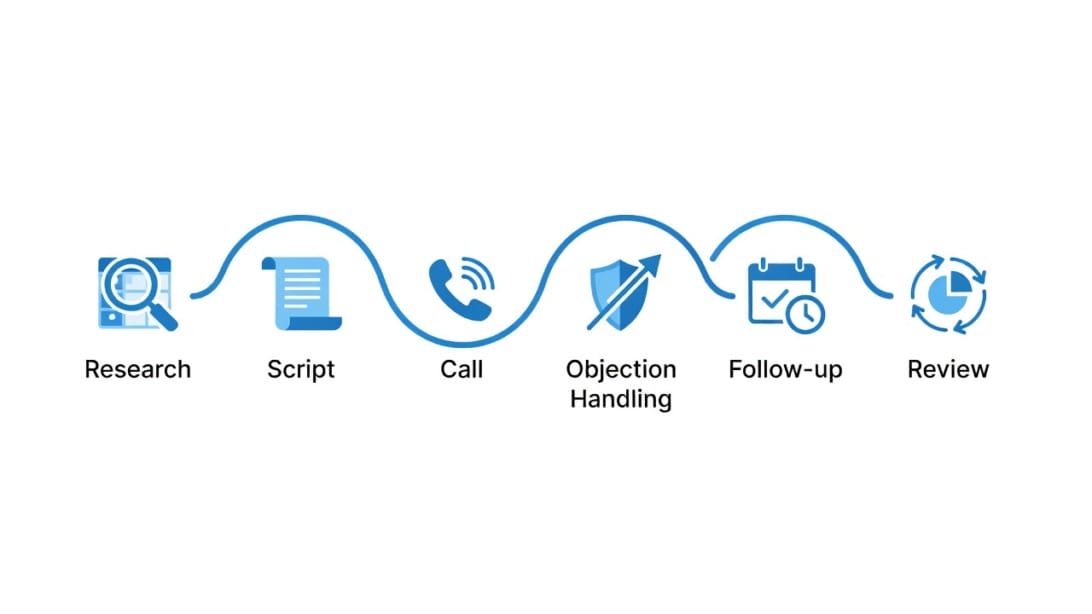
Cold calling works best as a repeatable process: identify the right prospect, research a relevant reason to call, open with context, ask discovery questions, handle objections, agree on a next step, and log the result. The process is simple, but each step requires discipline.
Step 1: Build a Targeted Prospect List
A cold call starts before the phone rings. The list determines whether your call feels relevant or random. Build lists around ideal customer profile signals such as industry, company size, geography, growth stage, technology used, hiring patterns, funding, and likely business pain. A smaller accurate list beats a large random one.
Bad lists waste time and create compliance risk. Good lists help reps personalize quickly. If you sell to sales leaders at B2B SaaS companies, your list should not include founders of local restaurants, consumer brands, or students. That sounds obvious, but many cold calling campaigns fail because the list was built for volume rather than fit.
Document why each segment belongs in the campaign. If you cannot explain the business reason for calling a segment, remove it.
Step 2: Research Before You Dial
Research gives your call a reason. Spend enough time to understand the prospect’s role, company, recent activity, and likely priorities. You do not need a full biography. You need one relevant observation that explains why the conversation might matter now.
Useful research signals include:
- Recent funding or expansion
- New executive hires
- Job postings that reveal priorities
- Technology changes
- Product launches
- Regulatory changes
- Public interviews or posts
- Competitor activity
- Website messaging changes
The goal is not to impress the prospect with trivia. The goal is to show that your call is not random.
Step 3: Prepare a Flexible Script
A script should guide the call, not control it. The best scripts provide structure for the opener, value statement, discovery questions, objection responses, and close. They do not force reps to sound identical. A script is a safety rail, not a cage.
Your script should answer five questions:
- Who are you?
- Why are you calling this person?
- What problem do you help solve?
- What question will you ask first?
- What next step are you seeking?
If the script cannot answer those questions clearly, revise it before calling.
Step 4: Open With Permission and Relevance
The opening must earn attention quickly. State your name, company, and reason for calling. Then either ask a brief permission-based question or move into a relevant observation. Avoid fake friendliness and vague claims. Prospects know when a caller is stalling.
A strong opener sounds like this:
“Hi Dana, this is Alex from Northstar Analytics. I know I am catching you out of the blue. The reason I called is that your team is hiring five new SDRs, and we help sales leaders reduce ramp time. Do you have 30 seconds for why I thought this might be relevant?”
This opening works because it is honest, specific, and brief.
Step 5: Ask Discovery Questions
Discovery questions turn a cold call into a conversation. Ask questions that help the prospect talk about their current process, pain, priorities, and timing. Avoid questions that can be answered with a flat yes or no unless you intentionally need confirmation.
Good discovery questions include:
- “How are you handling this today?”
- “What prompted your team to prioritize this now?”
- “Where does this usually break down?”
- “What would improving this change for the team?”
- “Who else is involved in decisions like this?”
Listen for urgency, ownership, and impact. Those signals tell you whether to continue, qualify out, or ask for a referral.
Step 6: Close With a Clear Next Step
A cold call should end with a specific outcome. That outcome might be a meeting, referral, permission to send information, or a decision that there is no fit. Vague endings create stalled opportunities. Clear endings create momentum.
Instead of saying, “I will send something over,” say, “I will send a two-paragraph summary and a case study today. If it looks relevant, can we hold 15 minutes Thursday at 10 AM to decide whether it is worth a deeper conversation?” The difference is commitment. A next step should include who, what, and when.
Cold Calling Script Templates That Work
A cold calling script should help you sound prepared without sounding robotic. The best scripts are short, flexible, and focused on relevance. They include a reason for the call, a pain-oriented question, and a low-friction next step. Use the templates below as starting points, not as word-for-word rules.
Template 1: The Value-First Script
This script works when you have a clear business outcome that matters to the prospect’s role. It leads with relevance, not a product tour. Use it for B2B prospects where you can connect your offer to a measurable problem such as pipeline, cost, risk, speed, retention, or operational efficiency.
Hi [name], this is [your name] from [company]. I know I am calling out of the blue. The reason I reached out is that [specific trigger or observation].

We help [similar teams] solve [specific problem] by [plain-language outcome]. I am not sure if this is relevant, but I wanted to ask: how are you handling [problem area] today?

[Listen and qualify.]

Based on what you shared, it sounds like [summary]. Would it be useful to compare notes for 15 minutes next week?
Template 2: The Referral Hook Script
This script works when you have a mutual connection, internal referral, partner introduction, or account-based reason to contact the prospect. The referral should be honest. Do not imply endorsement if someone merely appeared in the same LinkedIn group or company directory.
Hi [name], this is [your name] from [company]. [Referral source] suggested you might be the right person to speak with about [topic].

We have been helping [similar companies] with [business problem], and your team came up because [specific reason]. I wanted to ask whether [problem] is something your team is focused on this quarter.

If it is, I can share what we are seeing across similar teams. If not, I can close the loop and avoid bothering you again.
Template 3: The Trigger Event Script
This script works when a recent event creates urgency. Funding, hiring, market expansion, leadership changes, new regulations, new product lines, or public strategic shifts can all justify a timely call. The key is to connect the event to a problem you can credibly discuss.
Hi [name], this is [your name] from [company]. I noticed [company] recently [trigger event]. Teams going through that often run into [specific challenge].

We help [role/team] handle that by [outcome]. I am curious: is [challenge] already on your radar, or is it too early?

[Listen.]

If it is worth exploring, I can send a short example and we can decide whether a deeper conversation makes sense.
Template 4: The Voicemail Script
Voicemail should be short, specific, and connected to another touchpoint. Do not try to pitch the whole offer in a voicemail. The job of voicemail is to create recognition, curiosity, and a reason to notice your follow-up email.
Hi [name], this is [your name] from [company]. I called because [specific reason tied to their role or company]. We help [similar teams] with [outcome]. I will send a short email with context as well. If it is relevant, you can reach me at [number]. Again, that is [number]. Thanks.What Should You Say in the First 30 Seconds?
The first 30 seconds should answer three questions for the prospect: who is calling, why now, and why should I keep listening? Do not open with a long company description. Use a direct, honest opener that acknowledges the interruption and quickly explains relevance.
A strong 30-second opening looks like this:
“Hi Priya, this is Jordan from Acme Data. I know I am catching you cold. The reason I called is that your company is hiring enterprise reps, and we help sales leaders reduce ramp time for new outbound teams. Do you have 30 seconds for why I thought this might matter?”
This works because it does four things well:
- It names the caller and company.
- It admits the call is unexpected.
- It ties the call to a real trigger.
- It asks for a small amount of time.
Avoid openers like:
- “How are you today?”
- “Did I catch you at a bad time?”
- “I just wanted to touch base.”
- “We are the leading provider of…”
- “Can I have 15 minutes?”
Those openings either sound generic, invite an easy exit, or ask for too much too soon.
Should You Ask for Permission?
Permission-based openers work when they are brief and confident. Asking “Do you have 30 seconds?” is better than launching into a pitch. However, permission can become weak if the rep sounds apologetic or gives the prospect too many chances to exit before hearing relevance.
A good permission opener does not beg. It frames the request as small and specific. “Do you have 30 seconds for why I called?” is stronger than “Is now a good time?” because it gives the prospect a clear reason to say yes. If they say no, ask when would be better or offer to send a concise email.
The Best Times to Cold Call
The best cold calling windows are usually midweek and mid-morning, when prospects have cleared urgent tasks but are not yet overloaded by end-of-day work. Tuesday, Wednesday, and Thursday often perform better than Monday or Friday. Always adjust for the prospect’s timezone, role, and industry schedule.
| Day | Recommended window | Why it can work |
|---|---|---|
| Tuesday | 10:00 AM to 11:30 AM | Weekly priorities are clearer |
| Wednesday | 10:00 AM to 12:00 PM | Strong midweek availability |
| Thursday | 1:00 PM to 3:00 PM | Follow-up and planning window |
| Tuesday to Thursday | 4:00 PM to 5:00 PM | Some prospects return calls late day |
| Monday | Avoid early morning | Planning and backlog dominate |
| Friday | Avoid late afternoon | Low attention and weekend drift |
Timing is not magic. A relevant call at an imperfect time beats an irrelevant call at the perfect time. Still, disciplined timing improves the odds. Track your own connect rates by day, hour, industry, and persona instead of relying only on generic benchmarks.
How Timezones Affect Cold Calling
Timezone mistakes make cold calls feel careless. A call that is reasonable in your city may be intrusive in the prospect’s city. Always schedule calls based on the prospect’s local time and avoid early morning, lunch, and late evening unless the industry normally works those hours.
If your CRM stores location data, use it. If not, add timezone checks to your calling workflow. For distributed companies, use the prospect’s personal location if available, not just headquarters. Remote work has made headquarters-based calling schedules less reliable.
Common Cold Calling Objections and How to Handle Them
Objections are normal in cold calling. They do not always mean the prospect has rejected the offer. Often, they mean the prospect needs relevance, timing, authority, trust, or clarity. Treat objections as information, not as personal failure.
| Objection | What it may mean | Useful response |
|---|---|---|
| “I am not interested” | No relevance yet | “I understand. Before I go, can I ask how you handle [problem] today?” |
| “Send me an email” | Wants control or context | “Absolutely. To make it useful, can I ask one quick question?” |
| “No budget” | Not prioritized or not owner | “That makes sense. Is this a budget issue because the problem is not active, or because timing is wrong?” |
| “We already use a vendor” | Status quo feels safe | “That is helpful. What do you like most about the current setup?” |
| “Call me next quarter” | Possible timing objection | “Happy to. What changes next quarter that would make this more relevant?” |
| “I am not the right person” | Routing needed | “Thanks for clarifying. Who usually owns this area?” |
| “Too busy” | Value not proven | “Understood. Would a 20-second summary help you decide whether it is worth revisiting?” |
The best objection handling starts with acknowledgement. Do not argue. Do not rush into another pitch. Confirm what you heard, ask one clarifying question, and decide whether to continue or exit politely.
How to Handle “Send Me an Email”
“Send me an email” is not always a brush-off. Sometimes the prospect genuinely wants context. The problem is that reps often send a generic email and then chase endlessly. Use the objection to earn one piece of information before sending anything.
Try this response:
“Absolutely. I do not want to send something generic. Is the bigger priority for your team right now [option A] or [option B]?”
If they answer, you can send a relevant follow-up. If they refuse, keep the email short and acknowledge that they did not have time for a full conversation.
How to Handle “Not Interested”
“Not interested” usually means the prospect has not heard a reason to care. Your response should be calm, brief, and respectful. Do not try to overpower the objection. Ask one question that tests whether there is any problem worth discussing.
Example:
“I understand. Just so I do not make assumptions, is [problem] already solved on your side, or is it simply not a priority right now?”
If they say it is solved, ask what they use and whether there is anything they wish worked better. If they say it is not a priority, thank them and move on.
Is Cold Calling Legal? Compliance and Regulations
Cold calling is legal in many business contexts, but it is regulated by country, channel, audience, and industry. Teams must respect do-not-call lists, calling hours, caller identification rules, consent requirements, and data protection laws. This section is informational, not legal advice.
United States Rules
In the United States, cold calling is shaped by the Telephone Consumer Protection Act (TCPA), the Telemarketing Sales Rule (TSR), state laws, and the National Do Not Call Registry. Rules vary depending on whether you call consumers, businesses, landlines, mobile numbers, or use automated technology.
Common US compliance practices include:
- Scrub lists against the National Do Not Call Registry where required.
- Maintain an internal do-not-call list.
- Honor opt-out requests quickly.
- Call only during allowed hours.
- Use accurate caller ID.
- Avoid prerecorded or autodialed calls without proper consent.
- Keep records of consent and call outcomes.
TCPA penalties can be significant, especially for repeated violations. If you use autodialers, prerecorded messages, text messages, or consumer mobile numbers, get legal review before launching.
UK and EU Rules
In the UK and EU, cold calling is affected by privacy and electronic communication rules, data protection law, and preference services. UK teams must consider PECR, UK GDPR, and the Telephone Preference Service (TPS). EU teams must account for GDPR and local member-state rules.
Common requirements include:
- Do not call numbers registered with applicable preference services unless an exemption or valid consent applies.
- Establish a lawful basis for processing personal data.
- Explain who you are and why you are calling.
- Provide a clear opt-out path.
- Keep data accurate and sourced lawfully.
- Maintain suppression lists for people who object.
B2B rules can differ from consumer rules, but B2B does not mean rule-free. Sole traders and partnerships may receive protections that larger corporate numbers do not.
Industry-Specific Rules
Some industries have additional restrictions. Financial services, healthcare, insurance, debt collection, and energy sales often face stricter calling rules. Scripts may require approval, claims may need substantiation, and certain products may be restricted or prohibited from cold phone promotion.
If your offer touches regulated decisions, do not rely on generic cold calling advice. Work with counsel, compliance officers, and documented scripts. Train reps on what they can and cannot say. Record approvals and maintain call records where required.
Cold Calling Tools and Technology in 2026
Modern cold calling relies on tools for data, dialing, recording, coaching, compliance, and follow-up. Technology does not replace skill, but it can remove manual work and reveal what is actually happening in calls. The right stack makes reps more focused and managers more informed.
Dialers and Call Platforms
Dialers reduce the dead time between calls. A click-to-call tool lets reps dial from the CRM. A power dialer moves through a list one contact at a time. A predictive dialer can dial multiple numbers and connect reps when someone answers, although that approach requires stricter compliance review.
Choose dialer technology based on your sales motion. Enterprise account-based teams usually need quality and context more than raw volume. High-volume appointment setting teams may need speed, list controls, and voicemail drop. In both cases, the dialer should integrate with your CRM and compliance workflow.
CRM and Data Tools
A CRM is the system of record for cold calling. It should show who was called, when they were called, what happened, what the next step is, and whether the person opted out. Without clean CRM logging, managers cannot coach, forecast, or prove compliance.
Data tools help find phone numbers, job titles, company details, and buying signals. Use them carefully. Purchased or enriched data still needs legal review, accuracy checks, and opt-out handling. A phone number being available does not automatically mean it is appropriate to call.
Conversation Intelligence
Conversation intelligence tools record, transcribe, and analyze calls. They can show talk-to-listen ratio, common objections, competitor mentions, next-step language, and coaching moments. These tools are especially useful for onboarding new reps and identifying which scripts actually work.
However, call recording laws vary by jurisdiction. Some locations require one-party consent, while others require all-party consent. If you record calls, disclose recording where required and store recordings securely.
How to Measure Cold Calling Success and ROI
Cold calling success should be measured by business outcomes, not just dial volume. Calls made can show effort, but meetings, qualified opportunities, pipeline, revenue, and learning quality show value. A healthy measurement system tracks both activity and outcomes.
Metrics That Matter
Track these metrics consistently:
- Dials made: Total outbound calls.
- Connect rate: Percentage reaching a live person.
- Conversation rate: Percentage producing a meaningful conversation.
- Meeting rate: Percentage that becomes a booked meeting.
- Show rate: Percentage of booked meetings that actually happen.
- Opportunity rate: Percentage that becomes qualified pipeline.
- Win rate: Percentage of call-sourced opportunities that close.
- Average deal size: Revenue value of closed deals.
- Cost per meeting: Total program cost divided by meetings created.
- Revenue per rep hour: Revenue influenced by calling divided by rep time.
Avoid optimizing one metric in isolation. If dials increase but meetings and pipeline fall, the team may be rushing. If meetings increase but opportunities do not, qualification may be weak.
Simple ROI Formula
Cold calling ROI compares the revenue created by calls with the total cost of running the program. Include salaries, tools, data, management time, training, compliance costs, and any outsourced services. Do not count revenue that would clearly have arrived from another channel without calling.
Use this formula:
ROI = (Revenue attributed to cold calling - Total cold calling cost) / Total cold calling cost x 100For example, if a cold calling program costs $40,000 per month and produces $80,000 in attributed revenue, the monthly ROI is 100%. If it costs $40,000 and produces $20,000, the program needs improvement or a different channel mix.
Voicemail Strategies for Cold Calling
Most cold calls do not become live conversations, so voicemail matters. A good voicemail is short, specific, and connected to a follow-up email. It should not explain the entire offer. Its job is to create recognition and make the next touch feel familiar.
The 30-Second Voicemail Rule
Keep voicemail under 30 seconds because prospects rarely listen to long unknown messages. Say your name, company, reason for calling, and callback number clearly. If you will send an email, say so. That creates a second channel and helps the prospect connect the call with your written message.
A simple voicemail:
Hi [name], this is [your name] from [company]. I called because [specific reason]. We help [similar teams] with [outcome], and I thought it might be relevant based on [trigger]. I will send a short email too. You can reach me at [number]. Again, that is [number]. Thanks.When Not to Leave a Voicemail
Do not leave a voicemail every time. If you call the same person repeatedly, too many voicemails feel desperate. A good rule is to leave one early voicemail and one later voicemail only if you have a new reason. Between those moments, use email or LinkedIn to add context.
Avoid vague messages like “just checking in” or “wanted to touch base.” Those messages do not create value or curiosity. If the voicemail does not answer why you called this person now, skip it.
Multi-Channel Outreach: Combining Calls With Email and Social
The strongest outbound programs combine phone, email, and social touches into one coordinated sequence. Cold calling should not operate in a silo. Each channel should make the next channel warmer by adding context, familiarity, or proof.

A Practical 14-Day Sequence
A 14-day sequence gives prospects enough space to respond without turning outreach into harassment. The exact cadence depends on deal size and audience, but each touch should add a new reason, not repeat the same ask.
Example sequence:
1. Day 1: Send a short personalized email.
2. Day 3: Call and reference the email.
3. Day 4: Connect on LinkedIn if relevant.
4. Day 6: Send a useful resource or insight.
5. Day 8: Call with a new trigger or question.
6. Day 11: Send a short proof point or customer-style example.
7. Day 14: Send a polite break-up email.
The break-up email should not guilt the prospect. It should simply close the loop and make it easy for them to respond if timing changes.
How to Avoid Multi-Channel Spam
Multi-channel outreach becomes spam when every touch repeats the same pitch. Avoid that by varying the value of each message. One touch can ask a question. Another can share a relevant benchmark. Another can mention a trigger event. Another can offer a short comparison.
Also cap your sequence. If a prospect does not respond after a reasonable number of attempts, pause and move them into a lower-frequency nurture track. Persistence is useful. endless chasing is not.
Industry-Specific Cold Calling Approaches
Cold calling should change by industry because buyer expectations, risk tolerance, regulation, and urgency differ. A generic script that works for a SaaS operations manager may fail with a healthcare executive or financial advisor. Start with the buyer’s world, then adapt the call structure.
SaaS Cold Calling
SaaS cold calling works best when the rep connects the call to a measurable software or process problem. Buyers often know the category already, so the call should focus on timing, pain, differentiation, and next steps rather than a long feature explanation.
Useful SaaS triggers include funding, hiring, technology changes, product launches, churn signals, and expansion into new markets. Keep the opening short. Reference a specific operational problem. Ask how the team handles it today. The first call usually aims for a discovery meeting or demo, not a full close.
Financial Services Cold Calling
Financial services cold calling requires extra care because regulations, disclosures, and suitability rules can be strict. The caller should avoid exaggerated claims, pressure tactics, or unapproved promises. Educational positioning usually works better than aggressive selling.
Scripts should be compliance-reviewed. Reps should know exactly what they may say about returns, risk, fees, and suitability. The goal is often to start a compliant advisory conversation, not to sell a product immediately. Records matter, so document call outcomes carefully.
Professional Services Cold Calling
Professional services cold calling should lead with expertise and relevance. Buyers of consulting, agencies, legal services, and advisory work are not buying a simple tool. They are buying judgment, trust, and context. The call should demonstrate insight quickly.
A strong opener might reference a market shift, common client pattern, or public company challenge. Instead of pitching services, ask a thoughtful question that shows you understand the prospect’s situation. Follow up with a concise insight or example that proves you can help.
Cold Calling Training and Coaching
Cold calling skill improves through practice, feedback, and repetition. A team that only hands reps a script and tells them to dial will produce inconsistent results. Good training teaches the process, lets reps rehearse, reviews real calls, and reinforces what works.
New Rep Onboarding
New reps need structured onboarding before live dialing. Start with the buyer persona, the problem space, compliance basics, and the reason the script is written the way it is. Then move into role-play, recorded practice, and supervised live calls.
A practical onboarding path:
1. Learn the product and buyer pain.
2. Study the ideal customer profile.
3. Review compliance rules.
4. Memorize the call framework.
5. Practice openers and objections.
6. Shadow experienced reps.
7. Make live calls with coaching.
8. Review recordings and metrics.
The goal is not perfection. The goal is controlled competence before reps call real prospects at volume.
Call Reviews and Coaching
Call reviews should be specific, not motivational speeches. Review the opener, pacing, discovery questions, objection handling, next-step request, and call notes. Pick one improvement area at a time. Too much feedback after one call overwhelms the rep.
Managers should build a library of strong call examples. New reps learn faster when they can hear what good sounds like. Include examples of both wins and recoveries, such as a rep turning “send me an email” into a real discovery question.
Common Cold Calling Mistakes to Avoid
Most cold calling mistakes come from poor preparation, weak relevance, or too much pressure. The caller either fails to earn attention, talks too much, ignores signals, or pushes for a meeting before the prospect sees value. Fixing these basics improves results quickly.
Common mistakes include:
- Calling unqualified prospects from broad lists.
- Opening with generic small talk.
- Pitching before asking questions.
- Reading a script in a monotone voice.
- Arguing with objections.
- Failing to ask for a specific next step.
- Not logging call outcomes.
- Ignoring compliance rules.
- Calling too often without new value.
- Treating voicemail as a full pitch.
The fastest fix is to shorten the opening and improve the first question. If the prospect understands why you called and gets a thoughtful question quickly, the call has a chance.
Talking Too Much
Talking too much is the most common cold calling error. Reps often talk because silence feels uncomfortable. Unfortunately, the more a rep talks, the less they learn. A cold call should quickly shift from explanation to discovery.
A healthy call often has the rep speaking less than half the time after the opener. If your recordings show long uninterrupted monologues, revise the script. Add earlier questions. Practice pausing. Teach reps to tolerate silence after asking a good question.
Key Takeaways
Cold calling is still useful when it is targeted, compliant, and connected to a broader outreach strategy. It is not magic, and it is not dead. The teams that win use better data, better timing, better scripts, and better follow-up instead of relying on brute-force dialing.
- Cold calling means contacting a prospect who has not requested the call.
- The goal is to qualify fit and earn a next step, not close immediately.
- Cold calling works best for targeted B2B outreach and higher-value deals.
- Cold email and cold calling perform better together than alone.
- A strong opener explains who you are, why you called, and why it matters now.
- Discovery questions are more important than long pitches.
- Objections are information, not personal rejection.
- Compliance rules such as TCPA, TSR, PECR, GDPR, and DNC requirements matter.
- Measure calls by meetings, pipeline, revenue, and learning, not just dial volume.
- Training, call review, and clean CRM logging turn cold calling into a repeatable process.
Frequently Asked Questions
What is cold calling in simple terms?
Cold calling is when a salesperson calls someone who has not asked to be contacted and has no prior relationship with the company. The goal is to start a relevant business conversation, understand whether there is a fit, and agree on a useful next step such as a meeting, referral, or follow-up email.
Is cold calling still effective in 2026?
Cold calling is still effective when the prospect list is targeted, the caller has a relevant reason, and the team follows compliance rules. It is less effective as random mass dialing. Modern cold calling works best when paired with email, social touches, CRM logging, and strong follow-up.
What is the difference between cold calling and warm calling?
Cold calling happens when the prospect has no prior relationship or active buying signal with the caller. Warm calling happens after some connection already exists, such as a referral, event interaction, email reply, website inquiry, or previous conversation. Warm calls usually have higher response rates because trust already exists.
What is the difference between cold calling and telemarketing?
Cold calling usually describes sales outreach to start a targeted business conversation, especially in B2B. Telemarketing is broader and can include consumer promotions, surveys, fundraising, and high-volume call center work. The terms overlap, but telemarketing often has stricter consumer-facing compliance concerns and a more scripted reputation.
Is cold calling legal?
Cold calling is legal in many contexts, but it is regulated. Rules depend on country, state, audience, phone type, industry, and technology used. Teams must respect do-not-call registries, calling hours, opt-out requests, caller ID rules, consent requirements, and data protection laws. For regulated industries, get legal review.
How many cold calls should a salesperson make per day?
A realistic B2B target is often 30 to 50 quality calls per day for a full-time outbound rep, depending on research depth, deal complexity, and follow-up workload. High-volume teams using dialers may make more, but call quality, compliance, and accurate notes should not be sacrificed for volume.
What is a good cold calling success rate?
A good success rate depends on the definition of success. If success means booked meetings, many teams see low single-digit percentages from cold calls. Better targeting, stronger triggers, and skilled objection handling can improve results. Track your own baseline by segment, persona, industry, time window, and rep experience.
What should I say at the start of a cold call?
Start with your name, company, honest acknowledgement that the call is unexpected, and a specific reason for calling. A strong opener might say: “I know I am catching you cold. The reason I called is that your team is hiring SDRs, and we help sales leaders reduce ramp time.” Then ask for a brief permission-based continuation.
How do I handle “send me an email” on a cold call?
Treat “send me an email” as a chance to qualify, not as an automatic dismissal. Say you will send one, then ask one quick question so the email is relevant. If the prospect refuses, send a concise note that references the reason for your call and offers a simple next step.
Should I leave a voicemail when cold calling?
Leave a voicemail only when you can make it short, specific, and connected to a follow-up email. Do not leave long pitches or repeated messages with no new value. One clear voicemail early in a sequence and one later voicemail with a new reason is usually enough.
What tools do I need for cold calling?
At minimum, you need a clean prospect list, a phone system, a CRM, and a way to track outcomes. Larger teams may add dialers, data enrichment, conversation intelligence, voicemail drop, compliance scrubbing, and sales engagement platforms. The stack should reduce manual work without encouraging careless mass dialing.
How do I measure cold calling ROI?
Measure ROI by comparing revenue attributed to cold calling against the total program cost. Include salaries, tools, data, training, management time, and compliance costs. Track intermediate metrics such as connect rate, meeting rate, show rate, opportunity rate, win rate, and average deal size to understand what drives results.
{ “@context”: “https://schema.org”, “@type”: “Article”, “headline”: “What Is Cold Calling? Definition, Process, Scripts, and Compliance Guide for 2026”, “description”: “A comprehensive guide to cold calling, including definition, process, scripts, objection handling, compliance, tools, ROI, and FAQs.”, “author”: {“@type”: “Organization”, “name”: “Mystrika”}, “publisher”: {“@type”: “Organization”, “name”: “Mystrika”}, “datePublished”: “2026-07-03”, “dateModified”: “2026-07-03”, “mainEntityOfPage”: “https://blog.mystrika.com/what-is-cold-calling/” } { “@context”: “https://schema.org”, “@type”: “FAQPage”, “mainEntity”: [ {“@type”:”Question”,”name”:”What is cold calling in simple terms?”,”acceptedAnswer”:{“@type”:”Answer”,”text”:”Cold calling is when a salesperson calls someone who has not asked to be contacted and has no prior relationship with the company. The goal is to start a relevant business conversation, understand whether there is a fit, and agree on a useful next step.”}}, {“@type”:”Question”,”name”:”Is cold calling still effective in 2026?”,”acceptedAnswer”:{“@type”:”Answer”,”text”:”Cold calling is still effective when the prospect list is targeted, the caller has a relevant reason, and the team follows compliance rules. It works best when paired with email, social touches, CRM logging, and strong follow-up.”}}, {“@type”:”Question”,”name”:”What is the difference between cold calling and warm calling?”,”acceptedAnswer”:{“@type”:”Answer”,”text”:”Cold calling happens when the prospect has no prior relationship or active buying signal with the caller. Warm calling happens after a connection already exists, such as a referral, event interaction, email reply, inquiry, or previous conversation.”}}, {“@type”:”Question”,”name”:”What is the difference between cold calling and telemarketing?”,”acceptedAnswer”:{“@type”:”Answer”,”text”:”Cold calling usually describes sales outreach to start a targeted business conversation, especially in B2B. Telemarketing is broader and can include consumer promotions, surveys, fundraising, and high-volume call center work.”}}, {“@type”:”Question”,”name”:”Is cold calling legal?”,”acceptedAnswer”:{“@type”:”Answer”,”text”:”Cold calling is legal in many contexts, but it is regulated. Rules depend on country, state, audience, phone type, industry, and technology used. Teams must respect do-not-call registries, calling hours, opt-out requests, caller ID rules, consent requirements, and data protection laws.”}}, {“@type”:”Question”,”name”:”How many cold calls should a salesperson make per day?”,”acceptedAnswer”:{“@type”:”Answer”,”text”:”A realistic B2B target is often 30 to 50 quality calls per day for a full-time outbound rep, depending on research depth, deal complexity, and follow-up workload. High-volume teams using dialers may make more.”}}, {“@type”:”Question”,”name”:”What is a good cold calling success rate?”,”acceptedAnswer”:{“@type”:”Answer”,”text”:”A good success rate depends on the definition of success. If success means booked meetings, many teams see low single-digit percentages from cold calls. Better targeting, stronger triggers, and skilled objection handling can improve results.”}}, {“@type”:”Question”,”name”:”What should I say at the start of a cold call?”,”acceptedAnswer”:{“@type”:”Answer”,”text”:”Start with your name, company, honest acknowledgement that the call is unexpected, and a specific reason for calling. Then ask for a brief permission-based continuation.”}}, {“@type”:”Question”,”name”:”How do I handle send me an email on a cold call?”,”acceptedAnswer”:{“@type”:”Answer”,”text”:”Treat send me an email as a chance to qualify, not as an automatic dismissal. Say you will send one, then ask one quick question so the email is relevant.”}}, {“@type”:”Question”,”name”:”Should I leave a voicemail when cold calling?”,”acceptedAnswer”:{“@type”:”Answer”,”text”:”Leave a voicemail only when you can make it short, specific, and connected to a follow-up email. Do not leave long pitches or repeated messages with no new value.”}}, {“@type”:”Question”,”name”:”What tools do I need for cold calling?”,”acceptedAnswer”:{“@type”:”Answer”,”text”:”At minimum, you need a clean prospect list, a phone system, a CRM, and a way to track outcomes. Larger teams may add dialers, data enrichment, conversation intelligence, voicemail drop, compliance scrubbing, and sales engagement platforms.”}}, {“@type”:”Question”,”name”:”How do I measure cold calling ROI?”,”acceptedAnswer”:{“@type”:”Answer”,”text”:”Measure ROI by comparing revenue attributed to cold calling against the total program cost. Include salaries, tools, data, training, management time, and compliance costs.”}} ] } { “@context”: “https://schema.org”, “@type”: “HowTo”, “name”: “How to make an effective cold call”, “description”: “A step-by-step process for planning, making, and following up on a cold call.”, “step”: [ {“@type”:”HowToStep”,”position”:1,”name”:”Build a targeted prospect list”,”text”:”Select prospects based on ideal customer profile signals, buying triggers, and fit.”}, {“@type”:”HowToStep”,”position”:2,”name”:”Research before dialing”,”text”:”Find a relevant reason to call, such as a hiring signal, funding event, role priority, or operational challenge.”}, {“@type”:”HowToStep”,”position”:3,”name”:”Prepare a flexible script”,”text”:”Create an opener, value statement, discovery questions, objection responses, and a clear close.”}, {“@type”:”HowToStep”,”position”:4,”name”:”Open with permission and relevance”,”text”:”Explain who you are, why you called, and why it may matter in under 30 seconds.”}, {“@type”:”HowToStep”,”position”:5,”name”:”Ask discovery questions”,”text”:”Use open-ended questions to understand the prospect’s current process, pain, urgency, and ownership.”}, {“@type”:”HowToStep”,”position”:6,”name”:”Close with a clear next step”,”text”:”End with a specific action, owner, and time, then log the outcome and follow up.”} ] }