
What is lead enrichment?
Lead enrichment is the automated or manual process of enhancing an incomplete lead profile-such as an email address or a name-with supplementary, actionable data points. These insights typically include firmographics, technographics, intent signals, and social media behavior, transforming basic contacts into robust buyer profiles that empower sales and marketing teams to personalize outreach and prioritize high-value prospects.
Understanding the nuances of lead enrichment is more critical than ever in today’s fast-paced B2B landscape. When a prospect fills out a form on your website, they usually provide the bare minimum: a name, an email address, and perhaps a company name. While this initial conversion is a victory for your marketing team, a skeletal lead record leaves sales representatives operating in the dark. They are forced to spend valuable selling time manually researching the prospect on LinkedIn, company websites, and industry directories just to understand if the lead fits their Ideal Customer Profile (ICP).
Lead enrichment bridges this gap. It acts as the connective tissue between a top-of-funnel conversion and a bottom-of-funnel closed deal. By dynamically appending data from third-party databases, proprietary APIs, and public sources, lead enrichment platforms instantly turn a simple `@company.com` email address into a 360-degree view of the buyer. You instantly know the company’s annual revenue, the prospect’s exact seniority, the software stack they currently use, and whether their company has recently received funding.
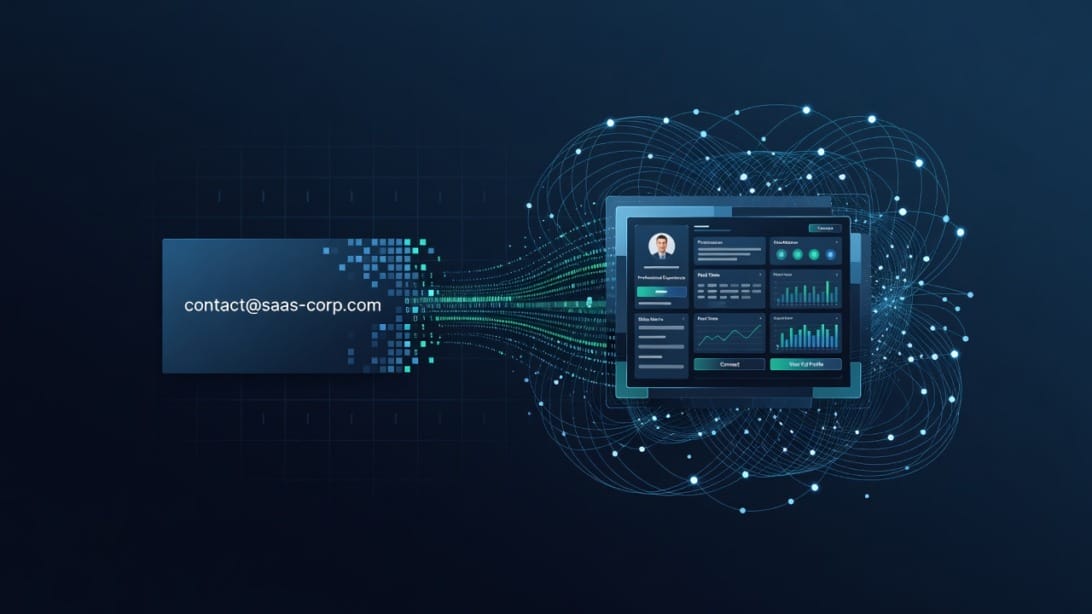
Consider a scenario where your inbound marketing engine captures 1,000 new leads per week. Without enrichment, your sales development representatives (SDRs) might spend 15 minutes researching each lead. That equates to 250 hours of manual research per week-time that should be spent on the phone or crafting personalized emails. With a robust lead enrichment strategy in place, those 1,000 leads are instantly scored, categorized, and enriched. Your reps log into their CRM and see exactly who they should call first, armed with personalized talking points based on the enriched data.
Why is lead enrichment important for your business?
Lead enrichment is crucial because it dramatically improves conversion rates, combats data decay, and aligns sales and marketing efforts. By providing deep context about a prospect, enrichment allows teams to hyper-personalize outreach, shorten sales cycles, accurately score leads, and prevent wasted time on unqualified prospects, ultimately driving higher revenue efficiency.
Combating Data Decay
One of the most insidious problems in B2B sales is data decay. B2B data decays at a staggering rate of roughly 22% to 30% per year. People change jobs, companies are acquired, phone numbers change, and email addresses are deactivated. If your CRM is filled with static data collected months or years ago, you are likely wasting a massive portion of your outreach efforts on dead ends. Continuous lead enrichment acts as a self-healing mechanism for your database, verifying and updating records to ensure your team is always working with the most accurate and current information.
Eliminating Friction in Lead Capture
Marketers face a constant dilemma: if you make a web form too long (asking for job title, company size, industry, etc.), conversion rates plummet. If you make it too short (just asking for an email), sales complains about lead quality. Lead enrichment solves this. You can keep your forms incredibly short-reducing friction and maximizing conversion rates-while relying on backend enrichment tools to fill in the blanks instantly.
Enabling Hyper-Personalization
In an era where buyers are bombarded with generic automated emails, personalization is the only way to cut through the noise. But you cannot personalize if you don’t know who you are talking to. Enriched data allows you to segment your audience with surgical precision. Instead of sending a generic blast to “all marketing managers,” you can send a highly tailored message to “Marketing Directors in the Midwest working at SaaS companies using HubSpot that recently announced a Series B funding round.”
If you are using a tool like Mystrika for your outbound campaigns, this level of personalization is effortless. Mystrika offers comprehensive features including an AI writer and personalization engine, automated warmup, a robust cold email sequencer, a unified inbox, and a whitelabel solution-starting at just $15/month. By feeding enriched data into Mystrika, you can automatically generate hyper-personalized intro lines for every prospect in your sequence.
Types of lead enrichment data
Lead enrichment relies on aggregating various data categories to build a complete profile. The primary types of enrichment data include contact, firmographic, demographic, intent, technographic, social media, geographic, account, and behavioural data. Combining these distinct data sets provides a holistic view of both the individual buyer and their organization.
Contact data
Contact data is the foundational layer of any lead profile. It includes the essential information needed to initiate communication.
- Full Name and Title: Ensuring you have the correct spelling and the most recent, accurate job title.
- Email Addresses: Business emails, and sometimes personal emails for specific marketing channels.
- Phone Numbers: Direct dials, mobile numbers (increasingly important for remote workforces), and corporate HQ lines.
Firmographic data
Firmographics are to companies what demographics are to people. This data helps you understand if the organization fits your target market.
- Industry and Vertical: The specific sector the company operates in (e.g., FinTech, Healthcare, Logistics).
- Company Size: Number of employees, which indicates potential budget and organizational complexity.
- Revenue: Annual recurring revenue (ARR) or overall gross revenue.
- Company Structure: Parent companies, subsidiaries, and exact corporate hierarchy.
Demographic data
Demographic data focuses on the individual characteristics of the buyer themselves.
- Age and Gender: While less critical in some B2B contexts, this can still inform marketing tone and messaging.
- Education Level: Universities attended and degrees earned.
- Professional Background: Past companies worked for, which can reveal valuable connection points or brand loyalties.
Intent data
Intent data is arguably the most powerful category for timing your outreach. It indicates when a prospect is actively researching a solution like yours.
- First-Party Intent: Data showing the prospect visiting your pricing page, downloading your whitepapers, or attending your webinars.
- Third-Party Intent: Data aggregated from external networks (like Bombora) showing the prospect is reading articles on specific topics, comparing software on review sites, or searching for specific keywords related to your industry.
Technographic data
Technographics reveal the software and hardware stack a company currently uses.
- Current Technologies: Knowing if a prospect uses Salesforce versus HubSpot, or AWS versus Azure.
- Contract Renewals: Estimated dates when their current software contracts might be up for renewal.
- Technology Spend: Overall budget allocated to IT or specific software categories.
This is particularly useful if your product integrates with specific tools, or if you are running a displacement campaign against a competitor.
Social media data
Social data provides a pulse on what the prospect and their company are publicly discussing.
- LinkedIn Profiles: Recent promotions, job changes, or posts they’ve engaged with.
- Company News: Recent press releases, funding announcements, or product launches shared on social channels.
- Personal Interests: Topics the prospect frequently shares or comments on.
Geographic data
Geographic data is essential for territory routing and location-specific campaigns.
- HQ Location: Where the company is officially based.
- Employee Location: Where the specific prospect is physically located (crucial for remote workers).
- Time Zones: Critical for timing cold calls or email sends to hit the top of the inbox at 8:00 AM local time.
Account data
Account data looks at the broader context of the organization beyond just firmographics.
- Financial Health: Recent funding rounds, IPO status, or bankruptcy filings.
- Hiring Trends: Are they rapidly expanding their engineering team? Are they laying off marketing staff?
- Organizational Charts: Identifying the buying committee, decision-makers, and key influencers within the account.
Behavioural data
Behavioural data tracks how the prospect interacts with your specific brand and assets.
- Email Engagement: Open rates, click-through rates, and specific links clicked.
- Website Navigation: Time spent on specific pages, bounce rates, and conversion paths.
- Event Participation: Attendance at virtual or in-person events hosted by your company.
Examples of lead enrichment in action
Lead enrichment manifests in numerous ways across the revenue organization. Examples include transforming anonymous website traffic into named accounts, appending missing phone numbers to inbound webinar leads, updating job titles for an aging database prior to a product launch, and triggering automated outreach based on specific technographic changes.
To truly grasp the impact of lead enrichment, let’s look at a few illustrative scenarios of how revenue teams apply this data in their daily operations.
Scenario 1: The Inbound Form Optimization
A B2B SaaS company wants to increase the number of demo requests they receive. Their current form asks for First Name, Last Name, Email, Phone, Company, Industry, and Job Title. The conversion rate is a dismal 1.5%.
The marketing team decides to implement a real-time lead enrichment API. They strip the form down to just two fields: Work Email and First Name. Immediately, the conversion rate jumps to 4%.
When a prospect enters `[email protected]`, the enrichment tool instantly pings its database in the background. Before the lead even hits the CRM, it is enriched with Acme Corp’s industry, employee count, and Sarah’s title (VP of Operations). The sales team still gets the full profile they need to qualify the lead, but marketing successfully removed the friction from the buyer’s journey.
Scenario 2: The Intent-Driven Outbound Campaign
An enterprise cybersecurity firm is struggling with cold outbound outreach. Their emails are generic, and their response rates are hovering near zero. They integrate an intent data enrichment tool into their workflow.
The tool flags that several employees at a target account, “GlobalTech,” have been reading articles about “cloud security posture management” (third-party intent). Simultaneously, the enrichment tool updates GlobalTech’s firmographic profile, noting they just hired a new Chief Information Security Officer (CISO).
Armed with this enriched data, the sales rep crafts a highly specific email to the new CISO, referencing their recent appointment and asking if cloud security is a priority for their new roadmap, given their team’s recent research. This timely, highly relevant outreach yields a booked meeting within hours.
Scenario 3: The Revived Database
A manufacturing supplier has been using the same CRM database for five years. They decide to launch a new product line targeting Directors of Procurement. They pull a list of 5,000 prospects from their CRM, but a quick test reveals a massive bounce rate. The data has decayed.
They run the list through a batch lead enrichment process. The tool identifies that 30% of those prospects no longer work at those companies, updates the current titles of the remaining prospects, and appends fresh, verified email addresses. The subsequent email campaign has a 98% deliverability rate and successfully generates a pipeline for the new product, saving the campaign from complete failure.
How does lead enrichment work?
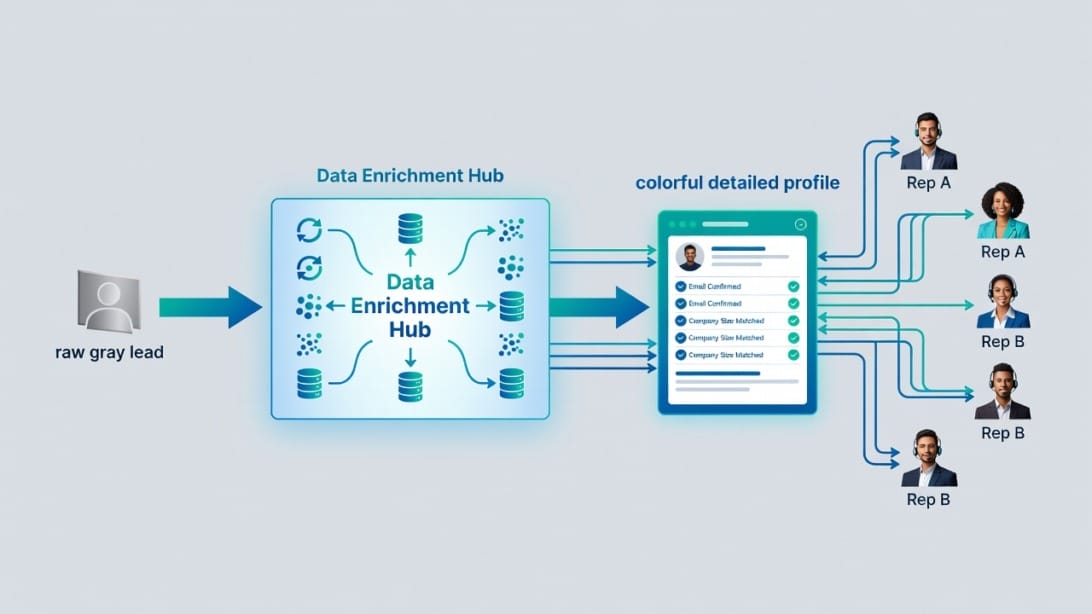
Lead enrichment works through a systematic workflow that aggregates, cleanses, and applies data. The core process involves data collection from disparate sources, lead routing based on enriched attributes, lead conversion through personalized engagement, and ongoing lead nurturing utilizing dynamic data updates to guide the prospect through the funnel.
Understanding the mechanics behind lead enrichment helps you integrate it effectively into your existing technology stack. It is not just a magic button; it is a structured data pipeline.
Data collection
The enrichment process begins the moment a lead is captured. Enrichment platforms aggregate data from a vast array of sources. These include public records, corporate filings, social media APIs, web scraping, and proprietary data partnerships.
When a partial lead record (like an email) enters your system, the enrichment tool uses that single data point as a “key.” It searches its massive databases for that key and pulls all associated information.
This stage also involves crucial sub-processes:
- Lead scoring: Once the data is collected, the system assigns a numerical value to the lead based on how closely their enriched profile matches your Ideal Customer Profile (ICP). A lead at a Fortune 500 company might get +50 points, while a student gets -100 points.
- Lead segmentation: The enriched data allows you to automatically drop the lead into specific marketing buckets. For example, all leads from the healthcare sector are segmented into a specific nurture track, distinct from leads in the retail sector.
Lead routing
Speed to lead is critical in sales. You don’t want a massive enterprise lead sitting in a round-robin queue waiting for a junior rep to claim it. Enriched data enables intelligent lead routing.
If the enrichment tool identifies a lead as working for a company with over $1B in revenue, the CRM can automatically route that lead directly to your top Enterprise Account Executive. If the lead is from a small business in Europe, it can be routed to the EMEA SMB team. This ensures the prospect is immediately handled by the most appropriate and qualified representative.
Lead conversion
Enrichment directly impacts the conversion stage by arming the sales rep with context. Before the first call is even made, the rep reviews the enriched profile. They know the prospect’s tech stack, their company’s recent news, and their seniority.
This allows the rep to bypass the standard, annoying discovery questions (“So, tell me a bit about what your company does…”) and jump straight into value-driven conversations (“I saw you recently expanded to Canada and are using AWS; how are you handling the latency issues associated with that?”). This deeply informed approach dramatically increases the likelihood of converting a prospect into an active opportunity.
Lead nurturing
Enrichment is not a one-and-done event. The best revenue teams utilize continuous enrichment. If a prospect isn’t ready to buy today, they go into a nurture sequence. Over the next six months, the enrichment tool continuously monitors that prospect.
If the prospect gets promoted, or if their company receives Series C funding, the enrichment tool flags this change. This triggers a specific, timely notification to the sales rep, prompting them to reach out with a congratulatory message and re-engage the prospect at the exact moment their budget or authority has likely increased.
Cost and Pricing of Enrichment Tools
The cost of lead enrichment tools varies widely, ranging from free basic extensions to enterprise platforms costing upwards of $20,000 annually. Pricing models typically revolve around credit-based systems (pay per enriched lead), subscription tiers based on database access, or custom enterprise contracts determined by API call volume and feature requirements.
When evaluating enrichment tools, understanding the pricing landscape is critical for ROI calculations. Vendors rarely have a one-size-fits-all model, and the hidden costs of low-quality data can often outweigh the upfront savings of a cheaper tool.
Credit-Based Pricing
Many popular enrichment platforms operate on a credit system. You purchase a block of credits (e.g., $500 for 5,000 credits). Each time you request enrichment for a lead, or request a specific data point like a direct-dial phone number, a credit is deducted.
- Pros: Highly predictable; you only pay for what you use. Great for small teams or sporadic campaign needs.
- Cons: Can become prohibitively expensive at scale. If you are enriching 10,000 inbound leads a month, credit models deplete rapidly.
Tiered SaaS Subscriptions
Standard B2B SaaS pricing models are common. You pay a flat monthly or annual fee (e.g., $1,000/month) for a set limit of API calls, a certain number of user licenses, and access to specific data types (e.g., basic firmographics might be in the lower tier, while intent data requires the premium tier).
- Pros: Easier to budget for; usually includes platform features like CRM integrations and dashboards.
- Cons: You might pay for capacity you don’t use during slow months.
Enterprise Custom Contracts
For large organizations needing real-time API enrichment across massive databases, vendors provide custom quotes. These contracts often factor in the specific CRM being used, the requirement for custom data fields, dedicated support, and stringent service level agreements (SLAs) regarding uptime and data accuracy.
- Important Consideration: Always ask about the cost of data refresh. Some vendors charge you to initially enrich a lead, and then charge you again to update that same lead a year later.
When building out your cold email infrastructure, managing costs across various tools is essential. If you are looking for cost-effective, highly reliable cold email infrastructure to support your enriched leads, DoYouMail is a top-tier choice. For starting at just $39/month, DoYouMail provides unlimited email IDs, a dedicated private IP server, high deliverability, and the ability to bring your own domains. It handles the complex backend of SPF, DKIM, and DMARC automatically, allowing you to focus on leveraging your enriched data for outreach.
DIY enrichment vs vendor comparison
Building your own enrichment pipeline in-house gives you total control over data sources and privacy, but it requires significant engineering resources, ongoing maintenance, and access to expensive third-party data APIs. Vendor solutions offer speed, pre-built integrations, and massive aggregated databases, but they come with recurring subscription costs and less flexibility in data sourcing.
The decision between building a custom enrichment system and buying a vendor solution is one of the most consequential strategic choices a revenue operations team can make. Each path has distinct trade-offs that affect your team’s velocity, data quality, and total cost of ownership.
The DIY approach
Building your own enrichment engine involves writing custom scripts that call multiple APIs (such as Clearbit, Hunter.io, or LinkedIn scraping) and then stitching the results together into a unified profile. You would also need to build the logic for deduplication, data conflict resolution, and field mapping into your CRM.
| Factor | DIY Enrichment | Vendor Solution |
|---|---|---|
| Initial Setup Time | 4-12 weeks of engineering | 1-2 hours (plug-and-play) |
| Monthly Cost (1K leads) | $200-800 (API keys + dev time) | $300-1,500 (subscription) |
| Data Coverage | Limited to APIs you integrate | Broad, aggregated databases |
| Maintenance Burden | High (API changes, rate limits) | Low (vendor handles updates) |
| Customization | Total control | Limited to vendor’s schema |
| Accuracy Guarantees | None (you must validate) | Often 90-95% match rates |
The vendor approach
Vendors like ZoomInfo, Lusha, and Cognism have spent years building massive proprietary databases. They aggregate data from thousands of sources, including public records, corporate filings, and partner networks. When you send them a lead, they match it against their entire database and return the most complete profile available.
When to choose DIY
DIY enrichment makes sense when you have a highly specific data requirement that vendors cannot meet. For example, if you need to enrich leads with data from a niche industry database that is not available through any major enrichment vendor, building a custom integration is your only option. It also makes sense for organizations with strict data privacy requirements that prohibit sending lead data to third-party platforms.
When to choose a vendor
Vendors are almost always the better choice for speed and scale. If you need to enrich 10,000 leads per month with standard firmographic and contact data, a vendor will do it in minutes with a simple API call. The engineering time required to build and maintain a comparable system internally would cost far more than the vendor’s subscription fee.
Data quality scoring methodologies
Data quality scoring is a systematic framework for measuring the completeness, accuracy, consistency, and freshness of your enriched lead data. Common methodologies include the Data Quality Score (DQS), which assigns weighted points to each field based on its importance to your sales process, and the Completeness Ratio, which measures the percentage of required fields that are populated.
Without a data quality scoring methodology, you are enriching blindly. You might think your database is healthy because it has 50,000 records, but if 40,000 of those records have outdated phone numbers or incorrect job titles, your database is effectively worthless. Data quality scoring gives you a quantifiable metric to track improvement over time.
The Data Quality Score (DQS) Framework
The DQS is a weighted scoring model that evaluates each record in your database. Not all data fields are equally important. For a B2B sales team, a verified email address might be worth 40 points, a direct dial phone number worth 30 points, a current job title worth 20 points, and a company name worth 10 points. A record with all four fields populated would have a perfect DQS of 100.
| Field | Weight | Populated? | Score Contribution |
|---|---|---|---|
| Verified Email | 40 | Yes | 40 |
| Direct Dial Phone | 30 | No | 0 |
| Current Job Title | 20 | Yes | 20 |
| Company Name | 10 | Yes | 10 |
| Total DQS | 100 | 70 |
The Completeness Ratio
This is a simpler metric that measures what percentage of your required fields are filled. If you have defined 10 required fields for a complete lead profile, and a specific lead has 7 of those fields populated, that lead has a Completeness Ratio of 70%. This is useful for high-level dashboard reporting but lacks the nuance of the weighted DQS.
The Freshness Score
Data freshness measures how recently a record was verified or updated. A lead enriched six months ago is significantly less valuable than a lead enriched yesterday. The Freshness Score decays over time. A common approach is to assign a score of 100 to records verified within the last 30 days, 80 to records verified within 60 days, 50 to records verified within 90 days, and 0 to records verified more than 180 days ago.
Implementing a quality scoring system
To implement a data quality scoring system in your organization, follow these steps:
1. Define your critical fields. Work with your sales and marketing teams to identify the 5-10 data fields that are essential for qualification and personalization.
2. Assign weights. Use a simple 100-point scale, distributing points across your critical fields based on their importance.
3. Set a threshold. Define a minimum DQS threshold for a lead to be considered “sales-ready.” For example, any lead with a DQS below 60 might be routed to a marketing nurture track instead of a sales rep.
4. Automate the scoring. Configure your enrichment tool or CRM to calculate the DQS automatically every time a record is enriched or updated.
5. Monitor trends. Track your average DQS over time. A declining average DQS indicates that your enrichment process is failing to keep up with data decay.
API technical implementation details
Implementing lead enrichment via API involves sending a partial lead record (typically an email address or domain) to an enrichment endpoint, receiving a structured JSON response with matched data, and mapping that response to your CRM or database fields. The technical process requires handling authentication, rate limiting, error states, and asynchronous webhook callbacks for batch processing.
For technical teams, understanding the nuts and bolts of enrichment API integration is essential for building a reliable data pipeline. Most enrichment vendors follow a RESTful API pattern with JSON request and response formats.
Authentication and request structure
Most enrichment APIs use API key authentication passed via an HTTP header. A typical enrichment request looks like this:
GET https://api.enrichment-vendor.com/v1/person/enrich
  [email protected]
  &include=firmographics,technographics
Authorization: Bearer sk_live_abc123def456The response is typically a JSON object containing all matched data points. A successful response might look like:
{
  "status": "success",
  "data": {
    "person": {
      "full_name": "Sarah Jones",
      "title": "VP of Operations",
      "seniority": "executive",
      "linkedin_url": "https://linkedin.com/in/sarahjones"
    },
    "company": {
      "name": "Acme Corp",
      "domain": "acmecorp.com",
      "industry": "Software",
      "employee_count": 450,
      "revenue_range": "$50M-$100M",
      "founded_year": 2012
    },
    "technographics": {
      "crm": "Salesforce",
      "marketing_automation": "Marketo",
      "analytics": "Google Analytics 4"
    }
  }
}
Handling rate limits and concurrency
Enrichment APIs enforce rate limits to prevent abuse. A typical limit might be 100 requests per minute for a standard plan. When enriching large batches, you must implement a queuing system that respects these limits.
Consider a scenario where you need to enrich 50,000 leads. If your rate limit is 100 requests per minute, processing them sequentially would take over 8 hours. To accelerate this, you can implement a concurrent worker pool that respects the rate limit. A common pattern is to use a token bucket algorithm where you maintain a counter of available API calls and decrement it with each request, refilling it at the rate limit interval.
Batch enrichment via webhooks
For large-scale enrichment, most vendors offer asynchronous batch processing. Instead of making individual API calls, you upload a CSV or send a JSON array of leads to a batch endpoint. The vendor processes the batch asynchronously and sends a webhook callback to your server when the enrichment is complete.
POST https://api.enrichment-vendor.com/v1/batch/enrich
Content-Type: application/json
Authorization: Bearer sk_live_abc123def456

{
  "leads": [
    {"email": "[email protected]"},
    {"email": "[email protected]"},
    {"email": "[email protected]"}
  ],
  "webhook_url": "https://myapp.com/webhooks/enrichment-complete"
}
Error handling and retry logic
A robust enrichment integration must handle various error states gracefully. Common HTTP status codes include:
| Status Code | Meaning | Handling Strategy |
|---|---|---|
| 200 | Success | Parse and map the response |
| 401 | Unauthorized | Check API key validity |
| 429 | Rate Limited | Implement exponential backoff |
| 502 | Upstream Error | Retry with backoff (3 attempts) |
| 404 | Not Found | Log the unmatched lead for manual review |
Data mapping and conflict resolution
Once the enrichment response is received, you must map the vendor’s field names to your CRM field names. This is often the most time-consuming part of the integration. For example, the vendor might return `employee_count` while your Salesforce field is `Number_of_Employees__c`.
You also need a conflict resolution strategy. If your CRM already has a value for a field and the enrichment tool returns a different value, which one takes precedence? A common approach is to use a “last verified wins” strategy, where the most recently verified data point overwrites the existing value, but only if the enrichment confidence score exceeds a certain threshold (e.g., 90%).
Enrichment for non-CRM systems (MAP, CDP)
Lead enrichment is not limited to CRM platforms. Modern revenue stacks include Marketing Automation Platforms (MAPs) like Marketo and HubSpot, Customer Data Platforms (CDPs) like Segment and mParticle, and data warehouses like Snowflake. Enriching data in these systems enables more sophisticated segmentation, predictive modeling, and omnichannel orchestration.
While CRM enrichment is the most common use case, limiting enrichment to your CRM means you are missing opportunities to leverage enriched data across your entire technology stack. Each system in your stack benefits from enriched data in different ways.
Enrichment for Marketing Automation Platforms (MAPs)
MAPs are the engine of your lead nurturing and scoring programs. When you enrich leads directly in your MAP, you unlock more sophisticated behavioral scoring and dynamic content personalization.
For example, if your MAP knows that a lead works for a company with 500+ employees and uses Salesforce, you can automatically enroll them in a “Salesforce Integration” nurture track. If the lead is from a company with fewer than 50 employees, they go into a “Getting Started” track. This level of segmentation is impossible without enriched firmographic data flowing into your MAP.
Enrichment for Customer Data Platforms (CDPs)
CDPs are designed to unify customer data from multiple sources into a single, persistent customer profile. Enrichment is a natural fit for CDPs because it fills in the gaps between known data points.
Consider a scenario where a CDP has behavioral data from your website (page views, form fills) and transactional data from your billing system (purchases, subscription tier). But it lacks demographic and firmographic data. By integrating an enrichment API into your CDP pipeline, every known customer profile is automatically augmented with company size, industry, and technographic data. This enriched unified profile can then be used to power predictive churn models, lookalike audience generation, and personalized product recommendations.
Enrichment for Data Warehouses (Snowflake, BigQuery)
For organizations that practice reverse ETL (Extract, Transform, Load), enrichment can happen directly in the data warehouse. This approach is particularly powerful for data teams that want to maintain a single source of truth.
The workflow looks like this:
1. Raw lead data is loaded into a staging table in Snowflake.
2. A scheduled task or dbt model calls an enrichment API for each unmatched lead.
3. The enriched data is written to a production table.
4. Reverse ETL tools like Hightouch or Census sync the enriched data back to operational systems (CRM, MAP, support tools).
This approach ensures that every downstream system receives the same enriched data from a single, authoritative source, eliminating the data silo problem that plagues many organizations.
Enrichment for Sales Engagement Platforms
Sales engagement platforms (like Mystrika) benefit enormously from enriched data. When you connect an enrichment pipeline to your sales engagement tool, your sales team can see enriched profiles directly within their workflow without switching tabs.
Mystrika, for instance, integrates enriched data into its cold email sequencer and unified inbox. When a sales rep opens a prospect’s profile in Mystrika, they see not just the email address, but the prospect’s full company context, recent intent signals, and technographic data. This allows the AI writer to generate deeply personalized email sequences that reference the prospect’s specific situation, dramatically improving reply rates.
International data coverage specifics beyond compliance mentions
When enriching international leads, simply adhering to GDPR or CCPA is not enough. You must consider the stark differences in data availability, cultural naming conventions, local corporate registry structures, and the prevalence of specific social networks (e.g., Xing in Germany versus LinkedIn globally) across different regions.
Many enrichment vendors boast “global coverage,” but the reality is often nuanced. A vendor that provides 95% accuracy in the United States might offer less than 40% coverage in the Asia-Pacific (APAC) or Latin America (LATAM) regions. Understanding these regional disparities is crucial for international go-to-market strategies.
The Myth of Uniform Global Data
In the US, data aggregation is relatively straightforward due to a highly digitized corporate environment, uniform reporting standards, and a generally permissive data culture (historically, though changing). When you move to Europe or Asia, the landscape shifts dramatically.
Europe (EMEA) Nuances
While GDPR is the dominant topic regarding European data, the structural differences are equally important.
- Corporate Registries: In the UK, Companies House provides free, easily accessible corporate data. In Germany, the Handelsregister is more complex to access programmatically. A good enrichment vendor must normalize data from dozens of disparate national registries.
- Professional Networks: While LinkedIn is ubiquitous globally, DACH region (Germany, Austria, Switzerland) professionals heavily utilize Xing. If your enrichment tool only scrapes LinkedIn, you will miss a massive segment of the DACH professional market.
- Naming Conventions: Handling double-barreled surnames (common in Spain) or specific localized titles (e.g., “Prokurist” in Germany, roughly equivalent to an authorized signatory) requires sophisticated natural language processing and localization within the enrichment engine.
Asia-Pacific (APAC) Nuances
APAC is arguably the most challenging region for data enrichment due to language diversity, less digitized public records in some countries, and differing corporate structures.
- Language and Transliteration: Enriching a lead from Japan or China often requires handling double-byte characters and transliteration. A prospect might submit an English form, but their corporate record is in Japanese. The enrichment tool must map the English name to the Kanji record to pull accurate firmographics.
- Keiretsu and Chaebol Structures: In Japan (Keiretsu) and South Korea (Chaebol), complex cross-shareholding corporate structures make it difficult to determine true company size or parent-subsidiary relationships. Basic firmographic data often fails to capture the true buying power of a subsidiary.
- Mobile-First Markets: In many Southeast Asian countries, business is conducted primarily via mobile devices and messaging apps (WhatsApp, WeChat, Line) rather than traditional email. Enrichment tools that focus solely on email verification will struggle in these markets.
Evaluating Vendors for International Coverage
When selecting an enrichment vendor for global campaigns, ask specific questions about their international coverage:
1. “What is your match rate for [Specific Country] compared to the US?” Demand hard numbers, not generalizations.
2. “How do you handle localized job titles?” Ask them to demonstrate how they map a “Direttore Commerciale” (Italian) to a “Sales Director.”
3. “Do you integrate with regional data sources?” Ensure they aren’t just relying on global networks that may lack local penetration.
Real-time vs batch enrichment trade-offs
Real-time enrichment provides instantaneous data appended at the point of capture (e.g., a web form submission), minimizing friction but demanding high API reliability. Batch enrichment processes large volumes of existing database records simultaneously on a scheduled cadence (e.g., monthly), which is more cost-effective for database maintenance but slower to activate.
The choice between real-time and batch enrichment-or a hybrid approach-depends on your specific use cases, technical capabilities, and budget.
Real-Time Enrichment: The Speed Advantage
Real-time enrichment occurs via API calls triggered by a specific event. The classic use case is form shortening. A prospect enters their email address, your system makes a synchronous API call to the enrichment vendor, and within milliseconds, the full profile is returned and injected into the CRM record before the sales rep even sees it.
- The Trade-offs:
- Cost: Real-time API calls are generally more expensive per record than batch processing.
- Latency: If the vendor’s API is slow or times out, it can break your lead routing or user experience. You must implement robust fallback mechanisms (e.g., if the enrichment fails, route the partial lead to a manual review queue).
- Match Rates: Real-time enrichment relies on the data available at that exact moment. If the vendor hasn’t updated their database recently, you might get stale data.
Batch Enrichment: The Maintenance Workhorse
Batch enrichment involves exporting a large list of leads (often via CSV or bulk API endpoint) and processing them all at once. This is typically run on a scheduled cadence (e.g., monthly or quarterly) to clean up decayed data, append missing fields to old leads, or prepare a massive list for a new outbound campaign.
- The Trade-offs:
- Cost: Bulk processing is significantly cheaper, and many vendors offer tiered discounts for large batch jobs.
- Speed: Batch jobs can take hours or even days to process depending on volume. The data is not instantly actionable.
- Staleness: A lead enriched in a monthly batch job is already up to 30 days old by the time the next batch runs.
The Hybrid Approach
The most sophisticated revenue organizations use a hybrid approach.
1. Real-time for net-new inbound: Every new form fill or inbound lead is enriched in real-time to ensure rapid, accurate routing and immediate sales context.
2. Batch for database maintenance: A scheduled monthly batch job runs against the entire CRM to catch decayed data, update job titles for people who were promoted, and append new intent signals to dormant accounts.
By combining both methods, you ensure immediate actionability for hot leads while maintaining long-term database health at a reasonable cost. For more insights on building high-converting outbound engines, check out our guide on sales engagement best practices.
Key Takeaways
- Lead enrichment is essential for reducing friction and combating data decay: It transforms sparse contact details into robust buyer profiles, enabling shorter forms and ensuring your CRM data remains accurate as people change jobs.
- Enrichment spans multiple data types: A comprehensive profile includes contact, firmographic, demographic, intent, technographic, social, geographic, account, and behavioural data.
- Real-time vs. Batch: Choose real-time API enrichment for instant inbound lead routing, and use batch processing for cost-effective, ongoing database maintenance and cleanup.
- Global data is complex: Don’t assume a vendor with strong US coverage has equal accuracy in EMEA or APAC. Account for language, local corporate structures, and dominant regional professional networks.
- Implement data quality scoring: Use metrics like the Data Quality Score (DQS) to continuously monitor the health of your enriched database and hold your vendors accountable.
- Enrichment extends beyond the CRM: Integrating enriched data into your Marketing Automation Platforms, Customer Data Platforms, and data warehouses unlocks advanced segmentation and unified customer profiles.
Frequently Asked Questions
What is the difference between lead generation and lead enrichment?
Lead generation is the process of capturing new prospects (e.g., getting someone to fill out a form or attend a webinar). Lead enrichment is the subsequent process of adding supplementary data (like company size, industry, or intent signals) to that captured lead to make it more actionable for sales.
Is lead enrichment compliant with GDPR and CCPA?
Yes, lead enrichment can be fully compliant, provided you use reputable vendors. Vendors must ensure their data collection methods adhere to regional privacy laws (e.g., obtaining proper consent or relying on legitimate interest for B2B data). Always review a vendor’s privacy policy and data processing agreements (DPA) before integrating.
How often should I enrich my database?
For active inbound leads, enrichment should happen in real-time. For existing database maintenance, a quarterly batch enrichment is the minimum recommended frequency to combat the ~30% annual B2B data decay rate. High-velocity sales teams often run monthly batch updates.
Can lead enrichment help with Account-Based Marketing (ABM)?
Absolutely. Enrichment is foundational to ABM. It allows you to map leads to specific accounts, identify the entire buying committee based on organizational charts, and track account-level intent signals, enabling highly targeted, multi-threaded outreach.
Does lead enrichment include email verification?
Many lead enrichment platforms include email verification as part of their service, but not all do. Verification ensures the email address is valid and can receive mail, which is critical for outbound campaigns. For dedicated, high-accuracy email verification (both CSV and API), tools like FilterBounce are often used alongside enrichment platforms to guarantee deliverability before launching a campaign.