
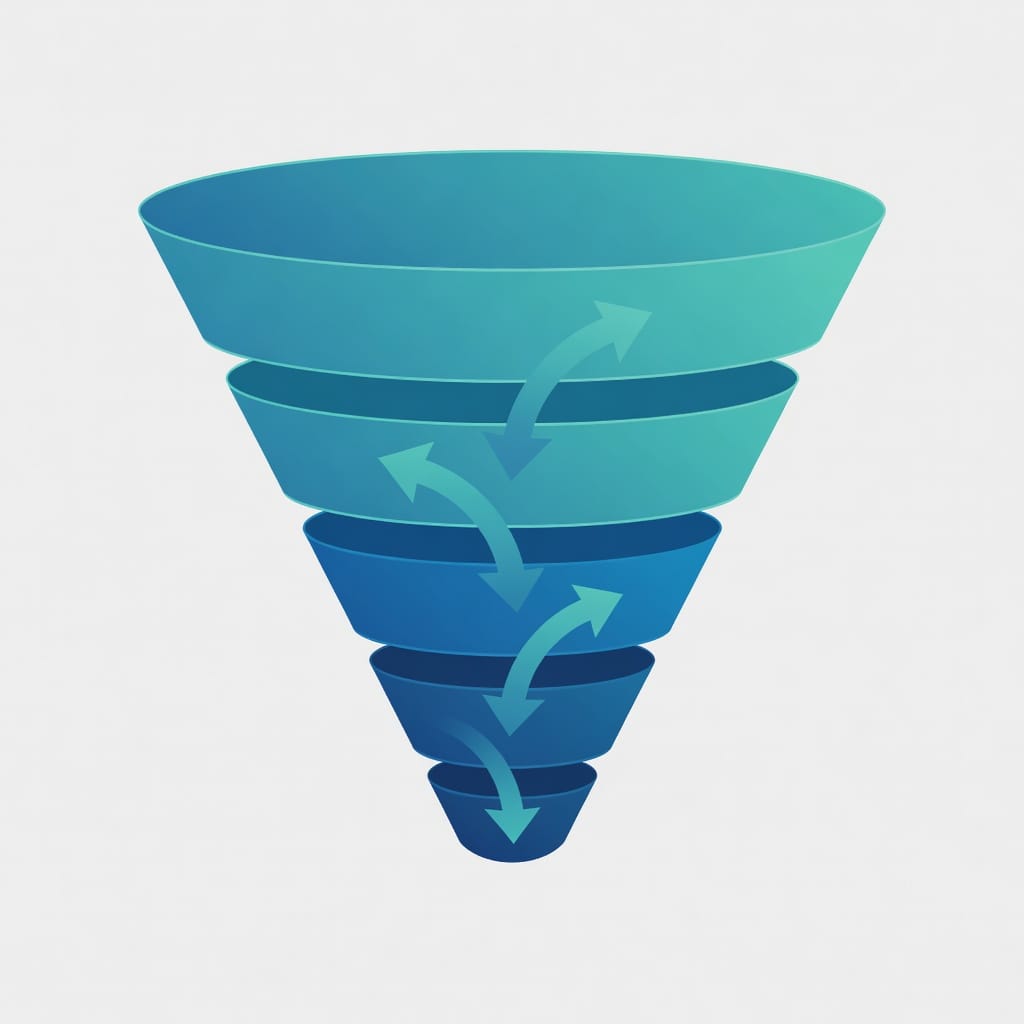
A B2B sales process is the repeatable operating system your team uses to turn qualified companies into customers. It defines who to target, how to start conversations, how to qualify real opportunities, how to prove value, how to navigate procurement, and how to turn first customers into renewals, expansions, and referrals.
Direct answer: The best B2B sales process has 10 stages: ICP definition, target-list building, prospecting, qualification, discovery, tailored presentation, objection handling, proposal, procurement, and close plus expansion. Each stage needs clear entry criteria, exit criteria, owner, CRM fields, and conversion metrics. Without those gates, the process becomes a loose checklist instead of a revenue system.
This guide is built to beat the typical 7-stage or 8-stage explanation because it covers the parts most guides skip: deliverability, handoffs, legal review, buying committees, post-sale expansion, AI-assisted personalization, and practical stage gates. You will find direct-answer blocks, tables, checklists, templates, case examples, and FAQ answers you can use to build or repair your own sales motion.
What Is a B2B Sales Process?
A B2B sales process is a documented sequence of repeatable actions for selling products or services from one business to another. It turns a messy set of buyer conversations into a measurable workflow. A strong process makes every rep answer the same core questions: who are we targeting, why would they care, who must approve, what value have we proved, what risk remains, and what happens after the deal is signed?
B2B Sales Process Definition
A B2B sales process is a structured path from target-account selection to customer expansion. It covers outreach, qualification, discovery, demo, negotiation, procurement, onboarding, and renewal. The purpose is not to make selling robotic. The purpose is to remove avoidable ambiguity so reps can spend more energy on judgment, research, listening, and relationship building. When the process is clear, managers can diagnose stage-level problems instead of blaming reps vaguely for “not closing enough.”
B2B Sales Process vs B2B Sales Cycle
The sales process is what your team does. The sales cycle is how long the buyer takes to move through it. This distinction matters because teams often try to shorten the cycle without fixing the process. If legal review adds 21 days, the process should introduce security and legal documents earlier. If discovery adds delay, the process should sharpen qualification and stakeholder mapping. Cycle length is the symptom. Process design is the lever.
B2B Sales Process vs B2C Sales Process
B2B sales differs from B2C sales because the buyer is usually a group, not one person. A consumer may buy shoes, software, or insurance after one visit. A company buying a revenue tool, compliance platform, or infrastructure product usually needs budget approval, stakeholder consensus, security review, legal review, and implementation planning. That changes the process. B2B teams must multi-thread, quantify business impact, handle risk, and document every promise so customer success can deliver what sales sold.
| Dimension | B2B Sales | B2C Sales |
|---|---|---|
| Decision makers | Buying committee | Individual or household |
| Sales cycle | Weeks to months | Minutes to days |
| Main motivation | ROI, risk reduction, productivity | Convenience, emotion, preference |
| Proof required | Case studies, demos, security docs, ROI | Reviews, brand trust, price |
| Handoff after purchase | Customer success or implementation | Support or self-service |
Why a Documented Process Beats Rep Improvisation
Improvisation can work for one talented founder or top rep, but it does not scale across a team. A documented process captures what top performers already do, then turns it into coachable behavior. It also makes forecasting more honest. If a deal has not completed discovery, found an economic buyer, and confirmed a next step, it should not be forecast like a late-stage opportunity. A process makes the pipeline less emotional and more inspectable.

Why B2B Sales Processes Fail
Most B2B sales processes fail because they describe stages but do not define proof. A CRM column called “proposal sent” tells you almost nothing. Was the proposal reviewed live? Did legal receive the right documents? Did the buyer agree to the mutual action plan? Did procurement confirm the vendor onboarding timeline? Without proof-based exit criteria, reps move deals forward because they feel good, not because the buyer has taken a meaningful action.
Failure Mode 1: Vague Stage Names
Stage names like “qualified,” “demo,” and “negotiation” sound useful until two reps interpret them differently. One rep may mark a lead qualified because the prospect replied. Another may wait until budget, pain, authority, and timeline are documented. The fix is to define stage entry and exit criteria in operational language. For example: “Qualified” means the prospect matches ICP, has a named business pain, has a known owner, and has accepted a discovery meeting.
Failure Mode 2: No Handoff Rules
A sales process breaks when marketing, sales development, account executives, revenue operations, and customer success hand off work informally. The buyer feels the gaps. They repeat the same information, receive conflicting timelines, or hear promises after the contract that nobody in implementation recognizes. Each handoff should include required notes, owner, due date, next meeting, risk flags, and what the buyer believes success looks like. Handoffs are where trust is either reinforced or quietly lost.
Failure Mode 3: Tooling Without Behavior Change
Buying a CRM, sales engagement tool, or AI assistant will not fix a weak process by itself. Tools enforce behavior only when the workflow is designed around them. If reps can skip required fields, ignore sequence outcomes, or move opportunities forward without evidence, the system becomes an expensive note archive. Start with the sales behavior you want, then configure the tool to make that behavior easier than the bad habit it replaces.
The 10 Stages of the B2B Sales Process
The modern B2B sales process starts before prospecting and ends after the first contract. That matters because the best teams do not treat sales as a narrow closing function. They treat it as a revenue lifecycle. Each stage below includes purpose, actions, owner, exit criteria, and metrics. Use it as a template, then simplify or expand based on deal size, average contract value, and buyer complexity.
Stage 1: Define Your Ideal Customer Profile
The first stage is deciding which companies deserve your sales effort. Your Ideal Customer Profile should include firmographics, technographics, urgency signals, operational pain, and disqualifiers. A weak ICP says “SaaS companies with 50 to 500 employees.” A strong ICP says “B2B SaaS companies with outbound teams, recent hiring in sales development, multiple sending domains, and a visible need to improve reply rates without damaging deliverability.” The exit criterion is a written ICP that sales and marketing both use.
Stage 2: Build Target Lists and Verify Data
Target-list quality determines the ceiling for outbound performance. A small, verified, high-fit list usually beats a large, messy database. Start with accounts that match your ICP, then map personas by role, seniority, department, buying influence, and likely pain. Before any cold email campaign, verify addresses to avoid bounces and reputation damage. FilterBounce is useful here because it supports CSV and API verification, helping teams keep bad addresses out of their sequences before outreach begins.
Stage 3: Start Multi-Channel Prospecting
Prospecting should combine email, LinkedIn, phone, referrals, intent triggers, and customer-led introductions. Cold email is still one of the highest-leverage channels when the infrastructure and copy are good. Mystrika supports this stage with warmup, cold email sequencing, unified inbox management, AI-assisted writing, personalization, and agency-friendly whitelabel options starting at $15 per month. For dedicated sending infrastructure, DoYouMail provides SMTP, IMAP, unlimited email IDs, dedicated private IP, and bring-your-own-domain setup at $39 per month.
Stage 4: Qualify Leads With a Clear Framework
Qualification protects your calendar and forecast. Use BANT for simpler deals, MEDDIC for enterprise deals, CHAMP for consultative selling, and GPCT when replacing an existing workflow. The goal is not to interrogate prospects. The goal is to learn whether the account has a painful problem, a reason to act now, the ability to buy, and a path to approval. The exit criterion is a documented qualification score with pain, business impact, stakeholders, timing, and next step.
Stage 5: Run Discovery and Map the Buying Committee
Discovery is where you earn the right to present. Ask about current workflow, cost of the problem, failed attempts, internal priorities, approval path, and stakeholder concerns. Do not stop at one champion. Map the economic buyer, technical evaluator, daily user, legal or security reviewer, finance approver, and possible blocker. A deal with one friendly contact is fragile. A deal with multiple informed stakeholders is forecastable. The exit criterion is a documented current state, desired state, impact, and stakeholder map.
Stage 6: Present a Tailored Solution
A strong B2B presentation is not a feature tour. It is a structured argument that connects the buyer’s pain to your solution and expected business outcome. Start with what you heard in discovery, confirm the priority, then demonstrate only the workflows that matter. If you show every feature, the prospect forgets the few that solve the problem. The exit criterion is that the buyer confirms fit, understands implementation path, and agrees to a mutual next step with a date.
Stage 7: Handle Objections and Build Consensus
Objections are signals. Budget objections often mean the value case is weak. Timing objections often mean urgency is unclear. Authority objections often mean the seller has not reached the real buying committee. Trust objections often mean the buyer needs proof, references, or risk reduction. Use a simple pattern: label the objection, investigate the real concern, respond with relevant evidence, and test whether the concern is resolved. The exit criterion is documented consensus on value, risk, and next step.
Stage 8: Send Proposal and Mutual Action Plan
A proposal should not surprise the buyer. It should summarize agreed problems, scope, timeline, pricing, success metrics, terms, and owner responsibilities. Pair it with a mutual action plan that lists every step from proposal review to signature to kickoff. Include owner, due date, status, and dependency. Never send a proposal and wait passively. Schedule a proposal review call before sending it. The exit criterion is buyer agreement on scope, price range, approval process, and timeline.
Stage 9: Navigate Procurement, Legal, and Security
Procurement is not a formality. It is a separate stage with its own stakeholders and risks. Security questionnaires, data processing agreements, vendor registration, payment terms, purchase orders, and legal redlines can stall otherwise healthy deals. Proactive sellers share standard security documents, privacy terms, and implementation notes before the buyer asks. The exit criterion is completed legal, procurement, and security review with only final signature remaining. If this stage is invisible in your CRM, your forecast will be unreliable.
Stage 10: Close, Onboard, Expand, and Ask for Referrals
Closed won is not the finish line. It is the transfer of trust from sales to customer success. The rep should hand over why the customer bought, what outcomes were promised, who cares about each outcome, and where risk remains. A customer that reaches first value quickly is more likely to renew, expand, and refer. The exit criterion is a signed agreement, completed kickoff, defined success plan, assigned owner, and scheduled review. Expansion should be a designed stage, not a happy accident.
B2B Sales Qualification Frameworks
Qualification frameworks help reps structure judgment. They are not scripts to recite mechanically. The right framework depends on deal complexity, sales cycle length, and buyer maturity. For a transactional subscription, a lightweight framework is enough. For a six-figure enterprise deal, you need a deeper view of metrics, decision process, and internal champion strength. The table below gives a practical decision guide.
BANT for Fast-Moving Sales Motions
BANT stands for Budget, Authority, Need, and Timeline. It is useful when you need a quick read on whether a lead deserves immediate sales attention. The weakness is that buyers often do not have a formal budget until they understand the problem. Instead of asking, “Do you have budget?” ask, “How are you funding this problem today, and what happens if it stays unresolved?” That reveals economic reality without forcing the buyer into a yes-or-no answer too early.
MEDDIC for Enterprise Deals
MEDDIC stands for Metrics, Economic Buyer, Decision Criteria, Decision Process, Identify Pain, and Champion. It is stronger for enterprise selling because it forces reps to understand how the organization makes decisions, not just whether one contact likes the product. The most underused part is Decision Process. If you do not know who signs, who reviews security, who approves budget, and when committees meet, you do not have a late-stage deal. You have a promising conversation.
CHAMP and GPCT for Consultative Selling
CHAMP prioritizes Challenges, Authority, Money, and Prioritization. GPCT focuses on Goals, Plans, Challenges, and Timeline. Both work well when the buyer needs consultative guidance rather than a direct product replacement. These frameworks help reps understand the business situation before discussing price. They also make discovery more natural because the questions feel like problem-solving rather than qualification. Use them when the buyer is still defining the category or building the internal case for change.
| Framework | Best for | Watch out for |
|---|---|---|
| BANT | SMB and fast-moving inbound | Can disqualify early buyers too soon |
| MEDDIC | Enterprise and complex approvals | Requires strong CRM discipline |
| CHAMP | Pain-led consultative selling | Can underweight procurement reality |
| GPCT | Strategy or replacement discussions | Needs deeper discovery skill |
Prospecting Workflow for B2B Sales Teams
Prospecting is the first visible part of the sales process, but it depends on everything before it. Your ICP, data quality, deliverability, copy, channel mix, and follow-up cadence all determine results. Many teams blame the copy when the real issue is unverified addresses, poor segmentation, weak domain reputation, or no reply-management process. Treat prospecting as an operational system, not a writing exercise.
Cold Email Infrastructure and Deliverability
Cold email performance starts with infrastructure. Use separate sending domains, configure SPF, DKIM, and DMARC, warm sending accounts gradually, verify lists, and watch bounce rate carefully. Mystrika helps with warmup and sequencing, while DoYouMail handles SMTP, IMAP, dedicated private IP, and unlimited email IDs for teams that want dedicated infrastructure. This matters because inbox placement is a prerequisite. If your emails land in spam, personalization and copy quality do not get a chance to matter.
Personalization Without Wasting Rep Time
Good personalization proves relevance without writing a custom essay for every prospect. The best pattern is one specific observation, one likely business problem, and one low-friction question. Mystrika’s AI writer can help create first drafts, but reps should still review messaging for accuracy. Avoid fake familiarity, generic compliments, and inflated claims. A good cold email sounds like a useful business note from someone who did research, not a mass email pretending to be personal.
A Practical 12-Touch Outbound Cadence
A strong outbound cadence blends channels over two to four weeks. Start with a short personalized email, follow with a LinkedIn view or connection, call with a relevant voicemail, send a problem-focused second email, add a value asset, then follow up with a breakup or timing question. Do not send twelve versions of “just checking in.” Every touch should add context, proof, contrast, or a new reason to respond. Measure replies, meetings, unsubscribes, and opportunities by segment.
Discovery Questions That Move Deals Forward
Discovery is the highest-leverage sales skill because it turns vague interest into a business case. The rep’s job is to understand pain, impact, urgency, current alternatives, decision process, and personal motivations. The best discovery calls feel like a structured consultation. The buyer should leave thinking more clearly about the problem than they did before the call.
Problem and Impact Questions
Ask questions that connect the operational problem to business impact. Examples: “What happens when this process fails?” “How many hours does the team lose each week?” “Which metric is most affected?” “Who notices when this goes wrong?” “What did leadership ask you to improve this quarter?” These questions make the problem measurable. Without measurable impact, the deal becomes a nice-to-have request competing against louder internal priorities.
Buying Committee Questions
Buying committee questions should feel helpful, not political. Ask, “Who else will care about the outcome of this project?” “Who usually reviews tools like this before approval?” “Who would object if we moved forward?” “What concerns will finance, legal, or security raise?” These questions prevent single-threaded selling. They also show maturity because experienced buyers know that internal alignment is part of the buying job.
Current Workflow Questions
Workflow questions expose friction and implementation requirements. Ask the buyer to walk through how work happens today, where data lives, who touches each step, what tools are involved, and where handoffs fail. This prevents generic demos. When the rep later presents the solution, they can mirror the buyer’s exact workflow and show the before-and-after change. That makes the presentation feel custom because it is built from the buyer’s own words.
Objection Handling and Negotiation
Objection handling is not about winning arguments. It is about uncovering the unresolved risk that prevents forward movement. A prospect who says “too expensive” may mean value is unclear, budget owner is absent, timing is poor, or a competitor is cheaper. The rep must diagnose before responding. Negotiation starts long before price is discussed because every discovery question shapes how the buyer evaluates value.
Budget Objections
When a buyer says the price is too high, do not immediately discount. Ask what number they were expecting, what they are comparing against, and how they measure the cost of the current problem. Then restate the expected business outcome and compare cost against impact. If a concession is necessary, trade for something meaningful such as annual prepayment, longer commitment, narrower scope, faster signature, case study participation, or executive access. Never give without getting.
Timing Objections
Timing objections often mean the buyer does not see enough cost of delay. Ask what changes if they wait three months, what other priorities are ahead of this, and whether the problem gets easier or harder over time. If the buyer has a legitimate timing constraint, create a nurture path with a scheduled re-engagement date. If the objection is vague, return to discovery. A real priority has a consequence. No consequence usually means no deal.
Authority and Consensus Objections
When a contact says they need to run it by the team, treat that as an invitation to help them build consensus. Ask what each stakeholder will care about and offer to prepare a short business-case summary. Better yet, ask for a joint meeting. Your champion should not be expected to sell alone internally with imperfect information. Give them proof, ROI language, objection responses, and a clear summary of the agreed problem.
Proposal, Procurement, and Close
Late-stage selling is project management. The rep must coordinate buyer stakeholders, internal legal, finance, implementation, and customer success. Many deals are lost not because the buyer disliked the solution, but because the process became too hard. A clear proposal, mutual action plan, and proactive procurement workflow reduce friction and increase buyer confidence.
Proposal Structure
A strong B2B proposal includes an executive summary, problem recap, business impact, recommended scope, pricing, implementation timeline, success metrics, assumptions, terms, and next steps. It should read like a shared plan, not a generic quote. Use the buyer’s language from discovery. If the buyer said their priority is reducing manual routing time, that phrase should appear in the proposal. Familiar language helps the proposal travel internally.
Mutual Action Plan
A mutual action plan lists every step between proposal review and go-live. Include stakeholders, owner, due date, status, and dependency. It should cover legal, security, procurement, purchase order, signature, kickoff, data migration, admin setup, training, and first value milestone. The plan protects both sides. The buyer sees what must happen internally, and the seller can forecast based on completed actions rather than hope.
Closing and Onboarding Handoff
A clean handoff prevents churn before it starts. Sales should document why the customer bought, what they expect, who the stakeholders are, what risks were discussed, and what was promised. Customer success should join before or immediately after signature for larger deals. The first 30 days should focus on reaching one visible win. If the customer does not experience value quickly, the renewal conversation becomes harder months later.
Metrics and Benchmarks for a Healthy B2B Sales Process
A process is only useful if it can be measured. Track conversion between stages, not just total revenue. If lead-to-opportunity conversion is weak, fix targeting or messaging. If opportunities stall after discovery, fix qualification or value articulation. If proposals stall in legal, fix procurement readiness. Stage-level metrics show where the system leaks.
Core Pipeline Metrics
Track lead-to-opportunity rate, opportunity-to-close rate, win rate, average contract value, sales cycle length, pipeline coverage, reply rate, meeting booked rate, no-show rate, proposal acceptance rate, forecast accuracy, and net revenue retention. Do not review these only at the company level. Segment by source, persona, industry, rep, deal size, and campaign. Averages hide the useful truth. One segment may be excellent while another burns time.
Stage Conversion Diagnostic Table
| Stage | Key metric | Healthy signal | Common repair |
|---|---|---|---|
| Prospecting | Reply rate | Replies from ICP accounts | Improve targeting, copy, deliverability |
| Qualification | Lead-to-opportunity | Strong fit and pain | Tighten scoring and disqualification |
| Discovery | Next-step rate | Buyer accepts demo or workshop | Improve questions and stakeholder mapping |
| Proposal | Review completion | Proposal reviewed live | Add mutual action plan |
| Procurement | Signature velocity | Legal blockers surfaced early | Share docs before request |
| Expansion | Net retention | Customer reaches value early | Improve onboarding and QBR cadence |
Forecasting Discipline
Forecasting should be based on buyer evidence, not seller confidence. A deal is not late stage because the rep had a good call. It is late stage because the buyer confirmed business impact, involved relevant stakeholders, reviewed a proposal, agreed to a timeline, and moved legal or procurement forward. Managers should ask, “What did the buyer do?” more often than, “How do you feel about this deal?” Buyer actions are better forecast signals than seller optimism.
Case Examples and Field-Tested Lessons
The most useful sales process lessons come from failures. The examples below are anonymized composites based on common patterns seen in outbound and SaaS sales teams. They are not meant as universal benchmarks. They show how a process change can create a measurable operating improvement without pretending that one tactic solves every market.
Case Example 1: Fixing a Single-Threaded Pipeline
A SaaS team had healthy demo volume but poor close rates. Pipeline review showed most opportunities had only one contact. When that contact went silent, the deal died. The team changed discovery rules so reps had to identify an economic buyer, technical evaluator, and daily user before proposal. They also added a stakeholder recap email after discovery. The result was not magic, but pipeline quality improved because reps stopped pretending one friendly user represented the whole buying committee.
Case Example 2: Repairing Cold Email Deliverability
A services firm blamed low outbound performance on weak copy. The real problem was infrastructure: high bounce rates, inconsistent sending volume, and no warmup discipline. The team moved to verified lists, separated sending domains, warmed accounts before scaling, and monitored replies by domain group. Mystrika handled warmup and sequencing, DoYouMail handled infrastructure, and FilterBounce cleaned lists before launch. Copy improved later, but inbox placement was the first bottleneck to remove.
Case Example 3: Reducing Proposal Stalls
A mid-market sales team had many proposals stuck for more than 30 days. The proposal itself was not the issue. Reps were sending proposals without a live review, without legal documents, and without a mutual action plan. The team required a review call, added procurement steps to the CRM, and sent security documents with the proposal. Deals still required approval, but fewer disappeared because the buyer and seller finally had a shared path to signature.

Tools That Support the B2B Sales Process
Tools should support the process, not replace it. A lean stack usually includes CRM, data source, email verification, cold email sequencer, sending infrastructure, calendar scheduling, call recording, proposal software, e-signature, and customer success tracking. The right stack depends on deal size. A founder-led team can start lightweight. A large revenue team needs governance, permissions, analytics, and integrations.
Mystrika for Cold Email Sequencing and Warmup
Mystrika fits naturally in the prospecting stage because it combines cold email sequencer, AI writer, personalization, unified inbox, warmup, and whitelabel capability. The unified inbox matters when teams run multiple sending accounts and campaigns because replies can scatter quickly. Starting at $15 per month, it is especially practical for founders, agencies, and outbound teams that need sequencing and warmup without enterprise complexity. Learn more through the Mystrika blog.
DoYouMail for Cold Email Infrastructure
DoYouMail is useful when the team wants dedicated cold email infrastructure rather than relying on a generic mailbox setup. It provides SMTP, IMAP, unlimited email IDs, dedicated private IP, and bring-your-own-domain support at $39 per month. Infrastructure does not make poor targeting work, but it protects the foundation. When paired with warmup, verification, and sane sending volumes, dedicated infrastructure gives outbound teams more control over deliverability.
FilterBounce for Email Verification
FilterBounce belongs before the first email is sent. Verification removes invalid, risky, disposable, and malformed addresses from campaign lists. That protects sender reputation, improves reporting accuracy, and prevents reps from mistaking data decay for copy failure. CSV upload is useful for campaign preparation, while API access helps teams verify addresses inside automated workflows. For B2B outbound, keeping bounce rate low is not optional. It is part of the sales process.
B2B Sales Process Checklist
Use this checklist to audit your current process. If one area is weak, repair that stage before adding more tools or hiring more reps. Most teams do not need a more complicated process. They need a clearer one with stronger gates, better data, and fewer silent handoff failures.
Pre-Outreach Checklist
Before outreach begins, confirm the ICP is current, account list matches the ICP, contacts are mapped to relevant personas, email addresses are verified, sending domains are warmed, SPF, DKIM, and DMARC are configured, sequences are segmented, and reply ownership is clear. Also confirm the campaign has a disqualification rule. Reps should know which replies are worth a meeting and which should be routed to nurture, partner, support, or no-fit categories.
Opportunity Checklist
Before an opportunity enters forecast, confirm business pain, impact, current workaround, decision process, budget path, timeline, stakeholders, competitor or status quo alternative, and next buyer action. If any field is unknown, the rep should not hide it. Unknowns are coaching opportunities. Forecast problems often start when unknown fields are silently treated as positive assumptions. A clean opportunity checklist makes risk visible earlier.
Close and Handoff Checklist
Before marking closed won, confirm signed agreement, payment or procurement status, kickoff date, customer success owner, implementation scope, promised outcomes, stakeholder list, risk notes, and first-value milestone. The handoff should be in CRM, not buried in a private Slack thread or rep notes. The buyer should feel continuity from sales to onboarding. A smooth handoff is the first proof that the company can deliver what it sold.
How to Improve Your B2B Sales Process in 30 Days
Improvement should be staged. Do not rewrite every workflow at once. Pick the bottleneck that affects revenue most, repair it, measure it, then move to the next. A 30-day process sprint works because it creates enough urgency to act, but not so much complexity that the team rejects the change.
Week 1: Audit the Pipeline
Review the last 30 closed-won deals, 30 closed-lost deals, and 30 stalled opportunities. Look for patterns by source, segment, stakeholder count, stage duration, and reason lost. Interview reps about where deals really stall, not where the CRM says they stall. Compare buyer actions to stage names. Your goal is to find the biggest gap between what the process says and what actually happens.
Week 2: Tighten Stage Gates
Rewrite stage entry and exit criteria using observable buyer actions. For example, “demo complete” is weaker than “buyer attended tailored demo, confirmed use case fit, named approval stakeholders, and accepted proposal review date.” Update CRM fields only where needed. Do not create administrative clutter. A few mandatory fields tied to real decisions are better than dozens of fields reps ignore.
Week 3: Fix Outreach and Follow-Up
Repair list quality, verification, domain warmup, sequence timing, and reply handling. Replace generic “checking in” messages with useful follow-ups that add proof, examples, or a sharper question. Review campaign performance by segment, not just total reply rate. If one persona responds and another does not, split messaging. Mystrika can help manage sequenced follow-up and replies while keeping outreach organized across accounts.
Week 4: Train, Inspect, and Iterate
Train the team on the new gates, then inspect live opportunities in pipeline review. Ask reps to show evidence for each stage. Reward clean disqualification, not just closed-won deals, because removing bad-fit opportunities protects time and forecast quality. At the end of the month, compare stage conversion, stage aging, and forecast accuracy against the starting baseline. Keep the changes that improved behavior and remove anything that created busywork.
Key Takeaways
- A B2B sales process is a repeatable system for turning qualified companies into customers and expansion revenue.
- The best process starts with ICP definition and ends after onboarding, renewal, expansion, and referral.
- Every stage needs entry criteria, exit criteria, owner, CRM fields, and conversion metrics.
- Prospecting performance depends on targeting, verification, warmup, infrastructure, messaging, and reply handling.
- Qualification frameworks like BANT, MEDDIC, CHAMP, and GPCT help reps separate real opportunities from wishful pipeline.
- Discovery should map pain, impact, current workflow, buying committee, decision process, and cost of inaction.
- Proposals need a live review and a mutual action plan, not a passive email attachment.
- Procurement, legal, and security deserve their own stage because they often control signature timing.
- Mystrika, DoYouMail, and FilterBounce naturally support the outbound part of the process: sequencing, warmup, infrastructure, and verification.
- The fastest improvement usually comes from tightening one broken stage, measuring it, and iterating before changing the next stage.
Frequently Asked Questions
What is the B2B sales process?
The B2B sales process is the repeatable set of steps a company uses to sell to another company. It usually includes targeting, prospecting, qualification, discovery, demo, objection handling, proposal, procurement, close, onboarding, and expansion. The process is valuable because it makes selling measurable and coachable. Instead of relying on rep intuition alone, teams can see where opportunities stall and repair the specific stage causing lost revenue.
What are the main stages of a B2B sales process?
The main stages are ICP definition, list building, prospecting, qualification, discovery, solution presentation, objection handling, proposal, procurement and legal review, closing, onboarding, and expansion. Some teams combine or rename these stages, but the underlying buyer work still exists. The important point is not the exact label. The important point is that each stage has clear proof before the deal advances to the next stage.
How long does a B2B sales cycle usually take?
A B2B sales cycle can take a few weeks for simple SMB purchases and several months for enterprise deals. Deal size, risk, integration complexity, security review, legal review, and number of stakeholders all affect duration. If your sales cycle is longer than expected, inspect stage aging. You may find that deals are not truly stuck everywhere. They may be stuck specifically after discovery, proposal, or procurement.
What is the difference between a sales process and a sales funnel?
A sales process describes the actions your team takes to move a buyer from target account to customer. A sales funnel describes how opportunities convert and drop off across stages. The process is operational. The funnel is analytical. You need both. The process tells reps what to do next, while the funnel tells managers where the system is leaking and which stage deserves repair first.
Which qualification framework is best for B2B sales?
The best framework depends on the type of deal. BANT is useful for simpler sales where speed matters. MEDDIC is stronger for enterprise deals with multiple stakeholders and formal approval processes. CHAMP and GPCT work well for consultative conversations where pain, goals, and priority need deeper exploration. The framework matters less than consistent use. A simple framework used every time beats a sophisticated one ignored in practice.
How do I build a B2B sales process from scratch?
Start by defining your ICP, mapping the buyer journey, documenting the actions required at each stage, and setting exit criteria based on buyer evidence. Then configure your CRM to reflect those stages, train reps on the workflow, and inspect stage conversion weekly. Do not overbuild at the start. A lean process with clear gates is easier to adopt than a massive playbook nobody uses.
What metrics should I track in a B2B sales process?
Track reply rate, meeting booked rate, lead-to-opportunity conversion, opportunity-to-close conversion, win rate, average contract value, sales cycle length, stage aging, pipeline coverage, proposal acceptance rate, forecast accuracy, and net revenue retention. Review metrics by segment and source. A blended average can hide the fact that one persona, channel, or industry is doing most of the work while another quietly wastes rep capacity.
How can cold email fit into a B2B sales process?
Cold email fits in the prospecting stage, but it should not be treated as a standalone tactic. It depends on ICP quality, verified lists, deliverability infrastructure, warmup, personalization, sequence design, and reply routing. Tools like Mystrika help with sequencing, AI writing, warmup, personalization, and unified inbox management. DoYouMail can support dedicated SMTP and IMAP infrastructure, while FilterBounce helps verify addresses before sending.
How do I stop deals from stalling after the proposal?
Schedule a live proposal review before sending the proposal, include a mutual action plan, share legal and security documents early, and confirm the buyer’s internal approval path. Most proposal stalls happen because the seller assumes the buyer knows how to move the deal internally. Make the path explicit. List every remaining step, owner, and due date. Then manage the close like a project, not a waiting game.
How often should I update my B2B sales process?
Review the process monthly for metrics and quarterly for structural changes. Monthly reviews should inspect stage conversion, stage aging, deal quality, and forecast accuracy. Quarterly reviews should ask whether your ICP, buying committee, objections, competitive landscape, and tool stack have changed. Avoid constant rewrites because they confuse the team. Improve the process in focused sprints, then let reps build muscle memory before changing it again.