
If you’ve ever felt like navigating B2B sales is akin to getting lost in a maze without a map, you are not alone. With purchasing decisions growing more complex every year, involving 6 to 10 or more stakeholders, a well-defined plan is no longer optional. You need a thorough understanding of the B2B buyer journey — the exact path your ideal customers take from realizing they have a problem to signing a contract and eventually becoming brand advocates.
This guide explores every stage of the modern B2B buyer journey in 2026, breaks down how it differs from consumer sales, explains the psychological and operational shifts happening right now, and gives you a data-driven framework for building a buyer journey map that actually accelerates revenue.
What makes this guide different? Instead of rehashing the same three-stage model from the 1990s, we dig into the dark funnel, buying committee dynamics, intent data, multi-channel attribution, post-purchase retention metrics, and how tools like Mystrika can help you engage buyers at every step.
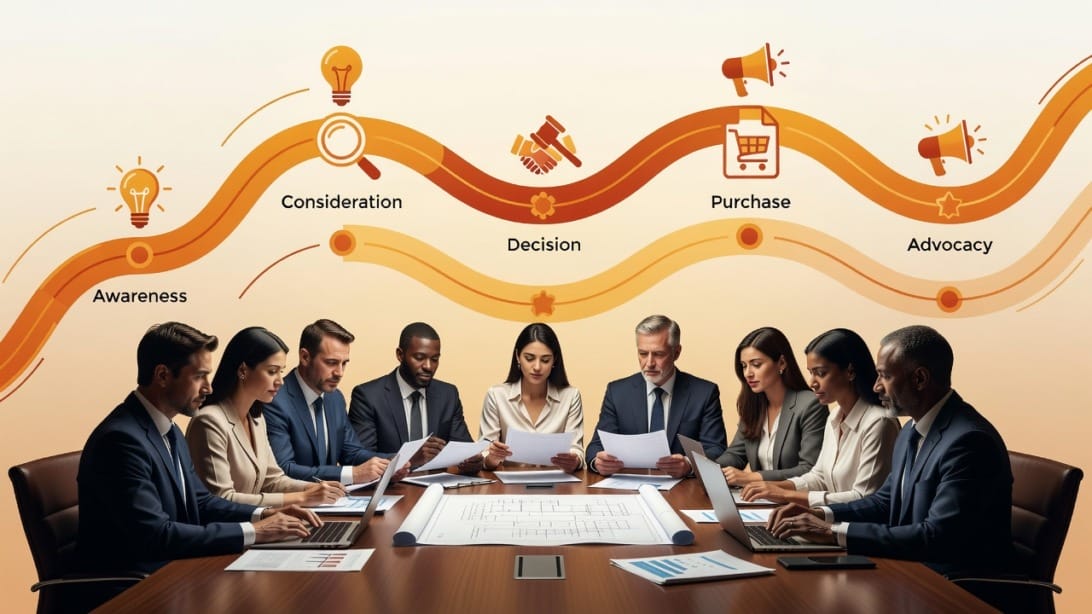
What is the B2B Buyer Journey?
The B2B buyer journey is the multi-stage process that a group of stakeholders goes through when purchasing a product or service for their organization. It starts with the initial recognition of a business problem, moves through extensive research and solution evaluation, culminates in a purchase decision, and continues into onboarding, retention, and advocacy.
A recent Gartner report found that 77% of B2B buyers described their most recent purchase as “very complex or difficult.” The average buying group now involves 6 to 10 decision-makers, each carrying 4 to 5 pieces of independently gathered information. When you multiply that out, the buying group collectively holds 24 to 50 data points that need to be reconciled before a decision can be made. This complexity is the core challenge that journey mapping solves.
Understanding the full scope of the buyer journey is essential because it prevents your team from optimizing for only the most visible touchpoints. When you understand the full path, you can design marketing campaigns, sales scripts, and product experiences that address the buyer’s actual needs at each step rather than guessing based on incomplete data.
Why the Journey is Non-Linear
One of the biggest mistakes marketers make is treating the B2B buyer journey as a simple linear funnel. In reality, buyers jump between stages. A prospect in the decision stage may discover a new requirement and loop back to consideration. An executive who was not involved in the early research may enter during the evaluation phase and demand a complete re-examination of alternatives.
According to Forrester’s research on B2B buying, the modern journey resembles a “maze” more than a “funnel.” Buyers frequently revisit earlier stages as new information surfaces or internal requirements shift. This means your content and outreach systems must support re-entry points, not just top-of-funnel.
The practical implication is that your marketing automation needs to support non-linear progression. A lead scoring model that simply adds points for each action and assumes forward movement will fail. Instead, you need behavioral scoring that accounts for regression and re-engagement. If a prospect who previously reached the demo stage starts downloading introductory content again, your system should recognize this as a signal that requirements have changed or new stakeholders have entered the process.
The Dark Funnel Concept
The “Dark Funnel” describes the invisible research activities that buyers perform before your sales team ever detects them. Buyers ask peers in private Slack communities. They read Gartner and G2 reviews. They listen to industry podcasts and consume analyst reports — all without filling out a single form on your website.
Industry data from SiriusDecisions (now part of Forrester) shows that B2B buyers complete 67% to 70% of their journey before ever contacting a vendor. Your content and outbound outreach must be strong enough to shape that invisible research phase.
How do you influence the Dark Funnel? You cannot track it directly, but you can win it by ensuring your brand has a strong presence everywhere buyers research. This means maintaining active profiles on review sites like G2 and Capterra, publishing guest posts on respected industry blogs, appearing as a guest on relevant podcasts, and ensuring your LinkedIn thought leadership reaches the right audience. If a prospect searches for “cold email deliverability tips” and finds your blog post, and then searches for “best cold email software” and sees your product listed on a review site, and then hears your founder on a podcast — you have effectively shaped the dark funnel without the buyer ever filling out a form.
How Buying Committees Actually Make Decisions
Gartner’s research on B2B buying reveals that buying groups engage in six distinct “buying jobs”: problem identification, solution exploration, requirements building, supplier selection, validation, and consensus creation. Critically, these jobs do not happen in a fixed sequence. A buyer may validate a decision before building formal requirements, or explore new solutions after initial supplier selection if concerns arise. This non-linear decision-making process is why modern B2B companies must have flexible engagement models that meet buyers wherever they are.
Research from Forrester further shows that each buying job involves different stakeholders at different times. The IT director may drive problem identification and solution exploration, but the CFO takes over during supplier selection and validation. Your content strategy needs to address each stakeholder at their point of highest influence, which varies by buying job.
How Does the B2B Journey Differ from B2C?
The differences between B2B and B2C buying are not just academic. Misunderstanding them causes companies to use the wrong tactics at the wrong time.

Here is a comparison table summarizing the key differences:
| Dimension | B2B Buyer Journey | B2C Buyer Journey |
|---|---|---|
| Decision-makers | 6-10 stakeholders | 1 individual |
| Average sales cycle | 3-12 months | Minutes to days |
| Deal size | $5,000 to $1M+ | $20 to $500 |
| Emotional driver | Professional risk mitigation | Personal desire |
| Research depth | 7+ sources consulted | 1-2 sources |
| Content needed | Deep, educational, multi-format | Quick, visual, persuasive |
| Post-purchase phase | Onboarding + expansion critical | Usually ends at purchase |
You Sell to Committees, Not Individuals
In B2C, one person decides. In B2B, you need consensus from a buying committee that includes end-users, managers, IT security, procurement, and the C-suite. Each persona cares about different things. The CFO wants an ROI model. The IT director wants a security questionnaire answered. The end-user wants a product that is easy to use and won’t make their daily workflow harder.
Your marketing and sales alignment must account for every persona. One-size-fits-all messaging fails in a committee setting. The challenge intensifies when different stakeholders enter the buying process at different times. The end-user may have been researching solutions for months before involving procurement, which means your content must speak to a stakeholder who is already well-informed while also being accessible to a newcomer who just joined the committee.
The Sales Cycles Are Significantly Longer
A B2B buying process typically runs 3 to 12 months from initial awareness to signed contract. For enterprise deals in regulated industries like healthcare or finance, the cycle can stretch beyond 18 months.
This is because the stakes are much higher. A bad SaaS tool purchase wastes thousands of dollars and months of implementation effort. Furthermore, budget approvals often run on quarterly cycles, and a missed fiscal deadline can reset the entire process.
The length of the sales cycle means you need a content and engagement strategy that sustains interest over many months. A single email sequence that runs for two weeks is insufficient. You need ongoing nurture campaigns that deliver value at regular intervals, with content that adapts as the buyer moves through different stages.
Emotional Connection Matters More than Conventional Wisdom Suggests
Conventional thinking says B2B is rational and B2C is emotional. But research from Google, Gartner, and Motista tells a different story. Their study found that B2B customers are significantly more emotionally connected to their vendors than B2C customers.
Why? Because a bad B2B purchase can cost someone their job, damage their company’s reputation, or ruin a quarterly target. The emotional weight of professional risk is enormous. B2B customers look for trust, reliability, and safety just as much as they look for features and price.
The Bain & Company study on “40 distinct kinds of value in B2B” reinforces this finding. B2B buyers evaluate vendors not just on functional value (features, cost savings) but also on emotional value (confidence, peace of mind, reduced anxiety) and life-changing value (career advancement, personal growth). Your marketing strategy must appeal to all three value types.
Content Needs Are Vastly Different
Because B2B buyers self-educate, the volume and depth of content you need is higher. A consumer might read one product review and make a purchase. A B2B buyer reads whitepapers, watches webinars, downloads ROI calculators, reads case studies, checks analyst reports, and asks for peer references — all before scheduling a single sales call.
Your content library must cover informational, educational, and decision-support materials for each stage of the buyer journey and for each stakeholder persona. A useful exercise is to create a content matrix with journey stages on one axis and stakeholder personas on the other axis, then identify the cells that are empty. Those empty cells represent content gaps that are actively slowing down your buyers.
What are the 5 Stages of the Modern B2B Buyer Journey?
Most classic frameworks describe three stages: Awareness, Consideration, and Decision. But in 2026, successful companies plan for a five-stage journey that extends well beyond the signature.
Stage 1: Problem Awareness
The journey begins when a business recognizes a gap between their current state and a desired state. They are not searching for vendors. They are searching for answers. What is causing this problem? How serious is it? What approaches exist for solving it?
At this stage, the buyer consumes educational content: blog posts, industry reports, LinkedIn thought leadership, and podcast episodes. They are trying to validate whether the problem is worth solving and whether now is the right time to act.
The most effective outreach at this stage comes from understanding the buyer’s industry context. A manufacturing company struggling with supply chain visibility has very different triggers than a SaaS company struggling with lead response times. Your awareness-stage content and cold email campaigns should be segmented by industry and common trigger events.
To reach buyers at this stage with cold email, you need to respect that they are not ready for a sales pitch. Your email should validate their pain, offer a unique insight or data point that they haven’t seen elsewhere, and provide a low-commitment next step like reading a related blog post or downloading a checklist.
A tool like Mystrika can help you test problem-focused email angles at scale. Its AI writer can generate different hooks and subject lines, and its warmup feature ensures your emails land in the primary inbox, not the spam folder. The unified inbox then tracks replies from multiple campaigns in one place, so you never miss a prospect who signals early interest.
Stage 2: Research and Consideration
The buyer has defined the problem and now evaluates possible solution categories. Should we hire an agency? Buy off-the-shelf software? Build an in-house solution? They are comparing approaches, not brands, at this stage.
The buying committee begins to form here. Each stakeholder comes with different criteria. The technical stakeholder reads documentation and API specs. The business stakeholder reads pricing pages and ROI case studies. The executive reads analyst reports and competitive comparisons.
This is where most B2B companies lose potential buyers, not because their product is inferior, but because their content fails to address the specific evaluation criteria of each stakeholder. If your website has a detailed technical specifications page but no one-page executive summary, the CFO who joins the committee mid-cycle cannot easily assess your total cost of ownership.
To optimize your outreach during the consideration stage, share comparison content and industry benchmarks rather than pushing for a demo. A prospect who receives a helpful vendor selection guide or a report on industry benchmarks is far more likely to engage than one who receives a “ready for a demo?” email.
Stage 3: Decision and Vendor Selection
The buyer has shortlisted 3 to 5 vendors. They are deep into direct evaluation: requesting demos, starting free trials, sending security questionnaires, and negotiating pricing.
This is the most visible stage because buyers are actively engaging with sales. But it is also the riskiest because one misstep — a slow response, a confusing pricing page, a pushy rep — can eliminate you from consideration.
The decision stage is where product quality and customer experience converge. Your product demo must address the specific use cases that matter to your prospect’s business. Generic demos that show every feature in alphabetical order waste the buyer’s time and signal that you do not understand their specific needs.
Make it easy to buy. Provide clear pricing, instant demo scheduling, and sample data. Equip your champion with executive summaries, competitive comparison one-pagers, and ROI models they can present internally.
In the current market, cold email outreach to decision-stage prospects can accelerate deal velocity. Use Mystrika’s cold email sequencer to send personalized follow-ups that address common procurement objections like implementation complexity, data migration, or onboarding support. The sequencer’s conditional branching lets you create different email paths for prospects who have pricing concerns versus those who have technical implementation questions.
Stage 4: Onboarding and Retention
The contract is signed, but the real work has just begun. The first 90 days of a customer relationship determine whether the buyer achieves the value they expected. Poor onboarding is the leading cause of early churn in SaaS.
According to SaaS industry benchmarks, companies with structured onboarding programs retain 70% to 80% of customers beyond the first year, compared to 40% to 50% for companies without one.
A structured onboarding plan should include welcome communications, setup guides, milestone check-ins, and usage benchmarks at 30, 60, and 90 days. The goal is to get the customer to their “aha moment” — the point where they clearly see the value of your product — as quickly as possible.
Implement a structured onboarding sequence with clear milestones. Assign a customer success manager from day one. Track adoption metrics and intervene when usage drops. Keep lines of communication open through your unified inbox so customers can message you directly without juggling multiple tools.
Stage 5: Advocacy and Expansion
A successful B2B buyer journey does not end with retention. The most profitable customers are those who renew, upgrade, and refer. Expansion revenue from existing customers is significantly more cost-efficient than acquiring net-new logos.
Gainsight data shows that companies with formal customer advocacy programs see 20% to 40% higher expansion revenue. The key is to identify which customers are most likely to advocate and then systematically ask them to participate in case studies, reference calls, review sites, and beta programs.
Build referral programs, collect and publish case studies, invite customers to beta test new features, and ask for reviews on G2 and Capterra. Send quarterly business reviews that demonstrate the value you have delivered. Use NPS surveys to identify promoters and detractors early, then take action on the feedback before it affects renewal decisions.
How to Build a B2B Buyer Journey Map
A buyer journey map is a visual representation of the steps your customers take from problem awareness to advocacy. Here is a step-by-step process for creating one that drives real revenue.
Step 1: Define Your Ideal Customer Profile and Buyer Personas
Start with data, not assumptions. Analyze your current best customers to identify common patterns:
| Attribute | What to analyze |
|---|---|
| Company size | Revenue band, employee count |
| Industry | Vertical-specific needs |
| Job roles | Titles of key decision-makers |
| Pain points | Problems that led to purchase |
| Buying triggers | Events that started the journey |
| Sources used | Where they found information |
Create 3 to 5 detailed personas. Each persona should include demographics, daily responsibilities, goals, pain points, information sources, and buying criteria.
Step 2: Identify All Touchpoints
List every possible interaction a prospect may have with your brand. This includes:
- Organic search and blog visits
- Content downloads (eBooks, templates, guides)
- Webinar attendance
- Social media engagement (LinkedIn, Twitter, Reddit)
- Cold email outreach
- Paid ads and retargeting
- Sales calls and discovery meetings
- Product demos and free trials
- Customer support and community forum visits
- Review sites (G2, Capterra, TrustRadius)
Document which touchpoints are most influential at each journey stage. Marketing automation platforms and CRM analytics can help you trace which touchpoints correlate with conversions. A common insight from this exercise is that the most influential touchpoints are often the ones your team is not directly responsible for, such as review sites or peer referrals.
Step 3: Find Friction Points
Analyze where prospects stall or drop off. Common friction points include:
- Abandoning the pricing page without requesting a demo
- Stalling after the first discovery call
- Dropping off during the trial without converting
- Going dark after initial positive signals
Identify the root cause of each friction point. If prospects drop off after the pricing page, perhaps your pricing is unclear, too high, or missing critical FAQ information. If deals stall after the demo, your sales team may not be answering specific technical or implementation questions clearly.
Use a combination of quantitative data (analytics drop-off rates) and qualitative data (sales call recordings, customer interviews) to diagnose friction points. The numbers tell you where the problem is; the conversations tell you why it exists.
Step 4: Map Content to Journey Stages
Audit your current content and assign each piece to a journey stage. When you overlay the audit on your funnel, gaps become obvious.
A common gap pattern: plenty of awareness-stage blog content but almost no decision-stage comparison guides or onboarding-stage educational materials. Fill those gaps before creating more top-of-funnel content.
Good B2B content marketing requires content for every stage and for every persona within the buying committee. A content gap matrix helps you visualize what is missing. If you have excellent technical documentation but no content aimed at executive stakeholders, you are making it harder for your champion to sell internally.
Step 5: Measure, Test, and Iterate
A buyer journey map is a living artifact. Review it quarterly with your sales and marketing teams. Track conversion rates between stages using CRM reports and analytics tools. Send NPS and customer satisfaction surveys to understand the experience from the buyer’s perspective.
If conversion from consideration to decision drops, run a root cause analysis. Has a competitor entered the market? Has your pricing changed? Are your sales demos outdated?
Document each iteration of your journey map with version notes explaining what changed and why. This creates institutional knowledge that survives employee turnover and helps new team members understand the evolving dynamics of your market.
How to Use Cold Email at Every Stage of the Buyer Journey
Outbound email is often treated as a tactic for generating top-of-funnel leads. But when used correctly, cold email can support buyers at every stage of their journey.
Awareness Stage Emails
Send educational content that validates the buyer’s pain. Cite statistics and industry research. Do not mention your product. The goal is to get a reply that signals interest, not to close a sale.
Example angle: “I noticed your team is expanding. Companies your size typically struggle with X. Here is a framework for tackling it.”
The ideal awareness email is 80 to 120 words, contains a specific insight the buyer likely has not encountered, and ends with a low-friction question. Avoid attachments and avoid multiple links — your only goal is to start a conversation.
Consideration Stage Emails
Share comparison content. Send a link to an industry benchmark report or a guide to evaluating vendors in your category. Help the buyer build a business case, even if that case ends up favoring a competitor — the trust you build now pays off in future buying cycles.
At this stage, you can mention your product but only in the context of broader education. For example: “Most teams we work with evaluate three to five vendors before choosing. Here is a framework we use internally to compare options.” This positions you as a helpful guide rather than a pushy salesperson.
Decision Stage Emails
Be direct and helpful. Offer to connect the buyer with a customer reference. Provide a detailed implementation timeline. Address specific procurement objections. This is where personalized, triggered sequences excel.
Send proposal summaries, case studies from similar companies, and comparison data that helps your prospect advocate for your solution internally. The goal is to arm your champion with everything they need to win the internal debate.
Best Practices for Deliverability
None of this works if your emails never reach the inbox. Here are three things you need:
- Email verification: Use FilterBounce to clean your prospect list before sending. High bounce rates destroy sender reputation and land your domain on blocklists.
- Private IP infrastructure: Use DoYouMail for dedicated SMTP servers with warm IPs. Shared IPs mean you are at the mercy of other senders on the same pool.
- Built-in warmup: A platform like Mystrika includes automatic warmup that gradually increases sending volume to establish domain reputation before campaigns go live. Combined with the unified inbox for managing replies, it creates a complete outreach stack. For a deeper dive on keeping your domain reputation healthy, check out our guide on improving cold email deliverability and best practices for inbox placement.
Using Intent Data to Prioritize Buyer Journey Targets
Intent data refers to behavioral signals that indicate a prospect is actively researching a solution category. Common intent signals include:
- Spikes in content consumption on industry topics
- Visiting pricing pages or feature comparison pages
- Downloading white papers or research reports
- Searching for specific third-party integrations
- Engaging with LinkedIn ads or sponsored content
Companies that use intent data to prioritize their outbound see significantly higher conversion rates because they contact prospects who are already in an active buying cycle.
There are two types of intent data: first-party (data from your own website and channels) and third-party (data from content networks, ad platforms, and publisher networks). First-party intent data is more accurate because it reflects actual engagement with your brand. Third-party intent data is broader because it captures research activity happening on other sites.
You can layer intent data onto your buyer journey map to identify accounts at each stage. An account showing high content consumption but no demo request is likely stuck in the consideration stage — your outreach should help them evaluate, not sell them on awareness. An account that visited your pricing page multiple times is in the decision stage and needs procurement support, not another blog post.
Buyer Journey Analytics: What to Measure
If you are not measuring the B2B buyer journey, you cannot optimize it. Here are the most important metrics to track:
Top-of-Funnel (Awareness) Metrics
- Traffic by source (organic, paid, social, referral)
- Blog post engagement (time on page, scroll depth)
- Lead generation rate from content downloads
- Email open and reply rates for cold outreach
Middle-of-Funnel (Consideration) Metrics
- Demo request rate from website traffic
- Trial sign-up rate
- Content-to-lead conversion by asset type
- Time from lead creation to first sales contact
Bottom-of-Funnel (Decision) Metrics
- Lead-to-opportunity conversion rate
- Opportunity-to-close rate
- Average deal size and sales cycle length
- Win rate by competitor
Post-Purchase Metrics
- Net Promoter Score (NPS)
- Customer health score (product usage)
- Time-to-value (days from sign-up to first key milestone)
- Churn rate and expansion revenue
Tracking these metrics over time lets you identify trends that would otherwise be invisible. For example, if your time-to-first-contact increases by 48 hours over a quarter, you may be losing deals simply because competitors are responding faster. A weekly buyer journey dashboard shared between sales and marketing prevents these creep issues from going unnoticed.
The Role of AI in the Modern B2B Buyer Journey
AI is reshaping how buyers and sellers interact. Here are three areas where AI is having the biggest impact:
AI-Powered Personalization at Scale
Buyers expect relevant content. With AI writing tools, you can generate personalized email sequences that adapt messaging based on recipient behavior, industry, role, and company size. Mystrika’s AI writer creates variations at scale, ensuring each prospect receives messaging that maps to their specific stage in the journey.
Predictive Lead Scoring
AI models can analyze historical conversion data to score leads based on their likelihood to buy. This helps sales teams prioritize accounts that show strong buyer intent signals, reducing wasted effort on prospects who are not ready.
Predictive scoring models typically weight dozens of signals — website behavior, email engagement, firmographic fit, intent data, and historical patterns — to produce a single score. The most sophisticated models update scores in real time as new signals arrive, allowing sales reps to prioritize their day based on which accounts are heating up.
Buyer Sentiment Analysis
Natural language processing tools can analyze email replies, call transcripts, and support tickets to gauge buyer sentiment. If a buyer’s tone shifts from engaged to defensive, your system can trigger a preemptive intervention — a customer success check-in or a personalized case study addressing their likely concern.
Sentiment analysis is particularly valuable for account-based sales where each deal represents a significant revenue opportunity. Detecting a shift in sentiment early gives you time to address concerns before the buyer goes dark or chooses a competitor.
9 Strategies for Optimizing the B2B Buyer Journey
Here are nine actionable strategies for improving your buyer experience and accelerating deal velocity.
1. Use Segment-Specific Account-Based Marketing
Generic messaging is the enemy of B2B success. Build account-based marketing campaigns that target specific accounts with personalized content for each stakeholder. Custom landing pages, tailored email sequences, and industry-specific case studies are far more effective than broadcast campaigns.
2. Remove Friction from Demos and Trials
Do not bury your demo request behind a 10-field form. Use instant scheduling tools that let prospects book a meeting in two clicks. Offer interactive product tours and sandbox environments so buyers can experience your product without committing to a sales call.
The difference between a frictionless demo flow and a high-friction one can be 3x to 5x in conversion rates. Every additional form field reduces completion rates by approximately 10%. Ask only for the information you genuinely need to deliver a quality demo.
3. Equip Your Internal Champion
Your champion inside the buying organization needs ammunition. Provide them with:
- One-page executive summaries for their boss
- Technical deep dives for the IT team
- Cost-benefit analysis spreadsheets
- Competitor battle cards
- Case studies from similar companies
The single most valuable asset you can give your champion is a customized total cost of ownership (TCO) model that they can present to their CFO. This turns a subjective purchasing decision into an objective financial analysis.
4. Unify Your Outreach Channels
Buyers interact with your brand across email, LinkedIn, webinars, and your website. Siloed data means your sales rep may call a prospect who just downloaded a pricing guide, and neither party realizes it. Use a unified inbox and CRM that centralizes all prospect interactions into a single timeline.
The goal is that every conversation with a prospect builds on the previous one, regardless of which channel each interaction happened on. A unified inbox makes this possible by showing the complete interaction history in chronological order.
5. Prove ROI Throughout the Journey
Do not save ROI proof for the closing call. Embed case studies, customer testimonials, and statistics into your awareness and consideration content. The more value a buyer sees early, the faster they progress through the funnel.
Consider creating an interactive ROI calculator on your website that prospects can use to estimate their potential savings or revenue lift. Interactive tools generate 2x to 3x more engagement than static content and keep prospects on your site longer.
6. Build Authority with Peer References
B2B buyers trust their peers more than they trust your sales team. Invest in collecting G2 and Capterra reviews. Create a customer reference program that connects prospects with existing customers who can share their experience candidly. Peer conversations are the highest-converting touchpoint in the entire journey.
For cold email outreach, mentioning a customer win in the same industry is one of the most effective ways to build credibility. For example: “We recently helped a manufacturing company similar to yours achieve a 40% reduction in lead response time.”
7. Align Sales and Marketing Around Stages
The most common B2B journey killer is misalignment between sales and marketing. Marketing generates leads and hands them off. Sales ignores the marketing-qualified lead score and starts from scratch. Fix this by agreeing on a shared definition of each journey stage and building service-level agreements that govern handoffs.
A simple but effective tool is a shared journey stage definition document that both teams co-author. This document should specify exactly what behavior or criteria qualifies a prospect for each stage and what action the receiving team must take within a defined time frame.
8. Use Triggered Behavioral Email Sequences
One-off email blasts are ineffective. Build triggered sequences that respond to specific buyer behaviors: a pricing page visit triggers a pricing FAQ email; a case study download triggers a customer testimonial email; a demo view triggers a follow-up from sales.
Mystrika’s cold email sequencer allows you to build multi-step sequences with conditional branching, so the buyer automatically receives the next relevant message based on their previous action. If they open an email about case studies but skip the one about pricing, the sequence can automatically send more case study content rather than repeating the pricing message.
9. Create a Seamless Post-Sale Handoff
The worst thing you can do is win a deal and then drop the ball on implementation. Create a structured handoff document that includes everything the customer success team needs to know: what was promised, the timeline agreed upon, the key stakeholders, and the success metrics the buyer expects.
Schedule a formal handoff meeting between the sales rep, the customer success manager, and the buyer within the first week after signing. This meeting ensures alignment on expectations and sets the stage for a successful onboarding experience.
Key Takeaways
- The B2B buyer journey is complex, non-linear, and involves 6 to 10 stakeholders making decisions over 3 to 12 months.
- Nearly 70% of the journey happens invisibly through the dark funnel before buyers engage with sales.
- Modern journey maps should cover 5 stages: Awareness, Consideration, Decision, Retention, and Advocacy.
- Cold email outreach can support buyers at every stage when combined with proper deliverability infrastructure.
- Intent data helps prioritize accounts that are actively in a buying cycle.
- AI-powered personalization, predictive scoring, and sentiment analysis are reshaping how B2B companies engage buyers.
- Remove friction at every stage: simplify demo booking, equip your champion with assets, and align your sales and marketing teams around shared definitions.
- A successful journey does not end at the signature — onboarding, retention, and advocacy are where long-term value is built.
Frequently Asked Questions
What is the difference between a buyer journey and a sales funnel?
A sales funnel represents your internal process for moving a lead to a closed deal. The buyer journey represents the customer’s perspective and the actual steps they take to solve their problem, which is often non-linear and spans multiple channels.
How long does the average B2B buyer journey take?
For most B2B purchases, the journey takes 3 to 12 months from initial awareness to closed deal. Enterprise purchases involving large buying committees and procurement processes can take 12 to 18 months or more.
What are the most common B2B buyer journey stages?
The five stages of the modern B2B buyer journey are Awareness, Consideration, Decision, Retention, and Advocacy. Many frameworks use three stages (Awareness, Consideration, Decision), but the most successful companies extend their view to include post-purchase stages.
How can I track where a buyer is in their journey?
Use a combination of website analytics, marketing automation scoring, intent data platforms, and CRM pipeline management to determine a buyer’s stage. Key signals include content consumption patterns, demo requests, pricing page visits, and sales call progression.
What is the dark funnel in B2B buying?
The dark funnel refers to the invisible research activities buyers perform that you cannot directly track. This includes private peer conversations on Slack and WhatsApp groups, third-party review sites, analyst reports, industry podcasts, and social media communities.
How many decision-makers are typically involved in B2B purchases?
According to Gartner, the average B2B buying group includes 6 to 10 stakeholders. Each stakeholder carries 4 to 5 pieces of independently gathered information, creating up to 50 data points that must be reconciled.
Why is email deliverability important for the buyer journey?
If your emails land in spam, the buyer never sees your value proposition. Maintaining high deliverability requires verified prospect lists, warm sending domains, and proper SMTP infrastructure. Using a dedicated private IP ensures your reputation is not harmed by other senders.
What role does cold email play in the modern B2B buyer journey?
Cold email can intercept buyers in the awareness and consideration stages who have not yet found your brand through organic channels. Combined with personalization and proper sequencing, it accelerates discovery and guides prospects toward considered evaluation.
What is the most important metric for measuring buyer journey success?
There is no single metric. The combination of conversion rates between stages, average sales cycle length, and post-purchase NPS score gives you the most complete picture of journey health. Track all three and watch for trends, not isolated numbers.