

What Is Account Based Marketing? (And Why It Dominates B2B in 2026)
Account based marketing (ABM) is a strategic B2B framework where marketing and sales teams align to target a curated set of high-value accounts with hyper-personalized campaigns, messaging, and buying experiences. Instead of casting a wide net and hoping leads convert, ABM flips the funnel: you identify the accounts most likely to generate significant revenue, then build your entire go-to-market motion around them.
The results speak for themselves. According to Demandbase research, companies running mature ABM programs for at least one year report over 30% revenue growth. ITSMA data shows that 84% of ABM practitioners see measurable improvement in brand reputation scores, and 74% report stronger customer relationships. SiriusDecisions found that 91% of ABM marketers see larger deal sizes, with 25% reporting more than 50% growth in average contract value.
But here is the reality check that most guides skip: ABM is not a quick fix. It is not a campaign you run for a quarter. It is an operational commitment that requires data infrastructure, sales-marketing alignment, content personalization engines, and a willingness to walk away from the volume game.
This guide covers everything you need to design, launch, scale, and measure an ABM program in 2026. Whether you are a startup running your first 1:Many program or an enterprise orchestrating 1:1 campaigns with executive sponsors, you will find actionable frameworks, real-world examples, and the exact metrics that separate ABM success stories from expensive experiments.
Why ABM Matters More Now Than Ever
The B2B buying landscape has shifted dramatically. Decision-makers are overwhelmed by generic outreach. Gartner data shows that B2B buyers spend only 17% of their purchasing journey meeting with potential suppliers. The rest is independent research, peer validation, and content consumption. If your message is not tailored to their specific context, it gets filtered out before a human ever reads it.
ABM solves this by forcing relevance at every touchpoint. When you know exactly which accounts you are pursuing, you can craft messaging that addresses their industry, their tech stack, their growth stage, and their known pain points. That relevance translates directly to pipeline velocity.
Consider this: the average B2B company using Mystrika for cold email outreach sees 20-40% pipeline growth simply because the platform enables them to personalize at scale. For a deeper look at how data quality drives these results, check out our Ultimate Guide to B2B Marketing Data. When you layer on the full ABM motion targeting, content personalization, multi-channel engagement, and closed-loop measurement that same data set becomes exponentially more powerful.
The Three Tiers of ABM (1:Many, 1:Few, 1:One)
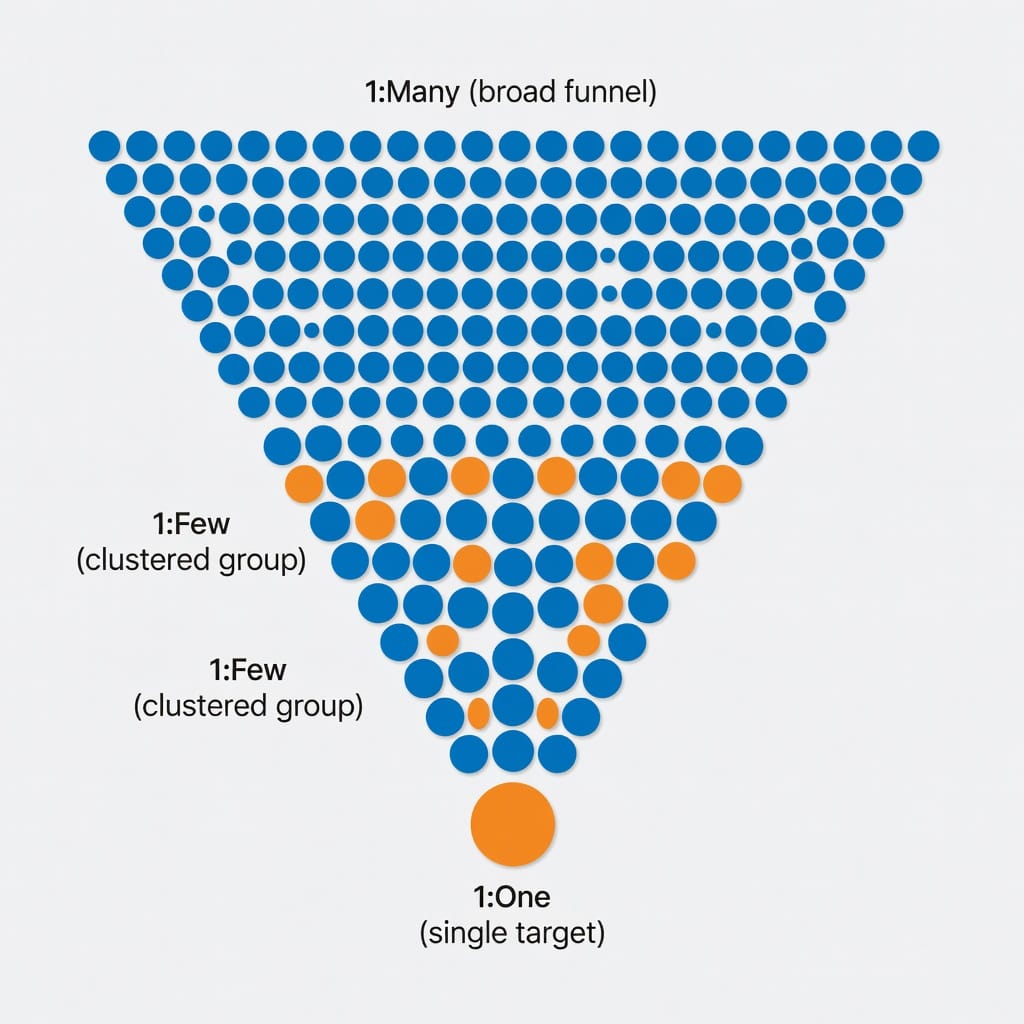
Not every account deserves the same level of investment. The ABM framework breaks down into three tiers, and understanding which tier applies to which account is the difference between an efficient program and a budget blowout.
1:Many ABM (Broad Reach) targets ICP-matched segments with programmatic advertising, content hubs, and automated outreach sequences. This is your scaled motion. Think of it as intelligent demand generation with ABM targeting. You use firmographic and technographic data to define segments, then deliver relevant content at scale. Mystrikas email warmup and AI writer are particularly effective here, ensuring your outreach lands in inboxes and resonates with the right personas.
1:Few ABM (Focused Acceleration) clusters similar accounts into micro-segments. Typically 10-50 accounts with shared characteristics. You build custom landing pages, run tailored SDR sequences, and create content that addresses the cluster’s common challenges. This tier is where most mature ABM programs see the highest ROI because it balances personalization with operational efficiency.
1:1 ABM (High-Stakes) is the full white-glove treatment for your top 5-20 named accounts. Every touchpoint is bespoke: personalized video demos, executive roundtables, custom gifting campaigns, and account-specific content. This tier makes sense when a single deal can move your quarterly revenue needle by 5% or more.
Here is a quick comparison of the three tiers:
| Dimension | 1:Many | 1:Few | 1:One |
|---|---|---|---|
| Number of accounts | 500-5000+ | 10-50 | 1-20 |
| Personalization level | Segment-based | Cluster-based | Account-specific |
| Primary channels | Paid ads, email, content hubs | Custom pages, SDR outreach, events | Executive engagement, gifting, demos |
| Budget per account | Low ($50-500) | Medium ($500-5,000) | High ($5,000-50,000+) |
| Sales involvement | Minimal | Moderate | Deep collaboration |
| Typical ACV range | $5K-50K | $50K-250K | $250K+ |
| Measurement focus | Engagement volume | Pipeline creation | Deal velocity and close rate |
Why Traditional B2B Marketing Fails Without ABM
Traditional demand generation treats every lead equally. You run ads, collect form fills, score leads by engagement, and hand them to sales. The problem is that this model was designed for an era when buyers had fewer options and less information. Today, that approach produces three critical failures.
The Volume Trap
When you optimize for lead volume, you attract a mixture of tire-kickers, students, competitors, and a handful of real buyers. Your SDR team spends 80% of their time qualifying out rather than selling. Cost per qualified lead skyrockets. Marketing reports on MQL volume, but pipeline numbers stay flat.
The Relevance Gap
Generic content cannot meet the specific needs of enterprise buyers. A CTO at a Series B SaaS company evaluating your platform has fundamentally different questions than a VP at a Fortune 500 manufacturing firm. If your emails, ads, and landing pages say the same thing to both, neither feels understood. And in a world where buyers expect personalization, feeling misunderstood means they move on.
The Attribution Black Hole
When you market broadly, you cannot tell which activities actually influenced a deal. Was it the webinar from three months ago? The LinkedIn ad they clicked last week? The case study someone forwarded internally? Without account-level attribution, you cannot optimize spend, justify budget, or prove marketing ROI to the board.
ABM solves all three problems simultaneously. By targeting accounts rather than individuals, you naturally filter for intent and fit. By personalizing at the account level, you make every interaction relevant. By measuring account engagement across the entire buying committee, you build a clear picture of what drives deals to close.
The Must-Have Foundations Before You Launch ABM
Before you pick software or build campaigns, you need to get the fundamentals right. Skipping this phase is the most common reason ABM programs fail.
Define Winning Before You Define Tools
The first conversation should not be about Martech. It should be about what success looks like. Answer these three questions with your leadership team and sales counterparts:
Which accounts would transform our business if we won them? Be specific. Name the accounts. If you cannot name 20 accounts that would represent a material revenue impact, you are not ready for ABM.
How do we define ABM success? Is it new pipeline created? Existing account expansion? Shortened sales cycles? Higher win rates? Penetration into net-new divisions? Each definition drives a different strategy.
How will marketing, SDRs, and AEs collaborate on these accounts? Who owns the relationship? Who triggers outreach? How do we share intelligence? Map the workflow before you automate it.
Mystrika customers typically start this process by pulling their best-performing accounts from their outreach platform, analyzing the commonalities, and building their ICP from real data rather than assumptions. Because Mystrika provides granular delivery and engagement analytics at the contact level, you already have the signal data you need to identify which profile types are most likely to convert.
Build an ICP-Driven Account Scoring Framework
Signal stacking is the technical foundation of ABM targeting. You assign weighted scores to accounts based on two categories of data:
Fit signals tell you whether an account matches your ideal customer profile. Industry vertical, employee count, revenue range, funding stage, technology stack, geographic region, and regulatory environment all feed into the fit score. For example, if your product integrates with Salesforce, accounts using a competing CRM should score lower.
Intent signals tell you whether an account is actively in-market for a solution like yours. Job posting increases for relevant roles, leadership changes, website visitor behavior, third-party content consumption, and competitor research all indicate buying intent.
A mature scoring model might look like this:
| Signal Category | Weight | Examples |
|---|---|---|
| Firmographic fit | 30% | Industry, revenue, employee count |
| Technographic fit | 20% | Existing tech stack compatibility |
| Intent data | 25% | Content consumption, keyword research |
| Trigger events | 15% | Funding rounds, executive changes, expansion |
| Engagement history | 10% | Email opens, ad clicks, webinar attendance |
Accounts that score above a certain threshold enter your ABM pipeline. The threshold itself should be calibrated against historical closed-won deals. If you have been running cold email outreach through Mystrika, export your converted accounts, analyze the common signal patterns, and use those patterns to set your scoring baseline.
Build Your ABM Funnel Layers
Your ABM program needs distinct motions for each stage of account maturity. A common mistake is treating all target accounts the same way.
Top of funnel: Identify and attract. Use 1:Many tactics to surface accounts that exhibit ICP fit plus any intent signal. Programmatic advertising, LinkedIn Matched Audiences, and targeted content syndication all work here. The goal is not to generate leads but to build a pool of accounts with verified engagement.
Middle of funnel: Engage and accelerate. Accounts showing consistent engagement graduate to 1:Few or 1:1 treatment. This is where custom landing pages, personalized email sequences, and targeted SDR outreach happen. Mystrikas AI writer is particularly useful at this stage because it can generate personalized email copy at scale based on account firmographics and engagement history.
Bottom of funnel: Convert and expand. The highest-value accounts receive executive sponsorship, bespoke content, and multi-threaded engagement across channels. Your goal here is to compress the sales cycle and maximize deal size by demonstrating an investment in the relationship that no competitor can match.
Accounts should move freely between tiers based on engagement. An account that goes dark for 60 days drops back to 1:Many nurture. An account that suddenly posts a VP of Engineering job opening jumps to 1:Few.
How to Execute ABM Campaigns That Actually Drive Pipeline
Once your foundations are in place, you shift from planning to execution. This section covers the tactical playbook for each ABM tier.
1:Many Execution: Scale Without Sacrificing Relevance
The challenge of 1:Many ABM is maintaining relevance at scale. Here is how to pull it off.
Build segment-specific content hubs. Instead of one generic blog post about your product, create pillar pages targeting each ICP segment. If you sell to both fintech and healthcare, those are two separate content hubs with industry-specific examples, compliance considerations, and use cases.
Use programmatic ABM advertising. Platforms like Demandbase and 6sense let you serve ads to contacts at your target accounts without knowing their individual identities. The ad creative should reference the specific challenge or category relevant to that account’s industry.
Deploy intelligent email sequences. This is where most ABM programs either shine or fail. Generic email blasts at target accounts feel like spam. Intelligent sequences that adapt based on engagement, reference account-specific triggers, and arrive from a warm sender name are the gold standard. Mystrikas sequencing engine allows you to build multi-step email campaigns that conditionally branch based on opens, clicks, and replies, all while maintaining inbox deliverability through its warmup pool.
Measure engagement at the account level. Stop tracking individual MQLs. Track account engagement scores: what percentage of the buying committee has interacted with your content, which topics generated the most interest, and how engagement correlates with deal progression.
1:Few Execution: The ROI Sweet Spot
For most B2B organizations, 1:Few ABM delivers the highest return on investment. Here is exactly how to run it.
Cluster accounts by shared triggers. Group accounts that recently raised Series B funding, or accounts that hired a new CMO, or accounts in the same vertical with the same CRM. Each cluster gets a custom landing page and a tailored outreach sequence.
Create one landing page per cluster. The landing page should reference the cluster’s shared industry or trigger event. Include a personalized video from the relevant sales rep, customer testimonials from similar accounts, and a clear next-step CTA that is not just book a demo.
Align SDR outreach with marketing content. The SDR’s email should arrive within 24 hours of the account visiting the landing page. The email should reference the page and add a specific insight: I noticed your team is evaluating CRM platforms. Our integration with Salesforce reduced onboarding time for similar companies by 40%.
Use gifting strategically. A $50 gift card to a coffee shop is table stakes. What works is gifting that demonstrates research: a book on a topic the CRO recently spoke about at a conference, a donation to a charity the CEO supports, or a curated package aligned to their industry. At 1:Few scale, you can afford meaningful gifting for 10-50 accounts.
1:One Execution: The Full Enterprise Treatment
When one deal can make your quarter, nothing is off the table.
Build a bespoke microsite for the account. Put the company’s name in the headline. Reference their specific challenges and goals. Include a custom ROI calculator calibrated to their industry and company size. This is not a template. It is a production that communicates: we invested in understanding your business before we asked for a meeting.
Host an executive dinner or roundtable. Invite multiple decision-makers from the account alongside peer executives from your existing customers. The agenda should not mention your product. It should address a shared strategic challenge and let your customers make the case through their own experience.
Create account-specific content. Write a white paper addressing the specific regulatory or market challenge the account faces. Record a custom Loom video walking through how your solution handles their specific use case. Build a data study using their anonymized data to show projected ROI. This level of effort signals commitment that generalists cannot match.
Coordinate multi-threaded outreach. Marketing runs parallel ads to multiple stakeholders at the account. SDRs reach out to different contacts with context-aware messaging. The AE focuses on the economic buyer. Customer success contacts existing champions. Every channel reinforces the same value proposition from a different angle.

The Channels That Drive ABM Results in 2026
Channel selection is where ABM strategy meets reality. The right mix depends on your target accounts’ preferences, your budget, and your team’s capabilities.
Cold Email: The Highest-ROI ABM Channel
Despite the rise of LinkedIn and paid ads, cold email remains the highest-ROI channel for ABM when done correctly. The key is integration: your email outreach must be informed by account intelligence and personalized at every step.
Modern ABM cold email is not about blasting 10,000 contacts. It is about sending 50 ultra-targeted emails per day to carefully selected contacts at your priority accounts, with messaging that refers to specific triggers, content they consumed, or challenges their industry faces.
Deliverability is the hidden variable. Even the best ABM email falls flat if it lands in the spam folder. That is why warmup infrastructure matters. Mystrikas warmup pool sends your emails to a network of real inboxes that engage with them, signaling to Google and Microsoft that your sending domain is legitimate. Combined with Mystrikas unified inbox for seeing all replies in one place, and its AI writer for generating personalized variants at scale, you get a complete ABM email engine for $15 per month.
Paid Advertising: Programmatic ABM
Programmatic advertising platforms like Demandbase allow you to serve ads exclusively to contacts at your target accounts. You can create distinct creative for each tier: broad brand awareness for 1:Many, problem-solution messaging for 1:Few, and account-specific value propositions for 1:One.
The metrics that matter here are not CTR or CPC. They are account reach (what percentage of your buying committee saw the ad), frequency distribution (are you over-targeting one person and missing everyone else?), and assisted pipeline (which ad impressions correlated with eventual deal creation).
LinkedIn: The ABM Social Layer
LinkedIn is indispensable for ABM, but it is often over-relied upon. Use it for three specific purposes:
Identify the full buying committee. LinkedIn Sales Navigator gives you visibility into who works at your target accounts and their reporting structures. Cross-reference with your existing contact data to find gaps.
Deliver thought leadership content. Your C-suite should be posting relevant content that your SDRs can share with target accounts. A comment from a VP at a target account on your CEO’s post is worth more than a cold email.
Run Matched Audience campaigns. Upload your target account list to LinkedIn and serve Sponsored Content and InMail specifically to decision-makers at those accounts. Pair this with your email outreach so the same contact sees your LinkedIn ad after receiving your email.
Events and Webinars: High-Touch Engagement
Virtual and in-person events remain powerful ABM channels because they create natural opportunities for follow-up. The playbook is straightforward:
Invite target accounts to an exclusive event on a topic relevant to their industry. Record their attendance and engagement. Follow up within 24 hours with content that extends the conversation. If you host a webinar on compliance in fintech, every fintech target account on your list should receive the recording with a personalized note from your compliance experts.
Direct Mail and Gifting: The Surprise-and-Delight Channel
Gifting in ABM is not about bribing prospects. It is about demonstrating research and investment. A well-executed gifting campaign can break through the noise in a way that digital channels cannot.
The most effective ABM gifting is triggered by specific events: a target account visits your pricing page, a decision-maker replies to an SDR email, or an account moves into an active evaluation phase. The gift should feel earned, not random. A box of high-quality coffee with a note referencing their company’s expansion into a new market signals that you are paying attention.
The ABM Tech Stack You Actually Need
There is a temptation to buy every ABM platform on the market. Resist it. Here is the minimum viable stack:
| Layer | Must-Have Tool | Nice-to-Have |
|---|---|---|
| CRM | Salesforce or HubSpot | Revenue Intelligence (Gong) |
| Account Data | ZoomInfo or Cognism | 6sense or Demandbase |
| Email Outreach | Mystrika | Outreach or SalesLoft |
| Advertising | LinkedIn Matched Audiences | Demandbase Programmatic |
| Analytics | Account-level dashboard in CRM | Attribution platform |
| Content Personalization | Landing page builder | CustomGPT or AI content engine |
The most important tool is the one that bridges your data and your outreach. If your ABM data lives in one system and your email outreach lives in another, you will always struggle with relevance at scale. Mystrika fills this gap by combining B2B email data with multi-step sequencing, AI-powered content generation, and deliverability infrastructure in a single platform.
For email validation, FilterBounce is a solid addition to any ABM tech stack. It verifies that the email addresses you target are valid before you invest time and sequencing effort on them. A clean contact list amplifies every dollar you spend on ABM tools.
How to Measure ABM Success (Metrics That Matter)
ABM measurement is fundamentally different from traditional marketing measurement. You are not tracking leads. You are tracking account progression.
Leading Indicators (Weekly)
These metrics tell you if your ABM engine is running:
Account coverage: What percentage of your target accounts have been contacted by sales, engaged with marketing, or both? If coverage is below 60%, you have a pipeline problem.
Engagement depth: Among your target accounts, how many unique contacts have interacted with your content or outreach? Five contacts at one account is more valuable than one contact at five accounts.
Trigger response time: When a target account triggers an intent signal, how quickly does your sales or marketing team respond? Best-in-class is under 1 hour. Average is 48 hours. The gap is millions of dollars in lost pipeline.
Inbox placement rate: What percentage of your ABM emails land in the primary inbox versus promotions or spam? If this drops below 95%, pause your campaigns and fix deliverability before continuing. Mystrikas warmup pool is designed to maintain inbox placement above 97% even at scale.
Pipeline influence: How much pipeline is being created from engagement at target accounts? This is your core leading ABM metric.
Lagging Indicators (Monthly)
These metrics tell you if ABM is working:
Win rate on target accounts vs. non-target accounts. If your ABM accounts are not winning at a higher rate, something in your targeting or messaging is off.
Average deal size on target accounts. ABM should increase ACV because you are engaging more stakeholders and demonstrating higher value. If deal size is flat, your 1:1 motion needs work.
Sales cycle length. ABM should compress the sales cycle because the buying committee is already educated and aligned before they enter active evaluation.
Account expansion. Are your target accounts expanding into new divisions, adding users, or upgrading tiers faster than your non-ABM accounts?
Revenue attribution by channel. Which ABM channels (email, ads, events, gifting) are driving the most pipeline and revenue? Double down on the winners.
Real ABM Campaign Examples That Generated Revenue
The Targeted Cold Email Campaign (1:Few)
A B2B SaaS company targeting Series B and Series C fintech companies built a 1:Few ABM program around a single trigger: recent funding announcements. Using their CRM and Mystrikas sequencing engine, they deployed the following playbook:
Day 1: Email to the VP of Engineering referencing the funding round and offering a technical white paper on scaling infrastructure.
Day 3: If no response, SDR calls the contact with a specific question about their current infrastructure setup.
Day 7: LinkedIn connection request from the AE with a personalized note about recent industry trends.
Day 14: Custom landing page invite featuring a case study from a similar company.
The results over a 12-week period: 40% meeting show rate, $1.2M in pipeline generated, and 3 closed-won deals worth $340K total ACV.
The Multi-Channel Enterprise Play (1:One)
A sales intelligence company going after a Fortune 500 financial services firm deployed a full 1:1 ABM campaign:
Month 1: Research phase. The marketing team built a custom microsite analyzing the target company’s market position and challenges. The team sent a personalized video from the CEO to the target’s VP of Sales.
Month 2: Engagement phase. The SDR team sent curated content to five stakeholders across the target account: the VP of Sales (competitive landscape report), the CRO (board presentation template), the Director of Operations (workflow efficiency study), the Head of Enablement (training ROI calculator), and the CEO (industry trends white paper).
Month 3: Conversion phase. An executive roundtable was held featuring three of the vendor’s existing customers from similar Fortune 500 firms. The target company sent their VP of Sales and their CRO.
Results: The deal closed at $475K ACV in under 5 months, compared to their typical 9-month enterprise sales cycle.
Common ABM Mistakes and How to Avoid Them
Mistake 1: Launching ABM Without Sales Buy-In
The number one reason ABM programs fail is that sales does not believe in them. If your sales team continues prospecting their own accounts while marketing runs a parallel ABM campaign, you are not doing ABM. You are running two disconnected motions that waste resources.
Fix: Run the first ABM campaign as a pilot with a single sales rep who is bought in. Prove the model, document the wins, then expand.
Mistake 2: Using Stale Data
ABM runs on account intelligence. If your contact data is six months old, you are emailing people who have changed jobs to accounts that have shifted strategy. Data freshness is not a nice-to-have. It is the oxygen of ABM.
Fix: Use tools that provide real-time data enrichment. Validate emails before sending. Mystrikas platform checks email validity before adding contacts to sequences, ensuring your outreach is not wasted on dead addresses. FilterBounce is another reliable option for verifying email addresses in bulk before they enter your ABM sequences.
Mistake 3: Over-Indexing on Technology
You do not need a $100K ABM platform to start. The most impactful ABM activities conversations with sales, account research, personalized content creation require zero new software. Start with what you have: your CRM, an email outreach tool like Mystrika, and a spreadsheet. Add tools only when you have proven the model.
Mistake 4: Ignoring Deliverability
Even the most perfectly personalized ABM email is useless if it hits the spam folder. Inbox placement is the silent killer of ABM campaigns. If your open rates are below 30%, it is rarely because your subject lines are bad. It is usually because your sending infrastructure is not properly warmed up or configured.
Fix: Use a dedicated sending domain for ABM campaigns. Warm up your domain before launching. Monitor blacklists and bounce rates daily. Mystrikas warmup pool automatically builds your sender reputation before you send a single campaign email.
Mistake 5: Measuring the Wrong Things
If your ABM dashboard still shows MQLs and cost per lead, you are not doing ABM. You are doing demand generation with a target account list. ABM measurement is account-level: account engagement score, account coverage, account pipeline velocity, account win rate.
Fix: Build a separate ABM dashboard in your CRM that tracks account-level metrics exclusively. Do not mix ABM and non-ABM metrics in the same view.
ABM and Cold Email: The Perfect Partnership
Cold email is the most scalable personalized channel in the ABM toolkit. When integrated correctly, it becomes the connective tissue between your account intelligence and your sales conversations.
Here is the cold email ABM workflow that top-performing teams use:
Step 1: Import your target account list into Mystrika. Each account should have at least 3-5 contacts identified through your data provider.
Step 2: Use Mystrikas AI writer to generate personalized email variants for each account tier. 1:Many accounts get segment-level personalization. 1:Few accounts get cluster-level personalization. 1:One accounts get account-specific messaging.
Step 3: Activate the warmup pool. Before any campaign emails go out, Mystrika establishes your sending reputation by exchanging warmup emails with its network of real inboxes. This typically takes 2-4 weeks for a new domain.
Step 4: Launch multi-step sequences. Each account tier has a different sequence. 1:Many sequences are shorter (3-4 steps). 1:One sequences are longer (7-10 steps) with more touchpoints and content offers.
Step 5: Monitor replies in the unified inbox. Mystrika consolidates all replies from all sequences into a single inbox so your SDRs can respond without switching between tools.
Step 6: Track account-level engagement. Which contacts opened, clicked, replied? Pass that data back to your CRM to update the account engagement score.
The beauty of this approach is that it costs $15 per month to start. You get the warmup pool, the AI writer, the multi-step sequencer, and the unified inbox in one subscription. There is no need for separate deliverability tools, email validation services, or outreach sequencers.
ABM vs. ABX: What Is the Difference?
You have probably seen the term ABX (Account Based Experience) gaining traction. Here is the distinction without the marketing fluff:
ABM focuses on marketing and sales alignment to acquire target accounts. The emphasis is on demand generation, pipeline creation, and deal conversion within a defined account set.
ABX extends the ABM philosophy across the entire customer lifecycle, involving customer success, support, and product teams in addition to marketing and sales. The emphasis shifts from acquisition to the full customer experience.
In practice, most organizations should master ABM before attempting ABX. If you cannot consistently acquire and convert target accounts, expanding the scope to the entire customer journey will only compound your problems. Start with ABM. Prove it. Scale it. Then extend to ABX.
How Different Senders Can Run ABM Together with DoYouMail
One practical challenge in ABM is managing multiple senders and domains across a campaign. When you have several SDRs sending from different email addresses to the same account, deliverability risks multiply. DoYouMail solves this by providing dedicated, pre-warmed sending infrastructure for each sender, ensuring that ABM sequences maintain consistent inbox placement regardless of who is sending.
For teams running 1:Few or 1:One ABM with multiple SDRs, combining DoYouMail for sender infrastructure with Mystrika for sequencing and warmup creates a powerful stack that scales without degrading deliverability.
How to Build an ABM Team Structure
The team that runs ABM looks different from a traditional marketing team. Here are the roles you need:
ABM Director or Manager: Owns the strategy, selects target accounts, coordinates between marketing and sales, and reports on account-level metrics.
Data Analyst: Sources and maintains account intelligence, builds scoring models, and ensures data freshness. This role is critical because ABM without data is just expensive guesswork.
Content Strategist: Creates segment-specific and account-specific content. This includes landing pages, white papers, case studies, email copy, and video scripts.
SDR Lead: Aligns SDR outreach with ABM campaigns. The SDR lead participates in account selection, reviews campaign triggers, and ensures SDRs follow the prescribed playbook.
Channel Specialist (optional at smaller orgs): Manages programmatic advertising, LinkedIn campaigns, and event logistics specific to ABM accounts.
In a smaller organization, one person may wear multiple hats. The critical principle is that someone owns the account-specific strategy and coordination. If no one is responsible for making sure the SDR, the content team, and the ad buyer are working the same accounts in the same week, you are not doing ABM.
Key Takeaways
- Account based marketing is a strategic alignment of sales and marketing that targets high-value accounts with personalized campaigns, not a lead generation tactic.
- The three-tier framework (1:Many, 1:Few, 1:One) allows you to allocate resources proportionally based on account potential and engagement signals.
- ABM success depends on three foundations: a clear definition of winning, an ICP-driven scoring model, and a layered funnel that moves accounts between tiers based on engagement.
- Cold email is the highest-ROI ABM channel when combined with proper deliverability infrastructure and AI-powered personalization at scale.
- Measurement must shift from lead-level metrics (MQLs, cost per lead) to account-level metrics (coverage, engagement depth, pipeline influence, win rate).
- Start small with a single sales rep pilot, prove the model with real pipeline, then scale methodically.
- Technology is the last thing you should invest in, not the first. Start with your CRM, an email outreach tool, and a data source.
- Data freshness and email deliverability are non-negotiable technical prerequisites. Stale data and poor inbox placement will kill even the best ABM strategy.
- Master ABM before pursuing ABX. Acquisition success is the prerequisite for lifecycle expansion.
Frequently Asked Questions
What is account based marketing in simple terms?
Account based marketing is a B2B strategy where marketing and sales teams work together to target specific high-value companies instead of casting a wide net for individual leads. Every campaign, email, ad, and piece of content is designed to persuade that specific company to become a customer.
How is ABM different from demand generation?
Demand generation attracts anyone who might be interested in your product. ABM selects specific companies and then builds marketing and sales activity around convincing them. Demand generation is wide and shallow. ABM is narrow and deep.
What is the minimum budget needed to start ABM?
You can start ABM with no additional tools beyond your CRM and an existing email outreach platform. The initial investment is time in account research, sales alignment conversations, and content creation. Mystrika starts at $15 per month for email outreach, warmup, and sequencing, which is all you need to launch a 1:Many ABM email motion.
How long does it take to see results from ABM?
If your sales cycle is 6-12 months, do not expect closed deals in the first quarter. However, you should see leading indicators within 30-60 days: account engagement, meeting conversions, and early-stage pipeline creation. Cognism reported $300K in pipeline within 8 weeks of their ABM launch. Real revenue from ABM typically materializes in months 3-6 for shorter cycles and months 6-12 for enterprise cycles.
How many accounts should I target for ABM?
Start with 15-20 accounts for a 1:Few program. This is small enough to manage manually and large enough to generate meaningful pipeline data. Expand to 1:Many once you have proven the model and built the operational infrastructure.
Can ABM work for small businesses?
Yes, but with caveats. ABM is most effective when your average deal size supports the investment in personalization. If your ACV is under $2,000, 1:1 ABM does not make financial sense. Focus on 1:Many ABM with strong ICP targeting and personalized email sequences.
What is the most important metric in ABM?
Account engagement depth the number of unique contacts at a target account who are actively interacting with your content and outreach. It is the strongest leading indicator of pipeline creation and deal progression. A single engaged contact is a conversation. Five engaged contacts at the same account is a deal.
Do I need special ABM software?
No. Many successful ABM programs start with a CRM, a spreadsheet, and an email outreach tool. Add specialized ABM platforms only when you need to scale programmatic advertising or manage more than 100 target accounts simultaneously.
How do I align sales and marketing for ABM?
Start with a pilot program involving one sales rep who is enthusiastic about ABM. Hold weekly joint meetings on the target account list. Define shared metrics that both teams are measured on, such as account engagement scores and pipeline generated from target accounts. Prove the model together before asking the full organization to adopt it.
What is the difference between ABM and inbound marketing?
Inbound marketing publishes content and waits for interested buyers to come to you. ABM identifies the buyers you want and proactively engages them with personalized outreach. The two are complementary: inbound content can support ABM by providing the thought leadership that your target accounts consume during their research phase.