
The facilities management industry runs on contracts, relationships, and timing. An AI lead scoring system for facilities management transforms how FM companies prioritize prospects by analyzing historical deal data, engagement signals, and firmographic patterns specific to commercial, industrial, and institutional buyers. Instead of chasing every RFP or cold inquiry, your sales team focuses on the leads that match your best-performing contracts.
This guide covers how to build, implement, and optimize an AI lead scoring system tailored to the facilities management sales cycle, including the data points that matter most for FM buyers, how to avoid common scoring mistakes, and how to align your outreach with lead scores for higher close rates.
What Is an AI Lead Scoring System for Facilities Management?
An AI lead scoring system for facilities management is a machine learning model that assigns numerical values to prospective clients based on how closely they resemble your past won contracts. It analyzes behavioral signals, firmographic data, and engagement patterns specific to FM buyers to predict which leads are most likely to convert.
Traditional lead scoring in FM relies on manual rules: a lead gets points for job title, company size, or service type. AI lead scoring replaces those static rules with a model that learns from your actual closed-won and closed-lost deals. It detects patterns that humans often miss, such as the combination of facility type, decision-maker seniority, and response time that consistently produces signed contracts.
For facilities management companies, the difference matters because FM sales cycles are long, contract values are high, and the buyer pool is concentrated. A typical commercial FM contract involves multiple stakeholders, a formal RFP process, and a 3-to-12-month sales cycle. Wasting time on unqualified leads is expensive. An AI scoring system helps you identify the 20 percent of prospects that represent 80 percent of your revenue potential before you invest in proposals and site visits.
How AI Lead Scoring Differs from Traditional Scoring in FM
| Factor | Traditional Lead Scoring | AI Lead Scoring |
|---|---|---|
| Rule source | Manual assumptions and gut feel | Historical deal data and machine learning |
| Weight assignment | Fixed point values for each attribute | Dynamic weights learned from past outcomes |
| Adaptability | Requires manual recalibration | Continuously updates as new deals close |
| Pattern detection | Linear, single-variable rules | Multi-variable pattern recognition |
| FM-specific signals | Generic B2B criteria | Facility type, service mix, contract term, RFP response patterns |
| Bias | Subject to human assumptions about what matters | Data-driven, reduced personal bias |
| Scalability | Breaks down beyond a few hundred leads | Handles thousands of leads automatically |

Why Facilities Management Needs a Specialized Lead Scoring Approach
Facilities management is not a standard B2B sale. The buying process, decision-maker profile, and competitive dynamics are distinct from SaaS, professional services, or manufacturing. A generic lead scoring model trained on typical B2B data will misclassify FM prospects because it lacks context for the signals that actually predict FM contract wins.
The FM Sales Cycle Is Longer and More Complex
A facilities management contract sale typically spans 3 to 12 months from first contact to signed agreement. The process involves facility managers, procurement teams, operations directors, and C-suite executives. Each stakeholder evaluates different criteria: facility managers care about service quality and response times, procurement focuses on pricing and compliance, and executives look at strategic alignment and risk reduction.
An AI lead scoring system for facilities management must account for this multi-stakeholder dynamic. It should track engagement from multiple contacts at the same account, not just a single lead. A prospect where only the facility manager is engaged scores differently from one where procurement and the COO are also involved.
Contract Value and Service Mix Vary Widely
FM contracts range from small janitorial agreements at a single location worth $50,000 annually to integrated facilities management (IFM) deals covering multiple sites worth millions. The service mix matters too: a lead seeking only HVAC maintenance has a different profile from one requesting full IFM including cleaning, security, groundskeeping, and energy management.
An AI model trained on your own deal history learns which service combinations and contract sizes correlate with your highest-margin, longest-tenure clients. It can score leads not just on likelihood to close, but on predicted lifetime value.
The Buyer Pool Is Concentrated and Relationship-Driven
Facilities management buyers tend to stay in their roles longer than average B2B buyers. Facility managers at large commercial properties, healthcare systems, and educational institutions often hold their positions for 5 to 10 years. They prefer vendors they trust and have worked with before.
An AI scoring system should factor in relationship history: past contracts, previous proposals, and even the tenure of your relationship with key contacts. A lead from a facility manager who previously awarded you a contract at another property should score higher than a cold inquiry from an unknown buyer.
Key Data Points for an FM Lead Scoring Model
The quality of your AI lead scoring system depends entirely on the data you feed it. For facilities management, the most predictive data points fall into four categories: firmographic, behavioral, engagement, and operational.
Firmographic Data Points
- Facility type: Commercial office, healthcare, education, industrial, retail, government, or multi-family. Different facility types have different service needs, budget cycles, and decision processes.
- Square footage: Total facility square footage correlates with contract value and service complexity.
- Number of locations: Single-site vs. multi-site prospects have different service requirements and buying processes.
- Annual facilities budget: Direct indicator of spending capacity and service scope.
- Industry vertical: Healthcare facilities have regulatory requirements that commercial offices do not. Industrial facilities need specialized safety compliance.
- Current service provider: Whether the prospect is insourcing, using a competitor, or self-managing. Prospects currently insourcing often convert faster than those locked into long competitor contracts.
- Contract expiration date: Leads approaching their current contract renewal are time-sensitive opportunities.
Behavioral Data Points
- RFP response history: Whether the prospect has sent you an RFP before and how they responded to your proposal.
- Site visit requests: Prospects that request a site walkthrough are further along in their buying process.
- Proposal download behavior: Which service line proposals or capability statements the prospect accesses.
- Email engagement: Open rates, click-through rates, and reply patterns on outreach campaigns.
- Website behavior: Pages visited, time on site, return visits, and content downloaded from your FM services pages.
- Event attendance: Whether the prospect attended webinars, industry events, or facility tours you hosted.
Engagement Data Points
- Response time: How quickly the prospect responds to your initial outreach. Faster responses correlate with higher intent.
- Stakeholder involvement: Number of contacts from the same account who engage with your content or communications.
- Meeting completion rate: Percentage of scheduled calls or meetings the prospect actually attends.
- Referral source: Whether the lead came from a referral, organic search, paid campaign, or outbound prospecting. Referral leads typically close at higher rates in FM.
- Social engagement: LinkedIn interactions, comments on your content, and connections with your sales team.
Operational Data Points
- Service line match: How closely the prospect’s needs align with your core service offerings.
- Geographic proximity: Distance from your nearest service hub or branch office. Closer prospects mean lower mobilization costs and faster service delivery.
- Credit profile: Payment history and financial stability indicators for the prospect organization.
- Compliance requirements: Whether the prospect requires certifications, insurance levels, or regulatory compliance that you already hold.
How to Build an AI Lead Scoring System for Your FM Company
Building an AI lead scoring system for facilities management does not require a data science team. Modern platforms and CRM integrations make it accessible to FM companies of any size. The process follows five steps.
Step 1: Clean and Structure Your Historical Deal Data
Your AI model is only as good as the data it learns from. Start by exporting your CRM data for the last 3 to 5 years of closed-won and closed-lost deals. For each deal, capture:
- Facility type, square footage, number of locations
- Service lines included in the contract
- Contract value and term length
- Sales cycle length from first contact to close
- Number of stakeholders involved
- Lead source and initial engagement channel
- Whether a site visit or proposal was requested
- Win/loss reason if available
Clean the data by removing duplicates, standardizing field values, and filling in missing information where possible. A dataset of at least 100 to 200 closed deals produces a reasonably accurate model, though more data improves performance.
Step 2: Define Your Ideal Customer Profile for Each Service Line
Facilities management companies often serve multiple segments. A lead that is ideal for your janitorial division may be a poor fit for your MEP (mechanical, electrical, plumbing) services. Define separate ideal customer profiles for each major service line or business unit.
For each ICP, document:
- Facility types that generate the highest margin and longest retention
- Contract value ranges that are profitable to service
- Geographic areas where you have strong operational density
- Decision-maker titles and organizational structures that typically buy
- Service combinations that lead to expansion opportunities
Your AI scoring model can then score leads against multiple ICPs and flag which service line each lead is best suited for.
Step 3: Select or Configure Your AI Scoring Platform
Most CRM platforms now include AI scoring capabilities. Salesforce offers Einstein Lead Scoring, HubSpot has Predictive Lead Scoring, and Microsoft Dynamics includes AI-driven scoring through its Sales Insights module. For FM companies not on these platforms, standalone tools like 6sense, Lusha, and LeadIQ provide scoring capabilities that integrate with common CRMs.
When evaluating platforms, prioritize:
- Explainability: The system should show why a lead received a particular score, not just the number. This helps your sales team trust and act on the scores.
- CRM integration: Scores should surface where your team already works, whether that is Salesforce, HubSpot, or a custom CRM.
- Customization: The model should allow you to weight FM-specific signals like facility type, service line match, and geographic proximity.
- Feedback loop: The system should learn from your sales team’s win/loss feedback and update scores accordingly.
Step 4: Train the Model on Your Data
Once your data is clean and your platform is selected, train the model on your historical deals. The platform will analyze patterns in your closed-won vs. closed-lost deals and assign weights to each data point based on its predictive power.
During training, the model identifies which signals most strongly predict a win. For many FM companies, the top predictors include:
- Facility type match with your strongest service line
- Number of locations (multi-site prospects often convert at higher rates)
- Lead source (referrals and repeat buyers outperform cold inbound)
- Response time to initial outreach
- Stakeholder count (more engaged stakeholders signal serious intent)
Review the model’s initial output and validate it against a holdout set of recent deals. If the model scores known won deals highly and known lost deals lowly, it is working correctly. If not, adjust your data or feature selection.
Step 5: Integrate Scores into Your Sales Workflow
An AI lead scoring system only creates value if your team uses it. Integrate scores into your daily sales workflow by:
- Routing leads above a threshold score directly to senior sales reps for immediate follow-up
- Placing medium-scoring leads into a nurture sequence with automated email outreach
- Flagging low-scoring leads for periodic review rather than active pursuit
- Setting up alerts when a lead’s score changes significantly, indicating a shift in intent
- Including the score and its top contributing factors in your CRM dashboard

AI Lead Scoring Decision Matrix for FM Sales Teams
Use this decision matrix to determine how to handle leads at each score level.
| Score Range | Classification | Action | Follow-up Timeline | Outreach Channel |
|---|---|---|---|---|
| 80-100 | Hot Lead | Direct assignment to senior sales rep | Within 2 hours | Phone call + personalized email |
| 60-79 | Warm Lead | Assign to sales development rep | Within 24 hours | Targeted email sequence + LinkedIn |
| 40-59 | Nurture Lead | Enter automated nurture campaign | Weekly touchpoints | Educational content + case studies |
| 20-39 | Low Priority | Periodic review, no active pursuit | Monthly check | Newsletter + re-engagement trigger |
| 0-19 | Unqualified | Exclude from active pipeline | Quarterly review | None unless score changes |
Common Mistakes When Implementing AI Lead Scoring in FM
Mistake 1: Using Generic B2B Scoring Models
The biggest mistake FM companies make is adopting a lead scoring model designed for SaaS or e-commerce. Generic models weight signals like email open rate and website visits heavily, but these signals are less predictive in FM. A facility manager who opens every email may still be 12 months from a buying decision because their current contract has not expired.
Fix this by training your model on FM-specific deal data and including contract timing signals like renewal dates and RFP cycles.
Mistake 2: Ignoring the RFP and Bid Calendar
Facilities management sales are heavily driven by the RFP calendar. Many large contracts only come to market every 3 to 5 years. A lead that is not currently in an RFP cycle may be a perfect fit but simply not ready to buy.
Your scoring model should include a time-based component that accounts for RFP timing. A lead approaching their contract renewal should score higher than one that just signed a 5-year deal with a competitor.
Mistake 3: Scoring Individual Contacts Instead of Accounts
In FM sales, the buying decision involves multiple stakeholders. Scoring a single contact at an account misses the bigger picture. An account where the facility manager, procurement director, and operations VP are all engaged is much more likely to close than one where only a junior coordinator has shown interest.
Configure your scoring system to aggregate signals across all contacts at an account. Account-level scoring provides a more accurate picture of buying intent.
Mistake 4: Not Updating Scores Based on Sales Feedback
AI models drift over time as market conditions, your service offerings, and buyer behavior change. If your sales team consistently reports that high-scoring leads are not converting, the model needs retraining.
Build a feedback loop where your sales team can mark leads as “not ready,” “wrong fit,” or “competitor locked.” Feed this data back into the model to improve its accuracy over time.
Mistake 5: Overlooking Data Quality
Garbage in, garbage out applies directly to AI lead scoring. If your CRM contains incomplete records, duplicate entries, or inconsistent data, your model will produce unreliable scores. Invest in CRM hygiene before implementing AI scoring.
How to Combine AI Lead Scoring with Cold Email Outreach for FM
AI lead scoring and cold email outreach work together to create a systematic lead generation engine for facilities management companies. Here is how to connect them.
Score Before You Send
Before launching a cold email campaign, score your prospect list using your AI model. Send your highest-scoring prospects a personalized outreach sequence. Send medium-scoring prospects a standard sequence. Exclude low-scoring prospects from active outreach until their score changes.
This approach ensures your sales team spends time on the prospects most likely to convert, rather than blasting the same message to everyone.
Use Engagement Signals to Update Scores
Cold email engagement is itself a scoring signal. When a prospect opens an email, clicks a link, or replies, their score should update in real time. A prospect who opens three emails in a row and clicks through to your FM capabilities page is demonstrating intent that the model should capture.
Set up your CRM to feed email engagement data back into the scoring model. Most email outreach platforms integrate with CRMs to automate this process.
Tailor Sequences by Score Tier
Different score tiers warrant different outreach approaches.
- Hot leads (80-100): Direct phone call from a senior sales rep within 2 hours. Follow with a personalized email referencing their specific facility type or service need.
- Warm leads (60-79): A 5-touch email sequence over 2 weeks, followed by a LinkedIn connection request and a call attempt.
- Nurture leads (40-59): A monthly email newsletter with FM industry insights, case studies, and service spotlights. Include a low-friction CTA like “Download our FM services guide.”
- Low priority (20-39): Quarterly re-engagement email. If no response after two quarters, archive the lead.
For FM companies running cold email at scale, using a platform like Mystrika helps manage multi-account warmup, deliverability monitoring, and sequence automation so your outreach lands in inboxes rather than spam folders. Proper warmup and sending infrastructure ensure that the engagement signals feeding your scoring model are based on real inbox placement, not bounced or filtered messages.
Measuring the Success of Your AI Lead Scoring System
Track these metrics to evaluate whether your AI lead scoring system is improving FM sales performance.
| Metric | What It Measures | Target Improvement |
|---|---|---|
| Lead-to-opportunity conversion rate | Percentage of scored leads that become qualified opportunities | 20-30% increase within 6 months |
| Sales cycle length | Average days from first contact to closed deal | 15-25% reduction |
| Win rate on high-scored leads | Percentage of leads scoring 80+ that convert | 40-60% win rate target |
| Time to first action | How quickly sales follows up on high-scored leads | Under 2 hours for hot leads |
| Revenue per sales rep | Total contract value closed per rep | 25-35% increase |
| Lead response time | Average time between lead creation and first contact | Under 24 hours for warm+ leads |
| Model accuracy | Percentage of high-scored leads that actually convert | 70%+ precision on top decile |
Review these metrics monthly for the first 3 months after implementation, then quarterly. If conversion rates on high-scored leads are below 40 percent, retrain the model with recent deal data and review your ICP definitions.
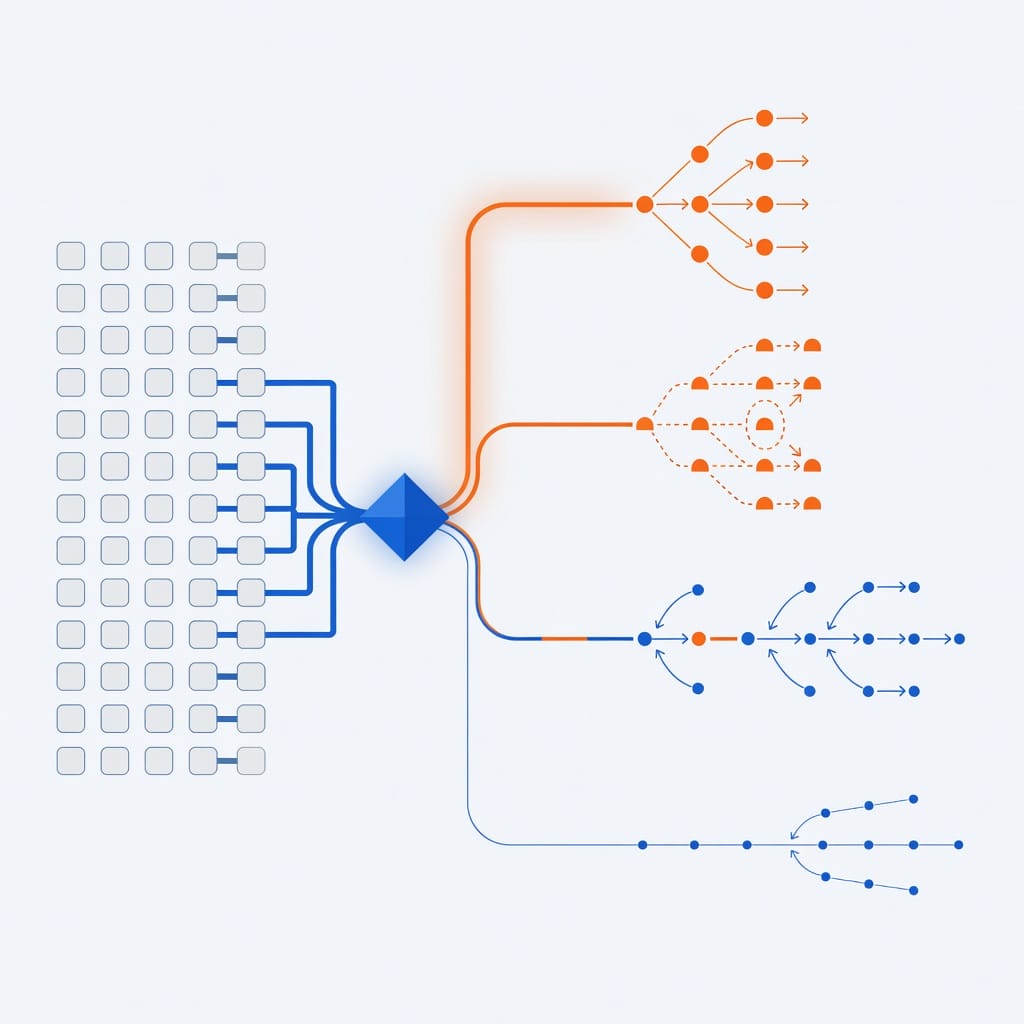
AI Lead Scoring System Implementation Checklist for FM Companies
Use this checklist to ensure a complete implementation.
- [ ] Export last 3-5 years of closed-won and closed-lost deal data from CRM
- [ ] Clean and standardize CRM data: remove duplicates, fill missing fields
- [ ] Define ideal customer profiles for each service line
- [ ] Select AI scoring platform that integrates with your CRM
- [ ] Configure scoring model with FM-specific data points
- [ ] Train model on historical deal data
- [ ] Validate model accuracy against holdout deal set
- [ ] Set score thresholds for hot, warm, nurture, and low-priority leads
- [ ] Integrate scores into CRM dashboard and sales workflow
- [ ] Configure email engagement tracking to feed scoring model
- [ ] Train sales team on interpreting and acting on scores
- [ ] Set up monthly model accuracy reviews
- [ ] Create feedback loop for sales team to flag incorrect scores
- [ ] Document RFP calendar and contract renewal dates for time-based scoring
- [ ] Establish account-level scoring for multi-stakeholder accounts
Key Takeaways
- An AI lead scoring system for facilities management uses machine learning to analyze historical deal data and predict which prospects are most likely to convert, accounting for FM-specific factors like facility type, service mix, contract value, and multi-stakeholder buying processes.
- FM companies need specialized scoring models because the sales cycle is longer, contract values are higher, and buyer behavior differs significantly from standard B2B patterns.
- The most predictive data points for FM scoring include facility type, square footage, number of locations, RFP response history, stakeholder engagement levels, and geographic proximity to service hubs.
- Building an AI scoring system requires clean historical deal data, clearly defined ideal customer profiles per service line, a platform that supports customization, and integration with your sales workflow.
- Common mistakes include using generic B2B models, ignoring RFP timing, scoring individual contacts instead of accounts, and failing to update the model based on sales feedback.
- Combining AI lead scoring with cold email outreach creates a systematic pipeline where high-scored prospects receive priority attention and engagement signals feed back into the model for continuous improvement.
Frequently Asked Questions
What is an AI lead scoring system for facilities management?
An AI lead scoring system for facilities management is a machine learning model that analyzes historical deal data, prospect behavior, and firmographic signals to predict which FM prospects are most likely to sign a contract. It assigns a numerical score to each lead based on how closely it resembles your past won deals, helping sales teams prioritize their time on the highest-value opportunities.
How is AI lead scoring different from traditional lead scoring in FM?
Traditional lead scoring uses static rules and manual point assignments, such as giving 10 points for a facility manager title or 5 points for a company over 500 employees. AI lead scoring learns from your actual closed-won and closed-lost deals to determine which signals are most predictive. It adapts automatically as new deals close, detects multi-variable patterns that humans miss, and handles thousands of leads without manual recalibration.
What data does an AI lead scoring model need for FM companies?
An AI lead scoring model needs historical deal data including facility type, square footage, number of locations, service lines, contract value, sales cycle length, lead source, stakeholder count, and win/loss reasons. It also benefits from behavioral data such as email engagement, website visits, RFP responses, and site visit requests. A minimum of 100 to 200 closed deals produces a reasonably accurate model.
How long does it take to implement an AI lead scoring system?
Implementation typically takes 4 to 8 weeks for most FM companies. The first 2 to 3 weeks involve cleaning and structuring historical deal data. Week 3 to 4 covers platform selection and configuration. Week 5 to 6 focuses on model training and validation. The final 2 weeks involve CRM integration, sales team training, and workflow setup. Ongoing optimization continues for several months as the model learns from new data.
Can small FM companies use AI lead scoring?
Yes. Small FM companies with as few as 100 closed deals can benefit from AI lead scoring. Modern CRM platforms like HubSpot and Salesforce include built-in AI scoring that requires no data science expertise. For companies on a budget, standalone tools with CRM integration start at under $100 per month. The key requirement is clean, structured CRM data, not a large team or budget.
How do I know if my AI lead scoring model is accurate?
Monitor the conversion rate of your highest-scored leads. If leads scoring 80 or above convert at a rate significantly higher than your average lead, the model is working. Target a precision of 70 percent or higher on your top score decile. Review model accuracy monthly by comparing predicted scores against actual outcomes. If accuracy drops, retrain the model with recent deal data.
What is the biggest mistake FM companies make with AI lead scoring?
The biggest mistake is using a generic B2B lead scoring model that does not account for FM-specific buying signals. Generic models over-weight email open rates and website visits while missing critical FM signals like RFP timing, contract renewal dates, facility type match, and multi-stakeholder engagement. FM companies should always train their model on their own deal data rather than relying on pre-built scoring rules.
How does cold email fit into an AI lead scoring strategy?
Cold email engagement provides real-time behavioral signals that feed your AI scoring model. When a prospect opens emails, clicks links, or replies, their score updates to reflect increased intent. AI scoring also determines which prospects receive cold email outreach in the first place: high-scored leads get priority sequences, while low-scored leads are excluded until their score changes. This ensures your outreach budget targets the most promising prospects.