
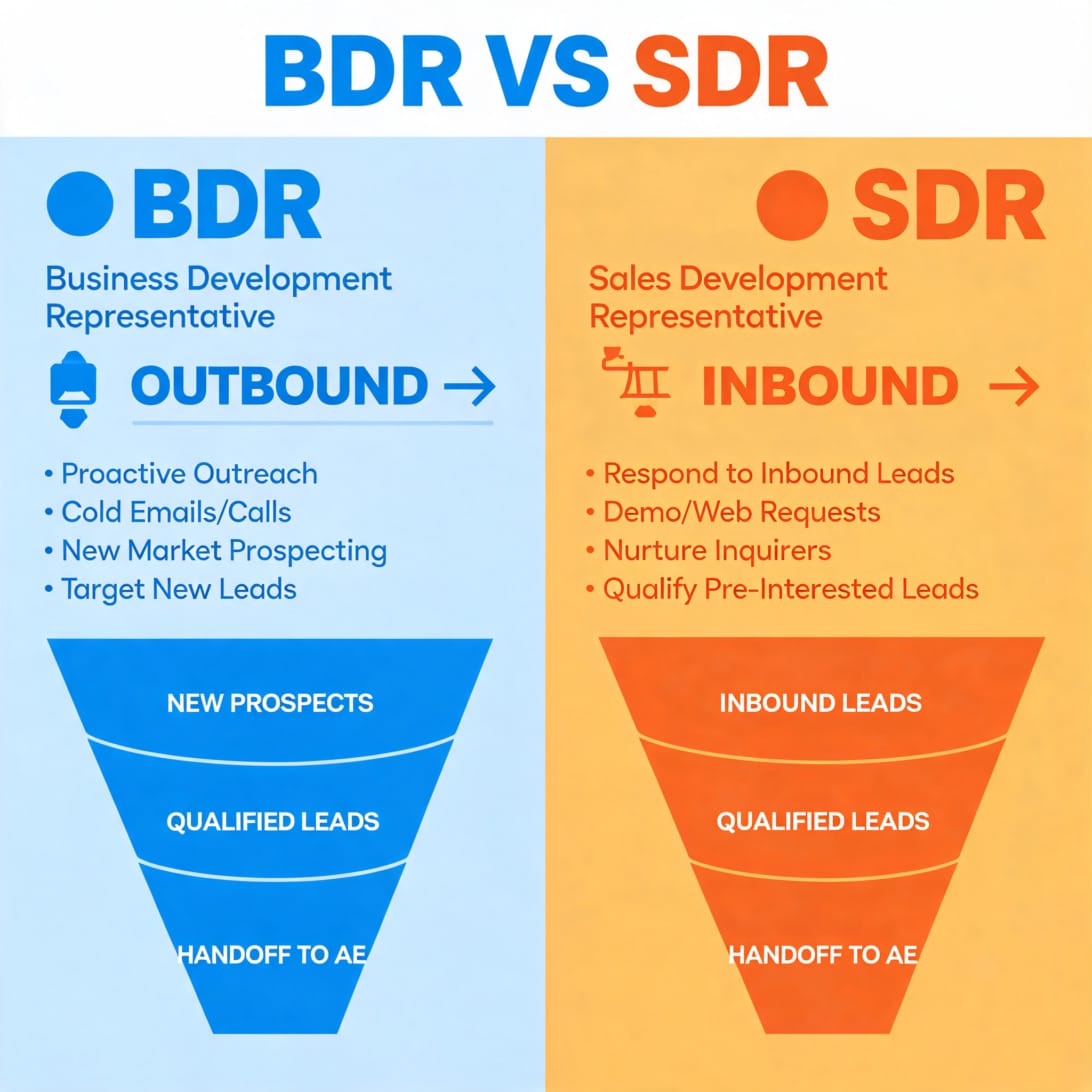
Quick Answer: BDRs (Business Development Representatives) focus on outbound prospecting – cold outreach to people who have never heard of your company. SDRs (Sales Development Representatives) focus on inbound lead qualification – responding to people who have already shown interest. BDRs create demand; SDRs capture it. In 2026, the median on-target earnings for both roles is approximately $80,000-$85,000, with BDRs typically earning slightly more in variable compensation. Most growing companies benefit from having both roles, but your first hire depends entirely on where your pipeline comes from.
—
What Is a BDR (Business Development Representative)?
A Business Development Representative (BDR) is a sales professional focused on outbound prospecting. Their job is to identify target accounts, research decision-makers, and initiate conversations with people who have never engaged with the company before.
BDRs operate at the very top of the sales funnel. They create opportunities from scratch through cold email, cold calling, LinkedIn outreach, and networking. Unlike SDRs who respond to inbound interest, BDRs generate their own pipeline.

Key Responsibilities of a BDR
- Research and build target account lists based on ICP (Ideal Customer Profile)
- Conduct cold outreach via email, phone, and LinkedIn
- Qualify prospects and book meetings for Account Executives
- Work with marketing to refine outreach strategies and messaging
- Maintain CRM records of all prospect interactions
- Track outbound KPIs: emails sent, calls made, meetings booked, opportunities created
How BDRs Are Measured (KPIs)
- Number of outbound leads generated
- Meetings or demos booked from outbound efforts
- Email open rates and reply rates
- Call connect rates and conversation quality
- Opportunities created (SQLs from outbound)
- Pipeline revenue influenced
BDR Salary in 2026
According to the Bridge Group 2022 SDR/BDR report and 2025-2026 market data:
| Component | Amount |
|---|---|
| Median on-target earnings (OTE) | $80,000 – $85,000 |
| Base salary (typical) | $50,000 – $55,000 |
| Variable/commission (typical) | $28,000 – $32,000 |
| Top performers (90th percentile) | $100,000+ |
| Entry-level starting | $45,000 – $55,000 |
BDRs typically earn more in variable compensation than SDRs because their role directly generates new business opportunities. Commission structures for BDRs often include bonuses for qualified meetings that convert to pipeline revenue.
—
What Is an SDR (Sales Development Representative)?
A Sales Development Representative (SDR) is a sales professional focused on inbound lead qualification. Their job is to respond to people who have already shown interest in the company – demo requests, form submissions, webinar registrations, content downloads – and determine whether they are a real sales opportunity.
SDRs work leads generated by marketing. They are the first human contact after a prospect raises their hand. Their primary goal is to qualify the lead and pass viable opportunities to Account Executives.
Key Responsibilities of an SDR
- Respond to inbound leads from website forms, demo requests, and content downloads
- Qualify prospects against established criteria (budget, authority, need, timeline)
- Schedule demos and discovery calls for Account Executives
- Maintain CRM hygiene with lead status and interaction history
- Follow up with leads that are not yet ready to buy
- Provide feedback to marketing on lead quality
How SDRs Are Measured (KPIs)
- Number of qualified leads processed
- Meetings or demos booked
- Speed-to-lead response time
- Lead-to-meeting conversion rate
- Sales-qualified leads (SQLs) generated
- Lead response time (critical – Harvard Business Review found companies responding within an hour are nearly 7x more likely to qualify the opportunity)
SDR Salary in 2026
| Component | Amount |
|---|---|
| Median on-target earnings (OTE) | $75,000 – $80,000 |
| Base salary (typical) | $52,000 – $58,000 |
| Variable/commission (typical) | $22,000 – $25,000 |
| Top performers (90th percentile) | $95,000+ |
| Entry-level starting | $40,000 – $50,000 |
SDR compensation is more heavily weighted toward base salary because inbound lead volume depends partly on marketing performance, not just individual effort. The base-to-variable split is approximately 68:32 according to Bridge Group data.
—
BDR vs SDR: Key Differences
| Dimension | BDR | SDR |
|---|---|---|
| Primary focus | Outbound prospecting | Inbound lead qualification |
| Lead source | Cold outreach, research, networking | Marketing-generated (forms, demos, webinars) |
| Funnel position | Top-funnel (creating demand) | Mid-funnel (capturing demand) |
| Nature | Proactive | Reactive |
| Typical lead volume | Lower volume, higher time per prospect | Higher volume, faster pace |
| Key metrics | Opportunities created, meetings booked | SQLs, response time, conversion rate |
| Team interaction | Collaborate throughout sales process | Hand off to AEs after qualification |
| Median OTE | $80,000 – $85,000 | $75,000 – $80,000 |
| Career path | → Account Executive or Strategic BD | → Account Executive or Account Manager |
1. Inbound vs Outbound
This is the fundamental difference. SDRs work leads that come to the company through marketing channels – website forms, demo requests, webinar signups, content downloads. BDRs create their own opportunities by researching target accounts and reaching out cold.
As Smith Digital puts it: “SDRs capture demand; BDRs create it.”
2. Lead Volume and Pace
SDRs typically handle higher lead volumes because inbound traffic is continuous. A busy SDR might process 30-50 leads per day, responding quickly and qualifying fast. BDRs invest more time per prospect – researching the account, crafting personalized outreach, and nurturing relationships over weeks or months.
3. Sales Funnel Position
Both roles sit at the top of the funnel, but they enter at different points. BDRs work top-funnel (creating new leads). SDRs work mid-funnel (nurturing leads that already exist). The Bridge Group reports a ratio of approximately 2.3 BDRs for every 1 SDR in organizations that maintain both roles.
4. Skills Required
SDR skills: Fast communication, CRM management, quick qualification judgment, responsiveness, process discipline. SDRs need to move fast and make accurate decisions about lead quality under time pressure.
BDR skills: Research, persistence, cold outreach, resilience against rejection, strategic thinking, stakeholder mapping. BDRs need comfort with ambiguity and the ability to build conversations from nothing.
5. Career Path
Both roles are common entry points into professional sales, but they build different strengths:
- SDRs → often advance to Account Executive (AE) or Account Manager (AM) roles. They develop strong qualification skills and learn to manage live buying activity.
- BDRs → often advance to AE roles focused on enterprise sales or strategic business development. They develop persistence, research skills, and comfort navigating longer sales cycles.
The reps who advance furthest are usually the ones who become genuinely curious about how businesses operate, regardless of which role they start in.
—
BDR vs SDR: Which Role Does Your Team Need?
The answer depends entirely on where your pipeline comes from.
Hire a BDR First If:
- You have limited inbound interest and need to create demand
- You are entering a new market or vertical
- Your sales cycle is long and requires relationship building
- You need to target specific high-value accounts
- Your marketing engine is still being built
Hire an SDR First If:
- You have consistent inbound traffic from SEO, content, or paid media
- Your marketing team generates qualified leads that need follow-up
- Your sales cycle is short and transactional
- You need to scale existing demand, not create it
- Your AEs are spending too much time on lead qualification
Hire Both If:
- You have both inbound demand and outbound targets
- Your revenue team has the budget for dedicated functions
- You want to maximize pipeline coverage across all channels
- Your sales process benefits from specialization
When You Might Need Neither
If you are a very early-stage startup with fewer than 10 employees and limited budget, the founder or early sales hire often handles both functions. The Bridge Group reports that smaller companies are more likely to deploy one person handling both SDR and BDR responsibilities.
—
Tools and Tech Stack for SDRs and BDRs
Both roles rely on technology to scale their efforts, but the tool sets differ based on their workflows.
Tools SDRs Use
- CRM – Salesforce, HubSpot, Pipedrive for lead tracking and pipeline management
- Lead qualification – Built-in CRM tools, lead scoring platforms
- Chat/live engagement – Intercom, Drift for real-time website visitor conversations
- Meeting scheduling – Calendly, Chili Piper for friction-free demo booking
- Analytics – Tableau, CRM dashboards for response time and conversion tracking
Tools BDRs Use
- CRM – Salesforce, HubSpot for account and contact management
- Prospecting databases – ZoomInfo, Saleshandy, Apollo.io for contact discovery
- Email outreach – Cold email platforms with deliverability infrastructure
- LinkedIn automation – Expandi, Dripify for scaled LinkedIn outreach
- Sales engagement – Outreach, Salesloft for multi-channel sequences
- Email deliverability – Dedicated infrastructure for cold email campaigns
Why Email Infrastructure Matters for BDRs
BDRs sending cold email at scale face deliverability challenges that SDRs handling inbound replies do not. Cold emails are more likely to trigger spam filters, bounce, or land in promotions folders. This is where dedicated email infrastructure becomes critical.
For BDR teams scaling cold email outreach, Mystrika provides automated warm-up, SPF/DKIM/DMARC setup, and deliverability optimization starting at $15/month. DoYouMail offers dedicated SMTP servers at approximately $40/month per server for teams that need full control over their sending infrastructure.
—
Day in the Life: SDR vs BDR
A Typical Day for an SDR
- 8:30 AM – Check and respond to overnight inbound leads
- 9:00 AM – Team standup: review lead volume, priority accounts, meeting targets
- 9:30 AM – Outbound follow-ups on leads that went cold (limited outbound)
- 10:30 AM – Inbound lead qualification calls
- 12:00 PM – Lunch
- 1:00 PM – Demo handoffs to AEs with context and qualification notes
- 2:00 PM – CRM updates, lead scoring, and prioritization
- 3:00 PM – More inbound response and qualification
- 4:30 PM – Reporting: response times, conversion rates, SQLs generated
- 5:00 PM – End of day
A Typical Day for a BDR
- 8:00 AM – Research target accounts: hiring, funding, tech stack changes
- 9:00 AM – Team standup: outbound targets, account assignments, messaging
- 9:30 AM – Cold email and LinkedIn outreach to new prospects
- 10:30 AM – Cold calling block (2-3 hours of concentrated calling)
- 12:00 PM – Lunch
- 1:00 PM – Follow-up on replies and warm leads
- 2:00 PM – Account research and list building for next outreach cycle
- 3:00 PM – Second outreach block: calls, personalized emails, LinkedIn messages
- 4:30 PM – CRM updates, meeting confirmations, pipeline reporting
- 5:30 PM – End of day
The key difference: SDRs spend more time on qualification calls and handoffs. BDRs spend more time on research, cold outreach, and follow-up sequences.
—
BDR vs SDR: Compensation Comparison
| Factor | BDR | SDR |
|---|---|---|
| Median OTE | $80,000 – $85,000 | $75,000 – $80,000 |
| Base salary (typical) | $50,000 – $55,000 | $52,000 – $58,000 |
| Variable (typical) | $28,000 – $32,000 | $22,000 – $25,000 |
| Base-to-variable split | ~65:35 | ~68:32 |
| Top performers | $100,000+ | $95,000+ |
| Entry-level | $45,000 – $55,000 | $40,000 – $50,000 |
BDRs typically earn more in variable compensation because their role directly generates new business. SDRs have a higher base-to-variable ratio because inbound lead volume depends partly on marketing performance.
According to the Bridge Group 2022 report, median OTE for both roles has increased only modestly over the past decade, with most growth coming from variable compensation rather than base salary increases.
—
How SDRs and BDRs Work with Account Executives
The handoff between SDR/BDR and AE is one of the most important processes in sales. A weak handoff creates problems that spread quietly through the entire funnel.
What a Good Handoff Looks Like
- Clear CRM notes documenting what triggered the conversation
- Qualification status: budget, authority, need, timeline
- Key business issues surfaced during discovery
- Stakeholder map: who was involved, who else needs to be included
- Realistic next steps and timeline
What a Weak Handoff Looks Like
- A meeting booked with no context about why the prospect engaged
- Missing qualification data – the AE has to start from scratch
- No documentation of what messaging worked
- Unclear next steps or buying timeline
As Smith Digital notes: “A sales meeting should never begin with the buyer repeating information they already shared two days earlier.”
Companies with strong conversion rates define qualification standards clearly and build feedback loops between SDRs/BDRs and AEs. This alignment reduces friction internally and creates a smoother buying experience externally.
—
BDR vs SDR: Which Is Harder?
Both roles are challenging in different ways.
SDR challenges: Constant rejection from leads who requested information but are not ready to buy. High volume means constant context switching. The role requires fast decision-making under time pressure.
BDR challenges: Cold outreach means most prospects have never heard of your company. The feedback loop is slower – it can take weeks to know if your outreach strategy is working. Requires persistence and comfort with ambiguity.
Neither role is inherently harder. The right fit depends on personality. Some people thrive on the fast pace and structure of inbound. Others prefer the research, strategy, and autonomy of outbound.
—
Key Takeaways
- BDRs focus on outbound prospecting (creating demand); SDRs focus on inbound lead qualification (capturing demand)
- Median OTE is $80,000-$85,000 for BDRs and $75,000-$80,000 for SDRs
- BDRs typically earn more variable compensation; SDRs have a higher base-to-variable ratio
- Hire a BDR first if you need to create demand; hire an SDR first if you have existing inbound traffic
- Both roles are entry points into sales but build different skills – SDRs toward AE/AM, BDRs toward enterprise AE/strategic BD
- The handoff quality between SDR/BDR and AE is one of the strongest predictors of pipeline health
- For BDR teams scaling cold email outreach, dedicated email infrastructure with warm-up and deliverability optimization is essential
- Neither role is senior to the other – they are parallel functions with different focus areas
—
Frequently Asked Questions
What is the difference between a BDR and an SDR?
A BDR (Business Development Representative) focuses on outbound prospecting – cold outreach to people who have never engaged with the company. An SDR (Sales Development Representative) focuses on inbound lead qualification – responding to people who have already shown interest through forms, demos, or content downloads.
Is BDR higher than SDR?
No. In most organizations, BDR and SDR are parallel roles with different focus areas, not a hierarchy. The difference is function, not seniority. Some companies use the titles interchangeably; others separate them based on whether the role is inbound or outbound.
Who gets paid more, BDR or SDR?
BDRs typically earn slightly more in total compensation ($80,000-$85,000 median OTE vs $75,000-$80,000 for SDRs), primarily because they earn more in variable compensation tied to new business generation.
What is the career path for an SDR?
Most SDRs advance to Account Executive (AE) or Account Manager (AM) roles. Some transition into BDR roles first to gain outbound experience. The typical timeline is 12-24 months as an SDR before promotion.
What is the career path for a BDR?
Most BDRs advance to Account Executive roles, often in enterprise sales. Some move into strategic business development, partnerships, or sales management. The typical timeline is 18-30 months as a BDR before promotion.
Should I hire a BDR or an SDR first?
Hire a BDR first if you need to create demand and have limited inbound traffic. Hire an SDR first if you have consistent inbound leads that need qualification. If you have both, hire both.
What tools do BDRs use?
BDRs use CRM platforms (Salesforce, HubSpot), prospecting databases (ZoomInfo, Saleshandy), cold email platforms, LinkedIn automation tools (Expandi, Dripify), and sales engagement platforms (Outreach, Salesloft). Email deliverability infrastructure is critical for cold email at scale.
What tools do SDRs use?
SDRs use CRM platforms, lead scoring tools, live chat platforms (Intercom, Drift), meeting schedulers (Calendly, Chili Piper), and analytics dashboards for response time and conversion tracking.
How do BDRs and SDRs work with Account Executives?
Both roles qualify leads and pass them to AEs with context and documentation. BDRs often collaborate more closely with AEs throughout the sales process, while SDRs typically hand off after initial qualification. Strong handoffs preserve context and prevent the buyer from repeating information.
What is the hardest part of being a BDR or SDR?
For SDRs, the hardest part is constant rejection from leads who requested information but are not ready to buy, combined with high-volume context switching. For BDRs, the hardest part is the slow feedback loop of cold outreach and the persistence required to build conversations from nothing.