
A salutation is the greeting or closing phrase in an email or letter. It sets the tone for your entire message and shapes how the recipient perceives you before they read a single word of your content.
This guide covers over 100 salutation examples organized by context: formal business emails, casual team messages, cover letters, cold outreach, group emails, international correspondence, and more. You will also find a decision tree for choosing the right salutation, a quick-reference table, common mistakes to avoid, and answers to the most frequently asked questions.
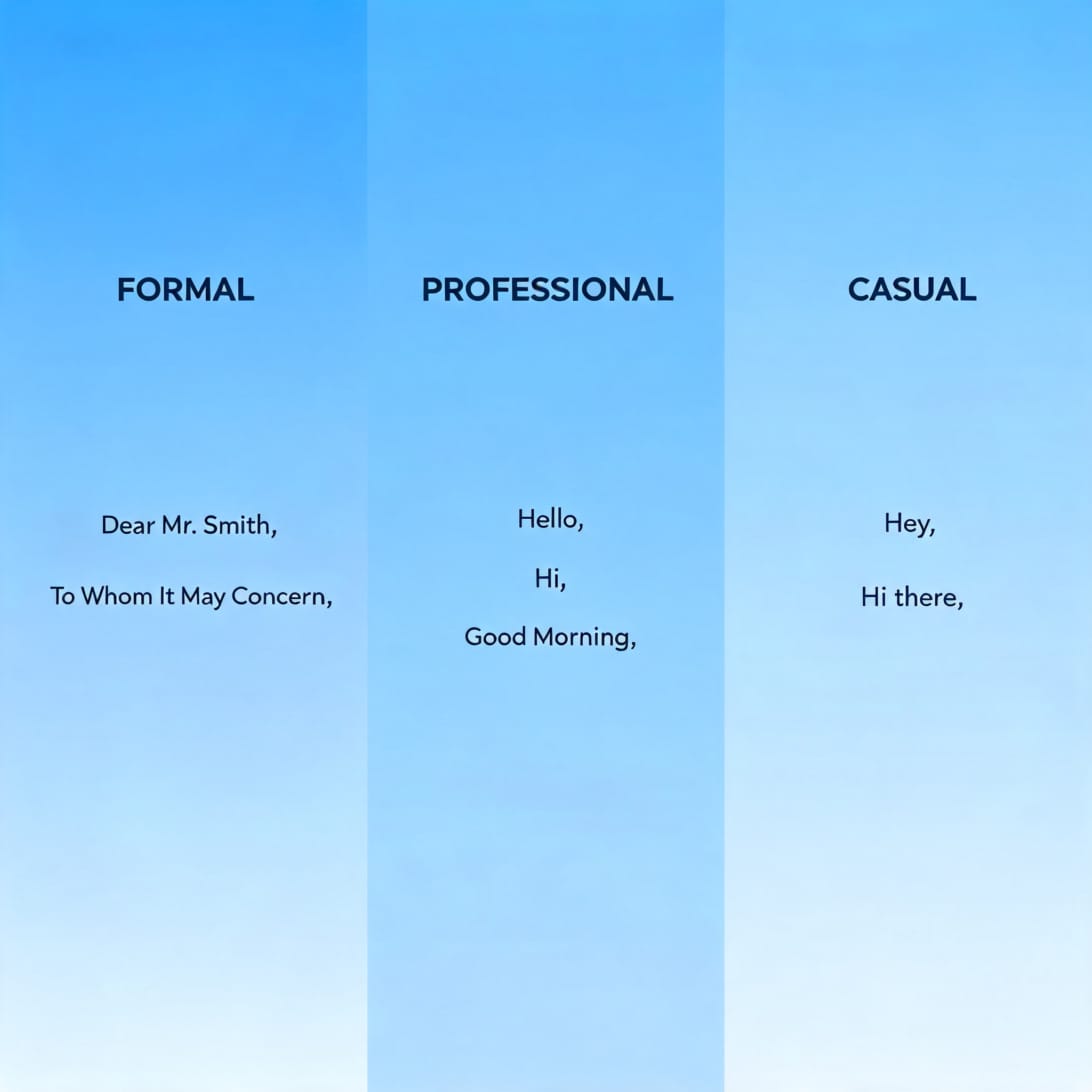
What Is a Salutation?
A salutation is the opening greeting or closing sign-off in written communication. In emails and letters, you encounter two types:
Opening salutations appear at the beginning, right before your message. Examples include “Dear Sarah,” “Hi team,” or “Good morning.” They acknowledge the recipient and establish your communication style from the first line.
Closing salutations come at the end, just before your name. Examples include “Best regards,” “Sincerely,” or “Thanks.” They provide a polite ending and reinforce the tone you have set throughout your message.
Both types serve as essential bookends to your communication, framing your message within appropriate professional or personal boundaries.
Why Salutations Matter
First impressions form in seconds. When someone opens your email, they scan the greeting before diving into your message. A well-chosen salutation signals professionalism, cultural awareness, and respect. A poor choice can make you appear careless, overly familiar, or socially tone-deaf.
Salutations set expectations. “Dear Ms. Johnson” signals formal business. “Hey Sarah” suggests an established, casual relationship. Your recipient subconsciously adjusts their interpretation of your entire message based on how you have opened. Mismatched formality creates cognitive dissonance: if you open with “Yo” but write in stiff corporate language, something feels off.
They demonstrate emotional intelligence. Choosing the right salutation shows you understand context, relationship dynamics, and professional norms. It proves you have thought about your audience, not just your message.
Research on professional email communication consistently shows that email greetings significantly impact recipient perception of sender professionalism. A Boomerang analysis of over 300,000 email openings found that messages starting with casual salutations like “Hey” (64% response rate) or “Hi” (63% response rate) performed significantly better than those without openings (48% baseline).
How to Choose the Right Salutation
Three key factors determine which salutation fits best:
1. Relationship with recipient. Are you writing to a stranger, a colleague, or a close team member? First contact requires more formality. Established relationships allow flexibility.
2. Communication context. Is this a job application, a sales pitch, an internal update, or a quick question? High-stakes situations like job interviews and client proposals warrant formal greetings. Routine correspondence allows casual approaches.
3. Medium and industry. Formal business correspondence follows stricter rules than email. Industries vary wildly: law firms expect “Dear Mr./Ms.” while tech startups commonly use “Hey.” Understanding professional norms in your field prevents missteps.
When these three factors align, your choice becomes obvious. When they conflict, err toward formality. It is always safer to be slightly too formal than too casual.
Email Opening Salutations
Formal Business Email Openings
Dear [Name]
“Dear” remains the gold standard for formal business emails. Use “Dear [First Name]” or “Dear Mr./Ms. [Last Name]” when writing to senior executives or clients you have never met, sending job applications, addressing formal business proposals or legal matters, communicating with academic professionals or government officials, or when your company culture leans traditional.
Example: “Dear Ms. Thompson, I am writing to follow up on our proposal submitted last week regarding the Q3 marketing strategy.”
The formality of “Dear” shows respect without seeming cold. It works across generations. Once the recipient signs their reply with their first name, you can switch to “Dear [First Name]” in subsequent exchanges.
To Whom It May Concern
This ultra-formal salutation survives only in specific scenarios: formal letters when you genuinely do not know the recipient’s name, legal documents or official complaints, and correspondence to a department rather than a person.
In email, this phrase feels increasingly archaic. Alternatives include “Dear Hiring Manager,” “Dear [Department] Team,” or “Hello” when you cannot identify a specific recipient. Modern best practice: spend five minutes finding an actual name. LinkedIn, company websites, and even calling the front desk can help you avoid this impersonal opener.
Dear Sir or Madam
Similar to “To Whom It May Concern” but slightly warmer. Use only when you know the recipient’s role but not their name or gender. Example: “Dear Sir or Madam, I am writing to inquire about your accounting services.”
This salutation is increasingly viewed as outdated. Whenever possible, find a specific name.
Dear [Title] [Last Name]
Use for formal correspondence where titles matter: “Dear Dr. Martinez,” “Dear Professor Williams,” “Dear Reverend Johnson.” This is standard in academic, medical, legal, and religious contexts.
Professional but Friendly Openings
Hi [Name]
“Hi” has become the workhorse of professional email salutations. It strikes the perfect balance: professional without being stuffy, friendly without being casual. Use “Hi [First Name]” when writing to colleagues at any level, following up with clients after initial formal contact, sending professional emails in moderately casual industries like tech or marketing, or when you have met the person but do not have a close relationship.
Example: “Hi Marcus, Thanks for the quick turnaround on the design mockups. I have reviewed them with the team and have a few thoughts.”
“Hi” works in approximately 70% of professional email situations. It has become the default because it adapts well: formal enough for clients, casual enough for coworkers, and appropriate across industries.
Hello [Name]
“Hello” sits slightly more formal than “Hi” but more approachable than “Dear.” Use “Hello [First Name]” when “Hi” feels too casual but “Dear” feels too stiff, writing to international contacts, or sending a first email to a business contact after being introduced.
Example: “Hello Dr. Patel, I was given your contact by Jennifer Wong, who suggested you might have insights on our AI implementation project.”
“Hello” particularly shines for first-contact emails where you want to seem professional but not rigidly formal.
Good Morning / Good Afternoon / Good Evening
Time-specific greetings add a personal touch and show attentiveness. Use these when sending emails during specific times and want to acknowledge it, writing to international contacts to show timezone awareness, or following up on real-time conversations.
Example: “Good morning Jennifer, Following up on our call yesterday about the budget reallocation.”
Caution: These work best for emails sent and read within the same business day. For asynchronous communication crossing time zones, stick with time-neutral greetings.
Greetings
“Greetings” is a neutral, safe option for group emails or when you are unsure of the recipient’s name. Example: “Greetings, I am reaching out to introduce our new platform.”
It is slightly warmer than “To Whom It May Concern” but less personal than “Hello.” Use it sparingly.
Casual Internal Team Openings
Hey [Name]
“Hey” signals casual familiarity. Reserve it for close colleagues you work with daily, internal team emails in casual company cultures, quick questions or informal check-ins, and tech, startup, or creative industries with relaxed norms.
Example: “Hey Jake, Quick question about the API endpoint we discussed — are we using v2 or v3 for the new integration?”
“Hey” implies you are on the same level and comfortable with each other. Do not use it for first contacts, clients, senior executives (unless they have used it with you first), or formal requests.
Hi Team / Hey Everyone / Hi All
Group greetings work for internal communications when addressing multiple people. Use “Hi team” for standard internal updates, “Hey everyone” for casual team messages, and “Hi all” as a safe default for mixed-audience emails.
Example: “Hi team, Just a quick update on the sprint timeline for this week.”
Hi there
“Hi there” is friendly and approachable but slightly impersonal. Use it when you do not know the recipient’s name or want a warm but neutral opening. Example: “Hi there, I came across your profile on LinkedIn and wanted to connect.”
Group Email Openings
Dear Team / Dear All
“Dear team” works for formal internal announcements or company-wide emails. “Dear all” is slightly more formal and works for external group communications.
Dear Colleagues
Use for formal internal communications such as policy changes, company announcements, or HR updates. Example: “Dear Colleagues, I am writing to share an important update about our benefits package.”
Dear [Department] Team
Use when addressing a specific department. Example: “Dear Marketing Team, Please find the Q3 campaign brief attached.”
To the [Department] Team
Similar to “Dear [Department] Team” but slightly more formal. Example: “To the Engineering Team, Please review the attached architecture proposal.”
Cover Letter and Job Application Openings
Dear Hiring Manager
Use when you do not know the hiring manager’s name. Example: “Dear Hiring Manager, I am writing to apply for the Senior Product Manager position advertised on LinkedIn.”
Dear [Company Name] Team
A warmer alternative to “Dear Hiring Manager” when you know the company culture is collaborative. Example: “Dear Acme Corp Team, I am excited to apply for the Marketing Director role.”
Dear Mr./Ms. [Last Name]
Use when you have researched the hiring manager’s name. Example: “Dear Ms. Rodriguez, I am writing to express my interest in the Software Engineer position.”
Always research the hiring manager’s name. Emails addressed to a specific person receive significantly more responses than generic greetings.
Cold Email Openings
Hi [First Name]
The standard for cold outreach. Professional but not stiff. Example: “Hi Sarah, I noticed your company recently expanded into the European market and thought our platform could help.”
Hello [First Name]
Slightly more formal than “Hi” for cold emails. Good for conservative industries. Example: “Hello James, I came across your profile on LinkedIn and wanted to reach out about a potential partnership.”
Dear [First Name]
Use for very formal cold outreach such as to senior executives or in traditional industries. Example: “Dear Michael, I am writing to introduce our consulting services for financial institutions.”
Email Closing Salutations
Formal Closings
Sincerely
The most formal standard closing. Use for job applications, cover letters, formal complaints, legal correspondence, and first contact with senior executives. Example: “Sincerely, David Chen”
Yours Sincerely
British English variant of “Sincerely.” Slightly more formal. Common in UK, Australia, and Commonwealth countries. Example: “Yours sincerely, David Chen”
Yours Faithfully
Use when you opened with “Dear Sir or Madam” in a formal letter. If you know the recipient’s name, use “Yours sincerely” instead. Example: “Yours faithfully, David Chen”
Respectfully
Use for very formal communications to senior officials, government agencies, or academic committees. Example: “Respectfully, Dr. Sarah Johnson”
With Gratitude
Use for thank-you notes, post-interview follow-ups, or when expressing appreciation. Example: “With gratitude, Maria Lopez”
Professional Standard Closings
Best Regards
The most versatile professional closing. Appropriate for clients, colleagues, and external partners across industries. Works in approximately 80% of professional situations. Example: “Best regards, David Chen”
Kind Regards
Slightly warmer than “Best regards” while maintaining professionalism. Good for client communications where you want to add warmth. Example: “Kind regards, Maria Lopez”
Warm Regards
Friendly and personal while still professional. Use after several exchanges with a client or for relationship-building emails. Example: “Warm regards, James Wilson”
Best
Short, modern, and professional. Increasingly common in tech and creative industries. Example: “Best, Sarah Johnson”
Thanks
Use when you have made a request or the recipient has done something for you. Example: “Thanks, David Chen”
Thank You
Slightly more formal than “Thanks.” Use for significant requests or after receiving substantial help. Example: “Thank you, Maria Lopez”
Friendly Closings
Cheers
Casual and friendly. Common in British and Australian English. Works for established relationships in casual industries. Example: “Cheers, James”
Take Care
Warm and personal. Use for close colleagues or when someone is leaving the company. Example: “Take care, Sarah”
All the Best
Friendly but professional. Good for wishing someone well on a project or before a holiday. Example: “All the best, David”
Talk Soon
Casual closing for ongoing conversations. Use with close colleagues or active email threads. Example: “Talk soon, Maria”
Looking Forward
Use when you expect a follow-up interaction. Example: “Looking forward to our call, James”
Situation-Specific Closings
Happy to Help
Use after resolving a support issue or answering a question. Example: “Happy to help, Sarah”
Let Me Know If You Have Questions
A safe, helpful closing for most business emails. Example: “Let me know if you have questions, David”
Appreciate Your Time
Use after someone has taken time to meet with you or review your work. Example: “Appreciate your time, Maria”
Onward and Upward
Motivational closing for team emails or project updates. Example: “Onward and upward, James”
In the Meantime
Use when you are waiting for something and want to acknowledge the gap. Example: “In the meantime, please let me know if anything changes. Best, Sarah”
Letter Salutations
Formal letters follow slightly different conventions than emails.
Formal Letter Openings
Dear Mr./Ms./Dr. [Last Name]:
Standard for formal business letters. Note the colon in American English. Example: “Dear Mr. Chen:”
Dear [First Name] [Last Name]:
Use when you are unsure of the recipient’s title or gender preference. Example: “Dear Jordan Smith:”
To the [Department]:
Use for letters addressed to a department rather than an individual. Example: “To the Admissions Committee:”
Dear Sir or Madam:
Use only when you cannot determine the recipient’s name or gender. Increasingly outdated.
Formal Letter Closings
Sincerely,
Standard for most formal letters. Example: “Sincerely, David Chen”
Yours Truly,
Traditional and highly formal. Use for legal or official correspondence. Example: “Yours truly, Maria Lopez”
Very Truly Yours,
Extremely formal. Use for legal documents or official government correspondence. Example: “Very truly yours, James Wilson”
Cordially,
Warm but formal. Use for social business correspondence or invitations. Example: “Cordially, Sarah Johnson”
Context-Specific Salutations
Sales Outreach
| Context | Opening | Closing | Why |
|---|---|---|---|
| First cold email | Hi [First Name] | Best regards | Professional but not stiff |
| Follow-up email | Hi [First Name] again | Best | Familiar but respectful |
| After a meeting | Great meeting you, [Name] | Best regards | Warm and personal |
| To a referral | Hello [Name] — [Referrer] suggested I reach out | Best regards | Contextual and warm |
| To a C-level executive | Dear [First Name] | Best regards | Respectful but direct |
Customer Support
| Context | Opening | Closing | Why |
|---|---|---|---|
| First response | Hello [Name] | Kind regards | Warm and professional |
| Follow-up | Hi [Name] | Best regards | Familiar but helpful |
| Resolved issue | Hi [Name] | Happy to help | Positive and conclusive |
| Escalation | Dear [Name] | Sincerely | Formal and serious |
Internal Communications
| Context | Opening | Closing | Why |
|---|---|---|---|
| Team update | Hi team | Best | Standard and efficient |
| Company announcement | Dear colleagues | Best regards | Formal and respectful |
| Quick question | Hey [Name] | Thanks | Casual and direct |
| Performance feedback | Hi [Name] | Best regards | Professional and balanced |
| Project update | Hi team | Onward and upward | Motivational |
Academic Correspondence
| Context | Opening | Closing | Why |
|---|---|---|---|
| Email to professor | Dear Professor [Last Name] | Sincerely | Standard academic form |
| Email to advisor | Dear Dr. [Last Name] | Best regards | Professional but warm |
| Peer collaboration | Hi [First Name] | Best | Casual and collaborative |
| Research inquiry | Dear [Title] [Last Name] | Respectfully | Formal and deferential |
Salutation Formality Spectrum
| Salutation | Formality Level | Best For |
|---|---|---|
| Dear Mr./Ms. [Last Name] | Very High | Legal, finance, formal letters |
| Dear [First Name] | High | Job applications, first client contact |
| Dear Sir or Madam | High | When name is unknown (avoid if possible) |
| To Whom It May Concern | Very High | Legal documents, official complaints |
| Hello [Name] | Medium-High | First contact, international, professional |
| Good Morning/Afternoon | Medium | Time-sensitive, warm professional |
| Greetings | Medium | Group emails, unknown recipients |
| Hi [Name] | Medium | 70% of professional situations |
| Hi team / Hi all | Medium | Group internal emails |
| Hey [Name] | Low | Close colleagues, casual cultures |
| Hey team / Hey everyone | Low | Casual internal groups |
| [Name] (no greeting) | Very Low | Quick replies, instant messages |
Salutation Matching: Openings and Closings
Your opening and closing should match in formality. Mixing a formal opening with a casual closing creates tonal whiplash.

| Opening | Matching Closing | Formality |
|---|---|---|
| Dear Mr./Ms. [Last Name] | Sincerely / Yours truly | Very High |
| Dear [First Name] | Best regards / Sincerely | High |
| Hello [Name] | Best regards / Kind regards | Medium-High |
| Good morning [Name] | Best regards / Best | Medium |
| Hi [Name] | Best / Thanks | Medium |
| Hey [Name] | Thanks / Cheers | Low |
| Hi team | Best / Thanks | Medium |
| [No greeting] | [Name only] / Thanks | Very Low |
Common Salutation Mistakes to Avoid
Using “Dear Sir or Madam” When You Can Find a Name
This is the most common salutation mistake. With LinkedIn, company websites, and email finders, you can almost always find a name. Using “Dear Sir or Madam” signals you did not try.
Mismatching Formality Levels
Opening with “Dear Mr. Johnson” and closing with “Cheers” creates tonal inconsistency. Match your opening and closing formality.
Using “To Whom It May Concern” in Emails
This phrase belongs in formal letters, not emails. Use “Dear Hiring Manager” or “Hello” instead.
Assuming Gender
Do not assume “Mr.” or “Ms.” based on a name you are unsure about. Use the full name: “Dear Jordan Smith” instead of “Dear Mr. Smith.”
Overusing “Hey” in Professional Contexts
“Hey” is not appropriate for first contact, clients, or senior executives. When in doubt, use “Hi.”
Using No Salutation at All
Jumping straight into your message without a greeting feels abrupt and impersonal. Always include at least “Hi [Name]” or “Hello.”
Using “Dear” with a Misspelled Name
A misspelled name after “Dear” is particularly noticeable and damaging. Double-check every name before sending.
Using Time-Specific Greetings Across Time Zones
“Good morning” sent at 3 PM local time to someone in a different time zone feels off. Use time-neutral greetings for asynchronous communication.
International and Cultural Considerations
Salutation norms vary significantly across cultures. What works in American business English may feel too casual or too formal elsewhere.
United States
- “Hi [First Name]” is standard in most professional contexts
- “Dear [First Name]” for formal situations
- “Best regards” is the safest closing
- First names are common even in early professional relationships
United Kingdom
- “Dear [First Name]” is more common than “Hi” for initial contact
- “Dear Mr./Ms. [Last Name]” for very formal situations
- “Yours sincerely” for formal closings, “Best regards” for standard
- “Cheers” is acceptable in casual contexts
Germany
- Very formal. Use “Dear Mr./Ms. [Last Name]” consistently
- First names come slowly, only after explicit invitation
- “Mit freundlichen Grüßen” (Kind regards) is standard
- Titles matter significantly
Japan
- Extremely formal and hierarchical
- “Dear [Last Name]-san” or “Dear Mr./Ms. [Last Name]”
- Titles matter significantly
- “Best regards” or “Sincerely” for closings
- First names are rarely used in business correspondence
France
- Formal. “Dear Mr./Ms. [Last Name]” is standard
- “Cordialement” or “Best regards” for closings
- First names used after relationship is established
- “Bonjour” is common in email openings
Brazil and Latin America
- Warmer and more relationship-focused
- “Dear [First Name]” is common after initial contact
- “Warm regards” or “Kind regards” for closings
- Personal touches are appreciated
Middle East
- Formal and respectful
- Titles are important
- Gender-separate professional contexts in some regions
- “Dear Mr./Ms. [Last Name]” is standard
Multilingual Teams
When working with international colleagues whose first language is not English:
- Match their approach. If they use “Dear,” you use “Dear.” If they switch to “Hi,” you can too.
- Choose universally understood options. “Hello [First Name]” and “Best regards” work globally.
- When in doubt, ask: “Please let me know how you prefer to be addressed.” This shows cultural sensitivity.
Quick Reference Table
| Context | Opening | Closing | Formality |
|---|---|---|---|
| Job application | Dear [Name] | Sincerely | Very High |
| First client contact | Hello [Name] | Best regards | High |
| Established client | Hi [Name] | Best regards | Medium-High |
| Colleague (same level) | Hi [Name] | Thanks / Best | Medium |
| Close team member | Hey [Name] | Thanks / Cheers | Low |
| Formal announcement | Dear Colleagues | Best regards | High |
| Team update | Hi team | Best | Medium |
| Executive (first contact) | Dear [Title] [Name] | Sincerely | Very High |
| Executive (established) | Hello [Name] | Best regards | Medium-High |
| Customer service | Hello [Name] | Kind regards | Medium-High |
| Apology or complaint | Dear [Name] | Sincerely | High |
| Thank you note | Dear [Name] | With gratitude | High |
| International (unknown) | Hello [Name] | Best regards | Medium-High |
| Legal or finance | Dear [Title] [Name] | Sincerely | Very High |
| Tech or startup | Hi [Name] | Best / Thanks | Low-Medium |
| Academic | Dear Professor [Last Name] | Sincerely | Very High |
| Cold email | Hi [First Name] | Best regards | Medium |
| Follow-up email | Hi [First Name] again | Best | Medium |
| Group email | Hi team / Dear team | Best / Best regards | Medium |
| Quick reply | [Name only] | Thanks | Very Low |
Pro Tips for Choosing Salutations
1. Mirror their style after first contact. If they sign “Cheers, Mike,” you can respond with “Hi Mike” and “Cheers” or “Thanks.” Mirroring builds rapport by showing you are on the same wavelength.
2. When formality is uncertain, go up one level. Better to seem slightly formal than inappropriately casual. You can always relax later; you cannot undo a too-casual first impression.
3. Use their email signature as your guide. How do they sign off? That reveals their preferred formality. “Michael J. Thompson, Esq.” wants different treatment than “Mike.”
4. Context matters more than relationship. Even with a close colleague, use formal salutations for serious topics like performance issues or formal requests, especially when others are CC’d.
5. Your industry norms trump personal preference. If you work in law or finance, “Hey” might feel natural to you but alarm clients. Match industry expectations.
6. Set the tone early in new relationships. If you want professional-but-casual going forward, start there. If you begin with “Dear Ms. Johnson” and “Sincerely,” it is awkward to suddenly switch to “Hey Jenny.”
7. Drop formality in long threads naturally. By the fifth reply in a thread, you can simplify. “Hi Sarah, Got it — thanks! David” is appropriate even if earlier emails were more formal.
8. Use their full name when unsure of title or gender. “Dear Taylor Smith” avoids the risk of misgendering or using the wrong title.
9. Keep it concise in quick replies. For fast internal replies, a simple “[Name], [message]” is acceptable. Save formal salutations for first emails and important communications.
10. Test and observe. Pay attention to how people respond to your salutations. If you consistently get positive responses, you are doing it right. If people seem cold or confused, adjust.
Key Takeaways
- Salutations set the tone for your entire message. A well-chosen greeting signals professionalism, cultural awareness, and respect.
- Three factors determine the right salutation: relationship with the recipient, communication context, and industry norms. When in doubt, err toward formality.
- “Hi [First Name]” works in approximately 70% of professional email situations. “Dear [Name]” is for formal contexts. “Hey” is for close colleagues only.
- Match your opening and closing formality. “Dear” pairs with “Sincerely.” “Hi” pairs with “Best” or “Thanks.”
- Mirror the recipient’s style after first contact. If they use “Hi,” you can too. If they use “Dear,” stay formal.
- International salutations vary significantly. “Hello [First Name]” and “Best regards” are the safest global defaults.
- Common mistakes include using “To Whom It May Concern” in emails, mismatching formality levels, assuming gender, and using no salutation at all.
- For more on professional email tone and closings, see our guide on professional email closings.
Frequently Asked Questions
What are the best email salutations for professional use?
For most professional emails, “Hi [First Name]” and “Hello [Name]” offer the best balance of professionalism and approachability. “Dear [Name]” works for formal situations like job applications or first client contact. For closings, “Best regards” is the safest default, working in approximately 80% of professional situations.
Should I use Dear or Hi in professional emails?
Use “Dear [Name]” for formal situations: job applications, first contact with senior executives or clients, cover letters, and traditional industries like law or finance. Use “Hi [Name]” for established professional relationships, routine business emails, and moderately casual industries like tech or marketing. “Hi” has become the standard in most professional contexts.
What is the most professional email closing?
“Best regards” is the most versatile professional closing, appropriate for clients, colleagues, and external partners across industries. “Sincerely” is more formal, ideal for job applications and cover letters. “Kind regards” adds warmth while maintaining professionalism.
Is it OK to use Hey in business emails?
“Hey” is acceptable only in specific contexts: internal emails to close colleagues, very casual company cultures (particularly tech startups), and established informal relationships. Never use “Hey” for first contact, client communications, formal requests, or when writing to senior executives unless they have used it with you first.
What salutation should I use for a cover letter?
Always use “Dear [Name]” for cover letters. Research the hiring manager’s name through LinkedIn, the company website, or by calling the office. If you absolutely cannot find a name, use “Dear Hiring Manager” or “Dear [Department] Team.” Never use “To Whom It May Concern” on cover letters.
What are formal salutations for business letters?
Formal business letters use “Dear [Title] [Last Name]:” with a colon in American English. Include appropriate titles: “Dear Mr. Chen:”, “Dear Dr. Martinez:”, “Dear Professor Williams:”. Close with “Sincerely,” or “Respectfully,” for very formal contexts.
Is Cheers too casual for business emails?
“Cheers” works in casual business environments, particularly in British and Australian English contexts where it is standard. In American business, “Cheers” is acceptable for established friendly relationships and creative industries. Avoid “Cheers” for first contacts, very formal situations, or conservative industries like law and finance.
How do I address someone when I don’t know their gender?
Use the full name without a title: “Dear Jordan Smith” or “Dear Taylor Johnson.” If you only have a first name, use “Dear [First Name]” which is gender-neutral. Avoid “Dear Sir or Madam” when possible.
What salutation should I use for a group email?
For internal groups, use “Hi team,” “Hi all,” or “Dear colleagues” depending on formality. For external groups, use “Dear [Department] Team” or “Hello everyone.” Match the formality to the audience and context.
Can I use Good Morning in an email?
Yes, “Good morning” works well for emails sent and read within the same business day. Avoid time-specific greetings for asynchronous communication across time zones. “Good morning” is particularly natural in customer service and client-facing roles.
How do I choose a salutation for international emails?
“Hello [First Name]” and “Best regards” are the safest global defaults. Research the recipient’s cultural norms if possible. When in doubt, err toward formality. Match the recipient’s style after they respond.
What is the difference between Sincerely and Best regards?
“Sincerely” is more formal and traditional, best for job applications, cover letters, and formal business correspondence. “Best regards” is versatile and professional, appropriate for most business emails. “Best regards” has become the standard in modern business communication.